

Anne Elliott's photos with the keyword: Family: Icteridae

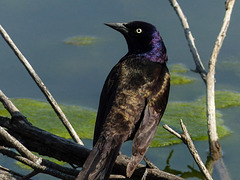
Common Grackle after a bath
| 27 May 2019 |
|
|
|
One of the new problems on Flickr today is having comments and faves not appear. If you get a first comment or make a first comment on someone else's photo, that comment will disappear. The comment is listed under the "bell", but does not appear under the photo. The "bell" stated that I had a comment under each of the five photos I posted today. These were the first comments to be made. Two of the comments stayed, but there was no sign of the other three. The same with faves - some show up, others don't. Other people are having the same problem and have reported it to the Help Forum.
On 23 May 2019, Flickr was unusable and some of the channels on TV were also not working. Combined, these two things made me decide that enough is enough, and that I needed to go for a short drive.
My first stop was at a local pond in the city, where I enjoyed seeing this Lesser Scaup, a Coot, Mallards, and a Common Grackle or two. It was also fun to come across a small group of children with their "care-givers". I identified a Coot for them and told them that it was not a duck and that their babies were so ugly that they were very, very cute. I did see one Red-necked Grebe swimming, but I didn't venture further along the path as I zoomed in on two Police officers checking out a parked car along the pathway.
After spending a bit of time at this location, I drove westwards to my "usual" area, wondering if I would see Mountain Bluebirds and a Snipe. I was in luck with both. This is the area that my small "team" covers for the annual May Species Count, so I was curious as to what I/we might see. The 23rd annual Count took place yesterday, 26 May. The weather was good (3C - 17C) - no sign of the rain that we've been getting on far too many days recently. However we desperately need the moisture. There are already wild fires in Alberta and the number will only increase over the summer.
There were nine of us on the May Species Count, travelling in two cars. We were out for 7 hours, travelling 52 km in our Count area, and saw 66 bird species. I will add the list of species in a comment box below so that I will be able to look back in a year's time and remind myself of what we saw in 2019.
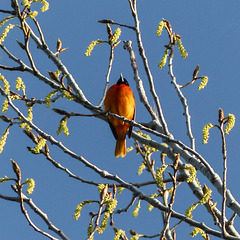
Baltimore Oriole, The Tip, Pt Pelee, Ontario
| 22 May 2018 |
|
Four friends (four of the six friends with whom I went to Trinidad & Tobago in March 2017) and I left Calgary airport on 6 May 2018 and flew to Toronto, Ontario, Canada. There, we rented a van and did the long drive to Point Pelee for four whole days of birding. We stayed at the Best Western Hotel, which is close to Point Pelee National Park. It fills up very quickly (with birders) and our rooms were booked months ago.
Our four days walking at Point Pelee were interesting and I, for sure, saw various things I had never seen before, including my very first Raccoon : ) Various friends had told me that the Warblers at Pelee were fantastic - so many and numerous species, and so close. Have to disagree with the "closeness" when we were there! I don't have binoculars as a camera(s) is enough for me to carry around, so I know I missed all sorts of birds. Though my Warbler count was lower than my friends' counts, I was happy to at least get a few distant photos of some species. So many of my shots are awful, but I will still post some of them, just for the record of seeing them. Some photos are so bad that I doubt anyone can ID them.
We covered several different trails at Pelee, and also drove to a few places somewhat further afield, such as Hillman Marsh. If you are unfamiliar with this Conservation Area, just wait till you see a photo of the old barn that was there. I couldn't believe my eyes! I was in so much pain that I wasn't sure if I would be able to walk across a grassy area to take a few photos. However, it was so unusual and beautiful, that I reckoned I could try and move forward inch by inch - and crawl (ha, ha) if necessary. Another place we enjoyed was Rondeau National Park. One amazing and totally unexpected sighting just outside Pelee was a very distant male Snowy Owl sitting in a fieldl!!
We walked every single day that we were at Pelee and the areas mentioned above, seeing not just birds, but a frog/toad, snakes that we suspect were mating, several Painted turtles, a few plants (including both white and red Triliums, that I had never seen growing wild before, and a couple of Jack in the Pulpit plants).
The Friends of Point Pelee have food available that one can buy. They also have a shuttle bus that one can take from the Visitor Centre all the way to the southern tip of Pelee, which is the most southern part of Canada. They also have birding walks each day (there is a charge). On 9 May, we spent the morning from 6:00 am to 11:00 am on a birding walk at Pelee with guide, Tom Hince, whom we had contacted while we were still in Calgary.
At the end of our stay at Point Pelee, we had to drive all the way back to Toronto, from where we flew to Quebec airport. From there, we had a four-hour drive to Tadoussac on the coast of the St. Lawrence Seaway. This is such a delightful, small place and in a beautiful setting. One of our friends, Anne B, and her husband have a summer cabin further along the cliff from the few stores and port. She had invited the four of us to go with her from Pelee to spend a week at her beautiful home. What an absolute treat this was! We were able to meet some of her relatives, too, who also have built cabins out there. We were looked after so well, and we were able to see and photograph all sorts of birds and other things. We made several trips to see different places, including the Cap Tourmente National Wildlife Area, where we were able to see endless thousands of Snow Geese. Breathtaking!
We also had two boat trips from Tadoussac - one was a whaling trip, where we saw very, very distant Beluga and Minke Whales. The Belugas looked almost like the white wave crests - but they were Belugas. The other boat trip was to the Brandy Pot Islands, inhabited by thousands of Razorbills and Common Murres, which were new birds for us, and Double-crested Cormorants that were nesting in tree tops. That long boat trip (in a tiny boat named Juno) started off in the rain and dark clouds and it was soooo cold! Thermal underwear, layers of fleece and toque and gloves were needed. This day was arranged through a contact of Anne's and it was so much enjoyed! Of course, we anchored a distance away from the island and sat there and ate our sandwiches and took endless photos.
Think I had better stop typing! As I add more photos, I can add bits of extra information. We only arrived home fairly early two evenings ago. Still so tired, especially as I was up at any time from 4:45 am to 6:00 am each morning, many hours earlier than I usually get up, being such a dreadful night owl!
Anne, I can't thank you enough for organizing this holiday for us all and for inviting us to spend a week at your cabin. You worked so hard and it was so much appreciated by each and every one of us. Thank you for doing all the many hours of driving, too! Janet and Anne, thank you so much for compiling the lists of birds seen each day at various locations, and posted to ebird. These entries will be a huge help while I try and sort out where we were and when, and what species we saw. Miss your cookies and muffins, Janet, that you kindly made for us in Tadoussac, to go along with the wonderful meals that Anne planned and made for us : )
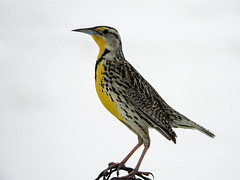
Western Meadowlark
| 16 Apr 2018 |
|
Flickr problems again - so many photos are not appearing in groups or on other people's photostreams. Just white spaces.
Once again, a giant leap from the tropical rainforest of Trinidad to the latest Alberta snowfall that arrived this morning. Sigh ... will this ever end, lol? Our temperature just before noon is -1C (windchill -7C). Thinking ahead to next month, it is not that unusual for us to have a major May snowstorm. Hopefully not this year.
From the Weather Network:
"Snowfall Warning Issued at 10:39 Monday 16 April 2018
Snowfall with total amounts of 10 to 20 cm is expected. 10 to 20 cm of heavy wet snow are likely.
Snow will end from south to north tonight, with 10 to 20 cm generally expected.
Near the eastern edge of the warning, including the city of Calgary, snowfall amounts will be highly variable and dependent on elevation. Lower portions of Calgary may see less than 10 cm while higher areas, most notably the northwestern part of the city, will likely see higher amounts.
Rapidly accumulating snow could make travel difficult over some locations. Visibility may be suddenly reduced at times in heavy snow."
Sure, this sounds and feels like spring : )
I feel so glad that I finally got out for a few hours yesterday, 15 April 2018, joining a group of friends on a birding trip SE of the city.
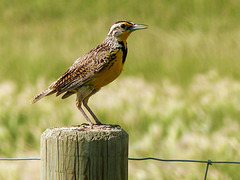
Western Meadowlark
| 01 Aug 2017 |
|
|
|
This is just one of the many Meadowlarks that friend, Pam, and I saw along the dusty back roads in Southern Alberta on 1 July 2017. Most of them flew as soon as they saw the car, but eventually, I managed to get a few shots of this beauty. We also saw so many Horned Larks, including on fence posts, though those birds were even more difficult to photograph.
"The buoyant, flutelike melody of the Western Meadowlark ringing out across a field can brighten anyone’s day. Meadowlarks are often more easily heard than seen, unless you spot a male singing from a fence post. This colorful member of the blackbird family flashes a vibrant yellow breast crossed by a distinctive, black, V-shaped band. Look and listen for these stout ground feeders in grasslands, meadows, pastures, and along marsh edges throughout the West and Midwest, where flocks strut and feed on seeds and insects." From AllAboutBirds.
www.allaboutbirds.org/guide/Western_Meadowlark/id
Canada Day, 1 July 2017, was a great day. I picked up Pam just after 8:00 am and did a long drive in Southern Alberta. We saw our target bird - a Common Nighthawk, and all sorts of other things including plants, wildlife, and old barns. It took a round trip of 414 km to get the Nighthawks, but it was so worth it! Much further than I normally drive. Towards the end of our day, the rain arrived, accompanied by lightning streaks. This couldn't have been timed more perfectly, to wash off a lot of the dust that covered my car after 12 hours of driving hot, dusty roads! So welcome!
It was such a thrill to see a Common Nighthawk / Chordeiles minor (a rather strange looking bird), as I had always wanted to see one actually lying on a fence post or wooden railing. People get such amazing photos of them like that, and that is what I was determined to find this summer. Last year, I had driven to this area in Southern Alberta, hoping to find one, but had been out of luck. Most of the Nighthawk photos I took on 1 July were of Nighthawks lying on metal railings, but I was still thrilled to bits. We saw four individuals, together, and one was on a fence post - not the best angle, but it was still nice to see a fence post perch. How close we came to missing them! I said I wanted to just check the first part of a small side road first, before continuing on the road we were on - and there they were! I had seen a nighthawk on maybe five different occasions over the years, but most were in flight and one was perched very high up in a tree. For Pam, this was the first time she had ever seen one, and she was so happy to see this lifer.
I was so tired after driving such a long distance and it was a hot day - the temperature got up to 30C. I so rarely do such a long drive, and I've barely driven all winter and spring. It felt so good to actually get out on a long drive like this, and we saw all sorts of interesting things that we just had to stop and photograph - of course!
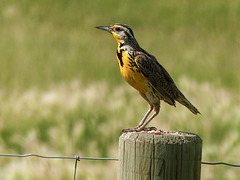
Western Meadowlark
| 06 Jul 2017 |
|
Wow, "Western Montana rattled by strong earthquake (5.8, after midnight last night) felt as far north as Calgary." I hope there will be no aftershocks this weekend, as I will be much closer to it!
globalnews.ca/news/3578563/magnitude-5-8-earthquake-in-mo...
This is just one of the many Meadowlarks that friend, Pam, and I saw along the dusty back roads in Southern Alberta five days ago. Most of them flew as soon as they saw the car, but eventually, I managed to get a few shots of this beauty. We also saw so many Horned Larks, including on fence posts, though those were even more difficult to photograph.
"The buoyant, flutelike melody of the Western Meadowlark ringing out across a field can brighten anyone’s day. Meadowlarks are often more easily heard than seen, unless you spot a male singing from a fence post. This colorful member of the blackbird family flashes a vibrant yellow breast crossed by a distinctive, black, V-shaped band. Look and listen for these stout ground feeders in grasslands, meadows, pastures, and along marsh edges throughout the West and Midwest, where flocks strut and feed on seeds and insects." From AllAboutBirds.
www.allaboutbirds.org/guide/Western_Meadowlark/id
Canada Day, 1 July 2017, was a great day. I picked up Pam just after 8:00 am and did a long drive in Southern Alberta. We saw our target bird - a Common Nighthawk, and all sorts of other things including plants, wildlife, and old barns. It took a round trip of 414 km to get the Nighthawks, but it was so worth it! Much further than I normally drive. Towards the end of our day, the rain arrived, accompanied by lightning streaks. This couldn't have been timed more perfectly, to wash off a lot of the dust that covered my car after 12 hours of driving hot, dusty roads! So welcome! We have another hot day today and the forecast is for very hot days (in the low 30Cs) for at least the next few days.
It was such a thrill to see a Common Nighthawk / Chordeiles minor (a rather strange looking bird), as I had always wanted to see one actually lying on a fence post or wooden railing. People get such amazing photos of them like that, and that is what I was determined to find this summer. Last year, I had driven to this area in Southern Alberta, hoping to find one, but had been out of luck. Most of the Nighthawk photos I took four days ago were of Nighthawks lying on metal railings, but I was still thrilled to bits. We saw four individuals, together, and one was on a fence post - not the best angle, but it was still nice to see a fence post perch. How close we came to missing them! I said I wanted to just check the first part of a small side road first, before continuing on the road we were on - and there they were! I had seen a nighthawk on maybe five different occasions over the years, but most were in flight and one was perched very high up in a tree. For Pam, this was the first time she had ever seen one, and she was so happy to see this lifer.
I was so tired after driving such a long distance and it was a hot day - the temperature got up to 30C. I so rarely do such a long drive, and I've barely driven all winter and spring. It felt so good to actually get out on a long drive like this, and we saw all sorts of interesting things that we just had to stop and photograph - of course!
Every single time I go out with my camera for a drive, I never forget to be SO thankful to live in a country where I have the freedom and safety to go where I want, and to see such beauty. Thank you, Alberta and Albertans - and Happy 150th Birthday, Canada! Such a young country.
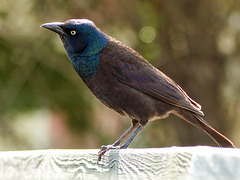
Common Grackle / Quiscalus quiscula
| 12 May 2017 |
|
The last 7 images that I have just uploaded were taken yesterday afternoon, 11 May 2017, at a pond in Calgary. Love seeing these beautiful Common Grackles, though I didn't catch much iridescence on this one. Much as I would rather not interrupt my Trinidad photos, I did want to post these local birds and plants, otherwise I might forget. Sorry that I have added so many photos, and at such a fast rate! Seeing my calendar filling up rather quickly, I know that I will be getting various chances to take photos, and it would help greatly if I can get my holiday photos finished.
This morning, I finished the last few photos taken at Manzaniila Beach, Trinidad. From there, we drove the Nariva Swamp area, which is mainly agricultural habitats with some wetlands. Some good birding there and I will be posting various new species. Also, at least a couple of plants that we enjoyed seeing, especially the Sacred Lotus. This is one of my favourite things to photograph in the Conservatory at the Calgary Zoo.
"Common Grackles are blackbirds that look like they've been slightly stretched. They're taller and longer tailed than a typical blackbird, with a longer, more tapered bill and glossy-iridescent bodies. Grackles walk around lawns and fields on their long legs or gather in noisy groups high in trees, typically evergreens. They eat many crops (notably corn) and nearly anything else as well, including garbage. In flight their long tails trail behind them, sometimes folded down the middle into a shallow V shape." From AllABoutBirds.
www.allaboutbirds.org/guide/Common_Grackle/id
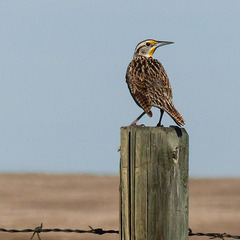
Western Meadowlark
| 20 May 2016 |
|
Two and a half weeks ago, on 2 May 2016, I was incredibly fortunate to be able to witness about 30 (?) Sharp-tailed Grouse, mainly male with just a handful of females, displaying at their "lek" or communal dancing ground. On this particular day, five of us went to see this. There had been a couple of possible chances to get out there, but these had fallen through. Then out of the blue, friend Dorothy phoned me, asking if I had been able to get to the lek yet. She said that if I hadn't been, her husband Stephen would be willing to drive me there! This was such a wonderful surprise, though anyone who knows this couple already knows what amazingly kind and generous people they are. I was so happy to get this unexpected chance and the three of us had a great morning, in good weather and in good company. Two young men also went, making their own way there. Delightful guys, highly respectful of not only the Grouse, but also of us, constantly moving form their seats to allow us to get our turn, and vice versa. They could so easily have left the 'hide/blind ahead of us when the Grouse had all left, but instead they waited till we were all packed up and then made sure that we were all able to safely get over the very awkward stile at the fence line. Having been out there last year, on 13 April 2015, I knew of this problem and had bought a three-step step ladder just in case I was able to go sometime this spring. This made so much difference, thank goodness, especially as I was really tired after staying up all night in order to leave at a very unearthly hour of the morning.
So glad we had a nice, sunny day - the day I went a year ago, the weather was overcast and not good for photos. Of course, the 'problem' of clumps of tall grass was exactly the same this year, lol, keeping the birds somewhat hidden, but every once in a while, a bird would come out into the open. Most of the time, they were quite dstant, but we were very lucky that several did give us a closer view. Such magnificent birds, with their yellow 'eyebrows', purple patch below the side of the neck on the males, and glorious feather pattern. Their dance display to attract the females is so fascinating to watch.
If you have time, the following 2:30 minute YouTube video by the Alberta Conservation Association is very good for showing the action of these birds. There are several still shots first and then the video starts. Pretty amazing! The birds remind me of a child's wind-up toy : )
youtu.be/vRUVIU4UfYo
Just after we got back to our cars, another car came along the road and stopped to talk with us. It turned out that this gentleman was indirectly connected to the lek. He voiced his huge concern at how many people had been out there this spring, feeling that this was not good for the Grouse. He said that hopefully no more people would be going, so that the Grouse would be undisturbed in their mating. We agreed with him and thought that maybe people should not be allowed to visit every year, but perhaps every two or three years. I will pass on his words and great concern to our Naturalist who organizes these visits.
After we left the lek, we travelled a few nearby backroads, hoping to see a Western Meadowlark. We saw 10! It had been so funny, while we sat in the blind at the lek, a Meadowlark was somewhere nearby and sang for us for about four hours! When we at last emerged from the blind into the sunlight, there was no sign of it anywhere. We did manage to get a few shots of two or three of them.
"The buoyant, flutelike melody of the Western Meadowlark ringing out across a field can brighten anyone’s day. Meadowlarks are often more easily heard than seen, unless you spot a male singing from a fence post. This colorful member of the blackbird family flashes a vibrant yellow breast crossed by a distinctive, black, V-shaped band. Look and listen for these stout ground feeders in grasslands, meadows, pastures, and along marsh edges throughout the West and Midwest, where flocks strut and feed on seeds and insects." From AllAboutBirds.
www.allaboutbirds.org/guide/Western_Meadowlark/id
en.wikipedia.org/wiki/Western_meadowlark
Thank you so much, Stephen and Dorothy, for offering to take me - so very kind and thoughtful of you, as always! The stop for having our sandwiches was great and the muffins you brought along with you ended the morning very nicely.
If you have time, the following 2:30 minute YouTube video by the Alberta Conservation Association is very good for showing the action of these birds. There are several still shots first and then the video starts. Pretty amazing! The birds remind me of a child's wind-up toy : )
youtu.be/vRUVIU4UfYo
I came across an excellent brochure (pdf file) about Sharp-tailed Grouse on the Internet and will use some of the information from it, instead of using my own words to describe what goes on at a lek. I had seen females of this species before, on Christmas Bird Counts, but not a male and not at breeding time.
www.ab-conservation.com/downloads/educational_materials/b...
"Sharp-tailed grouse perform spring courtship displays on communal “dancing grounds” called leks. Here, males compete for breeding opportunities by displaying their "dancing” ability to females. Most activity on the lek occurs in the early morning just before sunrise and for a few hours afterwards. The males’ energetic display includes fluttering wings, rapid foot stomping and spinning in tight circles - reminiscent of wind-up toys. The most dominant males court females with low cooing sounds and by strutting around them with inflated air sacs on their neck and fanned tail feathers. It is nearly a winner-take-all form of competition, as only a few of the males are selected as mates by the females.
Leks are found in areas with dry open ground, where dancing activity keeps the vegetation well-trampled. Leks are used over several weeks beginning in late March and are often used for years, even decades. They are an important part of sharp-tailed grouse life, and the loss of suitable lek habitat can be a limiting factor for sharp-tailed grouse in Alberta.
Male sharp-tailed grouse gather on the lek in late March. In April the females arrive, sparking increased displaying by the males. Peak attendance by females on the lek occurs between mid to late April in much of Alberta. Once they have selected a male, hens breed once and then seek out a place to nest, usually in late April to early May.
Leks are an integral part of the lifecycle of prairie grouse. Active leks should never be approached, as any disturbance to the birds may disrupt breeding activities and result in the abandonment of the lek. The locations of active and historical leks are of great interest to grouse biologists.
Native North Americans called the sharp-tailed grouse “Fire Bird” because of their reliance on fires to keep their habitat open in wooded areas. Suppression of natural fire in parkland and boreal areas reduces the amount of open grassland available to sharp-tailed grouse.
Sharp-tailed grouse were an important food source for native North Americans and they continue to be a popular game bird for hunters today.
In Alberta, the sharp-tailed grouse is listed as “Sensitive.”
While exact population numbers are not known, there is a feeling that sharp-tailed grouse have decreased significantly in numbers over the past 40 years. This trend is supported by lek counts, hunter surveys, aerial counts and Breeding Bird Survey data. Declining numbers are the result of a reduction in the quality and quantity of sharp-tailed grouse habitat, particularly the loss of quality nesting and brood-rearing habitat." From www.ab-conservation.com .
www.ab-conservation.com/downloads/report_series/Use-Habit...
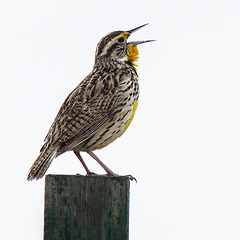
A prairie song
| 12 May 2016 |
|
|
|
It is raining here in Calgary this morning, 12 May 2016. It also snowed in some parts of the city earlier - I didn't set my alarm clock, so it may have snowed a little in my area while I was still asleep. Nothing settled, anyway. Our temperature is 2C, expected to soar to 5C this afternoon : ) Unfortunately, there is no rain up north in the Fort McMurray area and none expected till next week. They desperately need it to help with the massive wildfire.
Two and a half weeks ago, on 24 April 2016, I was out for the day, SE of Calgary around Frank Lake. Finally, after so much glorious, summer-like spring weather, the weather changed for the worse and we had a cool (needed gloves), very overcast day with light drizzle some of the time. Not good at all for taking photos. Later, we also had a fair bit of desperately needed rain that night. I was especially disappointed with the shots I took of this beautiful Western Meadowlark. Usually, they fly even when they see you in the far distance, but this beauty let me slowly walk quite close to get a number of photos. The quality is awful, but I don't get a chance to photograph Meadowlarks very often, so will post at least one or two grainy images. If you've never heard the song of a Meadowlark, it might be worth listening on AllAboutBirds website.
Eight friends and I had a great day, despite the weather. This is one of my favourite areas and I just hadn't been getting time to drive there myself for quite a long time. We started off at the main gate and drove to the blind/hide area, stopping half way to search for very distant birds. While everyone else had their binoculars pointed over the water, I was slowly walking towards this Meadowlark, who was singing its beautiful song. You can hear them and they sound so close, but their song seems to carry a long way. It kept flying away but each time returned to the same post. I was amazed and delighted that this one let me get so close. If the sun had been shining, it would have been perfect!
As usual when we go to Frank Lake, almost all the birds are very distant and pretty impossible to photograph. I did catch a male Red-winged Blackbird - the females had not yet returned here. The other amazing thing was when we had walked from the Frank Lake bird blind over to the water in the other direction, a flock of about 50 Tree Swallows were flying to and from a low tree/shrub, catching the many insects while in flight. Again, while everyone was searching over the water, I gradually made my way to within just a few feet of the bush. Quite a feeling to have so many Tree Swallows circling all the way around you. I have never ever seen so many of them acting like this, so it was a neat experience.
From this main area, we called in at the usual three other places around the lake. Two were rough roads that led to Basin 2 from the east and the west, and the third was the Ducks Unlimited location at the far southern edge of the lake, at Basin 3.
Thanks so much for a great day, Tony, and for the ride all day. I always look forward to the Frank Lake trips.
"The buoyant, flutelike melody of the Western Meadowlark ringing out across a field can brighten anyone’s day. Meadowlarks are often more easily heard than seen, unless you spot a male singing from a fence post. This colorful member of the blackbird family flashes a vibrant yellow breast crossed by a distinctive, black, V-shaped band. Look and listen for these stout ground feeders in grasslands, meadows, pastures, and along marsh edges throughout the West and Midwest, where flocks strut and feed on seeds and insects." From AllAboutBirds.
www.allaboutbirds.org/guide/Western_Meadowlark/id
en.wikipedia.org/wiki/Western_meadowlark
I will add our leader, Tony Timmons' list of species seen, adding that only 6 people walked as far as the Hudsonian Godwits - I was not one of them.
"Nine people were on the trip today to Frank Lake. Expected species were present in pretty fair numbers, with the best sighting being 15 Hudsonian Godwits at Basin 3.
A flock of 50 Tree Swallows hacking insects and using a small bush for a perch, made for an interesting scene.
We had 56 species for the trip
Horned Grebe
Eared Grebe
Western Grebe
Double-crested Cormorant
Great Blue Heron
White-faced Ibis (1 seen by Dan P.)
Canada Goose
Trumpeter Swan
Tundra Swan
Gadwall
American Wigeon
Mallard
Blue-winged Teal
Cinnamon Teal
Green-winged Teal
Northern Shoveler
Northern Pintail
Canvasback
Redhead
Ring-necked Duck
Lesser Scaup
Bufflehead
Common Goldeneye
Ruddy Duck
Northern Harrier
Swainson's Hawk
Red-tailed Hawk
Gray Partridge
American Coot
Killdeer
Black-necked Stilt
American Avocet
Lesser Yellowlegs
Willet
Hudsonian Godwit
Wilson's Snipe
Franklin's Gull
Bonaparte's Gull
California Gull
Rock Pigeon
Mourning Dove
Great Horned Owl
Black-billed Magpie
American Crow
Common Raven
Tree Swallow
Marsh Wren
American Robin
European Starling
Song Sparrow
Dark-eyed Junco
Red-winged Blackbird
Yellow-headed Blackbird
Western Meadowlark
Brewer's Blackbird
House Sparrow"
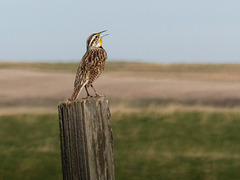
Singing its little heart out
| 07 May 2016 |
|
|
Five days ago, on 2 May 2016, I was incredibly fortunate to be able to witness about 30 (?) Sharp-tailed Grouse, mainly male with just a handful of females, displaying at their "lek" or communal dancing ground. On this particular day, five of us went to see this. There had been a couple of possible chances to get out there, but these had fallen through. Then out of the blue, friend Dorothy phoned me a few days ago, asking if I had been able to get to the lek yet. She said that if I hadn't been, that her husband Stephen would be willing to drive me there! This was such a wonderful surprise, though anyone who knows this couple already knows what amazingly kind and generous people they are. I was so happy to get this unexpected chance and the three of us had a great morning, in good weather and in good company. Two young men also went, making their own way there. Delightful guys, highly respectful of not only the Grouse, but also of us, constantly moving form their seats to allow us to get our turn, and vice versa. They could so easily have left the 'hide/blind ahead of us when the Grouse had all left, but instead they waited till we were all packed up and then made sure that we were all able to safely get over the very awkward stile at the fence line. Having been out there last year, on 13 April 2015, I knew of this problem and had bought a three-step step ladder just in case I was able to go sometime this spring. This made so much difference, thank goodness, especially as I was really tired after staying up all night in order to leave at a very unearthly hour of the morning.
So glad we had a nice, sunny day - the day I went a year ago, the weather was overcast and not good for photos. Of course, the 'problem' of clumps of tall grass was exactly the same this year, lol, keeping the birds somewhat hidden, but every once in a while, a bird would come out into the open. Most of the time, they were quite dstant, but we were very lucky that several did give us a closer view. Such magnificent birds, with their yellow 'eyebrows', purple patch below the side of the neck on the males, and glorious feather pattern. Their dance display to attract the females is so fascinating to watch.
Just after we got back to our cars, another car came along the road and stopped to talk with us. It turned out that this gentleman was indirectly connected to the lek. He voiced his huge concern at how many people had been out there this spring, feeling that this was not good for the Grouse. He said that hopefully no more people would be going, so that the Grouse would be undisturbed in their mating. We agreed with him and thought that maybe people should not be allowed to visit every year, but perhaps every two or three years. I will pass on his words and great concern to our Naturalist leader who organizes these visits.
After we left the lek, we travelled a few nearby backroads, hoping to see a Western Meadowlark. We saw 10! It had been so funny, while we sat in the blind at the lek, a Meadowlark was somewhere nearby and sang for us for about four hours! When we at last emerged into the sunlight, there was no sign of it anywhere. We did manage to get a few shots of two or three of them.
Thank you so much, Stephen and Dorothy, for offering to take me - so very kind and thoughtful of you, as always! The stop for having our sandwiches was great and the muffins you brought along with you ended the morning very nicely.
If you have time, the following 2:30 minute YouTube video by the Alberta Conservation Association is very good for showing the action of these birds. There are several still shots first and then the video starts. Pretty amazing! The birds remind me of a child's wind-up toy : )
youtu.be/vRUVIU4UfYo
I came across an excellent brochure (pdf file) about Sharp-tailed Grouse on the Internet and will use some of the information from it, instead of using my own words to describe what goes on at a lek. I had seen females of this species before, on Christmas Bird Counts, but not a male and not at breeding time.
www.ab-conservation.com/downloads/educational_materials/b...
"Sharp-tailed grouse perform spring courtship displays on communal “dancing grounds” called leks. Here, males compete for breeding opportunities by displaying their "dancing” ability to females. Most activity on the lek occurs in the early morning just before sunrise and for a few hours afterwards. The males’ energetic display includes fluttering wings, rapid foot stomping and spinning in tight circles - reminiscent of wind-up toys. The most dominant males court females with low cooing sounds and by strutting around them with inflated air sacs on their neck and fanned tail feathers. It is nearly a winner-take-all form of competition, as only a few of the males are selected as mates by the females.
Leks are found in areas with dry open ground, where dancing activity keeps the vegetation well-trampled. Leks are used over several weeks beginning in late March and are often used for years, even decades. They are an important part of sharp-tailed grouse life, and the loss of suitable lek habitat can be a limiting factor for sharp-tailed grouse in Alberta.
Male sharp-tailed grouse gather on the lek in late March. In April the females arrive, sparking increased displaying by the males. Peak attendance by females on the lek occurs between mid to late April in much of Alberta. Once they have selected a male, hens breed once and then seek out a place to nest, usually in late April to early May.
Leks are an integral part of the lifecycle of prairie grouse. Active leks should never be approached, as any disturbance to the birds may disrupt breeding activities and result in the abandonment of the lek. The locations of active and historical leks are of great interest to grouse biologists.
Native North Americans called the sharp-tailed grouse “Fire Bird” because of their reliance on fires to keep their habitat open in wooded areas. Suppression of natural fire in parkland and boreal areas reduces the amount of open grassland available to sharp-tailed grouse.
Sharp-tailed grouse were an important food source for native North Americans and they continue to be a popular game bird for hunters today.
In Alberta, the sharp-tailed grouse is listed as “Sensitive.”
While exact population numbers are not known, there is a feeling that sharp-tailed grouse have decreased significantly in numbers over the past 40 years. This trend is supported by lek counts, hunter surveys, aerial counts and Breeding Bird Survey data. Declining numbers are the result of a reduction in the quality and quantity of sharp-tailed grouse habitat, particularly the loss of quality nesting and brood-rearing habitat." From www.ab-conservation.com .
www.ab-conservation.com/downloads/report_series/Use-Habit...
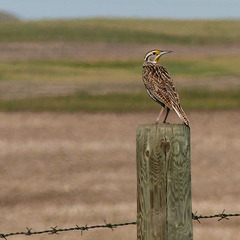
One of ten Meadowlarks seen yesterday
| 03 May 2016 |
|
Yesterday, 2 May 2016, I was incredibly fortunate to be able to witness about 30 (?) of these Grouse, mainly male with just a handful of females, displaying at their "lek" or communal dancing ground. On this particular day, five of us went to see this. There had been a couple of possible chances to get out there, but these had fallen through. Then out of the blue, friend Dorothy phoned me a few days ago, asking if I had been able to get to the lek yet. She said that if I hadn't been, that her husband Stephen would be willing to drive me there! This was such a wonderful surprise, though anyone who really knows this couple already knows what amazingly kind and generous people they are. I was so happy to get this unexpected chance and the three of us had a great morning, in good weather and in good company. Two young men also went, making their own way there. Delightful guys, highly respectful of not only the Grouse, but also of us, constantly moving form their seats to allow us to get our turn, and vice versa. They could so easily have left the 'hide/blind ahead of us when the Grouse had all left, but instead they waited till we were all packed up and then made sure that we were all able to safely get over the very awkward stile at the fence line. Having been out there last year, on 13 April 2015, I knew of this problem and had bought a three-step step ladder just in case I was able to go sometime this spring. This made so much difference, thank goodness, especially as I was really tired after staying up all night in order to leave at a very unearthly hour of the morning.
So glad we had a nice, sunny day - the day I went a year ago, the weather was overcast and not good for photos. Of course, the 'problem' of clumps of tall grass was exactly the same this year, lol, keeping the birds somewhat hidden, but every once in a while, a bird would come out into the open. Most of the time, they were quite dstant, but we were very lucky that several did give us a closer view. Such magnificent birds, with their yellowy orange 'eyebrows', purple patch below the side of the neck on the males, and glorious feather pattern. Their dance display to attract the females is so fascinating to watch.
Just after we got back to our cars, another car came along the road and stopped to talk with us. It turned out that this gentleman was indirectly connected to the lek. He voiced his huge concern at how many people had been out there this spring, feeling that this was not good for the Grouse. He said that hopefully no more people would be going, so that the Grouse would be undisturbed in their mating. We agreed with him and thought that maybe people should not be allowed to visit every year, but perhaps every two or three years. I will pass on his words and great concern to our Naturalist leader who organizes these visits.
After we left the lek, we travelled a few nearby backroads, hoping to see a Western Meadowlark. We saw 10! It had been so funny, while we sat in the blind at the lek, a Meadowlark was somewhere nearby and sang for us for about four hours! When we at last emerged into the sunlight, there was no sign of it anywhere. We did manage to get a few shots of two or three of them.
Thank you so much, Stephen and Dorothy, for offering to take me - so very kind and thoughtful of you, as always! The stop for having our sandwiches was great and the muffins you brought along with you ended the morning very nicely.
If you have time, the following 2:30 minute YouTube video by the Alberta Conservation Association is very good for showing the action of these birds. There are several still shots first and then the video starts. Pretty amazing! The birds remind me of a child's wind-up toy : )
youtu.be/vRUVIU4UfYo
I came across an excellent brochure (pdf file) about Sharp-tailed Grouse on the Internet and will use some of the information from it, instead of using my own words to describe what goes on at a lek. I had seen females of this species before, on Christmas Bird Counts, but not a male and not at breeding time.
www.ab-conservation.com/downloads/educational_materials/b...
"Sharp-tailed grouse perform spring courtship displays on communal “dancing grounds” called leks. Here, males compete for breeding opportunities by displaying their "dancing” ability to females. Most activity on the lek occurs in the early morning just before sunrise and for a few hours afterwards. The males’ energetic display includes fluttering wings, rapid foot stomping and spinning in tight circles - reminiscent of wind-up toys. The most dominant males court females with low cooing sounds and by strutting around them with inflated air sacs on their neck and fanned tail feathers. It is nearly a winner-take-all form of competition, as only a few of the males are selected as mates by the females.
Leks are found in areas with dry open ground, where dancing activity keeps the vegetation well-trampled. Leks are used over several weeks beginning in late March and are often used for years, even decades. They are an important part of sharp-tailed grouse life, and the loss of suitable lek habitat can be a limiting factor for sharp-tailed grouse in Alberta.
Male sharp-tailed grouse gather on the lek in late March. In April the females arrive, sparking increased displaying by the males. Peak attendance by females on the lek occurs between mid to late April in much of Alberta. Once they have selected a male, hens breed once and then seek out a place to nest, usually in late April to early May.
Leks are an integral part of the lifecycle of prairie grouse. Active leks should never be approached, as any disturbance to the birds may disrupt breeding activities and result in the abandonment of the lek. The locations of active and historical leks are of great interest to grouse biologists.
Native North Americans called the sharp-tailed grouse “Fire Bird” because of their reliance on fires to keep their habitat open in wooded areas. Suppression of natural fire in parkland and boreal areas reduces the amount of open grassland available to sharp-tailed grouse.
Sharp-tailed grouse were an important food source for native North Americans and they continue to be a popular game bird for hunters today.
In Alberta, the sharp-tailed grouse is listed as “Sensitive.”
While exact population numbers are not known, there is a feeling that sharp-tailed grouse have decreased significantly in numbers over the past 40 years. This trend is supported by lek counts, hunter surveys, aerial counts and Breeding Bird Survey data. Declining numbers are the result of a reduction in the quality and quantity of sharp-tailed grouse habitat, particularly the loss of quality nesting and brood-rearing habitat." From www.ab-conservation.com .
www.ab-conservation.com/downloads/report_series/Use-Habit...
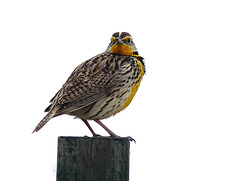
Western Meadowlark
| 25 Apr 2016 |
|
|
|
Yesterday, 25 April 2016, I was out for the day, SE of Calgary around Frank Lake. Finally, after so much glorious, summer-like spring weather, the weather changed for the worse and we had a cool (needed gloves), very overcast day with light drizzle some of the time. Not good at all for taking photos. We also had a fair bit of desperately needed rain last night. I was especially disappointed with the shots I took of this beautiful Western Meadowlark. Usually, they fly even when they see you in the far distance, but this beauty let me slowly walk quite close to get a number of photos. The quality is awful, but I don't get a chance to photograph Meadowlarks very often, so will post at least one or two grainy images. If you've never heard the song of a Meadowlark, it might be worth listening on AllAboutBirds website.
Eight friends and I had a great day, despite the weather. This is one of my favourite areas amd I just haven't been getting time to drive there myself for quite a long time. We started off at the main gate and drove to the blind/hide area, stopping half way to search for very distant birds. While everyone else had their binoculars pointed over the water, I was slowly walking towards this Meadowlark, who was singing its beautiful song. You can hear them and they sound so close, but their song seems to carry a long way. It kept flying away but each time returned to the same post. I was amazed and delighted that this one let me get so close. If the sun had been shining, it would have been perfect!
As usual when we go to Frank Lake, almost all the birds are very distant and pretty impossible to photograph. I did catch the male Red-winged Blackbird in the next photo - the females have not yet returned here. The other amazing thing was when we had walked from the Frank Lake bird blind over to the water in the other direction, a flock of about 50 Tree Swallows were flying to and from a low tree/shrub, catching the many insects while in flight. Again, while everyone was searching over the water, I gradually made my way to within just a few feet of the bush. Quite a feeling to have so many Tree Swallows circling all the way around you. I have never ever seen so many of them acting like this, so it was a neat experience.
From this main area, we called in at the usual three other places around the lake. Two were rough roads that led to Basin 2 from the east and the west, and the third was the Ducks Unlimited location at the far southern edge of the lake, at Basin 3.
Thanks so much for a great day, Tony, and for the ride all day. I always look forward to the Frank Lake trips.
"The buoyant, flutelike melody of the Western Meadowlark ringing out across a field can brighten anyone’s day. Meadowlarks are often more easily heard than seen, unless you spot a male singing from a fence post. This colorful member of the blackbird family flashes a vibrant yellow breast crossed by a distinctive, black, V-shaped band. Look and listen for these stout ground feeders in grasslands, meadows, pastures, and along marsh edges throughout the West and Midwest, where flocks strut and feed on seeds and insects." From AllAboutBirds.
www.allaboutbirds.org/guide/Western_Meadowlark/id
en.wikipedia.org/wiki/Western_meadowlark
I will add our leader, Tony Timmons' list of species seen, adding that only 6 people walked as far as the Hudsonian Godwits - I was not one of them.
"Nine people were on the trip today to Frank Lake. Expected species were present in pretty fair numbers, with the best sighting being 15 Hudsonian Godwits at Basin 3.
A flock of 50 Tree Swallows hacking insects and using a small bush for a perch, made for an interesting scene.
We had 56 species for the trip
Horned Grebe
Eared Grebe
Western Grebe
Double-crested Cormorant
Great Blue Heron
White-faced Ibis (1 seen by Dan P.)
Canada Goose
Trumpeter Swan
Tundra Swan
Gadwall
American Wigeon
Mallard
Blue-winged Teal
Cinnamon Teal
Green-winged Teal
Northern Shoveler
Northern Pintail
Canvasback
Redhead
Ring-necked Duck
Lesser Scaup
Bufflehead
Common Goldeneye
Ruddy Duck
Northern Harrier
Swainson's Hawk
Red-tailed Hawk
Gray Partridge
American Coot
Killdeer
Black-necked Stilt
American Avocet
Lesser Yellowlegs
Willet
Hudsonian Godwit
Wilson's Snipe
Franklin's Gull
Bonaparte's Gull
California Gull
Rock Pigeon
Mourning Dove
Great Horned Owl
Black-billed Magpie
American Crow
Common Raven
Tree Swallow
Marsh Wren
American Robin
European Starling
Song Sparrow
Dark-eyed Junco
Red-winged Blackbird
Yellow-headed Blackbird
Western Meadowlark
Brewer's Blackbird
House Sparrow"
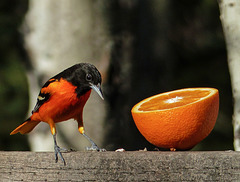
Matching colours
| 06 Feb 2016 |
|
|
|
This vibrantly coloured image was taken last year, on 23 May 2015. See what happens to you if you eat too many oranges, lol? The main focus of the trip we went on was someone's property SW of Calgary, a place that we always call in at when we take part in the May Species Count. The Count wasn't till the following weekend, so this visit was an extra one - and extra long, too, which was pure delight! I think we spent something like two hours, watching especially Barb's feeder area for some of the birds that had been showing up. We are always thrilled to bits to see the Evening Grosbeaks and the Baltimore Orioles - the first male Oriole to arrive at Barb's was on 15 May, and this male showed up during our visit. The orange was on top of a fence rail, so this is not a feeder shot : )
www.allaboutbirds.org/guide/Baltimore_Oriole/lifehistory
Though I'm not keen on feeder photos, I still take them, as well as when the birds are in the nearby trees. The Evening Grosbeaks came often to the feeders, giving us the chance to at least get closer shots. All the bird species were very fast-moving, so gave us a challenge for two hours. The Goldfinch and the Pine Siskins also were quick, but not totally impossible to photograph.
After our time at Barb's, we went to Brown-Lowery Provincial Park, mainly to look for Calypso Orchids, which we did find. Some people continued walking the trails, others returned home. I did part of the walk, but then went back to where the cars were parked and wandered through the forest around the parking lot. Tennessee Warblers sang continuously but were almost impossible to see. I was happy to find one single Coltsfoot plant - love the tight cluster of white flowers at the top of a tall stem.
From Brown-Lowery, we started our journey home, stopping at a couple of wetlands on the way.
I will add the list compiled by Andrew Hart, who kindly drove three of us around for the morning and early afternoon and then sent us his list that he submitted to ebird. Many thanks for both the ride and the final list, Andrew!
"Here is the elist of Birds seen at B. Castell's S of Priddis; Plummers & Priddis Valley Rd.; and Brown-Lowery PP, 23May2015. 24 participants
Number of Checklists: 3
Number of Species: 46
Checklists included in this summary:
(1): CA-AB-Priddis. Barb Castell
Date: May 23, 2015, 7:34 AM
(2): CA-Priddis Valley road
Date: May 23, 2015, 9:53 AM
(3): Brown-Lowery Provincial Park
Date: May 23, 2015, 10:28 AM
2 Canada Goose -- (1)
2 American Wigeon -- (1)
1 Mallard -- (1)
3 Blue-winged Teal -- (1)
3 Northern Shoveler -- (1),(2)
3 Green-winged Teal -- (1)
4 Lesser Scaup -- (1)
2 Common Goldeneye -- (1)
1 Swainson's Hawk -- (1)
1 Red-tailed Hawk -- (2)
4 Sora -- (2)
1 Spotted Sandpiper -- (1)
2 Wilson's Snipe -- (1)
7 Wilson's Phalarope -- (2)
1 Mourning Dove -- (1)
1 Rufous Hummingbird -- (1)
1 Red-naped Sapsucker -- (1)
2 Downy Woodpecker -- (1)
1 Hairy Woodpecker -- (1)
2 Least Flycatcher -- (2)
1 Eastern Kingbird -- (2)
1 Blue Jay -- (1)
3 Black-billed Magpie -- (1)
2 American Crow -- (1)
2 Common Raven -- (2)
11 Tree Swallow -- (1),(2)
1 Barn Swallow -- (2)
6 Black-capped Chickadee -- (1),(3)
3 House Wren -- (1),(2)
2 Golden-crowned Kinglet -- (3)
2 Ruby-crowned Kinglet -- (2),(3)
9 Mountain Bluebird -- (1),(2)
6 American Robin -- (1),(2),(3)
4 Tennessee Warbler -- (3)
2 Yellow Warbler -- (1),(2)
8 Clay-colored Sparrow -- (1),(2)
6 Savannah Sparrow -- (1),(2)
1 Lincoln's Sparrow -- (1)
1 White-throated Sparrow -- (1)
1 Dark-eyed Junco -- (3)
23 Red-winged Blackbird -- (1),(2)
3 Brown-headed Cowbird -- (1)
1 Baltimore Oriole -- (1)
17 Pine Siskin -- (1),(3)
5 American Goldfinch -- (1)
5 Evening Grosbeak -- (1),(3)"
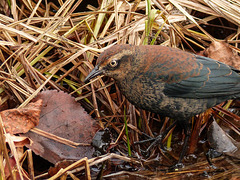
Rusty Blackbird
| 16 Jan 2016 |
|
In the early afternoon of 7 November 2014, I drove over to the east end of Fish Creek Provincial Park and was lucky enough to see two of these beautiful Rusty Blackbirds. IUCN Status: Vulnerable. I very rarely see these birds – in fact, I think I have only ever seen one once before and no photos. It was interesting to watch this one pick up and then toss aside endless fallen leaves along the edge of a tiiny creek, to check underneath them for food. Eventually, it did find a big, fat, juicy water worm of some kind, and ate it. As you can see from the photo, this bird is camouflaged quite well in those surroundings.
“The Rusty Blackbird is one of North America’s most rapidly declining species. The population has plunged an estimated 85-99 percent over the past forty years and scientists are completely puzzled as to what is the cause. They are relatively uncommon denizens of wooded swamps, breeding in the boreal forest and wintering in the eastern U.S. In winter, they travel in small flocks and are identified by their distinctive rusty feather edges and pallid yellow eyes.” From AllAboutBirds.
www.allaboutbirds.org/guide/rusty_blackbird/id
en.wikipedia.org/wiki/Rusty_blackbird
rustyblackbird.org/
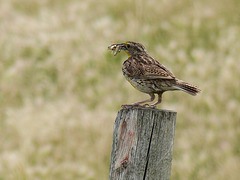
Western Meadowlark
| 06 Sep 2015 |
|
On this day, 26 July 2015, 22 of us drove out to Marsland Basin, E of Calgary. This beautiful wetland belongs to our friend, Lyn, and her partner - they have a house and yard that overlooks the wetland. This was the second time that I had visited the area, the first being on 28 June 2015. Each time, we have to sign a small guestbook. Also, everyone who can is asked to please submit a list of species seen to eBird. The birds on the water are very distant, so you need binoculars (which I don't have) and even better, a spotting scope. Really, they are too far away for photos, though I can get a distant shot with my point-and-shoot camera set at 48x zoom and then cropped. However, we did see 53 bird species there.
Like last time, I took a long look over the lake and then wandered round Lyn's property, this time finding a mushroom or two, a beautiful moth, a Thistle or two, their two donkeys, a House Wren, an Eastern Kingbird, a Mourning Dove, and a family of Western Kingbirds (that were just about impossible to see as they flitted in amongst the high branches.
The highlight of the visit for many of us was seeing a very, very distant family of American Badgers that were in a neighbour's field (so, private land), digging for prey (probably the nearby Richardson's Ground Squirrels). There are four family members, though some of us only saw three. I think I have only ever seen a Badger three times before in 37 years, the last one being on 11 June 2012, on one of Don Stiles' annual Mountain Bluebird outings.
The General Status of the American Badger in Alberta is Sensitive. More detailed Status is "Data Deficient" - not enough current information to determine its status.
en.wikipedia.org/wiki/American_badger
After our visit to the Marsland Basin, friends Dorothy and Stephen drove two of us back to Calgary again, travelling the roads slowly so that we could see a number of perched Swainson's Hawks, and a Meadowlark with mouth full of insects to feed to her babies. We also called in briefly at Weed Lake, closer to Calgary. Weed Lake is a popular place with birders, though I have still never driven out there myself.
www.allaboutbirds.org/guide/western_meadowlark/id
Thanks so much, Stephen, for the safe ride there and back. As always, hugely appreciated!
For a list of the 53 species of bird that were seen yesterday morning, look under the Badger family photo.
flic.kr/p/wygV8B
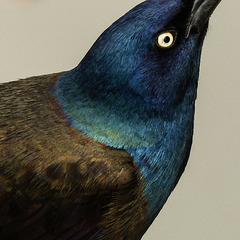
When black isn't really black
| 06 Jun 2015 |
|
This photo was an accident, but I thought it was still too pretty to delete : ) I was taking photos of this gorgeous Common Grackle, when it disappeared from sight and then suddenly popped up much closer than I was expecting. I cropped the sides of the photo to make it square, but other than that, this is how the photo was taken : ) Though these birds seem to be unpopular, I love to see them and try and capture their iridescent beauty. They appear to be a black bird, but when the sun catches them, they come alive with colour.
"Common Grackles are blackbirds that look like they've been slightly stretched. They're taller and longer tailed than a typical blackbird, with a longer, more tapered bill and glossy-iridescent bodies. Grackles walk around lawns and fields on their long legs or gather in noisy groups high in trees, typically evergreens. They eat many crops (notably corn) and nearly anything else as well, including garbage. In flight their long tails trail behind them, sometimes folded down the middle into a shallow V shape." From AllABoutBirds.
www.allaboutbirds.org/guide/Common_Grackle/id
animals.nationalgeographic.com/animals/birding/common-gra...
Two days ago, on 4 June 2015, it was a dry day, though a thunderstorm was forecast. After grey skies and rain the previous couple of days, I felt like going for a drive. Started at a wetland in SW Calgary, where I saw the usual Lesser Scaup and Redheads. The male Redhead did not like any of the other ducks around him and would chase away each one in turn. Quite the bully! Also managed to get a few more shots of a Common Grackle, including this one, though they move fast and seemingly constantly.
From there, I drove some of my usual backroads SW of the city. The clouds were building up quite dramatically, and I stopped at one wetland where they were reflected quite beautifully. I didn't see all that many birds, but was content to get a few chances to photograph a pair of Mountain Bluebirds, Tree Swallows, an Eastern Kingbird, and a Savannah Sparrow. No Wilson's Snipe this time, though I thought I had one on a distant fence post. Turned out to be a Mourning Dove - only the second time I've ever seen one on a fence post. Also saw a Swainson's Hawk which flew and landed on a high power pole near where the Bluebirds and Tree Swallows were nesting. The Tree Swallows, in true fashion, were causing the Bluebirds enough stress by flying and landing just a foot or two away from the Bluebirds' nesting box. The male Bluebird did such a great job of chasing away its rather beautiful, iridescent neighbours - which I also enjoy photographing. So, a short trip, but one that I always enjoy, especially each spring.
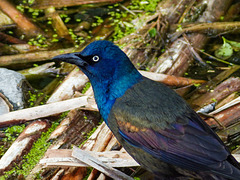
Showing off his colours
| 28 May 2015 |
|
Anyone else feeling totally worn out from trying to make everything work on the new Flickr set-up??? There are still many things that just will not work and I am spending so much more time here than I should be (words no doubt echoed by many people)! If you only post a photo with no description, tags, groups, albums, etc., it probably works OK, but nearly everything I try to do finds a problem. Yesterday, I learned that only a few photos can be seen in any album, instead of the full number - not good! Not sure, but I think this has now been fixed. You might want to just check your albums.
I wish this photo of a Common Grackle had been much sharper, but the light wasn't good where it was. Decided to post it anyway, as the colours of the iridescent feathers are so beautiful.
Yesterday, 27 May 2015, I had a volunteer shift and afterwards, as the sun was shining, I called in at the Reader Rock Garden. There is rain in the forecast for most of the next 12 days, which will drive me crazy, so I thought I'd better make the most of the blue sky while I could. Alberta is bone dry everywhere, with wildfires especially further north. Actually, one was burning near Water Valley the day after my daughter and I were there. So, much as I really dislike the rain, we desperately need it.
From the Garden, I drove through the adjoining Union Cemetery and then another nearby cemetery, and then called in at a wetland in SW Calgary, where I found this Grackle. Normally, I just don't see Grackles, so I'm always happy when I do see one.
"Common Grackles are blackbirds that look like they've been slightly stretched. They're taller and longer tailed than a typical blackbird, with a longer, more tapered bill and glossy-iridescent bodies. Grackles walk around lawns and fields on their long legs or gather in noisy groups high in trees, typically evergreens. They eat many crops (notably corn) and nearly anything else as well, including garbage. In flight their long tails trail behind them, sometimes folded down the middle into a shallow V shape." From AllABoutBirds.
www.allaboutbirds.org/guide/Common_Grackle/id
animals.nationalgeographic.com/animals/birding/common-gra...
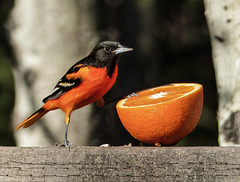
Glorious splash of colour
| 25 May 2015 |
|
|
|
This vibrantly coloured image was taken two mornings ago, on 23 May 2015. See what happens to you if you eat too many oranges, lol? The main focus of the trip we went on was someone's property SW of Calgary, a place that we always call in at when we take part in the May Species Count. The Count isn't held till next weekend, so this visit was an extra one - and extra long, too, which was pure delight! I think we spent something like two hours, watching especially Barb's feeder area for some of the birds that have been showing up. We are always thrilled to bits to see the Evening Grosbeaks and the Baltimore Orioles - the first male Oriole to arrive at Barb's was on 15 May, and this male showed up during our visit. The orange was on top of a fence rail, so this is not a feeder shot : ) I just keep shaking my head over the colour of this bird!
www.allaboutbirds.org/guide/Baltimore_Oriole/lifehistory
Though I'm not keen on feeder photos, I still take them, as well as when the birds are in the nearby trees. The Evening Grosbeaks came often to the feeders, giving us the chance to at least get closer shots. All the bird species were very fast-moving, so gave us a challenge for two hours. The Goldfinch and the Pine Siskins also were quick, but not totally impossible to photograph.
After our time at Barb's, we went to Brown-Lowery Provincial Park, mainly to look for Calypso Orchids, which we did find. Some people continued walking the trails, others returned home. I did part of the walk, but then went back to where the cars were parked and wandered through the forest around the parking lot. Tennessee Warblers sang continuously but were almost impossible to see. I was happy to find one single Coltsfoot plant - love the tight cluster of white flowers at the top of a tall stem.
From Brown-Lowery, we started our journey home, stopping at a couple of wetlands on the way. Even though this was mainly a morning trip, it had started at the meeting place at 7:00 am. Can't remember if it has been three or four nights this week that I have ended up getting only a couple of hours sleep, which really doesn't help!
I will add the list compiled by Andrew Hart, who kindly drove three of us around for the morning and early afternoon and then sent us his list that he submitted to ebird. Many thanks for both the ride and the final list, Andrew!
"Here is the elist of Birds seen at B. Castell's S of Priddis; Plummers & Priddis Valley Rd.; and Brown-Lowery PP, 23May2015. 24 participants
Number of Checklists: 3
Number of Species: 46
Checklists included in this summary:
(1): CA-AB-Priddis. Barb Castell
Date: May 23, 2015, 7:34 AM
(2): CA-Priddis Valley road
Date: May 23, 2015, 9:53 AM
(3): Brown-Lowery Provincial Park
Date: May 23, 2015, 10:28 AM
2 Canada Goose -- (1)
2 American Wigeon -- (1)
1 Mallard -- (1)
3 Blue-winged Teal -- (1)
3 Northern Shoveler -- (1),(2)
3 Green-winged Teal -- (1)
4 Lesser Scaup -- (1)
2 Common Goldeneye -- (1)
1 Swainson's Hawk -- (1)
1 Red-tailed Hawk -- (2)
4 Sora -- (2)
1 Spotted Sandpiper -- (1)
2 Wilson's Snipe -- (1)
7 Wilson's Phalarope -- (2)
1 Mourning Dove -- (1)
1 Rufous Hummingbird -- (1)
1 Red-naped Sapsucker -- (1)
2 Downy Woodpecker -- (1)
1 Hairy Woodpecker -- (1)
2 Least Flycatcher -- (2)
1 Eastern Kingbird -- (2)
1 Blue Jay -- (1)
3 Black-billed Magpie -- (1)
2 American Crow -- (1)
2 Common Raven -- (2)
11 Tree Swallow -- (1),(2)
1 Barn Swallow -- (2)
6 Black-capped Chickadee -- (1),(3)
3 House Wren -- (1),(2)
2 Golden-crowned Kinglet -- (3)
2 Ruby-crowned Kinglet -- (2),(3)
9 Mountain Bluebird -- (1),(2)
6 American Robin -- (1),(2),(3)
4 Tennessee Warbler -- (3)
2 Yellow Warbler -- (1),(2)
8 Clay-colored Sparrow -- (1),(2)
6 Savannah Sparrow -- (1),(2)
1 Lincoln's Sparrow -- (1)
1 White-throated Sparrow -- (1)
1 Dark-eyed Junco -- (3)
23 Red-winged Blackbird -- (1),(2)
3 Brown-headed Cowbird -- (1)
1 Baltimore Oriole -- (1)
17 Pine Siskin -- (1),(3)
5 American Goldfinch -- (1)
5 Evening Grosbeak -- (1),(3)"
Common Grackle / Quiscalus quiscula
| 09 May 2015 |
|
Flickr did not save a description I had just typed here. Just one of the many problems I - and no doubt, many of you - are experiencing this morning, thanks to all the new changes on Flickr. What a mess they have made of something that worked just fine!! Great difficulty or impossible to add tags. When something has been done to one of the photos, I can't get back to my photostream - have to close Flickr and open in a new tab, etc., etc.. When I open my photostream in a new tab, the most recent changes have not always been saved. And all those extra tags that Flickr has added to each photo! The tags "pet" and "dog" were added to my photo of a wild Moose suffering from a bad case of tick damage, lol! I always tag all my photos carefully and, with almost 11,000 images on my photostream, there is no way I could ever go through every photo deleting Flickr's inappropriate extra tags!
A couple of days ago, on 7 May 2015, I joined friends to go on a birding walk at the south end LaFarge Meadows, accessed off 194th Ave. The weather was beautiful, though the temperature was only 7C-11C, and the birds were so far away : ) I did manage to get a distant shot of two of the three Trumpeter Swans (both juveniles) that were near the river. A Bald Eagle flew overhead and a Great Blue Heron flew in the far distance. A little Savannah Sparrow posed in a small tree for us and a Muskrat was seen in the large pond by the river.
The reported list is as follows, though I didn't see many of these birds myself:
1. Canada Goose-15 + two families with young
2. Trumpeter Swan-3 juv.
3. Gadwall-4
4. American Wigeon-40
5. Mallard-30
6. Blue-winged Teal-42
7. Cinnamon Teal-3
8. Northern Shoveler-6
9. Canvasback-6
10. Redhead-1 m
11. Ring-necked Duck-6
12. Common Goldeneye-3
13. Common Merganser-5+
14. Red necked Grebe-3
15. Great Blue Heron-2
16. Osprey-2+
17. Bald Eagle-2ad. (adult on nest feeding young)
18. Sharp-shinned Hawk-2 (1 m/1 f.)
19. Swainson’s Hawk-3+ (includes one dark morph)
20. American Coot-100
21. Killdeer-4
22. GREATER YELLOWLEGS-1
23. SOLITARY SANDPIPER-2
24. SPOTTED SANDPIPER-5
25. Franklin’s Gull-380
26. white-headed gull sp.-1 heard
27. Black-billed Magpie-3
28. American Crow-2
29. Common Raven-3
30. Tree Swallow-20
31. Northern Rough-winged Swallow-1
32. Bank Swallow-1
33. American Robin-2
34. European Starling-1
35. CLAY-COLORED SPARROW-1 heard
36. Savannah Sparrow-15
37. Song Sparrow-3
38. Red-winged Blackbird-6 (5 m/1 f)
After the walk, I decided to call in at a wetland in SW Calgary, hoping that at least a few of the birds would be close enough for photos. I met a delightful, enthusiastic and knowledgeable photographer/birder while I was there, and she showed me the area accessed from a point that I had never tried before. I had hoped to maybe see a Common Grackle at this wetland and, sure enough, this one was down near the water's edge. Just managed to find a gap in the line of trees and shrubs and got this single, lucky shot before the bird flew off. Many people don't like Grackles, but I see them so rarely and I think they are beautiful birds.
"Common Grackles are blackbirds that look like they've been slightly stretched. They're taller and longer tailed than a typical blackbird, with a longer, more tapered bill and glossy-iridescent bodies. Grackles walk around lawns and fields on their long legs or gather in noisy groups high in trees, typically evergreens. They eat many crops (notably corn) and nearly anything else as well, including garbage. In flight their long tails trail behind them, sometimes folded down the middle into a shallow V shape." From AllABoutBirds.
www.allaboutbirds.org/guide/Common_Grackle/id
animals.nationalgeographic.com/animals/birding/common-gra...
WHY PHOTOGRAPHERS GET SUCH A BAD NAME! Shown on The Weather Network.
www.theweathernetwork.com/videos/Gallery/all/video_galler...
Jump to top
RSS feed- Anne Elliott's latest photos with "Family: Icteridae" - Photos
- ipernity © 2007-2026
- Help & Contact
|
Club news
|
About ipernity
|
History |
ipernity Club & Prices |
Guide of good conduct
Donate | Group guidelines | Privacy policy | Terms of use | Statutes | In memoria -
Facebook
X
