

Anne Elliott's photos with the keyword: explore2014September07

Burrowing Owl, after the storm
| 06 Sep 2014 |
|
|
There are 37 images in my Burrowing Owl album, but this photo shows one of the two first and only Burrowing Owls that I have ever been fortunate enough to see in the wild. To say that it was a thrill is an understatement! These endangered owls are tiny and so difficult to see, especially when they are down in the grasses. They are a true delight when, or if, they are seen on a fence post, so that the whole of the bird can be seen, not just a bright yellow eye peering out between the blades of grass. We saw two different individuals, possibly three, and for a brief moment both were perched on very distant fence posts at the same time. Most of the time, though, they were mainly hidden in the grass, so most of my photos tend to be of "eyes". This photo came out so dark, so I had to brighten it. We had called in a second time to see these owls, once the dreadful storm had moved on, though it was still very windy - which is why the head feathers of this owl look wet and dishevelled. Such a great pity that this is an endangered species!
"As a result of its ENDANGERED Species status in 1995, the Burrowing Owl has the focus of a variety of conservation efforts. Operation Burrowing Owl and other projects involving habitat preservation with landowners have been created. Populations are monitored by Fish and Wildlife departments. They have been reintroduced into the British Columbia interior, where it was extirpated. Outlook would improve if larger areas of habitat were preserved and harmful pesticides were banned in all areas of their range. Numbers could increase if an increased tolerance to burrowing mammals develops (i.e. badgers) – provides homes for the Burrowing Owl. Outlook: perilous." From burrowingowl.com.
en.wikipedia.org/wiki/Burrowing_owl
Without the help of two friends (Ron and Joyce) who helped us know where we might find these birds, and friends Cathy and Terry who invited me to go with them on a wonderful three-day trip to Waterton Lakes National Park, I would never have had this amazing sighting. For years, I had longed to see a wild Burrowing Owl, but never thought it would actually happen! Same for Cathy and Terry, so all three of us are SO grateful for the help we received! I'm still on a natural high and I know I will be for some time yet : )
During our three days away, we saw so many things, I hardly know where to start. This always happens when I go anywhere with Cathy and Terry - every day is a very long, fun-filled day, full of exciting finds.
Perhaps I will simply mention some of the things and then add more detail to each photo as I add them to my photostream. Of course, we couldn't have had a more beautiful area to explore! Waterton Lakes National Park has amazing scenery and wildlife. The weather forecast that I saw before we left Calgary said that we were in for three beautiful days of sunshine - too often, it can be rainy weather. So, luck was on our side, giving us warm, sunny days - until the BIG STORM hit, lol! We had driven eastwards from the park, hoping to see Yellow-bellied Marmots and, if we were really lucky, a Burrowing Owl. A few days ago, I posted a photo of the storm that was approaching very fast, around 5:00 p.m. on our third day, just before we started our return trip to Calgary. It was like nothing I had ever seen before - a menacing shelf (?) cloud that was travelling fast and furious. Despite trying our best to get away from it, it eventually engulfed our car, surrounding us with more or less zero visibility, pounding hail, thunder and lightning and extremely strong winds. There was nothing to do but stop the car and sit tight, hoping that the hail would not break the car windows and that this severe thunderstorm would not develop into a tornado! This storm was very scary, but at the same time, exciting (only because all turned out OK in the end!). Our road trip sure went out with a bang! Someone from the Alberta Tornado Watch told me that this particular storm was a Mesocyclone. Thankfully, we were not right in the very centre of it, but it was still a very scary experience.
So, a few of the things we saw on our trip - fantastic scenery, 4 Black Bears (including one that was swimming in the lake), Bison, Deer, Golden-mantled Ground Squirrels, Chipmunks, various bird species including the Burrowing Owls, a few wildflowers, several Yellow-bellied Marmots (a first for me!), a few different insect species, and a family of Dusky Grouse (uncommon in Waterton Lakes National Park). I even got the chance to see three or four new-to-me old, wooden grain elevators.
Cathy and Terry, thanks so much for yet another wonderful trip with you! Can't thank you enough for inviting me along. You always do such a great job of finding so many interesting things for us to see and enjoy. Lots of fun!
flic.kr/p/p69jQ6
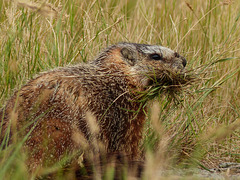
Yellow-bellied Marmot gathering grasses
| 06 Sep 2014 |
|
These Yellow-bellied Marmots were so much fun to watch. This is the "best" shot I took of an adult that was busily collecting grasses to take back to its burrow. Pretty much impossible to get a shot, they move so fast and partly hidden by the long grass. These animals collect and store these grasses both for food and to line their burrows.
"Yellow-bellied marmots usually weigh from 1.6 to 5.2 kilograms (3.5 to 11.5 lb) when fully grown, though males typically weigh more than females. Adult males typically weigh between 3 to 5 kilograms (6.6 to 11.0 lb); females typically weigh between 1.6 to 4 kilograms (3.5 to 8.8 lb). They get fatter in the autumn just before hibernating.
Their territory is about 4 to 7 acres (2 to 3 ha) around a number of summer burrows. Marmots choose to dig burrows under rocks because predators are less likely to see their burrow. Predators include wolves, foxes, coyotes, dogs and eagles.
Yellow-bellied marmots spend about 80% of their life in their burrow, 60% of which is spent hibernating. They often spend mid-day and night in a burrow as well. These burrows are usually constructed on a slope, such as a hill, mountain, or cliff. The hibernation burrows can be up to 5 to 7 metres (16 to 23 ft) deep, but the burrows constructed for daily use are usually only 1 metre (3.3 ft) deep. Their hibernation period varies on elevation, but it is typically from September to May.
Yellow-bellied marmots are diurnal. The marmot is also an omnivore, eating grass, grains, leaves, flowers, legumes, fruit, grasshoppers, and bird eggs." From Wikipedia.
en.wikipedia.org/wiki/Yellow-bellied_marmot
During three days away (26, 27 and 28 August 2014) with friends Cathy and Terry, we saw so many interesting things. This always happens when I go anywhere with them - every day is a very long, fun-filled day, full of exciting finds.
Perhaps I will simply mention some of the things and then add more detail to each photo as I add them to my photostream. Of course, we couldn't have had a more beautiful area to explore! Waterton Lakes National Park has amazing scenery and wildlife. The weather forecast that I saw before we left Calgary said that we were in for three beautiful days of sunshine - too often, it can be rainy weather. So, luck was on our side, giving us warm, sunny days - until the BIG STORM hit! We had driven eastwards from the park, hoping to see Yellow-bellied Marmots and, if we were really lucky, a Burrowing Owl. The storm was approaching very fast, around 5:00 p.m. just before we started our return trip to Calgary. It was like nothing I had ever seen before - a menacing shelf (?) cloud that was travelling fast and furious. Despite trying our best to get away from it, it eventually engulfed our car, surrounding us with more or less zero visibility, pounding hail, thunder and lightning, and very strong winds. There was nothing to do but stop the car and sit tight, hoping that the hail would not break the car windows and that this severe thunderstorm would not develop into a tornado! This storm was very scary, but at the same time, exciting (only because all turned out OK in the end!). Our road trip sure went out with a bang!
A few of the things we saw included fantastic scenery, 4 Black Bears (including one that was swimming in the lake), Bison, Deer (including several that we saw in the town of Waterton, where we stayed for two nights at the clean and friendly Bear Mountain Motel), Golden-mantled Ground Squirrels, Chipmunks, various bird species including the endangered Burrowing Owls, a few wildflowers, several Yellow-bellied Marmots (a first for me!), a few different insect species, and a family of Dusky Grouse that are uncommon to the Waterton Lakes National Park. I even got the chance to see three or four new-to-me old, wooden grain elevators.
Jump to top
RSS feed- Anne Elliott's latest photos with "explore2014September07" - Photos
- ipernity © 2007-2026
- Help & Contact
|
Club news
|
About ipernity
|
History |
ipernity Club & Prices |
Guide of good conduct
Donate | Group guidelines | Privacy policy | Terms of use | Statutes | In memoria -
Facebook
X
