

Anne Elliott's photos with the keyword: Olds
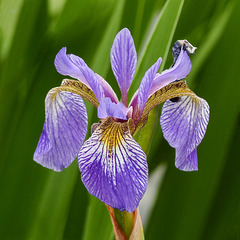
Iris at Olds College Botanical Gardens and Wetland…
| 24 Jun 2016 |
|
On 4 July 2015, it was the Nature Calgary annual bus trip, and last year it was a visit to the Olds College Botanic Gardens and Wetlands. The College is approximately 95.0 km north of Calgary, roughly a 55 minute drive. This once-a-year outing always feels so good for everyone - no driving, simply relaxing on a bus. We had about three hours there, which sounded short, but in fact worked out quite well.
The mission of the College is:
"Our goal is to develop a Botanic Garden on the Olds College campus, which introduces, conserves, and maintains a diverse, well-documented and accurately labeled collection of prairie hardy plants.
Our collections will preserve our natural heritage, expand the role of Olds College as a Centre of Excellence in Horticulture, and gain formal recognition with the Canadian Botanical Conservation Network (CBCN) and the American Public Garden Association (APGA).
Olds College Botanic Garden will enhance and support education, training, demonstration, and applied research programs that span the generations and encourage the exchange of information and ideas with industry, students, other botanical gardens and the public.
The Botanical Garden will also raise awareness with the public regarding the importance of sustainable environments."
About the College:
"Not just a walk down the garden path, the gardens are designed to meet the instructional needs of courses and programs on campus, and are used as the location and subject matter for research projects. The Botanic Gardens are an aesthetically beautiful, diverse and well-maintained garden and constructed wetlands. Highlights include our collections of hardy peonies, lilies and roses, natural areas, a wide variety of aquatics, herb garden, fabulous annual displays each year and much more.
The Gardens are comprised of three phases spread over 25 acres and are populated with a wide ranging collection of prairie hardy plant material, both native and ornamental. The most established parts of the garden are the Central Portion opened in 2002.
The third and most recent phase of our Botanic Gardens is the East Portion which contains the Treatment Wetlands, opened in early September of 2013.
The three phases when considered together include naturalized landscapes, specialty gardens, walking trails, demonstration plots, an arboretum and 20 constructed treatment wetlands and display ponds. The area is complete with two public gazebos, an amphitheater and event areas. The Botanic Gardens & Treatment Wetlands has the ability to host weddings, reunions, graduations, workshops, and boasts 1.3 kilometers of trails throughout the gardens and wetlands.
Botanic gardens are quite different from other public garden spaces or show gardens. To be able to be identified as a botanic garden, several criteria must be met. For example, botanic gardens must:
Be open to the public
1. Exhibit a degree of permanence
2. Use a scientific basis as the foundation for their collections
3. Document and monitor the collection
4. Communicate information to other gardens, institutions and the public
The Botanic Gardens and Treatment Wetlands at Olds College is dedicated to meeting all criteria and continuing to expand its value to the college and extended community."
www.oldscollege.ca/about-us/botanic-gardens/about-us/index
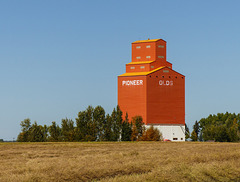
Olds grain elevator, Alberta
| 13 Sep 2015 |
|
Last night, we had rain and this morning has been very overcast and dreary. A splash of bright colour feels good! It's only 10°C this morning and we are supposed to get more rain this afternoon. Yesterday, the temperature got up to around 28°C, but the sun was very harsh and the lighting was not good for most photos.
I'm really hoping that the forecast for rain is correct for the next few days, as I shouldn't drive my vehicle till it has been serviced and fixed. Quite apart from maybe doing more damage to the car, I definitely don't want to find myself stranded somewhere. About 10 days ago, the orange Engine Warning light came on a few times, but since then, it has been OK. Yesterday, it was not a good feeling when the light came on again, far from home! The same thing has happened before and seems to be connected to the way the car keeps jerking when I am stopped at traffic lights. Feels as if the car might stall. It is due for a service, anyway, and it also needs a new control box installed. So, I'm hoping this can be done as soon as possible. Meanwhile, I'll be missing all the gorgeous fall colours : (
Yesterday, 12 September 2015, I drove further than I've ever driven before - a total of 410 km (254 miles). Today, I'm feeling tired out and finding it difficult to get going, so it's taking me ages to just add tags and descriptions, ha.
I met my daughter at 9:00 am and we headed northwards, with our main destination being the Bowden Sunflower Maze. She feels well enough now after her recent hospital stay, to get out for a day trip. The quickest route from Calgary is a distance of 96 km (60 miles), but I needed to avoid the main, busy route. Also, the backroads are more pleasant to drive - less traffic and, if one is lucky, the occasional old barn. There was one barn in particular that I had seen last year, that I really wanted to show my daughter and this took us a little out of our way. We drove through the town of Olds, stopping briefly to take a couple of photos of the bright orange grain elevator. Haven't yet been able to find any information about this Pioneer elevator. Going north, we drove the roads to the west of the main Highway 2, and on our return trip we drove the roads to the east of Highway 2. I think this trip really convinced my daughter, more strongly than ever, that sadly she has a mother with almost zero sense of direction!
This was the first time I had ever been to Bowden and the Sunflower Maze. For years, I had wished we had a field of Sunflowers somewhere within reach, as I had seen so many gorgeous photos taken by other people in various parts of the world. I certainly didn't get photos like those, but I was happy to get the shots I did get. Apparently, this weekend is going to be the last chance to really see the flowers, so we were just in time. This maze at Eagle Creek Farm is apparently the only Sunflower Maze in Canada. There is also an adjoining Corn Maze, but neither of us wanted to walk through that one, thanks to remembering the horror movie, "Children of the Corn"! The farm also has U-pick vegetables and flowers.
www.sunmaze.ca/
Thanks, Rachel, for spending the day with me - and for all your directions getting us there and back to the city! Lucky we went when we did, as it has been raining ever since.
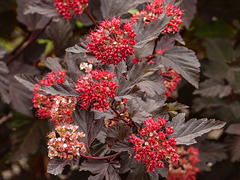
Diabolo Ninebark
| 08 Jul 2015 |
|
"'Diabolo' is a purple-leaved ninebark cultivar. Like the species, it is an upright, spreading, somewhat coarse, deciduous shrub which is closely related to genus Spiraea. It typically grows 4-8' (less frequently to 10') tall. Small pinkish-white, five-petaled flowers in dense, flat, rounded, 1-2" diameter, spirea-like clusters (corymbs) appear in late spring. Flowers give way to drooping clusters of reddish fruit (inflated seed capsules). Ovate to rounded, usually 3-5 lobed leaves (to 4" long) are dark purple. Purple foliage tends to green up in hot summer climates as the summer progresses. Ninebark is named for its exfoliating bark (on mature branches) which peels in strips to reveal several layers of reddish to light brown inner bark. Bark provides winter interest but is usually hidden by the foliage during the growing season."
www.missouribotanicalgarden.org/PlantFinder/PlantFinderDe...
Four days ago, on 4 July 2015, it was the Nature Calgary annual bus trip, and this year it was a visit to the Olds College Botanic Gardens and Wetlands. The College is approximately 95 km north of Calgary, roughly a 55 minute drive. This once-a-year outing always feels so good for everyone - no driving, simply relaxing on a bus. We had about three hours there, which sounded short, but in fact worked out quite well.
The mission of the College is:
"Our goal is to develop a Botanic Garden on the Olds College campus, which introduces, conserves, and maintains a diverse, well-documented and accurately labeled collection of prairie hardy plants.
Our collections will preserve our natural heritage, expand the role of Olds College as a Centre of Excellence in Horticulture, and gain formal recognition with the Canadian Botanical Conservation Network (CBCN) and the American Public Garden Association (APGA).
Olds College Botanic Garden will enhance and support education, training, demonstration, and applied research programs that span the generations and encourage the exchange of information and ideas with industry, students, other botanical gardens and the public.
The Botanical Garden will also raise awareness with the public regarding the importance of sustainable environments."
About the College:
"Not just a walk down the garden path, the gardens are designed to meet the instructional needs of courses and programs on campus, and are used as the location and subject matter for research projects. The Botanic Gardens are an aesthetically beautiful, diverse and well-maintained garden and constructed wetlands. Highlights include our collections of hardy peonies, lilies and roses, natural areas, a wide variety of aquatics, herb garden, fabulous annual displays each year and much more.
The Gardens are comprised of three phases spread over 25 acres and are populated with a wide ranging collection of prairie hardy plant material, both native and ornamental. The most established parts of the garden are the Central Portion opened in 2002.
The third and most recent phase of our Botanic Gardens is the East Portion which contains the Treatment Wetlands, opened in early September of 2013.
The three phases when considered together include naturalized landscapes, specialty gardens, walking trails, demonstration plots, an arboretum and 20 constructed treatment wetlands and display ponds. The area is complete with two public gazebos, an amphitheater and event areas. The Botanic Gardens & Treatment Wetlands has the ability to host weddings, reunions, graduations, workshops, and boasts 1.3 kilometers of trails throughout the gardens and wetlands.
Botanic gardens are quite different from other public garden spaces or show gardens. To be able to be identified as a botanic garden, several criteria must be met. For example, botanic gardens must:
Be open to the public
1. Exhibit a degree of permanence
2. Use a scientific basis as the foundation for their collections
3. Document and monitor the collection
4. Communicate information to other gardens, institutions and the public
The Botanic Gardens and Treatment Wetlands at Olds College is dedicated to meeting all criteria and continuing to expand its value to the college and extended community."
www.oldscollege.ca/about-us/botanic-gardens/about-us/index
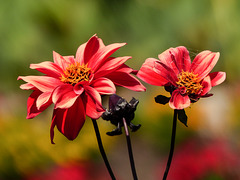
Summer colour
| 06 Jul 2015 |
|
Two days ago, on 4 July 2015, it was the Nature Calgary annual bus trip, and this year it was a visit to the Olds College Botanic Gardens and Wetlands. The College is approximately 95 km north of Calgary, roughly a 55 minute drive. This once-a-year outing always feels so good for everyone - no driving, simply relaxing on a bus. We had about three hours there, which sounded short, but in fact worked out quite well.
The mission of the College is:
"Our goal is to develop a Botanic Garden on the Olds College campus, which introduces, conserves, and maintains a diverse, well-documented and accurately labeled collection of prairie hardy plants.
Our collections will preserve our natural heritage, expand the role of Olds College as a Centre of Excellence in Horticulture, and gain formal recognition with the Canadian Botanical Conservation Network (CBCN) and the American Public Garden Association (APGA).
Olds College Botanic Garden will enhance and support education, training, demonstration, and applied research programs that span the generations and encourage the exchange of information and ideas with industry, students, other botanical gardens and the public.
The Botanical Garden will also raise awareness with the public regarding the importance of sustainable environments."
About the College:
"Not just a walk down the garden path, the gardens are designed to meet the instructional needs of courses and programs on campus, and are used as the location and subject matter for research projects. The Botanic Gardens are an aesthetically beautiful, diverse and well-maintained garden and constructed wetlands. Highlights include our collections of hardy peonies, lilies and roses, natural areas, a wide variety of aquatics, herb garden, fabulous annual displays each year and much more.
The Gardens are comprised of three phases spread over 25 acres and are populated with a wide ranging collection of prairie hardy plant material, both native and ornamental. The most established parts of the garden are the Central Portion opened in 2002.
The third and most recent phase of our Botanic Gardens is the East Portion which contains the Treatment Wetlands, opened in early September of 2013.
The three phases when considered together include naturalized landscapes, specialty gardens, walking trails, demonstration plots, an arboretum and 20 constructed treatment wetlands and display ponds. The area is complete with two public gazebos, an amphitheater and event areas. The Botanic Gardens & Treatment Wetlands has the ability to host weddings, reunions, graduations, workshops, and boasts 1.3 kilometers of trails throughout the gardens and wetlands.
Botanic gardens are quite different from other public garden spaces or show gardens. To be able to be identified as a botanic garden, several criteria must be met. For example, botanic gardens must:
Be open to the public
1. Exhibit a degree of permanence
2. Use a scientific basis as the foundation for their collections
3. Document and monitor the collection
4. Communicate information to other gardens, institutions and the public
The Botanic Gardens and Treatment Wetlands at Olds College is dedicated to meeting all criteria and continuing to expand its value to the college and extended community."
www.oldscollege.ca/about-us/botanic-gardens/about-us/index
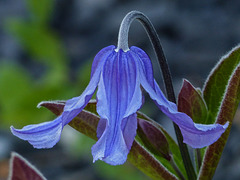
Clematis integrifolia
| 05 Jul 2015 |
|
For the second day in a row, I missed some dramatic weather in Calgary because I was out on day trips N and NW of the city! The following link was from yesterday's hailstorm and flash flooding! For us, the rain only started when we had finished our trip to Olds and had just got back on to our bus. Great timing.
www.theweathernetwork.com/videos/Gallery/all/video_galler...
www.cbc.ca/player//ID/2671122665/
This macro shot shows a Clematis flower, but I'm not 100% sure if it is Clematis integrifolia. Also, my camera couldn't capture exactly the right shade of blue. These flowers, however, are beautiful.
Yesterday, 4 July 2015, was the Nature Calgary annual bus trip, and this year it was a visit to the Olds College Botanic Gardens and Wetlands. The College is approximately 95.0 km north of Calgary, roughly a 55 minute drive. This once-a-year outing always feels so good for everyone - no driving, simply relaxing on a bus. We had about three hours there, which sounded short, but in fact worked out quite well.
The mission of the College is:
"Our goal is to develop a Botanic Garden on the Olds College campus, which introduces, conserves, and maintains a diverse, well-documented and accurately labeled collection of prairie hardy plants.
Our collections will preserve our natural heritage, expand the role of Olds College as a Centre of Excellence in Horticulture, and gain formal recognition with the Canadian Botanical Conservation Network (CBCN) and the American Public Garden Association (APGA).
Olds College Botanic Garden will enhance and support education, training, demonstration, and applied research programs that span the generations and encourage the exchange of information and ideas with industry, students, other botanical gardens and the public.
The Botanical Garden will also raise awareness with the public regarding the importance of sustainable environments."
About the College:
"Not just a walk down the garden path, the gardens are designed to meet the instructional needs of courses and programs on campus, and are used as the location and subject matter for research projects. The Botanic Gardens are an aesthetically beautiful, diverse and well-maintained garden and constructed wetlands. Highlights include our collections of hardy peonies, lilies and roses, natural areas, a wide variety of aquatics, herb garden, fabulous annual displays each year and much more.
The Gardens are comprised of three phases spread over 25 acres and are populated with a wide ranging collection of prairie hardy plant material, both native and ornamental. The most established parts of the garden are the Central Portion opened in 2002.
The third and most recent phase of our Botanic Gardens is the East Portion which contains the Treatment Wetlands, opened in early September of 2013.
The three phases when considered together include naturalized landscapes, specialty gardens, walking trails, demonstration plots, an arboretum and 20 constructed treatment wetlands and display ponds. The area is complete with two public gazebos, an amphitheater and event areas. The Botanic Gardens & Treatment Wetlands has the ability to host weddings, reunions, graduations, workshops, and boasts 1.3 kilometers of trails throughout the gardens and wetlands.
Botanic gardens are quite different from other public garden spaces or show gardens. To be able to be identified as a botanic garden, several criteria must be met. For example, botanic gardens must:
Be open to the public
1. Exhibit a degree of permanence
2. Use a scientific basis as the foundation for their collections
3. Document and monitor the collection
4. Communicate information to other gardens, institutions and the public
The Botanic Gardens and Treatment Wetlands at Olds College is dedicated to meeting all criteria and continuing to expand its value to the college and extended community."
www.oldscollege.ca/about-us/botanic-gardens/about-us/index
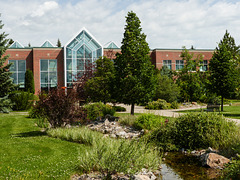
Olds College Botanic Gardens and Wetlands
| 05 Jul 2015 |
|
Yesterday, 4 July 2015, was the Nature Calgary annual bus trip, and this year it was a visit to the Olds College Botanic Gardens and Wetlands. The College is approximately 95.0 km north of Calgary, roughly a 55 minute drive. This once-a-year outing always feels so good for everyone - no driving, simply relaxing on a bus. We had about three hours there, which sounded short, but in fact worked out quite well.
The mission of the College is:
"Our goal is to develop a Botanic Garden on the Olds College campus, which introduces, conserves, and maintains a diverse, well-documented and accurately labeled collection of prairie hardy plants.
Our collections will preserve our natural heritage, expand the role of Olds College as a Centre of Excellence in Horticulture, and gain formal recognition with the Canadian Botanical Conservation Network (CBCN) and the American Public Garden Association (APGA).
Olds College Botanic Garden will enhance and support education, training, demonstration, and applied research programs that span the generations and encourage the exchange of information and ideas with industry, students, other botanical gardens and the public.
The Botanical Garden will also raise awareness with the public regarding the importance of sustainable environments."
About the College:
"Not just a walk down the garden path, the gardens are designed to meet the instructional needs of courses and programs on campus, and are used as the location and subject matter for research projects. The Botanic Gardens are an aesthetically beautiful, diverse and well-maintained garden and constructed wetlands. Highlights include our collections of hardy peonies, lilies and roses, natural areas, a wide variety of aquatics, herb garden, fabulous annual displays each year and much more.
The Gardens are comprised of three phases spread over 25 acres and are populated with a wide ranging collection of prairie hardy plant material, both native and ornamental. The most established parts of the garden are the Central Portion opened in 2002.
The third and most recent phase of our Botanic Gardens is the East Portion which contains the Treatment Wetlands, opened in early September of 2013.
The three phases when considered together include naturalized landscapes, specialty gardens, walking trails, demonstration plots, an arboretum and 20 constructed treatment wetlands and display ponds. The area is complete with two public gazebos, an amphitheater and event areas. The Botanic Gardens & Treatment Wetlands has the ability to host weddings, reunions, graduations, workshops, and boasts 1.3 kilometers of trails throughout the gardens and wetlands.
Botanic gardens are quite different from other public garden spaces or show gardens. To be able to be identified as a botanic garden, several criteria must be met. For example, botanic gardens must:
Be open to the public
1. Exhibit a degree of permanence
2. Use a scientific basis as the foundation for their collections
3. Document and monitor the collection
4. Communicate information to other gardens, institutions and the public
The Botanic Gardens and Treatment Wetlands at Olds College is dedicated to meeting all criteria and continuing to expand its value to the college and extended community."
www.oldscollege.ca/about-us/botanic-gardens/about-us/index
Jump to top
RSS feed- Anne Elliott's latest photos with "Olds" - Photos
- ipernity © 2007-2025
- Help & Contact
|
Club news
|
About ipernity
|
History |
ipernity Club & Prices |
Guide of good conduct
Donate | Group guidelines | Privacy policy | Terms of use | Statutes | In memoria -
Facebook
X
