

Anne Elliott's photos with the keyword: rain
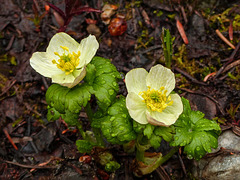
Wildflowers at Peyto Lake
| 06 Jul 2018 |
|
|
|
Are these White Globe Flowers / Trollius albiflorus laxus? I thought they had more petals.
On 23 June 2018, I had the wonderful chance to return to two of my favourite places in the mountains - Bow Lake and Peyto Lake. This was thanks to the annual Bus Trip for Nature Calgary, with each year being to a different location in Alberta. These two Lakes are too far for me to drive (roughly two and a half hours), but mainly because they are way out of my driving comfort zone. I think I have only ever been to Peyto Lake twice before, the first time being something like 38 years ago, and the second time being in August 2013. Almost 40 years ago, I fell in love with Bow Lake, my absolute favourite place. I have been lucky enough to visit it a handful of times in recent years.
Unfortunately, we couldn't capture the beautiful, really deep turquoise colour that Peyto lake is so well known for. Too many low clouds and an overcast, damp day, but you can still see the beauty of this lake and its gorgeous surroundings. The forecast that I had seen for this whole area had been for snow-rain showers, with a high temperature of 12C and a low of 1C. Though the day started off with rain, we were lucky that we only had a few raindrops while we were out walking. It was really dreary weather, though, which was not good as far as photography was concerned.
Our first stop was at Peyto Lake, where we walked the short distance to the wooden Lookout deck. From there, we hiked a loop through the forest, finding a few wildflowers and some beautiful Orange Peel Fungus. On the way back to the Lookout, you really need to be very careful to take a path that leads back to the correct parking lot! The last few people took the wrong path and ended up waiting for a bus that never came for them. So easily done. They were eventually found, but after a long delay.
"Peyto Lake (pea-toe) is a glacier-fed lake located in Banff National Park in the Canadian Rockies. The lake itself is easily accessed from the Icefields Parkway. It was named for Ebenezer William Peyto, an early trail guide and trapper in the Banff area. The lake is formed in a valley of the Waputik Range, between Caldron Peak, Peyto Peak and Mount Jimmy Simpson, at an elevation of 1,860 m (6,100 ft). During the summer, significant amounts of glacial rock flour flow into the lake, and these suspended rock particles give the lake a bright, turquoise color. Because of its bright color, photos of the lake often appear in illustrated books, and area around the lake is a popular sightseeing spot for tourists in the park. The lake is best seen from Bow Summit, the highest point on the Icefield Parkway. The lake is fed by the Peyto Creek, which drains water from the Caldron Lake and Peyto Glacier (part of the Wapta Icefield), and flows into the Mistaya River."
wikimapia.org/655560/Peyto-lake
From Peyto Lake, we drove to the nearby Bow Lake, which just takes my breath away. I had told a couple of friends how beautiful it is, but that the best kind of day to visit is a sunny day with absolutely calm lake water so that reflections are seen. Well, that was definitely not the kind of day we had, but one makes the best of what one gets. We spent time there, walking part way along the edge of the lake, looking for any bird and wildflower species, and simply soaking up the amazing beauty of our surroundings.
www.travelalberta.com/ca/listings/bow-lake-1997/
On the way back to Calgary, we were very lucky to notice a handful of cars that had pulled over on the side of the road. This always makes one wonder if a bear has been sighted. Sure enough, our bus driver slowed down and stopped for a short while to allow us to take a few photos. After a few minutes, I heard our organizer tell someone (or more than one person) to stop using flash, as it was stressing out the bear. Tell me, just WHY would anyone think it was OK to use flash on a wild animal that was just a few feet away from our bus!!! An animal that was busy feeding on dandelions and had been taking no notice of us. So maddening when photographers don't have respect for wildlife and just don't think! I happened to be sitting on the 'wrong' side of the bus and had two or three rows of people who were sitting or standing up, all trying to get their shots in between the people in front of them. So, my photos are not good, but serve as a record of having had the privilege of seeing such a beautiful creature.
A final, short stop on the way home was near Castle Mountain, which is a very impressive sight. It also has an interesting history, which I will add when I eventually post a photo taken there.
Many thanks, Penny, for organizing our trip to such perfect places! I know a huge amount of work goes into making all the plans - thanks, too, to John for helping out with this. A very successful and most enjoyable outing. Shirley and Pam - I greatly appreciated your driving to meeting places here in the city!
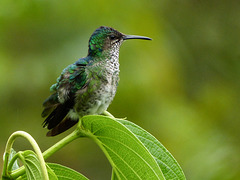
On a rainy day in Trinidad
| 18 Apr 2018 |
|
|
|
So many things not working (for me, anyway) on Flickr this morning!
Quickly editing and posting my "daily three", after getting up late. As mentioned yesterday, my daughter went in for major surgery yesterday morning, and it was a huge relief when I was able to go and visit her in the evening. This was thanks to friends, Mary-Jane and Bud, who so kindly said that they would drive me across the city if my daughter was up to having a visitor and if I wished to go. I was so very grateful, as it was a huge relief to go and to see that my daughter was OK. Now comes a long healing process, starting with six weeks off work. SO thankful this all turned out OK.
Ha, ha, while I was posting these photos and starting on the descriptions, I had totally forgotten about the MOUSE in my HOUSE! I haven't been downstairs yet, so have to go and bravely face the unknown - is it still in my home and, if so, where is it and will it suddenly come running out across the floor, making me give out a loud scream?! Also, is it a mouse or something like a Meadow Vole (which don't normally go inside)? To me, it looked "huge" when it frightened the life out of me two days ago.
After more than a year, I have forgotten which Hummingbird is which. However, I think this might be a female White-necked Jacobin, perched in the rain. Taken at the Asa Wright Nature Centre on the island of Trinidad, on 20 March 2017. This Centre covers nearly 1,500 acres of mainly forested land in the Arima and Aripo Valleys of the Northern Range.
This adventure was only the second holiday of any kind, anywhere, that I have had in something like 30 or 35 years! The other holiday was a wonderful, one-week trip with my dear friends from England, Linda and Tony, when we went down south to Yellowstone National Park and the Grand Tetons in September 2012. I have had maybe half a dozen weekends away, including to Waterton National Park, which have helped keep me going.
Six birding/photographer friends and I decided that we would take this exciting trip together (from 12-21 March 2017), spending the first two or three days on the island of Tobago and then the rest of the time at the Asa Wright Nature Centre on the nearby, much larger island of Trinidad. We decided to take a complete package, so everything was included - accommodation at both places, all our food, and the various walks and day trips that we could choose from. Two of my friends, Anne B. and Brenda, saw to all the planning of flights and accommodations, which was so very much appreciated by the rest of us. I could never have done all this myself! We were so lucky with our flights, as we were just in time to get Black Friday prices, which were 50% off!
What a time we had, seeing so many beautiful and interesting things - and, of course, everything was a lifer for me. Some of these friends had visited Costa Rica before, so I think were familiar with some of the birds. There was a lot more to see on Trinidad, so we were glad that we chose Tobago to visit first and then spend a longer time at Asa Wright. It was wonderful to be right by the sea, though, at the Blue Waters Inn on the island of Tobago. Just gorgeous.
The Asa Wright Nature Centre, on Trinidad, is such an amazing place! We stayed in cabins up or down hill from the main building. Really, one doesn't need to travel away from the Centre for birding, as so many different species visit the Hummingbird feeders that are right by the huge, open veranda, and the trees of the rain forest high up the mountainous road. The drive up and down this narrow, twisting, pot-holed road was an adventure in itself! Never would I ever do this drive myself - we had a guide who drove us everywhere in a minibus. I had read many accounts of this road, lol! There was enough room for two vehicles to pass each other, and the honking of horns was almost continuous - either to warn any vehicle that might be coming fast around the next bend or as a sign that drivers knew each other. The drive along this road, from the coast to Asa Wright, took just over an hour each way.
I still miss the great food that was provided every single day at Asa Wright and even the Rum Punch that appeared each evening. I never drink at all, so I wasn't sure if I would even try the Punch - glad I did, though, as it was delicious and refreshing. Breakfast, lunch and dinner were all served buffet-style, with a great variety of dishes from which to choose. To me, pure luxury. So very, very grateful to have been invited to be part of this amazing adventure.
This is a video that I came across on YouTube, taken by Rigdon Currie and Trish Johnson, at many of the same places we visited on Trinidad and Tobago. Not my video, but it made me feel like I was right there still. Posting the link here again, so that I won't lose it.
youtu.be/BBifhf99f_M
I also came across the following 27-minute YouTube video of the flora and fauna of Trinidad, filmed by John Patrick Smith in February 2015.
youtu.be/6HHBm9MIxnk
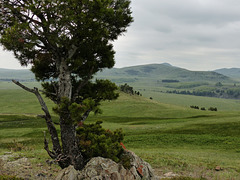
Rolling hills from the Whaleback
| 08 Mar 2018 |
|
|
|
International Women's Day today, 8 March 2018. Yay for Women!
All three photos posted today were taken on 29 May 2015, on a trip way down in southern Alberta. A small group of us spent the day at the Whaleback, climbing the ridges, doing a species count. We had such a great day, finding all sorts of things of interest - plants, mosses, lichens - and in my case, insects, animals and birds, too : ) In fact, anything and everything, lol.
The weather was good for walking, not too warm and, up till the last part, dry. We were so lucky that the rain stayed away for most of the day. When I went on this outing in May 2013, it rained all day, though I still managed to get plenty of photos. On 29 May 2015, it was overcast with low cloud, making scenic shots rather unpleasant.
Just before taking the turn for the road leading to a place to park, we stopped at a spot down by the river and did a search there. I was thrilled to bits to find three or four Tent Caterpillars on a plant next to a large rock and thought what a way to start the day. After taking a few photos, I walked to the other side of the rock and noticed what almost looked like a circular patch of lichen growing on the rock surface. A closer look revealed a mass of dozens of these writhing caterpillars, with several others climbing up in single file to join the rest. Still makes me itch all over, just thinking about it, lol!
Another highlight of the day for me was when I happened to notice a tiny spot of bright red deep inside a distant Early Yellow Locoweed flower. I zoomed in for a photo and thought it looked like it might be a Ladybug. Couldn't count the spots properly, so I very gently parted the petals to get a better look. Unfortunately, it crawled on to my hand and wouldn't return to a petal until after I had taken two or three shots, and then it immediately moved out of sight. I was so happy to find that it was a different kind of Ladybug, though I had seen one a few years ago - it was a Convergent Ladybug.
Part way through the day, I stayed behind while the rest of the group climbed to a higher ridge, and I explored the lower ground. It was a place where I knew I wouldn't get lost - but I did have to wait till at least some of the others returned a few hours later, as others were needed to create an opening to climb though the barbed-wire fence again. I found plenty to photograph and it was quite a feeling to be so high up with such an amazing view all around, and to be alone up there. While I sat to eat lunch on a rocky outcrop with a couple of trees, a tiny Sparrow (of some kind) came to visit a couple of times and sing for me. Also, there were maybe half a dozen Brewer's Blackbirds that stayed around the area for much of the time, flying or perched on low bushes. A truly magical time.
The rest of the group had a great time, too, and saw Parry's Townsendia flowers and lots of Balsamroot in bloom. Fortunately, I had seen the Townsendia before on a brutal hike to Picklejar Lakes several years ago. Two years before, I had also seen hillsides at the Whaleback covered in the bright yellow Balsamroot flowers. I did manage to find several plants huddled together lower down, so was happy to get a few photos of these bright and cheery flowers.
Altogether, a wonderful day in an incredibly beautiful place with great company! Many thanks, Robin and Cedric, for giving me a ride there and back - appreciated it SO much!
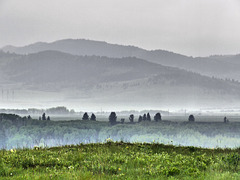
A scene in the Whaleback area
| 07 Mar 2018 |
|
|
|
All three photos posted today were taken on 29 May 2015, on a trip way down in southern Alberta. A small group of us spent the day at the Whaleback, climbing the ridges, doing a species count. We had such a great day, finding all sorts of things of interest - plants, mosses, lichens - and in my case, insects, animals and birds, too : ) In fact, anything and everything, lol.
The weather was good for walking, not too warm and, up till the last part, dry. We were so lucky that the rain stayed away for most of the day. When I went on this outing in May 2013, it rained all day, though I still managed to get plenty of photos. On 29 May 2015, it was overcast with low cloud, making scenic shots rather unpleasant, so I took this shot using a different setting in my camera.
Just before taking the turn for the road leading to a place to park, we stopped at a spot down by the river and did a search there. I was thrilled to bits to find three or four Tent Caterpillars on a plant next to a large rock and thought what a way to start the day. After taking a few photos, I walked to the other side of the rock and noticed what almost looked like a circular patch of lichen growing on the rock surface. A closer look revealed a mass of dozens of these caterpillars, with several others climbing up in single file to join the rest. Still makes me itch all over, just thinking about it, lol!
Another highlight of the day for me was when I happened to notice a tiny spot of bright red deep inside a distant Early Yellow Locoweed flower. I zoomed in for a photo and thought it looked like it might be a Ladybug. Couldn't count the spots properly, so I very gently parted the petals to get a better look. Unfortunately, it crawled on to my hand and wouldn't return to a petal until after I had taken two or three shots, and then it immediately moved out of sight. I was so happy to find that it was a different kind of Ladybug, though I had seen one a few years ago - it was a Convergent Ladybug.
Part way through the day, I stayed behind while the rest of the group climbed to a higher ridge, and I explored the lower ground. It was a place where I knew I wouldn't get lost - but I did have to wait till at least some of the others returned a few hours later, as others were needed to create an opening to climb though the barbed-wire fence again : ) I found plenty to photograph and it was quite a feeling to be so high up with such an amazing view all around, and to be alone up there. While I sat to eat lunch on a rocky outcrop with a couple of trees, a tiny Sparrow (of some kind) came to visit a couple of times and sing for me. Also, there were maybe half a dozen Brewer's Blackbirds that stayed around the area for much of the time, flying or perched on low bushes. A truly magical time.
The rest of the group had a great time, too, and saw Parry's Townsendia flowers and lots of Balsamroot in bloom. Fortunately, I had seen the Townsendia before on a brutal hike to Picklejar Lakes several years ago. Two years ago, I had also seen hillsides at the Whaleback covered in the bright yellow Balsamroot flowers. I did manage to find several plants huddled together lower down, so was happy to get a few photos of these bright and cheery flowers.
Altogether, a wonderful day in an incredibly beautiful place with great company! Many thanks, Robin and Cedric, for giving me a ride there and back - appreciated it SO much!
Shaking off the raindrops
| 11 Feb 2018 |
|
|
|
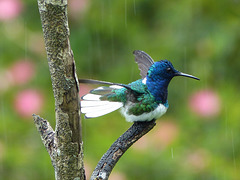
This was just one of several species of Hummingbird that my friends and I were lucky enough to see on our trip to Trinidad & Tobago. Though this species is found on both islands, this one was photographed on 16 March 2017, at the Asa Wright Nature Centre, high up in the mountains on Trinidad. This was our first day on Trinidad - and it was raining when I took this photo.
"The white-necked jacobin (Florisuga mellivora) is a large and attractive hummingbird that ranges from Mexico, south to Peru, Bolivia and south Brazil. It is also found on Tobago (sub-species F. m. flabellifera) and in Trinidad (sub-species F. m. mellivora)
Other common names are great jacobin and collared hummingbird.
The white-necked jacobin is a widespread inhabitant of forest, usually being seen at a high perch or just above the canopy. It is less common at lower levels, except near hummingbird feeders.
The approximately 12 cm long male white-necked jacobin is unmistakable with its white belly and tail, a white band on the nape and a dark blue hood. Immature males have less white in the tail and a conspicuous rufous patch in the malar region. Females are highly variable, and may resemble adult or immature males, have green upperparts, white belly, white-scaled green or blue throat, and white-scaled dark blue crissum (the area around the cloaca), or be intermediate between the aforementioned plumages, though retain the white-scaled dark blue crissum. Females are potentially confusing, but the pattern on the crissum is distinctive and not shared by superficially similar species.
These birds usually visit flowers of tall trees and epiphytes for nectar, and also hawk for insects." From Wikipedia.
en.wikipedia.org/wiki/White-necked_jacobin
This adventure was only the second holiday of any kind, anywhere, that I have had in something like 30 or 35 years! The other holiday was a wonderful, one-week trip with my dear friends from England, Linda and Tony, when we went down south to Yellowstone National Park and the Grand Tetons in September 2012. I have had maybe half a dozen weekends away, including to Waterton National Park, which have helped keep me going.
Six birding/photographer friends and I decided that we would take this exciting trip together (from 12-21 March 2017), spending the first two or three days on the island of Tobago and then the rest of the time at the Asa Wright Nature Centre on the nearby, much larger island of Trinidad. We decided to take a complete package, so everything was included - accommodation at both places, all our food, and the various walks and day trips that we could choose from. Two of my friends, Anne B. and Brenda, saw to all the planning of flights and accommodations, which was so very much appreciated by the rest of us. I could never have done all this myself! We were so lucky with our flights, as we were just in time to get Black Friday prices, which were 50% off!
What a time we had, seeing so many beautiful and interesting things - and, of course, everything was a lifer for me. Some of these friends had visited Costa Rica before, so were familiar with some of the birds. There was a lot more to see on Trinidad, so we were glad that we chose Tobago to visit first and then spend a longer time at Asa Wright. It was wonderful to be right by the sea, though, at the Blue Waters Inn on the island of Tobago. Just gorgeous.
The Asa Wright Nature Centre, on Trinidad, is such an amazing place! We stayed in cabins up or down hill from the main building. Really, one doesn't need to travel away from the Centre for birding, as so many different species visit the Hummingbird feeders that are right by the huge, open veranda, and the trees of the rain forest high up the mountainous road. The drive up and down this narrow, twisting, pot-holed road was an adventure in itself! Never would I ever do this drive myself - we had a guide who drove us everywhere in a minibus. I had read many accounts of this road, lol! There was enough room for two vehicles to pass each other, and the honking of horns was almost continuous - either to warn any vehicle that might be coming fast around the next bend or as a sign that drivers knew each other. The drive along this road, from the coast to Asa Wright, took just over an hour each way.
I still miss the great food that was provided every single day at Asa Wright and even the Rum Punch that appeared each evening. I never drink at all, so I wasn't sure if I would even try the Punch - glad I did, though, as it was delicious and refreshing. Breakfast, lunch and dinner were all served buffet-style, with a great variety of dishes from which to choose. To me, pure luxury. So very, very grateful to have been invited to be part of this amazing adventure.
This is a video that I came across on YouTube, taken by Rigdon Currie and Trish Johnson, at many of the same places we visited on Trinidad and Tobago. Not my video, but it made me feel like I was right there still. Posting the link here again, so that I won't lose it.
youtu.be/BBifhf99f_M
I also came across the following 27-minute YouTube video of the flora and fauna of Trinidad, filmed by John Patrick Smith in February 2015.
youtu.be/6HHBm9MIxnk
White-lined Tanager male / Tachyphonus rufus, Trin…
| 02 Feb 2018 |
|
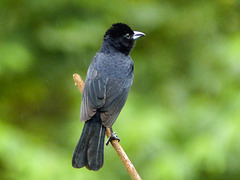
I think I have the correct ID for this bird, seen on 20 March 2017, at the Asa Wright Nature Centre, Trinidad. If I am wrong, please let me know - thanks. Taken in low light and rain.
"The white-lined tanager (Tachyphonus rufus) is a medium-sized passerine bird. This tanager is a resident breeder from Costa Rica south to northern Argentina, and on Trinidad and Tobago. It occurs in semi-open areas including gardens.
The adult male is glossy black, apart from white underwing coverts and a small white patch on the upperwing. These white areas are conspicuous in flight but otherwise rarely visible. Females and immatures are entirely rufous in plumage, somewhat paler below." From Wikipedia.
en.wikipedia.org/wiki/White-lined_tanager
This morning, 2 February 2018, I have posted seven photos taken at the Caroni Swamp on the island of Trinidad, that won't be of too much interest to anyone, but I wanted to add them to my Trinidad albums. Last of all, I thought I would add this bird photo to remind myself that I do, in fact, take bird photos - when I get the chance! Tomorrow, I will post a few distant shots of birds seen at the Caroni Swamp, including the breathtaking Scarlet Ibis. No close shots as boats have to stay at the far side of a huge lake in order to leave the birds in peace. However, the colour alone is enough to leave one in awe.
This adventure was only the second holiday of any kind, anywhere, that I have had in something like 30 or 35 years! The other holiday was a wonderful, one-week trip with my dear friends from England, Linda and Tony, when we went down south to Yellowstone National Park and the Grand Tetons in September 2012. I have had maybe half a dozen weekends away, including to Waterton National Park, which have helped keep me going.
Six birding/photographer friends and I decided that we would take this exciting trip together (from 12-21 March 2017), spending the first two or three days on the island of Tobago and then the rest of the time at the Asa Wright Nature Centre on the nearby, much larger island of Trinidad. We decided to take a complete package, so everything was included - accommodation at both places, all our food, and the various walks and day trips that we could choose from. Two of my friends, Anne B. and Brenda, saw to all the planning of flights and accommodations, which was so very much appreciated by the rest of us. I could never have done all this myself! We were so lucky with our flights, as we were just in time to get Black Friday prices, which were 50% off!
What a time we had, seeing so many beautiful and interesting things - and, of course, everything was a lifer for me. Some of these friends had visited Costa Rica before, so were familiar with some of the birds. There was a lot more to see on Trinidad, so we were glad that we chose Tobago to visit first and then spend a longer time at Asa Wright. It was wonderful to be right by the sea, though, at the Blue Waters Inn on the island of Tobago. Just gorgeous.
The Asa Wright Nature Centre, on Trinidad, is such an amazing place! We stayed in cabins up or down hill from the main building. Really, one doesn't need to travel away from the Centre for birding, as so many different species visit the Hummingbird feeders that are right by the huge, open veranda, and the trees of the rain forest high up the mountainous road. The drive up and down this narrow, twisting, pot-holed road was an adventure in itself! Never would I ever do this drive myself - we had a guide who drove us everywhere in a minibus. I had read many accounts of this road, lol! There was enough room for two vehicles to pass each other, and the honking of horns was almost continuous - either to warn any vehicle that might be coming fast around the next bend or as a sign that drivers knew each other. The drive along this road, from the coast to Asa Wright, took just over an hour each way.
I still miss the great food that was provided every single day at Asa Wright and even the Rum Punch that appeared each evening. I never drink at all, so I wasn't sure if I would even try the Punch - glad I did, though, as it was delicious and refreshing. Breakfast, lunch and dinner were all served buffet-style, with a great variety of dishes from which to choose. To me, pure luxury. So very, very grateful to have been invited to be part of this amazing adventure.
This is a video that I came across on YouTube, taken by Rigdon Currie and Trish Johnson, at many of the same places we visited on Trinidad and Tobago. Not my video, but it made me feel like I was right there still. Posting the link here again, so that I won't lose it.
youtu.be/BBifhf99f_M
I also came across the following 27-minute YouTube video of the flora and fauna of Trinidad, filmed by John Patrick Smith in February 2015.
youtu.be/6HHBm9MIxnk
Silver-beaked Tanager female, Trinidad
| 06 Jan 2018 |
|
|
|
HELP is needed to find the two amazing men who stopped (in brutal, -30C weather) to help save the life of one of our birder/photographer friends, who was in a very serious vehicle accident. Mike (Mike Kelly on Flickr), who is in hospital with a broken jaw, broken wrist, and two broken legs, really, really wants to meet his two rescuers so that he can thank them in person for saving his life. Everyone is using the social media on Facebook in an attempt to find these two good Samaritans, and I thought I would add it here, too, in the hope that someone out there might just know the hoped-for information. It would mean so much to Mike! His many friends would be so happy, too. I will add the link to today's Global TV News article. Of course, it is possible that the two rescuers might see the News today and hopefully come forward. Mike thinks that one of them might live in British Columbia, the province to the west of us.
globalnews.ca/news/3949198/calgarian-who-barely-survived-...
***********************************************************************************************
Yet again, there is something very wrong with Stats, yesterday and today! Overnight, there was basically no activity.
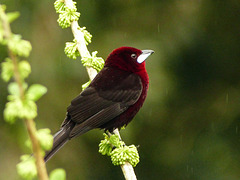
"The Silver-beaked Tanager is a common resident of bushy forest margins and secondary forest across the Amazon basin from Venezuela south to Northern Paraguay. Male Silver-beaked Tanagers are stunningly colored birds with velvety blackish-crimson heads and underparts, darker blackish-crimson upperparts and a bill that is black above and shining silvery white below. Females are a dull dark reddish brown with a brighter red rump. In poor light, these tanagers appear all dark with a white bill. Silver-beaked Tanagers travel in noisy bands of 4 to 10 individuals in the undergrowth along forest borders. As Silver-beaked Tanagers forage for fruit and insects, they hop rapidly and heavily through foliage often nervously flicking their tales and wings." From Cornell's Neotropical Birds.
neotropical.birds.cornell.edu/Species-Account/nb/species/...
This adventure was only the second holiday of any kind, anywhere, that I have had in something like 30 or 35 years! The other holiday was a wonderful, one-week trip with my dear friends from England, Linda and Tony, when we went down south to Yellowstone National Park and the Grand Tetons in September 2012. I have had maybe half a dozen weekends away, including to Waterton National Park, which have helped keep me going.
Six birding/photographer friends and I decided that we would take this exciting trip together (from 12-21 March 2017), spending the first two or three days on the island of Tobago and then the rest of the time at the Asa Wright Nature Centre on the nearby, much larger island of Trinidad. We decided to take a complete package, so everything was included - accommodation at both places, all our food, and the various walks and day trips that we could choose from. Two of my friends, Anne B. and Brenda, saw to all the planning of flights and accommodations, which was so very much appreciated by the rest of us. I could never have done all this myself! We were so lucky with our flights, as we were just in time to get Black Friday prices, which were 50% off!
What a time we had, seeing so many beautiful and interesting things - and, of course, everything was a lifer for me. Some of these friends had visited Costa Rica before, so were familiar with some of the birds. There was a lot more to see on Trinidad, so we were glad that we chose Tobago to visit first and then spend a longer time at Asa Wright. It was wonderful to be right by the sea, though, at the Blue Waters Inn on the island of Tobago. Just gorgeous.
The Asa Wright Nature Centre, on Trinidad, is such an amazing place! We stayed in cabins up or down hill from the main building. Really, one doesn't need to travel away from the Centre for birding, as so many different species visit the Hummingbird feeders that are right by the huge, open veranda, and the trees of the rain forest high up the mountainous road. The drive up and down this narrow, twisting, pot-holed road was an adventure in itself! Never would I ever do this drive myself - we had a guide who drove us everywhere in a minibus. I had read many accounts of this road, lol! There was enough room for two vehicles to pass each other, and the honking of horns was almost continuous - either to warn any vehicle that might be coming fast around the next bend or as a sign that drivers knew each other. The drive along this road, from the coast to Asa Wright, took just over an hour each way.
I still miss the great food that was provided every single day at Asa Wright and even the Rum Punch that appeared each evening. I never drink at all, so I wasn't sure if I would even try the Punch - glad I did, though, as it was delicious and refreshing. Breakfast, lunch and dinner were all served buffet-style, with a great variety of dishes from which to choose. To me, pure luxury. So very, very grateful to have been invited to be part of this amazing adventure.
This is a video that I came across on YouTube, taken by Rigdon Currie and Trish Johnson, at many of the same places we visited on Trinidad and Tobago. Not my video, but it made me feel like I was right there still. Posting the link here again, so that I won't lose it.
youtu.be/BBifhf99f_M
I also came across the following 27-minute YouTube video of the flora and fauna of Trinidad, filmed by John Patrick Smith in February 2015.
youtu.be/6HHBm9MIxnk
White-necked Jacobin female, Trinidad
| 24 Apr 2017 |
|
|
|
Well, hello again, winter! Got up this morning, 24 April 2017, to find it's snowing. Actually, the weather forecast for this week is for rain and snow.
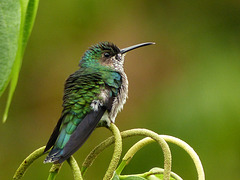
Late last night, I posted the first few photos from Day 5 (of 8 days) of our trip to Trinidad & Tobago. This photo was taken on 20 March 2017, at the Asa Wright Nature Centre on the island of Trinidad. It was raining, which is why this tiny Hummingbird is looking rather dishevelled, rather than its usual sleek self.
This adventure was only the second holiday (or was it actually my third?) of any kind, anywhere, that I have had in something like 30 or 35 years! The other holiday was a wonderful, one-week trip with my great friends from England, Linda and Tony, when we went down south to Yellowstone National Park and the Grand Tetons in September 2012. I have had maybe half a dozen weekends away, including to Waterton National Park, which have helped keep me going.
Six birding/photographer friends and I decided that we would take this exciting trip together (from 12-21 March 2017), spending the first two or three days on the island of Tobago and then the rest of the time at the Asa Wright Nature Centre on the nearby, much larger island of Trinidad. We decided to take a complete package, so everything was included - flights (we were so very lucky to get Black Friday prices, which were 50% off!), accommodation at both places, all our food, and the various walks and day trips that we could chose from. Two of my friends, Anne B. and Brenda, saw to all the planning of flights and accommodations, which was so very much appreciated by the rest of us. I could never have done all this myself!
What a time we had, seeing so many beautiful and interesting things - and, of course, everything was a lifer for me. Some of these friends had visited Costa Rica before, so were familiar with some of the birds. There was a lot more to see on Trinidad, so we were glad that we chose Tobago to visit first and then spend a longer time at Asa Wright. It was wonderful to be right by the sea, though, at the Blue Waters Inn on the island of Tobago. Just gorgeous.
The Asa Wright Nature Centre, on Trinidad, is such an amazing place! We stayed in cabins up or down hill from the main building. Really, one doesn't need to travel away from the Centre for birding, as so many different species visit the Hummingbird feeders that are right by the huge, open veranda, and the trees of the rain forest high up a mountainous road. The drive up and down this narrow, twisting, pot-holed road was an adventure in itself! Never would I ever do this drive myself - we had a guide who drove us everywhere in a van/small bus. I had read many accounts of this road, lol! There was just enough room for two vehicles to pass each other, and the honking of horns was almost continuous - either to warn any vehicle that might be coming fast around the next bend or as a sign that drivers knew each other. The drive along this road, from the coast to Asa Wright, took just over an hour each way.
Even after one month, I still miss the great food that was provided every single day at Asa Wright and even the Rum Punch that appeared each evening. I never drink at all, so I wasn't sure if I would even try the Punch - glad I did, though, as it was delicious and refreshing. Breakfast, lunch and dinner were all served buffet-style, with a great variety of dishes from which to choose. To me, pure luxury. So very, very grateful to have been invited to be part of this amazing adventure.

Breaking through the storm clouds
| 06 Sep 2016 |
|
Yesterday, 5 September 2016, was one of those days that I wasn't really feeling like bothering to get myself ready and go for a walk, but something kept 'telling' me to go. So, I drove over to Fish Creek Park, hoping that I would be able to find one of the Black-crowned Night-herons that people have been seeing recently. Last year, I was lucky enough to see a juvenile on a couple of occasions at this location. However, I was out of luck with the herons and everything else, till just before I got back to my car. I spotted a patch of tan colour way off in the distance, through the bushes. Stopping to take a better look, I saw that it was a beautiful doe and her twins. They walked up a slight hill and I was able to get a clear look at them. Yes, the photo is blurry, but I so rarely see White-tailed Deer fawns, so I wanted to post the image for the record. Love it when the young ones still have their white spots. Definitely worth getting lightly rained on : ) The black clouds and drizzle had rolled in, just in time for my walk and for the drive home.
Challenges of a photographer
| 13 Jul 2016 |
|
We are having torrential rain today, 13 July 2016, and I'm sure there will be more flooding, like yesterday. After having such a dry winter and spring, we are now paying the price with many days of thunderstorms and heavy rain. Yesterday, I was on a botany walk at Shannon Terrace, Fish Creek Park, climbing the hillside and coming down through the forest. Thunder and lightning surrounded us and, though the rain was only very light during the walk, it poured when we were just about back at the cars. I don't like to think how much flooding there will be today. More days of similar weather are in our forecast.
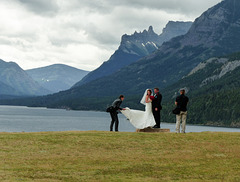
One of my favourite mountains in Waterton is the jagged row of pinnacles that can be seen slightly right of the centre of this image. These are the Citadel Peaks pinnacles, seen from near the Prince of Wales Hotel, high up on the cliff overlooking Upper Waterton Lake. On this day, 9 July 2016, we visited the hotel and ended up staying there longer than we had planned. It was a perfect place to escape the heavy rain until it had more or less stopped. I wanted to take a photo of the lake, but other people had a similar plan. What an amazingly beautiful setting for wedding photos, and the bride's bouquet of bright red flowers made the scene. It became obvious that the photographers were going to take their time and, as my friends and I wanted to continue our drive, I decided I would have to include the wedding group in my photo if I wanted to photograph the Citadel peaks pinnacles.
Three days ago, late afternoon, (I think around 5:15 pm), on 10 July 2015, I arrived back home from my holiday of the year - a two and a half day trip to Waterton National Park. It was wonderful to again be surrounded by such magnificent scenery, go on a few pleasantly slow walks/hikes with plenty of time to look for, and photograph, wildflowers, insects, and a few birds and animals. Lots of great company with 22 people, some of whom I already knew and lots of new faces, too. The trip was organized by Nature Calgary. Everyone was free to go wherever they wanted each day, but for the two nights, we stayed at the very basic Canyon Church Camp, off the Red Rock Parkway. Dorm-style cabins (about which I will say nothing, lol!), but they do have showers and even flush toilets at the camp. We were fed so well - lots of variety and good food. We were given two breakfasts and two suppers, plus a packed lunch for the two days. Our thanks go out to the lady (can't remember her name, sorry, but she was also there for us in July 2015) who cooked and prepared these meals for us! They were so much enjoyed and greatly appreciated!
"Waterton Lakes National Park is a UNESCO World Heritage Site, it is also an International Peace Park, and a Biosphere Reserve. No other park in the world has these three designations. Waterton Biosphere Reserve as it is officially called, was designated in 1979 under what is called the internationally recognized "Man and the Biosphere program" of the United Nations Educational, Scientific and Cultural Organization (UNESCO), that sure is a mouthful. Biosphere Reserves are designed to promote and demonstrate a balanced relationship between people and nature."
www.wediscovercanadaandbeyond.ca/2010/11/red-rock-canyon-...
Thank you SO much, Janet, for driving your friend and me to and from Calgary and around the park some of the time, too. To say that I appreciated it is a huge understatement!! Our thanks, too, to Andrew for organizing this trip so brilliantly, as usual! A great time was had by all. And I am SO happy and relieved that you were finally able to find a bear (and her cub) - yes, we came across the same ones shortly after you saw them. Not sure if they were two of the three I had seen at more or less the same location the previous morning, 9 July 2016. If it was the same female, then her second cub must have been really well hidden in the tangle of bushes and trees. We didn't get a good view, though I did take a handful of photos, including when the cub looked towards us for a split second. I had never seen such a young cub before, so I was thrilled to bits. Can't forget to add my huge thanks for finding me a Lazuli Bunting yesterday, too, at some unearthly hour (well, 7:30 am). No idea how on earth you managed to spot such a small bird from so far away - just a tiny speck in the far, far distance. Also was delighted that you found two Nighthawks flying high overhead at the Nature Conservancy area. So, I guess you and I both returned to Calgary feeling really happy : )
Wild Rose in the rain
| 26 Jun 2016 |
|
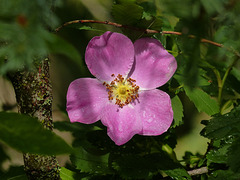
All three photos posted this morning were taken yesterday, 25 June 2016, when I drove SW of the city to possibly meet friends. No one was sure how bad the weather was going to be, as the forecast was for rain and thunderstorms. It had rained overnight, so everywhere was soaking wet. Normally, on a day like that, I stay home, but I'm really glad I did go, especially as I was able to find a Bobolink again. Or, perhaps I should say it found me. Three times now, when I have been photographing a particular pair of Mountain Bluebirds, I have heard a certain call, turned around, and there was a Bobolink sitting on a fence post across the road. It just kept up this call until I stopped what I was doing, crossed the road, and started taking photos of him, as if to say: "Hey, take my photo, too!"
I didn't think any friends were going to turn up, as I hadn't seen anything that looked like a small convoy of cars. Then suddenly, one single car came around a distant corner and stopped. Three people got out - Andrew, Tony and Howard. Three people who are excellent birders and who didn't let the weather keep them from doing what they love.
I followed them slowly as far as Brown-Lowery Provincial Park, where the day's walk was supposed to take part, stopping to look at various birds along the way, Once there, we parted ways, as I didn't want hours of walking in mud and dripping trees. Instead, I wandered for a few minutes near the parking lot, where I took my next two photos and then I returned to the Bluebirds, where the Bobolink reappeared and repeated his behavior, giving me another chance for photos.
And now I have to dash, as I overslept almost an hour, and I have to pick up a friend and then do a long drive NW of the city, where we will be meeting others for a walk, followed by a BBQ. Ths annual event is always very enjoyable - just hope the forecast rain and thunderstorms stay away! Will have to finish off my tags this evening. Gotta run!
"Perched on a grass stem or displaying in flight over a field, breeding male Bobolinks are striking. No other North American bird has a white back and black underparts (some have described this look as wearing a tuxedo backwards). Added to this are the male’s rich, straw-colored patch on the head and his bubbling, virtuosic song. As summer ends he molts into a buff and brown female-like plumage. Though they’re still fairly common in grasslands, Bobolink numbers are declining." From AllAboutBirds.
www.allaboutbirds.org/guide/Bobolink/id
"The Bobolink inhabits Canada's grassland and agricultural areas from the interior of British Columbia to the east coast. Relative to 1970 levels, this species has shown a large decrease across most of its range, with the exception of the Prairie Potholes Bird Conservation Region where populations have changed little. The Committee on the Status of Endangered Wildlife in Canada assessed the Bobolink as Threatened in 2010 (COSEWIC 2010d). This species has been identified as a priority for conservation and/or stewardship in one or more Bird Conservation Region Strategies in Canada."
www.ec.gc.ca/soc-sbc/oiseau-bird-eng.aspx?sY=2014&sL=...

Forest refractions on a wet Dandelion : )
| 26 Jun 2016 |
|
All three photos posted this morning were taken yesterday, 25 June 2016, when I drove SW of the city to possibly meet friends. No one was sure how bad the weather was going to be, as the forecast was for rain and thunderstorms. It had rained overnight, so everywhere was soaking wet. Normally, on a day like that, I stay home, but I'm really glad I did go, especially as I was able to find a Bobolink again. Or, perhaps I should say it found me. Three times now, when I have been photographing a particular pair of Mountain Bluebirds, I have heard a certain call, turned around, and there was a Bobolink sitting on a fence post across the road. It just kept up this call until I stopped what I was doing, crossed the road, and started taking photos of him, as if to say: "Hey, take my photo, too!"
I didn't think any friends were going to turn up, as I hadn't seen anything that looked like a small convoy of cars. Then suddenly, one single car came around a distant corner and stopped. Three people got out - Andrew, Tony and Howard. Three people who are excellent birders and who didn't let the weather keep them from doing what they love.
I followed them slowly as far as Brown-Lowery Provincial Park, where the day's walk was supposed to take part, stopping to look at various birds along the way, Once there, we parted ways, as I didn't want hours of walking in mud and dripping trees. Instead, I wandered for a few minutes near the parking lot, where I took my next two photos and then I returned to the Bluebirds, where the Bobolink reappeared and repeated his behavior, giving me another chance for photos.
And now I have to dash, as I overslept almost an hour, and I have to pick up a friend and then do a long drive NW of the city, where we will be meeting others for a walk, followed by a BBQ. Ths annual event is always very enjoyable - just hope the forecast rain and thunderstorms stay away! Will have to finish off my tags this evening. Gotta run!
"Perched on a grass stem or displaying in flight over a field, breeding male Bobolinks are striking. No other North American bird has a white back and black underparts (some have described this look as wearing a tuxedo backwards). Added to this are the male’s rich, straw-colored patch on the head and his bubbling, virtuosic song. As summer ends he molts into a buff and brown female-like plumage. Though they’re still fairly common in grasslands, Bobolink numbers are declining." From AllAboutBirds.
www.allaboutbirds.org/guide/Bobolink/id
"The Bobolink inhabits Canada's grassland and agricultural areas from the interior of British Columbia to the east coast. Relative to 1970 levels, this species has shown a large decrease across most of its range, with the exception of the Prairie Potholes Bird Conservation Region where populations have changed little. The Committee on the Status of Endangered Wildlife in Canada assessed the Bobolink as Threatened in 2010 (COSEWIC 2010d). This species has been identified as a priority for conservation and/or stewardship in one or more Bird Conservation Region Strategies in Canada."
www.ec.gc.ca/soc-sbc/oiseau-bird-eng.aspx?sY=2014&sL=...
Raindrops on the back of a Canada Goose
| 15 Apr 2016 |
|
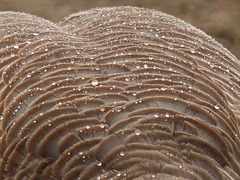
This photo was taken yesterday morning, 14 April 2016, when I was on a walk with friends in Carburn Park. I almost didn't bother to go on this walk, as it was such a gloomy, overcast morning, along with an occasional bit of light drizzle. I love to see water droplets on a bird's feathers, and this Canada Goose was close enough for a photo in the drizzle. Ducks and Geese preen and rub oil from a gland at the base of their tail all over their feathers. Water really does "roll off a duck's (Goose's) back", as the old saying goes.
We used to see lots of goslings at this park several years ago, but people started to complain about the mess that Geese made on the ground. This resulted, sadly, in the Goose eggs being 'oiled', to make sure no goslings were hatched.
"A familiar and widespread goose with a black head and neck, white chinstrap, light tan to cream breast and brown back. Has increased in urban and suburban areas in recent years; just a decade or two after people intentionally introduced or reintroduced “giant” Canada Geese to various areas, they are often considered pests." From AllAboutBirds.
www.allaboutbirds.org/guide/canada_goose/id
The large group divided into three smaller groups, and each group didn't necessarily see every species on our main leader's final list. The list is long, but it might just give someone an idea of what is being seen at that park at the moment. Also helps to jog my own memory.
"FFCPPSoc. Spring Birding, Carburn Park, Calgary, 0915-1215, Thu 14Apr2016. Cloudy, light sprinkle, N wind 15 kph. 4 – 8°C. Combined results of three groups.
Canada Goose-70
Wood Duck-2
American Wigeon-8
Mallard-50
GREEN-WINGED TEAL-5
Common Goldeneye-40
Common Merganser-128
OSPREY-1
Bald Eagle-2 ad..
Sharp-shinned Hawk-1
COOPER’S HAWK-1
RED-TAILED HAWK-3+
Merlin-1
FRANKLIN’S GULL-15
Ring-billed Gull-30+
California Gull-1
Herring Gull-6+
Rock Pigeon-1
Downy Woodpecker-8
Hairy Woodpecker-1, excavating nest cavity
Northern Flicker-12
Black-billed Magpie-10
American Crow-2
Common Raven-2
TREE SWALLOW-2500+
NORTHERN ROUGH-WINGED SWALLOW-1
Black-capped Chickadee-8.
Red-breasted Nuthatch-4, excavating nest.
White-breasted Nuthatch-1
RUBY-CROWNED KINGLET-3
American Robin-60
European Starling-100+
Bohemian Waxwing-10
SONG SPARROW-2
Dark-eyed Junco-2
Red-winged Blackbird-3
House Finch-3
RED CROSSBILL-4+
White-winged Crossbill-1+
Pine Siskin-2
House Sparrow-12
Eastern Gray Squirrel-3
Muskrat-2
JUMPING MOUSE sp.-1"
Barn at Folk Tree Lodge
| 17 Jul 2015 |
|
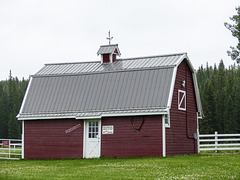
Yesterday, a botanizing outing had been planned to an acreage west of Calgary, near the hamlet of Bragg Creek. The forecast included rain, which started just as I left home. Hoping that it would have stopped by the time I had driven out there, I decided to still go. Only two others arrived and, after a while, it became obvious that the rain was not going to let up, so back home I went. Not before I was told to drive down the driveway to look at a couple of old barns that had been renovated. The present owners of the property have only lived there for four months.
This morning, it's raining again. We desperately needed rain, but if only it could rain just at night.

At the start of our climb
| 31 May 2015 |
|
All three photos posted today were taken the day before yesterday, 29 May 2015, on a trip way down in southern Alberta. A small group of us spent the day at the Whaleback, climbing the ridges, doing a species count. We had such a great day, finding all sorts of things of interest - plants, mosses, lichens - and in my case, insects, animals and birds, too : ) In fact, anything and everything, lol.
The weather was good for walking, not too warm and, up till the last part, dry. When I say "walking", the word "strolling" is perhaps more accurate - with friends like this, there seems to be something of interest every few feet. This kind of outing really suits me and my body! We were so lucky that the rain stayed away for most of the day. When I went on this outing in May 2013, it rained all day, though I still managed to get plenty of photos. The day was overcast with low cloud, making scenic shots rather unpleasant. On a clear day, you can just see the distant peaks of the Rocky Mountains.
Just before taking the turn for the road leading to a place to park, we stopped at a spot down by the river and did a search there. I was thrilled to bits to find three or four Tent Caterpillars on a plant next to a large rock and thought what a way to start the day. After taking a few photos, I walked to the other side of the rock and noticed what almost looked like a circular patch of lichen growing on the rock surface. A closer look revealed a mass of dozens of these caterpillars, with several others climbing up in single file to join the rest. Still makes me itch all over, just thinking about it, lol! Did I take a photo? Yes, of course I did, and I will post one in the next day or two.
Another highlight of the day for me was when I happened to notice a tiny spot of bright red deep inside a distant Early Yellow Locoweed flower. I zoomed in for a photo and thought it looked like it might be a Ladybug. Couldn't count the spots properly, so I very gently parted the petals to get a better look. Unfortunately, it crawled on to my hand and wouldn't return to a petal until after I had taken two or three shots, and then it immediately moved out of sight. I was so happy to find that it was a different kind of Ladybug, though I had seen one a few years ago - still have to check the ID, but I believe it was a Convergent Ladybug.
Part way through the day, I stayed behind while the rest of the group climbed to a higher ridge, and I explored the lower ground. It was a place where I knew I wouldn't get lost - but I did have to wait till at least some of the others returned a few hours (?) later, as others were needed to create an opening to climb though the barbed-wire fence again : ) I found plenty to photograph and it was quite a feeling to be so high up with such an amazing view all around, and to be alone up there. While I sat to eat lunch on a rocky outcrop with a couple of trees, a tiny Sparrow (of some kind) came to visit a couple of times and sing for me. Also, there were maybe half a dozen Brewer's Blackbirds that stayed around the area for much of the time, flying or perched on low bushes. A truly magical time.
The rest of the group had a great time, too, and saw Parry's Townsendia flowers and lots of Balsamroot in bloom. Fortunately, I had seen the Townsendia before on a brutal hike to Picklejar Lakes several years ago. Two years ago, I had also seen hillsides at the Whaleback covered in the bright yellow Balsamroot flowers. I did manage to find several plants huddled together lower down, so was happy to get a few photos of these bright and cheery flowers. As usual, their large leaves and beautiful flowers had been well-nibbled by the caterpillars that live on them.
Altogether, a wonderful day in an incredibly beautiful place with great company! Many thanks, Robin and Cedric, for giving me a ride there and back - appreciated it SO much! And Sandy, if you happen to read this, I guess I have to thank you for not letting me know that you wouldn't be going, lol!
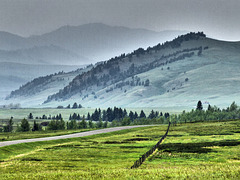
Impressive view at the Whaleback
| 30 May 2015 |
|
All three photos posted today were taken yesterday, 29 May 2015, on a trip way down in southern Alberta. A small group of us spent the day at the Whaleback, climbing the ridges, doing a species count. We had such a great day, finding all sorts of things of interest - plants, mosses, lichens - and in my case, insects, animals and birds, too : ) In fact, anything and everything, lol.
The weather was good for walking, not too warm and, up till the last part, dry. We were so lucky that the rain stayed away for most of the day. When I went on this outing in May 2013, it rained all day, though I still managed to get plenty of photos. Yesterday was overcast with low cloud, making scenic shots rather unpleasant, so I took this shot using a different setting in my camera (Impressive Art, hence the word Impressive in my title). Our climb took us up a hillside off to the right of the photo.
Just before taking the turn for the road leading to a place to park, we stopped at a spot down by the river and did a search there. I was thrilled to bits to find three or four Tent Caterpillars on a plant next to a large rock and thought what a way to start the day. After taking a few photos, I walked to the other side of the rock and noticed what almost looked like a circular patch of lichen growing on the rock surface. A closer look revealed a mass of dozens of these caterpillars, with several others climbing up in single file to join the rest. Still makes me itch all over, just thinking about it, lol! Did I take a photo? Yes, of course I did, and I will post one in the next day or two.
Another highlight of the day for me was when I happened to notice a tiny spot of bright red deep inside a distant Early Yellow Locoweed flower. I zoomed in for a photo and thought it looked like it might be a Ladybug. Couldn't count the spots properly, so I very gently parted the petals to get a better look. Unfortunately, it crawled on to my hand and wouldn't return to a petal until after I had taken two or three shots, and then it immediately moved out of sight. I was so happy to find that it was a different kind of Ladybug, though I had seen one a few years ago - still have to check the ID, but I believe it was a Convergent Ladybug.
Part way through the day, I stayed behind while the rest of the group climbed to a higher ridge, and I explored the lower ground. It was a place where I knew I wouldn't get lost - but I did have to wait till at least some of the others returned a few hours (?) later, as others were needed to create an opening to climb though the barbed-wire fence again : ) I found plenty to photograph and it was quite a feeling to be so high up with such an amazing view all around, and to be alone up there. While I sat to eat lunch on a rocky outcrop with a couple of trees, a tiny Sparrow (of some kind) came to visit a couple of times and sing for me. Also, there were maybe half a dozen Brewer's Blackbirds that stayed around the area for much of the time, flying or perched on low bushes. A truly magical time.
The rest of the group had a great time, too, and saw Parry's Townsendia flowers and lots of Balsamroot in bloom. Fortunately, I had seen the Townsendia before on a brutal hike to Picklejar Lakes several years ago. Two years ago, I had also seen hillsides at the Whaleback covered in the bright yellow Balsamroot flowers. I did manage to find several plants huddled together lower down, so was happy to get a few photos of these bright and cheery flowers.
Altogether, a wonderful day in an incredibly beautiful place with great company! Many thanks, Robin and Cedric, for giving me a ride there and back - appreciated it SO much! And Sandy, if you happen to read this, I guess I have to thank you for not letting me know that you wouldn't be going, lol!

The beautiful Whaleback
| 23 Dec 2013 |
|
|
|
Yesterday evening, I started looking for a really bright, colourful image to post in between all my snowy, winter postings. So short of time, so I grabbed this one that is at least green and not white or blue. Taken on 31 May 2013, when I went with a group of botany friends south of Calgary to the Whaleback area. Such a beautiful area of rolling hills, with the mountains in the distance. It was a day of low cloud and non-stop rain all day, ha. However, the scenery is spectacular and we loved seeing the yellow Balsamroot in flower.
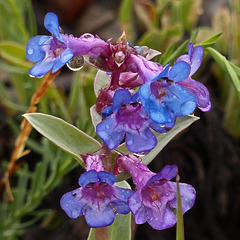
Smooth Blue Beardtongue
| 08 Jun 2013 |
|
On 31 May 2013, I went with a small group of friends to the Whaleback for the May Species Count. This location is 171 km south of Calgary, down towards Pincher Creek. I'm adding photos taken that day to a Set of photos that, up till then, contained images taken on the Small Whaleback on 10 July 2011. It rained/drizzled all day, so the light was really bad and of course there was a constant battle with raindrops on the camera lens : ) This is a macro shot of one of the native wildflower species that was growing there. They grow in clusters at the top of each stem. This attractive, native plant grows on dry, rocky embankments and shale slopes and blooms in May and June.
Today, we were going to the Dry Island Buffalo Jump Provincial Park, way north of Calgary, to botanize the area. However, there was a Severe Thunderstorm Watch in effect yesterday and, sure enough, the heavy rain apparently did arrive. The trip had to be cancelled because the Bentonite clay in the area becomes extremely slippery and treacherous. The gravel road down into the area is always closed when it's raining or has been raining. Last year, we did go, but had to walk down (and then back up) the endless road, feeling the ground slide beneath our feet. Spent the whole day soaked to the skin!
Jump to top
RSS feed- Anne Elliott's latest photos with "rain" - Photos
- ipernity © 2007-2026
- Help & Contact
|
Club news
|
About ipernity
|
History |
ipernity Club & Prices |
Guide of good conduct
Donate | Group guidelines | Privacy policy | Terms of use | Statutes | In memoria -
Facebook
X
