

Anne Elliott's photos with the keyword: Crab Spider
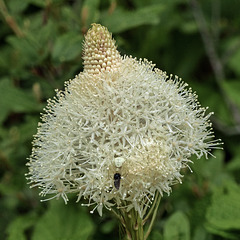
Bear Grass with Crab Spider and prey
| 27 Jul 2017 |
|
|
|
For many years, I had longed to see Bear Grass / Xerophyllum tenax, and finally, in 2015, I was lucky enough to visit Waterton Lakes National Park and saw and photographed it for the very first time. The photo I posted today was taken on 24 June 2017, when I went on the annual Nature Calgary day bus trip to Waterton Lakes - each year, we go to a different destination in Alberta. The edge of the road we drove along had hundreds (thousands?) of these most impressive wildflowers. Each flower varies in shape - some have just a short length of tiny flowers near the top of the tall stem; others have flowers extending a bit further down the spike. The flower in this photo is still waiting to open all the flowers higher up the spike. We noticed the tiny Crab Spider only because the darker prey caught our eye. To visit Waterton for just one day does make for a very long day, though - takes about 3 hours to drive each way, for a start.
"Xerophyllum tenax is a North American species of plants in the corn lily family. It is known by several common names, including bear grass, squaw grass, soap grass, quip-quip, and Indian basket grass.
Xerophyllum tenax has flowers with six sepals and six stamens borne in a terminal raceme. The plant can grow to 15–150 cm in height. It grows in bunches with the leaves wrapped around and extending from a small stem at ground level. The leaves are 30–100 cm long and 2–6 mm wide, dull olive green with toothed edges. The slightly fragrant white flowers emerge from a tall stalk that bolts from the base. When the flowers are in bloom they are tightly packed at the tip of the stalk like an upright club. The plant is found mostly in western North America from British Columbia south to California and east to Wyoming, in subalpine meadows and coastal mountains, and also on low ground in the California coastal fog belt as far south as Monterey County. It is common on the Olympic Peninsula and in the Cascades, northern Sierra Nevada and Rockies.
Xerophyllum tenax is an important part of the fire ecology of regions where it is native. It has rhizomes which survive fire that clears dead and dying plant matter from the surface of the ground. The plant thrives with periodic burns and is often the first plant to sprout in a scorched area. This species has long been used by Native Americans who weave it in baskets. They also braid dried leaves and adorn them on traditional buckskin dresses and jewelry." From Wikipedia.
en.wikipedia.org/wiki/Xerophyllum_tenax
We had two main stopping places in the park - the lookout at Maskinonge Lake and a longer stop at Cameron Lake. The views from both places are spectacular. Luckily, we had beautiful weather all day.
Actually, we weren't too sure if the road going through the mountains to Cameron Lake was going to be open. It was due to reopen the day before out trip and, fortunately, the gate was open. Once at Cameron Lake, we found an empty picnic table right near the beach, and ate our picnic lunch. We were able to walk along the forest trail that followed the shoreline on the right edge of the lake. At a certain point, one had to turn around and go back along the same trail. Cameron Lake is one of my favourite places in the park, with a beautiful view of the lake and a pleasant, flat walk through the forest. There didn't seem to be a lot of forest wildflower species in bloom - maybe we were just a bit too early for them. However, the huge, creamy white flowers of Bear Grass growing along the edge of the road up to the lake had everyone in absolute awe. The road is only narrow and our bus was huge, so on the drive there, all we could do was gasp in amazement, with no chance for taking photos. We asked our excellent driver if there was any chance he would be willing and able to stop at one of the very small pull-offs at the edge of the road on the return drive - and he did! He was expecting maybe five or six people would get off, but I think almost everyone wanted to get a close look at these amazing plants. Even the driver himself got out to look and take photos. He had apparently never been to Waterton before and had never seen Bear Grass. We noticed tiny Crab Spiders on two of the flowers; one was lying in wait and the other had caught an insect. These spiders don't construct webs, but camouflage themselves by changing their colour to that of the flower they are hiding in, and then they wait. We also saw several stems of Striped Coralroot orchid in the ditch by some of the Bear Grass.
After spending a couple of hours at Cameron Lake, the driver took us back into town, as some people had said they wanted to eat there before the long drive back to Calgary. Others, including myself, would have preferred to have spent the time somewhere else, seeing nature and taking photos. However, we were able to walk to the lake's edge, from where we were able to take a few scenic photos - something I had been hoping for. On our way back to the bus, some of us called in at a very popular ice cream shop - we all agreed it was the best, tastiest ice cream we had ever had! A huge, single scoop of wild cherry in a waffle cone - what more could one want?
Penny, you did a great job of organizing this wonderful trip for us all! I know a lot of work goes into setting up an outing like this, and we all appreciate the time and effort you put into planning this. Such a perfect destination for this year's annual bus trip! Pam, thanks for your company on this long drive - helped make it far more enjoyable!
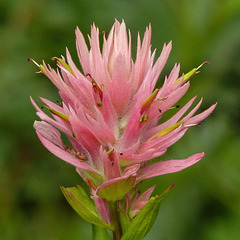
Paintbush, with a visiting Crab Spider
| 14 Jul 2016 |
|
Indian Paintbrush comes in so many different colours and I enjoy seeing each one. A reminder - the pink parts are bracts, not petals, and the actual flowers are the small, narrow green things. Thought this was a pretty colour, seen on a walk along Red Rock Canyon, Waterton, on 10 July 2016. We continued the walk that took us as far as the Blakiston Falls, where we saw an American Dipper's nest with one baby Dipper visible and either one or both adults flying back to the nest with food. We could also see several patches of Yellow Monkeyflower growing on the rocky wall at the falls and then spotted a couple of Orange False Dandelion flowers as we walked away from the falls. Three great sightings.
en.wikipedia.org/wiki/Castilleja
Four days ago, late afternoon, (I think around 5:15 pm), on 10 July 2015, I arrived back home from my holiday of the year - a two and a half day trip to Waterton Lakes National Park. It was wonderful to again be surrounded by such magnificent scenery, go on a few pleasantly slow walks/hikes with plenty of time to look for, and photograph, wildflowers, insects, and a few birds and animals. Lots of great company with 22 people, some of whom I already knew and lots of new faces, too. The trip was organized by Nature Calgary. Everyone was free to go wherever they wanted each day, but for the two nights, we stayed at the very basic Canyon Church Camp, off the Red Rock Parkway. Dorm-style cabins (about which I will say nothing, lol!), but they do have showers and even flush toilets at the camp. We were fed so well - lots of variety and good food. We were given two breakfasts and two suppers, plus a packed lunch for the two days. Our thanks go out to the lady (can't remember her name, sorry, but she was also there for us in July 2015) who cooked and prepared these meals for us! They were so much enjoyed and greatly appreciated!
"Waterton Lakes National Park is a UNESCO World Heritage Site, it is also an International Peace Park, and a Biosphere Reserve. No other park in the world has these three designations. Waterton Biosphere Reserve as it is officially called, was designated in 1979 under what is called the internationally recognized "Man and the Biosphere program" of the United Nations Educational, Scientific and Cultural Organization (UNESCO), that sure is a mouthful. Biosphere Reserves are designed to promote and demonstrate a balanced relationship between people and nature."
www.wediscovercanadaandbeyond.ca/2010/11/red-rock-canyon-...
Thank you SO much, Janet, for driving your friend and me to and from Calgary and around the park some of the time, too. To say that I appreciated it is a huge understatement!! Our thanks, too, to Andrew for organizing this trip so brilliantly, as usual! A great time was had by all. And I am SO happy and relieved that you were finally able to find a bear (and her cub) - yes, we came across the same ones shortly after you saw them. Not sure if they were two of the three I had seen at more or less the same location the previous morning, 9 July 2016. If it was the same female, then her second cub must have been really well hidden in the tangle of bushes and trees. We didn't get a good view, though I did take a handful of photos, including when the cub looked towards us for a split second. I had never seen such a young cub before, so I was thrilled to bits. Can't forget to add my huge thanks for finding me a Lazuli Bunting yesterday, too, at some unearthly hour (well, 7:30 am). No idea how on earth you managed to spot such a small bird from so far away - just a tiny speck in the far, far distance. Also was delighted that you found two Nighthawks flying high overhead at the Nature Conservancy area. So, I guess you and I both returned to Calgary feeling really happy : )
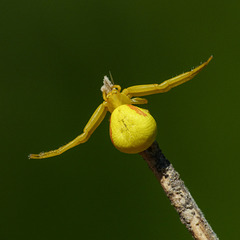
Tiny Crab Spider
| 15 Aug 2014 |
|
On 27 July 2014, a few of us had a "tour" of a naturalist's garden, as part of an Open House here in the city. I was glad to have the chance to take a few photos of some colourful flowers, including Showy Milkweed.. This tiny Crab Spider had obviously slowly changed its colour to camouflage itself against the yellow flowers on which it was first found. In a comment box below is another photo of the same spider, posted previously.
"Thomisidae do not build webs to trap prey, though all of them produce silk for drop lines and sundry reproductive purposes; some are wandering hunters and the most widely known are ambush predators. Some species sit on or beside flowers or fruit, where they grab visiting insects. Individuals of some species, such as Misumena vatia, are able to change color over a period of some days, to match the flower on which they are sitting. Some species frequent promising positions among leaves or bark, where they await prey, and some of them will sit in the open, where they are startlingly good mimics of bird droppings.
These spiders may be yellow or white, depending on the flower in which they are hunting. Especially younger females, which may hunt on a variety of flowers such as daisies and sunflowers, may change color "at will". Older females require large amounts of relatively large prey to produce the best possible clutch of eggs. They are therefore, in North America, most commonly found in goldenrod (Solidago sp.), a bright yellow flower which attracts large numbers of insects, especially in autumn. It is often very hard even for a searching human to recognize one of these spiders on a yellow flower. The color change from white to yellow takes between 10 and 25 days, the reverse about six days." From Wikipedia.
en.wikipedia.org/wiki/Misumena_vatia
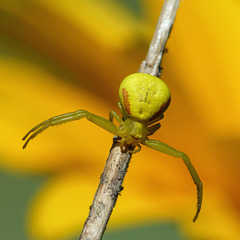
Yellow on gold
| 30 Jul 2014 |
|
|
|
On 27 July 2014, a few of us had a "tour" of a naturalist's garden, as part of an Open House here in the city. I was glad to have the chance to take a few photos of some colourful flowers, including the Showy Milkweed that I posted yesterday. This tiny Crab Spider had obviously slowly changed its colour to camouflage itself against the yellow flowers.
"Thomisidae do not build webs to trap prey, though all of them produce silk for drop lines and sundry reproductive purposes; some are wandering hunters and the most widely known are ambush predators. Some species sit on or beside flowers or fruit, where they grab visiting insects. Individuals of some species, such as Misumena vatia, are able to change color over a period of some days, to match the flower on which they are sitting. Some species frequent promising positions among leaves or bark, where they await prey, and some of them will sit in the open, where they are startlingly good mimics of bird droppings.
These spiders may be yellow or white, depending on the flower in which they are hunting. Especially younger females, which may hunt on a variety of flowers such as daisies and sunflowers, may change color "at will". Older females require large amounts of relatively large prey to produce the best possible clutch of eggs. They are therefore, in North America, most commonly found in goldenrod (Solidago sp.), a bright yellow flower which attracts large numbers of insects, especially in autumn. It is often very hard even for a searching human to recognize one of these spiders on a yellow flower. The color change from white to yellow takes between 10 and 25 days, the reverse about six days." From Wikipedia.
en.wikipedia.org/wiki/Misumena_vatia
It's supposed to get up to 34C (93.2F) this afternoon! Far too hot without air-conditioning! Maybe thunderstorms, which would feel great. After my volunteer shift, I need to go food shopping - can't wait to stand in the frozen foods section : )

Come into my parlour, said the spider to the (butt…
| 22 Jul 2014 |
|
|
I didn't notice the tiny Crab Spider until I was looking at this image on my computer. It had changed its colour to match the Gaillardia flower that it was hiding in. Also, I was standing quite a few feet away, using telemacro to photograph the flower and Fritillary butterfly. Taken at Bow Valley Provincial Park on 20 July 2014.
That day, I plucked up courage to do a drive that I’d never done before. I had been that route once before that I can think of, when I carpooled with others. A good part of the drive was in familiar territory, but I’d never driven the last part of the journey myself. I had met my daughter at 9:00 a.m. and we were both eager to see a display of birds of prey that had been brought up from the Coaldale Birds of Prey Centre. We came across Dee (rockymtnchick) and her partner, there to see the owls. Great to see you both!
This year, there were fewer birds, but it was great to see any at all. There was a Burrowing Owl, a Barn Owl, a Great Horned Owl (photo posted yesterday), and a Golden Eagle. Another real treat that was an amusing one, was seeing a baby Barn Owl that was just 45 days old! This little ball of fluff was acting as a great ambassador, letting young kids get a close view and ask questions, and fall in love with it – and to hopefully, in the future, do everything they can as adults to protect our precious wildlife. The enjoyment of seeing these birds up close reminds one that the reason these birds are not free to live in the wild, is because of some kind of interaction with humans – such as permanent injuries from being hit by a vehicle, pesticide use, or even worse, being shot by a human! This is what happened to “Spirit”, the magnificent Golden Eagle, shot and blinded by someone.
This exhibit was our first destination in the park, though on the drive from Calgary, we had stopped at the small McDougall Church at Morley (one of the photos posted yesterday). After seeing and photographing the birds of prey, we then drove to Middle Lake that’s in a different part of the park. We walked the very short distance to the edge of the lake, but didn't walk around it. From there, we drove to Many Springs Trail and did a very slow walk around the lake, stopping to look at different flowers and photograph a few butterflies including this Fritillary. Though slow, it was still further than I should have walked. Certain wildflowers were already finished, including various Orchid species, but there were still plenty of other species to see and enjoy. Even the weather cooperated, though the forecast had been for isolated showers. Not too hot, nice clouds in the sky and lovely to have my daughter’s company for the day.
Thanks so much to the people down at the Coaldale Bird of Prey Centre (near Lethbridge, down towards the Canada/US border) for bringing your gorgeous birds of prey for us to see! I have been south to the Centre three times I think, and always long to go back again, but it's not somewhere I can drive to, so this was a much-appreciated treat!
Any of you having the same problem as me with Flickr today? Each photo page loads just fine - tags, descriptions, groups, albums are all there, but every single comment has disappeared. New and old photos now have no comments, just a blank, white space, and no comment box! Flickr staff should soon see the messages on the Help Forum, so hopefully it will be fixed very soon!
Crab Spider on Richardson's Geranium
| 30 Jul 2013 |
|
|
|
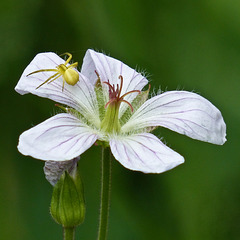
This was another thing that I saw on 27 July 2013, when a group of us did a Bioblitz along the E side of the Perrenoud WIldlife Reserve, NW of Calgary. A tiny Crab Spider, sitting on a Richardson's Geranium wildflower.
"Crab spider is a common name applied loosely to many species of spiders, but most nearly consistently to members of the family Thomisidae. Among the Thomisidae it refers most often to the familiar species of "flower crab spiders", though not all members of the family are limited to ambush hunting in flowers.
Thomisidae do not build webs to trap prey, though all of them produce silk for drop lines and sundry reproductive purposes; some are wandering hunters and the most widely known are ambush predators. Some species sit on or beside flowers or fruit, where they grab visiting insects. Individuals of some species, such as Misumena vatia (which I believe is shown n my photo), are able to change color over a period of some days, to match the flower on which they are sitting. Some species frequent promising positions among leaves or bark, where they await prey, and some of them will sit in the open, where they are startlingly good mimics of bird droppings. However, note that these members of the family Thomisidae are not to be confused with the spiders that generally are called bird dropping spiders, not all of which are close relatives of crab spiders.... The spiders of Thomisidae are not known to be harmful to humans." From Wikipedia.
en.wikipedia.org/wiki/Crab_spider
en.wikipedia.org/wiki/Geranium_richardsonii
"In 1980, George Emil Perrenoud donated this land to the Alberta Sport, Recreation, Parks and Wildlife Foundation for the purpose of a wilderness park for the benefit of the residents of the Province of Alberta."
www.asrpwf.ca/media/53811/perrenoud.pdf
www.flickr.com/photos/annkelliott/9399782073
Crab Spider on Gaillardia
| 09 Jul 2013 |
|
|
|
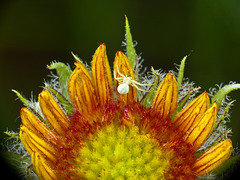
The third rather uninspiring photo of the day, lol! Some days, I just have no enthusiasm for posting the photos I've grabbed! Needed this one for my Set about the Leighton Art Centre, showing some of the flora and fauna that three of us found and listed when we botanized the hillside belonging to the Centre, on 6 July 2013. I love seeing Gaillardia flowers that are just beginning to open, surrounded by all those fine hairs. Happened to notice this tiny Crab Spider on this one.
UPDATE (9 July 2013) on the Calgary Zoo:
"The Calgary Zoo announced today that it will begin to move animals to other institutions on a permanent basis beginning as early as next week.
Recent flooding caused extensive damage across the zoo's 32-acre island. The South America building is one of the oldest facilities at the zoo and was one of the hardest hit in the flood. Dr. Clément Lanthier, zoo president and CEO, said the damage to the building and its systems is so extensive that it has been determined that it makes no sense to invest very limited resources in its repair. "Sadly this means we have to quickly find new homes for the 34 individual animals representing 11 species that were housed in this building," said Dr. Lanthier.
Prior to the flood, the zoo was looking for new homes for one white stork, one Parma wallaby, two black swans and seven Rock hyraxes--that search is ongoing and these animals will also be transferred to other facilities as soon as possible. This brings the total of animals to be moved to 45 individuals representing 15 species." From Calgary Zoo e-mail.
Deadly embrace
| 18 Jun 2012 |
|
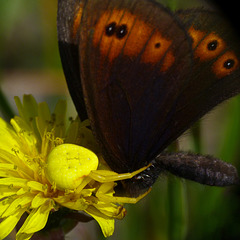
In total contrast to my previous photo, this bright, colourful macro image was taken yesterday, while botanizing the Kerfoot Ranch, NW of Cochrane. I had been trying to "catch" one of these Common Alpine butterflies, as I love the bright orange circle pattern on their wings. I suddenly spotted this one and at first was a bit surprised that it didn't fly away. And then I began to wonder if maybe it had been caught by a tiny Crab Spider. Sure enough, this is what I found. Poor butterfly.
Was out on a bird walk all morning at the east end of Fish Creek Park. When I got home, I noticed to my horror that the window people were working on the building right next to mine! I was expecting it to be a few more weeks before they reached my place, ready to replace eight windows and my patio door! PANIC!! I have so much that I need do before they have to come inside here, so I guess this is going to cut into my Flickr time. Sorry if at times I am missing in action! You have no idea how thankful I will be when this is all finished with! It's been hanging over my head for months. Then it will be my roof that has to be replaced in the next while, too - hail damage from last year, apparently.
Crab Spider on Goldenrod
| 10 Sep 2011 |
|
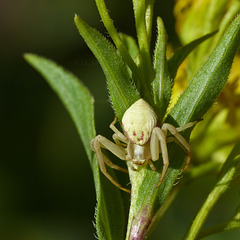
It was so disappointing to find that almost all the wildflowers were finished when I drove west of the city on Elbow Falls Trail on August 29th. A few Goldenrod and Asters (or were they Fleabane?) remained. However, I was happy to get a decent enough photo of this very tiny Crab Spider. They are common spiders, but so easily missed because of their tiny size. Females can grow up to 10 mm (excluding legs); males reach 5 mm at most. Macro photo taken near the parking lot at Ing's Mine.
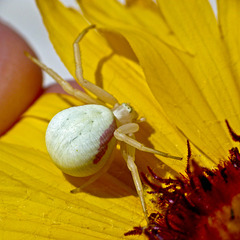
Tiny Crab Spider on Gaillardia
| 14 Jul 2011 |
|
A tiny Crab Spider hanging out on a Gaillardia flower. Photographed (macro) on a botany hike on the Small Whaleback on July 10th. This is just one small, wonderful area of rolling hills and wildflower meadows, off Highway 22, just north of the Oldman River, southern Alberta, about a two and a quarter hour drive south of Calgary.
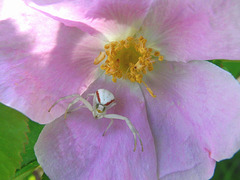
Crab Spider on wild Rose
| 30 Jun 2008 |
|
About nine of us spent the day at the eastern edge of the Rocky Mountains, at Bow Valley Provincial Park. The main focus was on birds of the area, but we were surrounded by wildflowers and insects, too. This provincial park is an amazing area for flowers at this time of the year. Lots of wild orchids, for a start! Not sure what the temperature was, but somewhere around 30C. Crab Spiders are often found on Roses. This one's for you, Doug!
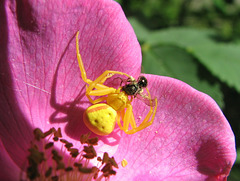
Crab Spider
| 24 Jun 2007 |
|
We saw this little spider eating its lunch a few days ago. I have seen them before on wild roses. They can change colour to match their background, but I guess this one was so focussed on food that it "forgot" to change colour, LOL!
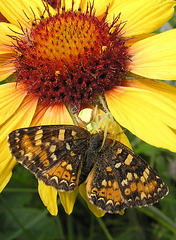
Crab Spider with Butterfly on Gaillardia
| 01 Sep 2006 |
|
Wondering why the butterfly wasn't flying away as I approached, I realized that it had been caught by a Crab Spider who now had lunch.
Jump to top
RSS feed- Anne Elliott's latest photos with "Crab Spider" - Photos
- ipernity © 2007-2025
- Help & Contact
|
Club news
|
About ipernity
|
History |
ipernity Club & Prices |
Guide of good conduct
Donate | Group guidelines | Privacy policy | Terms of use | Statutes | In memoria -
Facebook
X
