

Kicha's photos with the keyword: U.S. Army
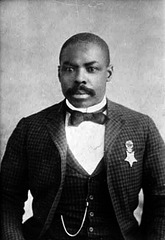
Corporal Isaiah Mays
| 17 Oct 2023 |
|
It was a journey that took more than a hundred years. Missing for decades, the remains of Cpl. Isaiah Mays, a Buffalo Soldier and Medal of Honor recipient, were laid to rest Friday at Arlington National Cemetery.
Paying respects were African-American veterans, U.S. Army soldiers and those who rode for days as part of a motorcycle escort -- members of the Missing in America Project, who traveled from as far away as California and Arizona at their own expense to make sure Mays got a proper burial.
None was a relative but they consider themselves his brothers.
They stood shoulder to shoulder in an older section of the cemetery, surrounded by the graves of veterans from wars long ago. Some came in Army dress blue uniforms. Others wore uniforms like those worn by the Buffalo Soldiers, who served in the legendary all-black Army units formed after the Civil War.
The crowd stood witness as a color guard folded the American flag and saluted when three rifle volleys pierced the air. A bugler, surrounded by the graves of other fallen heroes, played taps.
William McCurtis, the regimental sergeant major of a Buffalo Soldier group, perhaps voiced the sentiment of everyone who came: "One more out of 6,000 has his day of recognition. We need to get the rest recognized."
Mays was born enslaved in Virginia in 1858 but spent most of his life west of the Mississippi, joining the famed Buffalo Soldiers as the black cavalry and infantry troops fought in the frontier Indian Wars.
In 1889, he was part of a small detachment assigned to protect a U.S. Army pay wagon, which was caught in an ambush by a band of bandits. A gunfight ensued and almost all the soldiers were wounded or killed. Mays was shot in both legs. The bandits made off with $29,000 in gold coins.
Despite his wounds, Mays managed to walk and crawl two miles to a ranch to seek help. He was awarded a Medal of Honor on February 15, 1890.
More than 20 Buffalo Soldiers have received the Medal of Honor, the military's highest award for valor.
Mays left the Army in 1893 and many years later applied for a federal pension. But he was denied. He was committed to an Arizona state hospital that cared for the mentally ill, tuberculosis patients and the indigent.
When he died in 1925, Mays was buried in the hospital cemetery in a grave marked only with a number. Years later, a small group of hospital staff and veterans located his grave and arranged for a formal ceremony on Memorial Day 2001.
They were determined that Mays should not be forgotten.
After receiving court permission, volunteers dug up Mays' remains and transported them from Arizona to Washington so he could be buried with honor at Arlington.
After the ceremony, those who gathered to honor Mays posed for photographs and, like good soldiers, they congratulated each other for a hard-won battle. Cpl. Isaiah Mays was finally home.
Buffalo Soldier Gets Arlington Burial After 100 Years, [CNN, Bob Kovach] 5/29/2009; W.E.B. Du Bois Negro Exhibit of the American Section at the Paris Exposition Universelle in 1900
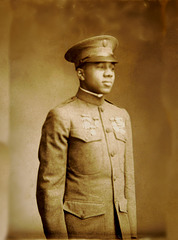
Victor R Daly
| 17 Oct 2023 |
|
Daly is the author of the novel Not Only War: A Story of Two Great Conflicts (1932), about African American soldiers in WWI and the racism they experienced while serving and after. It is believed to be the only WWI novel written by an African American veteran.
Victor Reginald Daly was born in New York City and educated in public schools. He was a member of the Class of 1919 at Cornell University.
In 1917, he joined the U.S. Army and trained at Fort Des Moines, along with 639 other African-American men. He was appointed 1st Lieutenant in the 367th Infantry Regiment, and was decorated with the Croix de Guerre for his service in France. In 1919, he married Adelaide Helen Cook (Cornell University Class of 1918). They had two daughters, Millicent and Peggy. He worked for the Urban League in New York after his discharge from the Army. He came to Washington, DC in the 1920s to serve as business manager of The Journal of Negro History. He also wrote short fiction that was published in The Crisis, and essays on civil rights issues such as equal access to housing and transportation, and integrating ranks of DC government. In 1932, he published a novel, Not Only War: A Story of Two Great Conflicts.
In 1934, he became an interviewer for the U.S. Employment Service in D.C. When he retired in 1966, he was Deputy Director in charge of the Manpower Development Program, which had begun in 1962 under his leadership. Over the years he worked tirelessly to persuade downtown retail stores to hire African-Americans in sales and clerical positions. He was instrumental in the 1950s in helping the Capitol Transit Co. and the union to agree to hire African-American bus drivers and street car operators. In 1956, he received the Distinguished Service Award, the highest honor conferred by the U.S. Dept. of Labor for his efforts in eliminating discrimination in hiring practices.
Source: Cornell University
Jump to top
RSS feed- Kicha's latest photos with "U.S. Army" - Photos
- ipernity © 2007-2026
- Help & Contact
|
Club news
|
About ipernity
|
History |
ipernity Club & Prices |
Guide of good conduct
Donate | Group guidelines | Privacy policy | Terms of use | Statutes | In memoria -
Facebook
X
