

Kicha's photos with the keyword: Restaurateur

Marjorie Ellen Elliott
| 16 Oct 2023 |
|
Her obituary appeared in the February 4, 2000 edition of the Las Vegas Sun : Margie Elliott had already made her mark as a Los Angeles actress, business owner and restaurateur before she came to Las Vegas in 1954.
Initially able to find work only as a waitress in what was then a racially segregated community, Elliott, worked at the Moulin Rouge, the city's first integrated Las Vegas hotel, which opened in the mid-1950s.
"Mom used to work the swing shift but hung around for the 2 a.m. show when the Strip celebrities stopped by. She was friends with many of them from her years in Los Angeles," longtime Las Vegas optometrist Lonnie Sisson said.
"She enjoyed being there with (former world heavyweight boxing champion) Joe Louis, who was the host, Sammy Davis Jr. -- all of the stars who came in."
But Elliott was destined for much bigger things. In the mid-1950s, she shifted her career direction and became one of the city's first black female real estate executives. For five decades she sold homes to generations of Las Vegans. Marjorie Ellen Elliott, a political activist who helped lobby for passage of Nevada's civil rights laws in the late 1950s and other legislation that gave more opportunity to minorities, died of complications from Alzheimer's at Cheyenne Residential Home. She was 84.
"Margie was a lovely lady who understood the political system and used it to help those people who needed help the most," said longtime friend and former two-term Nevada Gov. Mike O'Callaghan, the executive editor of the Sun. "She seldom raised her voice but usually won over her opponents with honesty and straight talk."
Elliott went to work in real estate at a time when she could sell homes only in the black community -- a time when what was called westside was in decay, blighted with many ramshackle houses and apartments.
"It was not easy for blacks, especially black women, in real estate back then," Sisson said. "She got her license in 1957 and decided to work on selling tracts in new developments like Casper Park 1 and 2. She even bought a home there, where she lived until two years ago."
When desegregation came to Las Vegas in the 1960s, Sisson could have sold real estate anywhere, but she chose to remain an advocate for West Las Vegas, selling homes there and otherwise working to improve conditions.
"She got a lot of referrals and put people into good homes," Sisson said. "As a result, the children and grandchildren of people she sold homes to came to her when it was time for them to buy because of the trust she had built."
Early on, she became involved in the National Association for the Advancement of Colored People and the Nevada Voters League. Born August 4, 1915, in Ardmore, Oklahoma, Eliott was the elder of two children of General Motors worker Samuel Elliott and the former Odessa Hood. The Elliotts relocated to Milford, Michigan, a suburb of Detroit, where Margie graduated from high school. Although she stood 5 feet 6 inches and weighed under 100 pounds, she was a standout on the girls basketball team.
Elliott attended the University of Southern California, where she developed an interest in dance and acting. She attended the Hollywood Finishing School. And in November of 1947 she established the Majorie Elliott's Finishing School, the first of its kind for Blacks. The business was located at 3632 4th Avenue, Los Angeles, California.
She also appeared in several Hollywood films, including the 1954 classic "Carmen Jones," with Pearl Bailey and Dorothy Dandridge, who in that title role became the first black person to be nominated for the best actress Academy Award. Also in the early 1950s, Elliott owned a Los Angeles restaurant. She came to Las Vegas in 1954 and, after the Moulin Rouge closed, became a 21 dealer at the old El Morocco and Cotton Club, both located on Jackson Avenue in West Las Vegas.
"My mother saw back then how few job opportunities there were for black women and worked hard to change that," Sisson said, recalling Elliott's earliest interests in political activism.
Negro Who's Who in California (1949 edition) by Commodore Wynn

Bessie Couture
| 16 Oct 2023 |
|
Bessie Couture born in Virginia, opened the Black and White restaurant in Skagway, Alaska in 1896 during the gold rush. It was the first Alaska business owned by an African American.
Many African Americans first moved to Alaska during the gold rush and then as soldiers. The first African-Americans in Alaska were whalest and other seamen who settled following the Alaska Purchase in 1867. Many came after the 1897 discovery of gold in the Canadian Yukon. The US was in depression and the gold rush was hope. Many stayed after that. In the 4 years during and after the gold rush, there were 158 members of the company of the 24th infantry were stationed at Dyea and Skagway to help preserve laws and order. Many chose to stay in Alaska after.
In the 1940 census, Ms. Couture was listed as head of household and on her last birthday she turned 71; it also indicated she was married. Around this time for occupation it was blank which I'm assuming meant she was retired.
Source: Anchorage Museum Archive

Lafayette Alonzo Tillman
| 16 Oct 2023 |
|
Here Tillman appears in uniform when he was with the Kansas City Police Department.
Born during slavery on March 15, 1858 in Evansville, Indiana, Lafayette Alonzo Tillman would be fortunate not to experience the harshness of the peculiar institution less than 100 miles away to the “South” in the state of Kentucky. Evansville was one of a number of gateway cities in Indiana that provided access to the Underground Railroad, assisting runaway slaves with food, shelter and safe passage to Canada. Information about Tillman’s childhood is fragmented, but there are a number of reflections accounting the death of his father when Tillman was five years old, as well as an assessment of his academic success within the public school system of Indiana. What is more, Tillman’s abilities and scholastic achievements provided him with the foundation he would need in pursuit of a college education at Oberlin College in Oberlin, Ohio, and at Wayland Seminary School in Washington, D.C.
At Wayland, Tillman studied theology in preparation to become a Baptist minister, while simultaneously developing his musical talent as a singer. Professor James Storum, the African American educator who became the first principal at Virginia Normal and Collegiate Institute in 1883, encouraged this ability. By the late 1870s, Tillman’s strength as a bass soloist and his virtuous nature attracted a number of prominent singing groups ready to take advantage of his rich voice and his gentlemanly decorum. African American singing groups such as the Fisk Jubilee Singers and the Tuskegee Institute Choir entertained both blacks and whites, and served as nationally and internationally recognized ambassadors who educated white patrons about African American culture through song and intimate interactions.
Performing with the New Orleans University Singers and the Donovan Tennesseeans of Philadelphia, Tillman was provided a number of opportunities to tour the eastern and midwestern United States, as well as Europe. (In 1884, in the “Blue Room” at the White House, Tillman and his New Orleans University Singers performed for then-President of the United States, Grover Cleveland. In the special program, Tillman performed his solo “The Laughing Song.”) In 1880, while traveling through the Midwest and performing at both black and white churches, Tillman and the Tennesseeans performed in Kansas City, where his proficiency as a singer gained him local fame as an entertainer. Tillman’s apparent fondness for the growing town and its 7,914 African Americans prompted his move to Kansas City. In 1881 he began a career as an entrepreneur, opening a restaurant at 105 East 12th Street, in the heart of the African American community.
By 1896, Tillman had married Amy Dods of St. Louis, Missouri, closed his restaurant, opened his own barber shop and had begun pursuing his interest in law at Kansas City Law School. The 1890s are recognized as the beginning of segregation in America. Blacks in general and black men in particular were being lynched at a rate of 100 per year. Thus the ideological foundation of Jim Crow in the United States served to shape the experiences of a majority of black men and women within the nation’s imagined borders.
In 1898 Tillman achieved the rank of Quarter-Master Sergeant in Company “K” of the 7th Regiment of the United States Volunteers. He was never deployed to the Philippines during the Spanish-American War, but nevertheless demonstrated his commitment to excellence as a soldier. This would be accounted for by his superior officers who had full faith in his abilities and recognized and applauded his outstanding leadership qualities. This was a turning point for Tillman’s career. Indeed, because of his commitment to excellence he would be honored by the Aurora Democratic Club of Kansas City, which boasted a membership roster that included Alderman James Pendergast, brother of future Kansas City “Boss,” Tom Pendergast. Acknowledging Tillman’s achievements, the Aurora Democratic Club presented the Sergeant with a uniform and an engraved sword which is inscribed: “Presented to Lieutenant L.A. Tillman/49th Regt/In recognition of his high personal character and fidelity to principle by his Kansas City friends and fellow members of Aurora Democratic Club.” The local recognition would secure Tillman’s future in Kansas City, and contribute to his future success in the military.
During the 1899 “Filipino Insurrection” by citizens of the Philippines against U.S. rule, Tillman received an appointment as First Lieutenant of the Forty-Ninth Volunteer Infantry from President William McKinley. Tillman would likely have been stationed in Manila at the same time as Lieutenant Charles Young, the third African American graduated from the United States Military Academy at West Point, and before World War I the highest ranked African American solider in the US military. After serving two years in Luzon in the Philippines, Tillman was honorably discharged and he returned to Kansas City.
Tillman’s life and career both refuted and denied any notion of black inferiority and ineptitude. Having gained and maintained a reputation for loyalty, bravery and respectability, Tillman’s connections to influential white Kansas Citians provided him with the needed recommendations to qualify him to the Board of Police Commissioners as a worthy police officer candidate. He was the third black police officer to serve in the Kansas City Police force, after William F. Davis and Robert Alexander. He served with distinction from 1903 until his death in 1914 [from chronic intestinal nephritis]. The range of contributions made by Tillman through his public presence and authority, as well as the degree to which his representation of black potentiality and respectability accelerated the future development of the African American community in Kansas City, has yet to be fully understood.
He and his wife (Amy L Tillman, 1863 - 1943), are buried in Highland Cemetery, Kansas City, Jackson County, Missouri.
Bio: Pellom McDaniels I, PhD., Assistant Professor of History and American Studies, University of Missouri-Kansas City
Photo: Lafayette Alonzo Tillman Collection at the Kansas City Museum
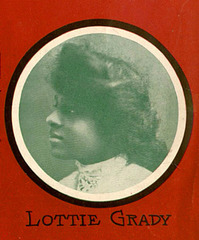
Lottie Grady
| 05 Apr 2016 |
|
Lottie Grady (1887-1970), as she appeared on sheet music for The Merry Widower, 1907.
She appeared as one of the lead characters in what's credited as being the first all black cast in a film company started by a black man, William Foster (stage name Juli Jones). The Railroad Porter came out in 1912.
Lottie Grady was born on September 8, 1887 in Chicago, Illinois. She was a well known stage actress in the early 20th century. Originally from the south side of Chicago, she was a talented singer, dancer, and actress. She performed on stage with the likes of Bert Williams (1904's show "Lode of Kole"), Jesse Shipp and S. H. Dudley ("The Smart Set") before returning to her hometown and becoming the leading lady of the Pekin Theatre Stock Company, a collection of actors and actresses who produced and performed in plays and other dramatic presentations, many written by African Americans, or adapted to appeal to a predominately African American audience. She would then join with William Foster and, with other members of the Pekin Theatre stock company, like Charles Gilpin, Abbie Mitchell and others, would act in his "photoplays." It was reported in contemporary newspapers that Grady would appear at showings of the films and while the reels were changed, would entertain the audience by singing.
She retired from performing in 1919, when she married Charles Roxborough (1887-1963), he served one term in the State Senate of Michigan (1931-1933) thus becoming the first black man elected to that chamber. The couple had two sons, Charles Anthony and John Walter. The couple divorced in 1939. After her divorce Lottie moved to the resort town of Idlewild, Michigan, where for almost thirty years she owned and operated (along with the help of her oldest son), a popular restaurant called The Rosana Tavern. She passed away on February 20, 1970 in Idlewild, Michigan. [imdb.com, by Jane Margaret Laight]
Jump to top
RSS feed- Kicha's latest photos with "Restaurateur" - Photos
- ipernity © 2007-2026
- Help & Contact
|
Club news
|
About ipernity
|
History |
ipernity Club & Prices |
Guide of good conduct
Donate | Group guidelines | Privacy policy | Terms of use | Statutes | In memoria -
Facebook
X
