

Kicha's photos with the keyword: Fearless

Dr. Emma Reynolds
| 16 Oct 2023 |
|
As a black woman, she was denied the right to become a nurse. " In 1889, Emma Reynolds, a young woman who aspired to be a nurse, was denied admission by each of Chicago's nursing schools on the grounds that she was black. Emma Reynolds, along with her brother, the Reverend Louis H. Reynolds, (pastor of the St. Stephens A.M.E. Church on the West Side of Chicago), approached Dr. Daniel Hale Williams seeking his influence so that Miss Reynolds could receive proper training as a professional nurse. Dr. Dan’s solution to the blatant racism was to establish the Provident Hospital and Training School, a private, interracial medical facility."
Emma Ann Reynolds (1862 - 1917), was born near Frankfort, Ohio. She desired to attend nursing school in Chicago but was refused because of her race. She enrolled in Wilberforce University instead. Upon graduation, she moved to Kansas City, Missouri, where four of her brothers lived, and where she taught in the public schools for seven years. Agitated by the poor health conditions of African Americans during this era, Reynolds convinced one of her brothers, the pastor of an African Methodist Episcopal Church in Chicago, to join her in seeking social reforms to address these pressing needs. Her brother contacted Dr. Daniel Hale Williams, a prominent African American physician and surgeon. In 1890, Williams organized the first interracial hospital, Provident Hospital in Chicago, and opened a school of nursing. Reynolds was one of the first two graduates to complete the eighteen‑month nursing program in 1892.
Reynolds went on to further training at the Northwestern University School of Medicine and became the first African American woman to receive an M.D. from that program. For the next seven years, she was a physician in Waco, Texas, and New Orleans, Louisiana, before returning to Ohio in 1902 because of ill health. After her recovery, Reynolds began practicing medicine in Ross County. She provided much needed services to the rural residents of this area until her death in 1917.
For her achievements, Reynolds was inducted into the Chillicothe‑Ross County Women’s Hall of Fame in the field of medicine in 1991.
Sources: Profiles of Ohio Women 1803-2003 by Jacqueline Jones Royster; The Provident Foundation
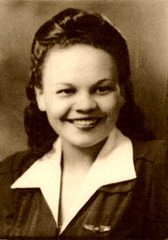
Mildred Hemmons Carter
| 16 Oct 2023 |
|
Wildly ambitious she continued to make the best of denied opportunities, ensuring, whether purposefully or not, that she left behind a legacy that is a source of inspiration for anyone who has ever been told they couldn’t become who they wanted to be.
Mildred Hemmons was born in Benson, Alabama in 1921 to a white businessman and a black postmistress. She spent most of her childhood in Alabama but eventually moved with her parents to North Carolina. There, she graduated from high school at the age of fifteen. After high school, she decided to return to Alabama to attend the Tuskegee Institute (now Tuskegee University). She graduated at nineteen with a degree in business. Having seen so many young men enter into the newly founded flight program, Mildred realized she could do the same thing. She applied for the Civilian Pilot Training Program (CPTP). She was rejected. At nineteen she was too young to be accepted.
Undeterred, Mildred applied again the next year and was accepted. She graduated from the program and received her license on February 1, 1941.
Thirsty for more, Mildred decided to apply for the Advanced Program but found that women were not accepted into this higher level training. A few years after yet another rejection, Mildred learned that the military had created a new initiative to recruit female pilots with a program called Women’s Air Service Program (WASP). This time Mildred was denied admission because she was African American.
Instead of giving up flying completely, Mildred continued to pursue her interest in aviation, even giving private flying lessons. In 1942, she joined the Civil Air Patrol Squadron, although she never got a chance to patrol.
That same year she married a man who shared her passion for the sky. Herbert Carter, a fellow pilot, first noticed Mildred’s vivacious spirit in 1939 and was captivated by her. The two didn’t start dating until he discovered she too was enrolled in flight school.
Unable to fraternize while they were in the program, the two had many of their dates in the air. Often they would pick a time to meet over Lake Martin, 3,000 feet in the air. They couldn’t communicate with one another with radios and settled for waving and blowing kisses to one another. Mildred didn’t have access to the type of planes Herbert was able to fly and he would often play aerial leap frog, leaving clouds of dust in her windshield.
Mildred is reported as saying she wasn’t distracted by her future husband’s antics. “I was the better pilot…I just didn’t fly the fastest aircraft.”
The two married in 1942, a month before Herbert became second lieutenant and a year before he was sent off to war. The couple went on to have three children, five grandchildren and two great grandchildren.
Even though she couldn’t fly with the Tuskegee airmen, she stayed in Tuskegee, dedicated to the mission. She became the first civilian to serve in the air project, bulldozing trees to clear the airfield path.
The recognition Mildred deserved as a pilot wouldn’t come until decades later. For the second time she received a letter from WASP. This time with more uplifting news.
Seventy years after she’d earned her license, Mildred was being recognized as a member of WASP. She even received a medal with an inscription reading: “The First Women in History to Fly America.”
Mildred’s health began to deteriorate and on October 21, 2011 at the age of 90, she passed away. Her husband, who called himself her wingman, was by her side. Herbert Carter died the following year at the age of 95 on November 9, 2012.
Source: Tuskegee News
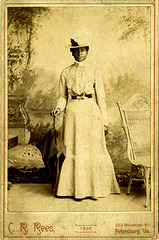
Who Is The Real Mary Elizabeth Bowser?
| 16 Oct 2023 |
|
For years the woman in this photograph was assumed to be the infamous spy, Mary Elizabeth Bowser. However, the photograph depicts a different Mary Bowser. She was photographed by C.R. Rees, in Petersburg, Virginia in 1900 (when the spy, Mary Elizabeth Bowser would have been in her sixties). This discovery was made by author Lois Leveen, who wrote the book, "The Secrets of Mary Bowser." I personally choose to use this image as a representation of Mary Elizabeth Bowser.
Mary Bowser was born into slavery in the household of John Van Lew, a wealthy hardware merchant in Richmond, Virginia. Van Lew's daughter Elizabeth freed Mary Bowser and all her father's other slaves after he died. Elizabeth Van Lew, who never married, was known as an eccentric who sometimes walked down the streets of Richmond, head bent to one side, holding conversations with herself. Some called her "Crazy Bet".
"Crazy Bet" Van Lew inherited a lot of money and her father's society connections. She used some of the money to send her former slave Mary Bowser to school in Philadelphia and later Elizabeth used her connections to get Mary Bowser a servant job in President Jefferson Davis' Confederate White House. To many Mary Bowser appeared to be uneducated and dull-witted. But she worked hard.
Sometimes Mary Bowser met with her old patron "Crazy Bet" at a farm outside Richmond. The spinster and the servant were not just exchanging recipes. Oh, no. They were spies.
"Crazy Bet" was the spymaster and Mary Bowser was one of her best agents -- part of a spy ring -- white, black, slave and free -- made up of servants, farmers, seamstresses, storekeepers, undercover Scottish abolitionists -- working in plain sight in the South for the North.
As the educated Mary Bowser dusted and served in the Confederate White House, she used her photographic memory to record military documents she found on the president's desk and conversations she overheard in the dining room.
Daily tasks could hide secrets -- in a basket of eggs one empty shell filled with military plans; a serving tray loaded with food and messages concealed in its false bottom; wet laundry hung up in code. For example, a white shirt beside an upside-down pair of pants meant "Gen. Hill moving troops to the west."
When the Civil War ended, the first Union flag in Richmond was raised from the roof of Crazy Bet's mansion. Gen. Ulysses S. Grant praised her service to the Union cause.
But Mary Bowser's story remained mostly untold, even in her family. Then in the 1960s an elderly cousin asked Mrs. McEva Bowser if she had ever heard of her husband's great great aunt Mary.
McEva Bowser: "And she said, 'Do they ever talk about Mary Elizabeth?' And I said, 'No, never heard of her.' And she said, 'Well, they don't ever talk about her 'cause she was a spy.'"
And she left a diary, a diary that McEva Bowser may have found in 1952 when her husband's mother died.
McEva Bowser: "I was cleaning her room and... I ran across a diary but I never had a diary and I didn't even realize what it was... And I did keep coming across (references to) Mr. Davis. And the only Davis I could think of was the contractor who had been doing some work at the house. And the first time I came across it I threw it aside and said I would read it again. Then I started to talk to my husband about it but I felt it would depress him. So the next time I came across it I just pitched it in the trash can."
But Mary Bowser's story survived anyway. It was retold by black researchers and recalled in the memoirs of others involved in the spy ring.
In 1995, 130 years after the War Between the States ended, Mary Bowser was admitted to the U.S. Army Intelligence Hall of Fame.
Sources: Gibbs Magazine: News, Opinions, and Ideas of African Americans
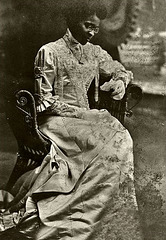
Dr. Charlotte Hawkins Brown
| 16 Oct 2023 |
|
Her 1912 wedding portrait.
Charlotte Hawkins Brown (1870 - 1961), was born in Henderson, North Carolina, but grew up in Massachusetts after her family moved from the South. She was educated in Boston and had planned to finish her college education when two events changed her life.
First, she met Alice Freeman Palmer, a prominent New England woman, who was so impressed by Hawkins' determination to get an education that she became Brown's benefactor. Then, in 1901, Brown returned to the South to teach in a country school that was supported by a Northern missionary society in the town of Sedalia, North Carolina.
"I have devoted my life to establishing for Negro youth something superior to Jim Crowism."
She arrived during the worst years of the Jim Crow era. Blacks had been disfranchised as well as segregated and there was little money available for black schools. When the school's funding ended after two years, Brown decided to remain in Sedalia to start her own school. She went north to raise money and returned with $100, which she used to open the Palmer Memorial Institute, an academic and industrial school for African Americans, in 1902.
Brown's life was a balancing act. She passionately hated segregation and continually sought ways around it. When she went to town to visit her doctor or lawyer, she would arrange to enter into their office immediately upon her arrival. Thus, she avoided sitting in the Jim Crow section of the waiting room. When her students went to the movies or other cultural events, she would rent the theater for the day so that they did not have to sit in the "colored" section.
To raise funds for the school, she wrote letters to potential supporters. Her students learned French, Latin, and other academic subjects. Brown prepared her students to be leaders of their race.
In addition to building her school, Charlotte Hawkins Brown was active in the women's club and suffragist movements. She later became president of the North Carolina Association of Colored Women's Clubs, and she helped organize voter registration drives for black women and tried to get white club women to back suffrage for black women.
She saw herself as part of the freedom struggle that was taking place in the black community. The Palmer Institute became an educational success and remained open until a decade after her death, in 1961.
Sources: Charles W. Wadelington and Richard F. Knapp, 'Charlotte Hawkins Brown and Palmer Memorial Institute; What One Young African American Woman Could Do.'
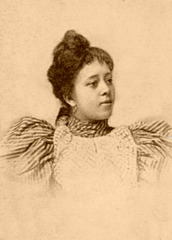
Lutie A Lytle: First African American to be admitt…
| 16 Oct 2023 |
|
In October 1897 Topekans were buzzing with the news that one of their own was a pioneer in her field. One of only two students in Central Tennessee law school's graduating class of 1897, Lutie A. Lytle was among the first African American woman to earn a law degree.
Lytle was born around 1875 in Murfreesboro, Tennessee, where her father's family had lived for some time. John R., Mary Ann "Mollie", the family's four children and Lutie's grandmother moved to Kansas around 1882, a time when many other African Americans were relocating from Tennessee to Kansas with the Exoduster movement.
The Lytle family lived at 1435 Monroe Street and Lutie and her brothers attended Topeka schools, including Topeka High School. John became active in the Populist Party and ran an unsuccessful campaign for city jailor. His involvement led to Lutie's appointment as the Populist's assistant enrolling clerk for the state legislature. She also worked for one of the African American newspapers in Topeka. It was in this position where she dreamt of higher pursuits.
"I conceived the idea of studying law in a printing office where I worked for years as a compositor," Lutie said during an interview 1897. "I read the newspaper exchanges a great deal and became impressed with the knowledge of the fact that my own people especially were the victims of legal ignorance. I resolved to fathom its depths and penetrate its mysteries and intricacies in hopes of being a benefit to my people."
At the age of 21, Lutie moved to Chattanooga, Tennessee. There she taught school to pay for her tuition at Central Tennessee College in Nashville. While in college, Lutie also became involved other social activities.
"There were a number of young men studying beside her, but she held her own with them all," stated a Nashville newspaper in 1897. "Though she studied hard, she did not shut herself out from the enjoyment of the society of her fellow students. She was a member of the college glee club, and at the numerous musical entertainments given by the students she was invariably relied upon to accompany on the piano."
In September 1897 Lytle was admitted to the Criminal Court in Memphis, Tennessee, after passing an oral exam. Newspaper accounts said that she was the first African American woman to be licensed to practice in Tennessee, and third in the United States. Later that month, after returning to Topeka, she became the first African American woman admitted to the Kansas bar.
Lutie continued to dream of helping other African Americans through the legal system, as she talked of establishing a practice in Chicago or New York. "I like constitutional law because the anchor of my race is grounded on the constitution," Lytle said. "It is the certificate of our liberty and our equality before the law. Our citizenship is based on it, and hence I love it."
"In connection with my law practice I intend to give occasional lectures, but not in any sense for personal benefit," Lytle said. "I shall talk to my own people and make a sincere and earnest effort to improve their condition as citizens. I believe in efficacy of reason to bring about the best results."
For the next year, Lutie lived in Topeka and became involved in the Interstate Literary Association with members from Kansas City, Missouri and Kansas communities. She was invited to lecture for women's groups and local colleges on law related to domestic issues.
"When I was graduated in June, I intended to commence practicing right away, but I found that a rest was what I needed," Lytle said. "Ever since a small girl in High school I have been interested in politics, and hoped some day to be able to take an active part in shaping the great questions of the day."
In fall 1898 Lytle announced that she would join the faculty at Central Tennessee. Newspaper accounts claimed that she was the only woman law instructor in the world. She served one session, 1898 - 1899, in that position.
In 1910 Lytle was living in Brooklyn, New York, with her husband, Alfred C. Cowan, also a lawyer. The couple attended the annual convention of what is now known as the Negro Bar Association in 1913. Media stories said she was the first African American female to become a member of a national bar organization and the first to participate with a spouse.
Lytle returned to Topeka in 1925 and addressed a large audience at St. John's A.M.E. Church, which she had attended in her youth. Lytle told her audience about the progress of African Americans in New York City. She shared examples of integration in the schools and government and told of the vision of Marcus Garvey, considered the father of contemporary Black Nationalism.
She died on November 12, 1955 in Brooklyn and is buried at Saint Charles Cemetery in Suffolk County, New York.
Others in the Lytle family also were well known in Topeka. Lutie's father, John, was a barber in downtown Topeka and also worked as a policeman. Lutie's brother, Charles, operated barbershops at 109 West Fifth and 326 Kansas Avenue. He later opened a drug store in 100 block of East Fourth. Charles had a lengthy career in law enforcement, which included police detective, chief of detectives, and deputy state fire marshal where he held a record for most convictions in arson cases at 236.
Source: Kansapedia: Kansas Historical Society
Jump to top
RSS feed- Kicha's latest photos with "Fearless" - Photos
- ipernity © 2007-2026
- Help & Contact
|
Club news
|
About ipernity
|
History |
ipernity Club & Prices |
Guide of good conduct
Donate | Group guidelines | Privacy policy | Terms of use | Statutes | In memoria -
Facebook
X
