

Kicha's photos with the keyword: Choreographer

Aida Overton Walker
| 20 Feb 2026 |
|
|
Aida Overton Walker is a name that should be more familiar to vaudeville and theater lovers than it is for she was the foremost African-American star of her generation which comprised the early years of the 20th century. Her national and even international fame was such that she was a living legend of black show business and in fact her vision of a world with dignified and respected black show business artists who did not have to demean themselves onstage was years ahead of reality. Her work helping young black artists and especially black women to become super-achievers and her own remarkable talents as singer, dancer, actress, comedienne and choreographer caused her to be one of the most admired and respected black women in America.
She was born in 1880 in New York City and became known quickly for her talent as a dancer and singer as well as her great natural beauty. By 1895 she was a member of the famous black touring company disparagingly known as John Isham’s Octoroons and then joined the Black Patti Troubadours. This famous group was headed by Matilda Sissieretta Joyner Jones, known as Sissieretta Jones, who became a famous soprano. She was called the “Black Patti” after the famous white soprano Adelina Patti, who was one of the foremost superstars of opera of her time. Her troupe, the Troubadours, consisted of a whole show that entertained black and sometimes also white audiences throughout the country. The show had some 40 performers but Adelina emerged as one of its leading stars.
In 1898 she joined the rapidly rising comedy team of Bert Williams and George Walker, being featured in all of their landmark black performances including The Policy Players (1899), The Sons of Ham (1900), the very famous In Dahomey (1902), Abyssinia (1905) and Bandanna Land (1907). Walker and Overton married soon after they began performing together.
Her performance of Miss Hannah from Savannah in Sons of Ham caused a national sensation and furthermore Aida did the choreography for all of these big shows and emerged as the glue or catalyst that made the Walker-Williams shows work so well, as she worked behind the scenes with her husband supplying the themes and basic ideas for the shows, which then featured the great humor of Bert Williams. Although forgotten today, whereas Williams and Walker are more remembered, the three of them formed the most popular trio of “colored” entertainers in the world in the early years of the 20th century. Aida was also in demand as a choreographer for other shows such as Bob Cole and J. Rosamond Johnson’s The Red Moon (1909).
In these shows, although she performed in blackface, Aida refused to play black plantation stereotypes and an essential part of her political activism was to make the black woman stand tall and be an object of dignity and respect, even though she would attempt to make this statement through comedy and song. She became a huge hit in England from 1902 to 1904 with In Dahomey and was frequently hired for major society parties because she became known as the Queen of the Cakewalk from her dancing in the show and the British wanted to learn this remarkable dance so-named because originally those black dancers who did it well might receive a cake for a prize. In 1903 she played a command performance at Buckingham Palace for King Edward VII which added to her international reputation.
In the midst of this success her husband allegedly contracted syphilis through his affairs with other women and he collapsed during the run of Bandanna Land in 1908. She was able to fill in for her ailing husband, performing his part in drag and managing to save the company, but eventually he grew more ill and died in 1911 as the disease, which had symptoms of stuttering and memory loss was incurable at this time. Bert Williams went on to solo success with the Ziegfeld Follies and Aida was forced to develop into a solo artist as well, leading to her work as choreographer and featured star in Red Moon and she joined the famous African-American Smart Set Company in 1910 while her husband was still gravely ill. What she must have thought of her husband’s behavior is not recorded but her indomitable will to survive and continue her art and her work even despite his situation is clear. Ten days after her husband’s death she signed a contract to star with S. H. Dudley in an all-black traveling show. Walker was buried in his home town of Lawrence, Kansas, one of many black superstars of the time to die of syphilis which almost reached epidemic proportions in the black theatrical community around this time.
Her post-Walker career was also distinctive as she emerged as a female superstar and was often invited to prominent white social gatherings to demonstrate the latest dances suitable for such events. Only Bert Williams among other black performers was able to do this and to work with white performers. For example she played the lead in Oscar Hammerstein’s 1912 revival of Salome at the Victoria Theater in New York, a role she had essayed in the black theater since the initial Salome craze of the early years of the century.
Aida was also an activist for black causes years and years before this was something that was popularly accepted. She raised significant funds for the Industrial Home for Colored Working Girls and worked to promote opportunities for young black women in the entertainment business through her connections. She hoped to promote a new generation of refined and elegant black performers free of the hamstringing stereotypes of the previous decades. To this end in 1913 and 1914 she promoted the Porto Rico Girls and the Happy Girls and produced shows for these troupes to show black women as original creative talent. This she did despite suffering from a number of disabling illnesses that beset her after the death of her husband.
In the 1910s she was described by critics as “the best Negro comedienne today” and “the most fascinating and vivacious female comedy actress the Negro race has ever produced”. Her ability to mesmerize an audience and her standard numbers performed in drag which she perfected while filling in for her ailing husband were legendary. Indeed each of her performances in shows or in vaudeville featured one of her famous drag numbers.
And then just as suddenly it was all over. Just 34 years of age, Aida died quickly on October 1, 1914 from kidney failure and hundreds of people came to her house to honor her and to grieve. A true legend of black vaudeville and theater had passed. Every black female entertainer of note in this world owes a great debt to this pioneering entertainer who envisioned a world which honored and respected black talent and who died at the height of her fame.
University of Arizona School of Anthropology Vaudeville Collection; Royal Magazine v. 10 (May - Oct. 1903), photographed by White Studio (NY)
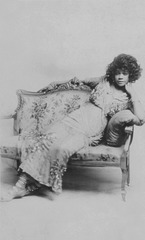
Aida Overton Walker
| 18 Oct 2023 |
|
Aida Overton Walker (1880-1914), dazzled early 20th century theater audiences with her original dance routines, her enchanting singing voice, and her penchant for elegant costumes. One of the premiere African American women artists of the turn of the century, she popularized the cakewalk and introduced it to English society. In addition to her attractive stage persona and highly acclaimed performances, she won the hearts of black entertainers for numerous benefit performances near the end of her tragically short career and for her cultivation of younger women performers. She was, in the words of the New York Age's Lester Walton, the exponent of "clean, refined artistic entertainment."
Born in New York City, where she gained an education and considerable musical training. At the tender age of fifteen, she joined John Isham's Octoroons, one of the most influential black touring groups of the 1890s, and the following year she became a member of the Black Patti Troubadours. Although the show consisted of dozens of performers, Overton emerged as one of the most promising soubrettes of her day. In 1898, she joined the company of the famous comedy team Bert Williams and George Walker, and appeared in all of their shows—The Policy Players (1899), The Sons of Ham (1900), In Dahomey (1902), Abyssinia (1905), and Bandanna Land (1907). Within about a year of their meeting, George Walker and Overton married and before long became one of the most admired and elegant African American couples on stage.
While George Walker supplied most of the ideas for the musical comedies and Bert Williams enjoyed fame as the "funniest man in America," Aida quickly became an indispensable member of the Williams and Walker Company. In The Sons of Ham, for example, her rendition of Hannah from Savannah won praise for combining superb vocal control with acting skill that together presented a positive, strong image of black womanhood. Indeed, onstage Aida refused to comply with the plantation image of black women as plump mammies, happy to serve; like her husband, she viewed the representation of refined African American types on the stage as important political work. A talented dancer, Aida improvised original routines that her husband eagerly introduced in the shows; when In Dahomey was moved to England, Aida proved to be one of the strongest attractions. Society women invited her to their homes for private lessons in the exotic cakewalk that the Walkers had included in the show. After two seasons in England, the company returned to the United States in 1904, and it was Aida who was featured in a New York Herald interview about their tour. At times Walker asked his wife to interpret dances made famous by other performers—one example being the "Salome" dance that took Broadway by storm in the early 1900s—which she did with uneven success.
After a decade of nearly continuous success with the Williams and Walker Company, Aida's career took an unexpected turn when her husband collapsed on tour with Bandanna Land. Initially Walker returned to his boyhood home of Lawrence, Kansas, where his mother took care of him. In his absence, Aida took over many of his songs and dances to keep the company together. In early 1909, however, Bandanna Land was forced to close, and Aida temporarily retired from stage work to care for her husband, now clearly seriously ill. No doubt recognizing that he likely would not recover and that she alone could support the family, she returned to the stage in Bob Cole and J. Rosamond Johnson's Red Moon in autumn 1909, and she joined the Smart Set Company in 1910. Aida also began touring the vaudeville circuit as a solo act. Less than two weeks after Walker's death in January 1911, Aida signed a two-year contract to appear as a co-star with S. H. Dudley in another all-black traveling show.
Although still a relatively young woman in the early 1910s, Aida began to develop medical problems that limited her capacity for constant touring and stage performance. As early as 1908, she had begun organizing benefits to aid such institutions as the Industrial Home for Colored Working Girls, and after her contract with S. H. Dudley expired, she devoted more of her energy to such projects, which allowed her to remain in New York. She also took an interest in developing the talents of younger women in the profession, hoping to pass along her vision of black performance as refined and elegant. She produced shows for two such female groups in 1913 and 1914—the Porto Rico Girls and the Happy Girls. She encouraged them to work up original dance numbers and insisted that they don stylish costumes on stage.
When Aida Overton Walker died suddenly of kidney failure on October 11, 1914, the African American entertainment community in New York went into deep mourning. The New York Age featured a lengthy obituary on its front page, and hundreds of shocked entertainers descended on her residence to confirm a story they hoped was untrue. Walker left behind a legacy of polished performance and model professionalism. Her demand for respect and her generosity made her a beloved figure in African American theater circles.
Source: Jazz: Black Musical Theater in New York, 1890-1915. Washington, D.C., Smithsonian Institution Press, 1989, Thomas L Riis
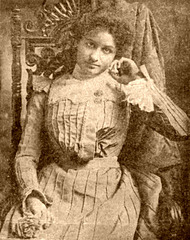
Belle Davis
| 18 Oct 2023 |
|
Belle Davis was an African American song and dance artist, entertainer, choreographer, and director. She was a recording pioneer who toured Europe extensively during the period 1901-1929. Not only did she record on disc as early as 1902, she also performed in front of a movie camera at least twice during the early years of this century. In spite of these extraordinary achievements, little has been written about her; her biography, her discography and her filmography remain sketchy.
Belle Davis, (1874 - circa 1938), was born in Chicago, Illinois on April 28, 1874, the daughter of George Davis. Of European and African ancestry, she spent most of her adult life abroad, largely in Britain, where she arrived in mid-1901 with two boys who were billed as Piccaninny Actors. Her performance style changed from ‘coon shouting’ and ‘ragtime singing’ in the 1890s to a more decorous manner, where prancing children provided the amusement. She directed their stage act, and with two, sometimes three or four, black children the act was a vigorous and popular entertainment in British and continental theatres.
Davis's troupe appeared on the reputable Empire Theatre circuit in late 1901, recorded in London in 1902 (including the song ‘The Honey-Suckle and the Bee’), continued touring London and the provinces in 1903, and ventured to the continent. Dozens of other African-Americans were entertaining the British at this time, and on June 9, 1904 Davis married one of the more successful, Henry Troy, in London. Following her marriage the act continued to tour, and was filmed, for commercial distribution. The Empire circuit continued to employ the group, as did other leading theatres. They presented their ten-minute stage act in Dublin, Cardiff, Swansea, Manchester, Birmingham, Nottingham, Leicester, Edinburgh, Liverpool, and Sheffield between May 1906 and August 1909, and appeared in Berlin, The Hague, Paris, Vienna, St Petersburg, and Brussels during the same period. Some leading performers had their apprenticeship as dancers in Davis's act; when they grew too large she recruited younger boys from America.
The act had been seen by hundreds of thousands of Britons by 1914, when war prevented continental touring and so exposed more Britons to Belle Davis and Her Cracker Jacks. She and the children performed in major cities as well as Ayr, Doncaster, Portsmouth, Ilkeston, and Weymouth during the war years. Her last known performance in Britain was in 1918. From 1925 to 1929 she directed the dancing in the revues at the Casino de Paris, and 1929 also saw Belle Davis Piccaninnies in Germany with Wunderland der Liebe, a revue set in the south seas. As early as 1915 she was describing herself as married to the African American entertainer Edward Peter (Eddie) Whaley (circa 1880–1960), and she took out an American passport in the name Belle Whaley in 1920. She and Whaley eventually did marry, on July 12, 1926, but they had divorced by 1936. In 1938 she boarded the Queen Mary in Southampton to return to a Chicago address.
Sometimes billed as a ‘creole’, Davis was a soprano whose songs were not from the minstrel show or spiritual traditions, but were graceful melodies. By contrast the children were energetic dancers who combined suppleness with comedy. Their well-dressed director's elegance was praised, and is evidenced by surviving promotional material. The mercurial entertainment business had few acts for whom top theatres provided employment for the length of time she worked in Britain. Her qualities both as a singer and as dance director, combined with her professionalism in travelling from town to town, country to country, in charge of boisterous children, were solid, and enabled her to have success at her chosen profession for three decades. Stately, well dressed, and showing faint African features, she presented American dance and song to countless Britons and kept top employers anxious to take her act for their shows.
Sources: Jeffrey Green and Rainer E. Lotz
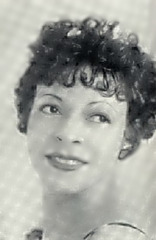
Maude Russell
| 18 Oct 2023 |
|
New York Times
March 29,2001
by Joyce Wadler
Maude Rutherford, 104, Dies
High-Kicking Songster of 1920's
Maude Russell Rutherford, a singer and dancer in the glory days of black theater in the 1920's who always said she was the one who really introduced the Charleston on Broadway, died on March 8 at her home in Atlantic City. She is believed to have been 104.
Strikingly pretty, she was billed as the Slim Princess when she worked with Josephine Baker, Fats Waller and Pearl Bailey. Never a star, Ms. Rutherford was usually the soubrette or a featured performer and a great favorite at Harlem's Cotton Club.
She wrote her particular footnote to history in 1922 in the Broadway show ''Liza, '' an all-black revue with lyrics and music by Maceo Pinkard. While many dance histories credit the 1923 show ''Runnin' Wild'' with bringing the Charleston to Broadway, Ms. Rutherford led the ''Liza'' chorus girls in the dance a year earlier.
She remained proud of her dance abilities to the end of her life.
''I used to kick 32 times across the stage, and my legs would hit my nose,'' Ms. Rutherford told Jean-Claude Baker, who was reared by Josephine Baker and who is a student of black entertainment. ''I was a dancing fool.''
Ms. Rutherford was born in Texas to a black mother, Margaret Lee, and a white father, William McCann. With interracial unions prohibited, her parents never lived together.
As a teenager working as a ticket taker, Ms. Rutherford met Sam Russell, a star of the black theater with the comedy team Bilo and Ashes. He asked her to go on the road with him. She demanded marriage first. The marriage was violent and short. Ms. Rutherford, weary of being beaten, surreptitiously relieved her husband of $100, then struck out on her own.
Tall, with a sweet voice, she would play the bouncy, good-time girl, perhaps the comic relief. ''I'm Forever Blowing Bubbles'' was a youthful audition choice. Early in her career a producer tried to mold her as a blues singer, but, as Ms. Rutherford told Mr. Baker in a taped interview, it did not fit. The producer said, ''Honey, you stick to bubbles.''
Her style offstage was down to earth and no-nonsense, and she used language too vivid to be called plain-spoken; she described one colleague as ''so ugly she could take a stick and break day.''
Ms. Rutherford's theater credits included ''Dixie to Broadway'' (1924), ''Chocolate Scandals'' (1927) and ''Keep Shufflin' '' (1928). She left show business in the 1950's and in 1953 married her fifth husband, Septimus Rutherford, chief steward for the Moore-McCormack Lines. She worked as a switchboard operator in an Atlantic City hotel.
But she never lost her show-biz flair.
When her husband died in 1980, Ms. Rutherford had her name carved into the headstone she and her husband would share, as well as a birth date, Mr. Baker said.
But instead of 1897, which she had told friends was the year of her birth, the carved date was 1902.
''She said, 'By the time I die, nobody will be here to remember, so I will go forever in eternity five years younger,' '' Mr. Baker said.
Jean-Claude Baker Foundation
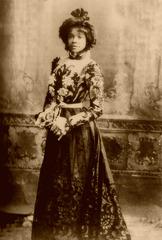
Aida Overton Walker
| 18 Oct 2023 |
|
Aida Overton Walker (1880-1914), dazzled early 20th century theater audiences with her original dance routines, her enchanting singing voice, and her penchant for elegant costumes. One of the premiere African American women artists of the turn of the century, she popularized the cakewalk and introduced it to English society. In addition to her attractive stage persona and highly acclaimed performances, she won the hearts of black entertainers for numerous benefit performances near the end of her tragically short career and for her cultivation of younger women performers. She was, in the words of the New York Age's Lester Walton, the exponent of "clean, refined artistic entertainment."
Born in New York City, where she gained an education and considerable musical training. At the tender age of fifteen, she joined John Isham's Octoroons, one of the most influential black touring groups of the 1890s, and the following year she became a member of the Black Patti Troubadours. Although the show consisted of dozens of performers, Overton emerged as one of the most promising soubrettes of her day. In 1898, she joined the company of the famous comedy team Bert Williams and George Walker, and appeared in all of their shows—The Policy Players (1899), The Sons of Ham (1900), In Dahomey (1902), Abyssinia (1905), and Bandanna Land (1907). Within about a year of their meeting, George Walker and Overton married and before long became one of the most admired and elegant African American couples on stage.
While George Walker supplied most of the ideas for the musical comedies and Bert Williams enjoyed fame as the "funniest man in America," Aida quickly became an indispensable member of the Williams and Walker Company. In The Sons of Ham, for example, her rendition of Hannah from Savannah won praise for combining superb vocal control with acting skill that together presented a positive, strong image of black womanhood. Indeed, onstage Aida refused to comply with the plantation image of black women as plump mammies, happy to serve; like her husband, she viewed the representation of refined African American types on the stage as important political work. A talented dancer, Aida improvised original routines that her husband eagerly introduced in the shows; when In Dahomey was moved to England, Aida proved to be one of the strongest attractions. Society women invited her to their homes for private lessons in the exotic cakewalk that the Walkers had included in the show. After two seasons in England, the company returned to the United States in 1904, and it was Aida who was featured in a New York Herald interview about their tour. At times Walker asked his wife to interpret dances made famous by other performers—one example being the "Salome" dance that took Broadway by storm in the early 1900s—which she did with uneven success.
After a decade of nearly continuous success with the Williams and Walker Company, Aida's career took an unexpected turn when her husband collapsed on tour with Bandanna Land. Initially Walker returned to his boyhood home of Lawrence, Kansas, where his mother took care of him. In his absence, Aida took over many of his songs and dances to keep the company together. In early 1909, however, Bandanna Land was forced to close, and Aida temporarily retired from stage work to care for her husband, now clearly seriously ill. No doubt recognizing that he likely would not recover and that she alone could support the family, she returned to the stage in Bob Cole and J. Rosamond Johnson's Red Moon in autumn 1909, and she joined the Smart Set Company in 1910. Aida also began touring the vaudeville circuit as a solo act. Less than two weeks after Walker's death in January 1911, Aida signed a two-year contract to appear as a co-star with S. H. Dudley in another all-black traveling show.
Although still a relatively young woman in the early 1910s, Aida began to develop medical problems that limited her capacity for constant touring and stage performance. As early as 1908, she had begun organizing benefits to aid such institutions as the Industrial Home for Colored Working Girls, and after her contract with S. H. Dudley expired, she devoted more of her energy to such projects, which allowed her to remain in New York. She also took an interest in developing the talents of younger women in the profession, hoping to pass along her vision of black performance as refined and elegant. She produced shows for two such female groups in 1913 and 1914—the Porto Rico Girls and the Happy Girls. She encouraged them to work up original dance numbers and insisted that they don stylish costumes on stage.
When Aida Overton Walker died suddenly of kidney failure on October 11, 1914, the African American entertainment community in New York went into deep mourning. The New York Age featured a lengthy obituary on its front page, and hundreds of shocked entertainers descended on her residence to confirm a story they hoped was untrue. Walker left behind a legacy of polished performance and model professionalism. Her demand for respect and her generosity made her a beloved figure in African American theater circles.
Bio: Jazz: Black Musical Theater in New York, 1890-1915. Washington, D.C., Smithsonian Institution Press, 1989, Thomas L Riis
Photo: "Staging Race: Black Performers in Turn of the Century America" Karen Sotiropoulos

Aida Overton Walker
| 16 Oct 2023 |
|
Aida Overton Walker is a name that should be more familiar to vaudeville and theater lovers than it is for she was the foremost African-American star of her generation which comprised the early years of the 20th century. Her national and even international fame was such that she was a living legend of black show business and in fact her vision of a world with dignified and respected black show business artists who did not have to demean themselves onstage was years ahead of reality. Her work helping young black artists and especially black women to become super-achievers and her own remarkable talents as singer, dancer, actress, comedienne and choreographer caused her to be one of the most admired and respected black women in America.
Aida was born in 1880 in New York City and became known quickly for her talent as a dancer and singer as well as her great natural beauty. By 1895 she was a member of the famous black touring company disparagingly known as John Isham’s Octoroons and then joined the Black Patti Troubadours. This famous group was headed by Matilda Sissieretta Joyner Jones, known as Sissieretta Jones, who became a famous soprano. She was called the “Black Patti” after the famous white soprano Adelina Patti, who was one of the foremost superstars of opera of her time. Her troupe, the Troubadours, consisted of a whole show that entertained black and sometimes also white audiences throughout the country. The show had some 40 performers but Adelina emerged as one of its leading stars.
In 1898 she joined the rapidly rising comedy team of Bert Williams and George Walker, being featured in all of their landmark black performances including The Policy Players (1899), The Sons of Ham (1900), the very famous In Dahomey (1902), Abyssinia (1905) and Bandanna Land (1907). Walker and Overton married soon after they began performing together.
Her performance of Miss Hannah from Savannah in Sons of Ham caused a national sensation and furthermore Aida did the choreography for all of these big shows and emerged as the glue or catalyst that made the Walker-Williams shows work so well, as she worked behind the scenes with her husband supplying the themes and basic ideas for the shows, which then featured the great humor of Bert Williams. Although forgotten today, whereas Williams and Walker are more remembered, the three of them formed the most popular trio of “colored” entertainers in the world in the early years of the 20th century. Aida was also in demand as a choreographer for other shows such as Bob Cole and J. Rosamond Johnson’s The Red Moon (1909).
In these shows, although she performed in blackface, Aida refused to play black plantation stereotypes and an essential part of her political activism was to make the black woman stand tall and be an object of dignity and respect, even though she would attempt to make this statement through comedy and song. She became a huge hit in England from 1902 to 1904 with In Dahomey and was frequently hired for major society parties because she became known as the Queen of the Cakewalk from her dancing in the show and the British wanted to learn this remarkable dance so-named because originally those black dancers who did it well might receive a cake for a prize. In 1903 she played a command performance at Buckingham Palace for King Edward VII which added to her international reputation.
In the midst of this success her husband allegedly contracted syphilis through affairs with other women and he collapsed during the run of Bandanna Land in 1908. She was able to fill in for her ailing husband, performing his part in drag and managing to save the company, but eventually he grew more ill and died in 1911 as the disease, which had symptoms of stuttering and memory loss was incurable at this time. Bert Williams went on to solo success with the Ziegfeld Follies and Aida was forced to develop into a solo artist as well, leading to her work as choreographer and featured star in Red Moon and she joined the famous African-American Smart Set Company in 1910 while her husband was still gravely ill. What she must have thought of her husband’s behavior is not recorded but her indomitable will to survive and continue her art and her work even despite his situation is clear. Ten days after her husband’s death she signed a contract to star with S. H. Dudley in an all-black traveling show. Walker was buried in his home town of Lawrence, Kansas, one of many black superstars of the time to die of syphilis which almost reached epidemic proportions in the black theatrical community around this time.
Her post-Walker career was also distinctive as she emerged as a female superstar and was often invited to prominent white social gatherings to demonstrate the latest dances suitable for such events. Only Bert Williams among other black performers was able to do this and to work with white performers. For example she played the lead in Oscar Hammerstein’s 1912 revival of Salome at the Victoria Theater in New York, a role she had essayed in the black theater since the initial Salome craze of the early years of the century.
Aida was also an activist for black causes years and years before this was something that was popularly accepted. She raised significant funds for the Industrial Home for Colored Working Girls and worked to promote opportunities for young black women in the entertainment business through her connections. She hoped to promote a new generation of refined and elegant black performers free of the hamstringing stereotypes of the previous decades. To this end in 1913 and 1914 she promoted the Porto Rico Girls and the Happy Girls and produced shows for these troupes to show black women as original creative talent. This she did despite suffering from a number of disabling illnesses that beset her after the death of her husband.
In the 1910s she was described by critics as “the best Negro comedienne today” and “the most fascinating and vivacious female comedy actress the Negro race has ever produced”. Her ability to mesmerize an audience and her standard numbers performed in drag which she perfected while filling in for her ailing husband were legendary. Indeed each of her performances in shows or in vaudeville featured one of her famous drag numbers.
And then just as suddenly it was all over. Just 34 years of age, Aida died quickly on October 1, 1914 from kidney failure and hundreds of people came to her house to honor her and to grieve. A true legend of black vaudeville and theater had passed. Every black female entertainer of note in this world owes a great debt to this pioneering entertainer who envisioned a world which honored and respected black talent and who died at the height of her fame.
Sources: The American Vaudeville Museum & UA Collection; James Weldon Johnson Collection in the Yale Collection of American Literature, Beinecke Rare Book and Manuscript Library

Queen of Swing: Norma Miller
| 16 Oct 2023 |
|
Norma Miller, a dancer, comedian and big-band singer whose acrobatic flips, slides, leaps and twists helped popularize the Lindy Hop dance craze of the 1930s and ’40s, earning her the title “Queen of Swing,” died May 5, 2019, at her home in Fort Myers, Florida. She was 99 and had continued performing with an Italian swing band until shortly before her death.
The cause was congestive heart failure, said her friend John Biffar, director of “Queen of Swing,” a 2006 documentary about her life.
“She had just cut four new tracks,” he said. “They were playing her music for her when she passed.”
Ms. Miller was among the last links to the glory days of Harlem’s Savoy Ballroom, a racially integrated dance hall where big bands led by Chick Webb and Benny Goodman dueled from opposing stages, fueling the steps of jitterbug dancers who bounded across the maple-and-mahogany hardwood under crystal chandeliers.
She was also considered the last surviving member of Whitey’s Lindy Hoppers, a legendary Savoy troupe. The swing dance style — involving dancers who turned themselves into human propellers with their spinning and tossing — reportedly was named for transatlantic aviator Charles Lindbergh.
In a career that spanned more than eight decades, Ms. Miller shared the stage with singers Ethel Waters and Billie Holiday, befriended filmmaker Orson Welles in Brazil, smoked marijuana with Louis Armstrong, helped integrate Miami Beach nightclubs with Cab Calloway, and launched a saucy and profane stand-up career with support from Redd Foxx and Richard Pryor.
Her big break came in 1932, when she was 12. The dance sensation Twist Mouth George Ganaway spotted her dancing on the sidewalk outside the Savoy dressed for Easter Sunday services and invited her to join him for a matinee performance. Because of age restrictions, it was the first time Ms. Miller had stepped inside the dance hall.
“He just threw me up; my feet never touched the ground,” she said in Ken Burns’s 2001 documentary “Jazz.” “People were screaming and he put me on top of his shoulders, walked me around the ballroom . . . and put me back outside. Greatest moment in my life and I’m excited, excited, and I’m gonna go home and tell my mother and my sister — and then I said no, I better not say nothin’!”
At 15, she was invited to join Whitey’s Lindy Hoppers as the troupe’s youngest member. They embarked on tours across Europe, the United States and South America, and were featured in Hollywood movies including the Marx Brothers comedy “A Day at the Races” (1937), which earned an Oscar nomination for best dance direction for the Lindy Hop routine to “All God’s Chillun Got Rhythm.”
For “Hellzapoppin’ ” (1941), a musical starring the comedy team of Ole Olsen and Chic Johnson, Ms. Miller played a dancing cook, flying under the legs and over the head of Billy Ricker at a freight-train tempo. Improbably, he appeared to swing her in a circle by the neck.
Ms. Miller also danced in Broadway musicals such as “Swingin’ the Dream,” a short-lived 1939 production headlined by Armstrong. But with the onset of World War II and the rise of bebop, the Lindy Hop began to vanish from the stage, leading Ms. Miller to reinvent herself while many of her fellow performers struggled to launch second careers.
She led a dance group on the chitlin’ circuit, traveling across the segregated United States by bus, before turning to comedy in the 1960s at the suggestion of Foxx. “Look, you’re not going to be able to dance any longer,” she recalled his saying. “Your knees are knocking. You better learn to talk.”
In between performances in Las Vegas, she presided over dance workshops and productions, and worked as a choreographer. She helped spur a Lindy Hop revival beginning in the 1980s, when she introduced the dance style to a new generation through shows at venues including Smalls’ Paradise and the Village Gate in Manhattan; collaborated with Manning on a sequence for Alvin Ailey’s “Opus McShann”; and watched what she described as a morbid game of musical chairs, as her old friends and fellow dancers died.
“When my last partner was put into the grave, I said, ‘Well, I’m the only one left here,’ ” she told NPR in 2017. “And I promised Frankie I will keep going and keep doing what he gave to the world because he gave all the young kids the dance.”
Norma Adele Miller was born in Manhattan on Dec. 2, 1919. Both her parents emigrated from Barbados: Her mother was a maid, and her father served in the Army and died of pneumonia shortly before she was born.
After winning a local dance contest, she was invited to join Whitey’s Lindy Hoppers, formed by Herbert White, a bouncer turned promoter. In her memoir, “Swingin’ at the Savoy,” Ms. Miller recalled that the Lindy Hop took off after her fellow Savoy dancers swept the competition at the 1935 Harvest Moon Ball, a contest at New York’s Madison Square Garden.
Ms. Miller left the group because of “accounting differences” with Whitey, according to Biffar, and formed the Norma Miller Dancers and Norma Miller and Her Jazzmen. In the 1970s she appeared alongside Foxx in episodes of his sitcoms “Sanford and Son,” “Grady” and “Sanford Arms.” She also toured Vietnam, performing her comedy routine for American troops.
In 1992, amid the Lindy Hop revival, she danced in Spike Lee’s “Malcolm X” and received an Emmy nomination for choreographing “Stompin’ at the Savoy,” a TV movie directed by Allen. Soon after, she met Biffar, a filmmaker, who cast her in his movie “Captiva Island.” They lived together for about a decade, and she helped raise his three children.
Ms. Miller, who never married and leaves no immediate survivors, once quipped that she was “the last of the closet queens, a spinster.” She appeared in several documentaries on swing dance and jazz, taught at Stanford University and the University of Hawaii, and in 2003 received a National Heritage Fellowship from the National Endowment for the Arts.
In 2018, at age 98, she presided over a dance camp in the Swedish countryside, shouting instructions from a chair — as a group of mostly white students practiced the dance style she had nurtured in Harlem.
When she first heard about the camp, Ms. Miller told the New York Times, she said, “You’ve got to be kidding talking about some [expletive] Lindy Hop in Sweden. Who the hell’s gonna come here?” Around 200 dancers made the trip, and Ms. Miller said she planned to return for her 100th birthday.
Sources: Washington Post article by Harrison Smith (May 6, 2019); Boris Bokany, Photographer
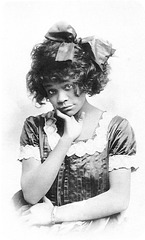
Aida Overton Walker
| 18 Oct 2023 |
|
|
Aida Overton Walker (1880-1914), dazzled early 20th century theater audiences with her original dance routines, her enchanting singing voice, and her penchant for elegant costumes. One of the premiere African American women artists of the turn of the century, she popularized the cakewalk and introduced it to English society. In addition to her attractive stage persona and highly acclaimed performances, she won the hearts of black entertainers for numerous benefit performances near the end of her tragically short career and for her cultivation of younger women performers. She was, in the words of the New York Age's Lester Walton, the exponent of "clean, refined artistic entertainment."
Born in New York City, where she gained an education and considerable musical training. At the tender age of fifteen, she joined John Isham's Octoroons, one of the most influential black touring groups of the 1890s, and the following year she became a member of the Black Patti Troubadours. Although the show consisted of dozens of performers, Overton emerged as one of the most promising soubrettes of her day. In 1898, she joined the company of the famous comedy team Bert Williams and George Walker, and appeared in all of their shows—The Policy Players (1899), The Sons of Ham (1900), In Dahomey (1902), Abyssinia (1905), and Bandanna Land (1907). Within about a year of their meeting, George Walker and Overton married and before long became one of the most admired and elegant African American couples on stage.
While George Walker supplied most of the ideas for the musical comedies and Bert Williams enjoyed fame as the "funniest man in America," Aida quickly became an indispensable member of the Williams and Walker Company. In The Sons of Ham, for example, her rendition of Hannah from Savannah won praise for combining superb vocal control with acting skill that together presented a positive, strong image of black womanhood. Indeed, onstage Aida refused to comply with the plantation image of black women as plump mammies, happy to serve; like her husband, she viewed the representation of refined African American types on the stage as important political work. A talented dancer, Aida improvised original routines that her husband eagerly introduced in the shows; when In Dahomey was moved to England, Aida proved to be one of the strongest attractions. Society women invited her to their homes for private lessons in the exotic cakewalk that the Walkers had included in the show. After two seasons in England, the company returned to the United States in 1904, and it was Aida who was featured in a New York Herald interview about their tour. At times Walker asked his wife to interpret dances made famous by other performers—one example being the "Salome" dance that took Broadway by storm in the early 1900s—which she did with uneven success.
After a decade of nearly continuous success with the Williams and Walker Company, Aida's career took an unexpected turn when her husband collapsed on tour with Bandanna Land. Initially Walker returned to his boyhood home of Lawrence, Kansas, where his mother took care of him. In his absence, Aida took over many of his songs and dances to keep the company together. In early 1909, however, Bandanna Land was forced to close, and Aida temporarily retired from stage work to care for her husband, now clearly seriously ill. No doubt recognizing that he likely would not recover and that she alone could support the family, she returned to the stage in Bob Cole and J. Rosamond Johnson's Red Moon in autumn 1909, and she joined the Smart Set Company in 1910. Aida also began touring the vaudeville circuit as a solo act. Less than two weeks after Walker's death in January 1911, Aida signed a two-year contract to appear as a co-star with S. H. Dudley in another all-black traveling show.
Although still a relatively young woman in the early 1910s, Aida began to develop medical problems that limited her capacity for constant touring and stage performance. As early as 1908, she had begun organizing benefits to aid such institutions as the Industrial Home for Colored Working Girls, and after her contract with S. H. Dudley expired, she devoted more of her energy to such projects, which allowed her to remain in New York. She also took an interest in developing the talents of younger women in the profession, hoping to pass along her vision of black performance as refined and elegant. She produced shows for two such female groups in 1913 and 1914—the Porto Rico Girls and the Happy Girls. She encouraged them to work up original dance numbers and insisted that they don stylish costumes on stage.
When Aida Overton Walker died suddenly of kidney failure on October 11, 1914, the African American entertainment community in New York went into deep mourning. The New York Age featured a lengthy obituary on its front page, and hundreds of shocked entertainers descended on her residence to confirm a story they hoped was untrue. Walker left behind a legacy of polished performance and model professionalism. Her demand for respect and her generosity made her a beloved figure in African American theater circles.
Sources: Jazz: Black Musical Theater in New York, 1890-1915. Washington, D.C., Smithsonian Institution Press, 1989, Thomas L Riis; Apeda Studio, NY.
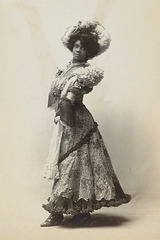
Aida Overton Walker
| 16 Oct 2023 |
|
Aida Overton Walker (1880-1914), dazzled early 20th century theater audiences with her original dance routines, her enchanting singing voice, and her penchant for elegant costumes. One of the premiere African American women artists of the turn of the century, she popularized the cakewalk and introduced it to English society. In addition to her attractive stage persona and highly acclaimed performances, she won the hearts of black entertainers for numerous benefit performances near the end of her tragically short career and for her cultivation of younger women performers. She was, in the words of the New York Age's Lester Walton, the exponent of "clean, refined artistic entertainment."
Born in New York City, where she gained an education and considerable musical training. At the tender age of fifteen, she joined John Isham's Octoroons, one of the most influential black touring groups of the 1890s, and the following year she became a member of the Black Patti Troubadours. Although the show consisted of dozens of performers, Overton emerged as one of the most promising soubrettes of her day. In 1898, she joined the company of the famous comedy team Bert Williams and George Walker, and appeared in all of their shows—The Policy Players (1899), The Sons of Ham (1900), In Dahomey (1902), Abyssinia (1905), and Bandanna Land (1907). Within about a year of their meeting, George Walker and Overton married and before long became one of the most admired and elegant African American couples on stage.
While George Walker supplied most of the ideas for the musical comedies and Bert Williams enjoyed fame as the "funniest man in America," Aida quickly became an indispensable member of the Williams and Walker Company. In The Sons of Ham, for example, her rendition of Hannah from Savannah won praise for combining superb vocal control with acting skill that together presented a positive, strong image of black womanhood. Indeed, onstage Aida refused to comply with the plantation image of black women as plump mammies, happy to serve; like her husband, she viewed the representation of refined African American types on the stage as important political work. A talented dancer, Aida improvised original routines that her husband eagerly introduced in the shows; when In Dahomey was moved to England, Aida proved to be one of the strongest attractions. Society women invited her to their homes for private lessons in the exotic cakewalk that the Walkers had included in the show. After two seasons in England, the company returned to the United States in 1904, and it was Aida who was featured in a New York Herald interview about their tour. At times Walker asked his wife to interpret dances made famous by other performers—one example being the "Salome" dance that took Broadway by storm in the early 1900s—which she did with uneven success.
After a decade of nearly continuous success with the Williams and Walker Company, Aida's career took an unexpected turn when her husband collapsed on tour with Bandanna Land. Initially Walker returned to his boyhood home of Lawrence, Kansas, where his mother took care of him. In his absence, Aida took over many of his songs and dances to keep the company together. In early 1909, however, Bandanna Land was forced to close, and Aida temporarily retired from stage work to care for her husband, now clearly seriously ill. No doubt recognizing that he likely would not recover and that she alone could support the family, she returned to the stage in Bob Cole and J. Rosamond Johnson's Red Moon in autumn 1909, and she joined the Smart Set Company in 1910. Aida also began touring the vaudeville circuit as a solo act. Less than two weeks after Walker's death in January 1911, Aida signed a two-year contract to appear as a co-star with S. H. Dudley in another all-black traveling show.
Although still a relatively young woman in the early 1910s, Aida began to develop medical problems that limited her capacity for constant touring and stage performance. As early as 1908, she had begun organizing benefits to aid such institutions as the Industrial Home for Colored Working Girls, and after her contract with S. H. Dudley expired, she devoted more of her energy to such projects, which allowed her to remain in New York. She also took an interest in developing the talents of younger women in the profession, hoping to pass along her vision of black performance as refined and elegant. She produced shows for two such female groups in 1913 and 1914—the Porto Rico Girls and the Happy Girls. She encouraged them to work up original dance numbers and insisted that they don stylish costumes on stage.
When Aida Overton Walker died suddenly of kidney failure on October 11, 1914, the African American entertainment community in New York went into deep mourning. The New York Age featured a lengthy obituary on its front page, and hundreds of shocked entertainers descended on her residence to confirm a story they hoped was untrue. Walker left behind a legacy of polished performance and model professionalism. Her demand for respect and her generosity made her a beloved figure in African American theater circles.
Sources: Jazz: Black Musical Theater in New York, 1890-1915. Washington, D.C., Smithsonian Institution Press, 1989, Thomas L Riis; James Weldon Johnson Collection in the Yale Collection of American Literature, Beinecke Rare Book and Manuscript Library
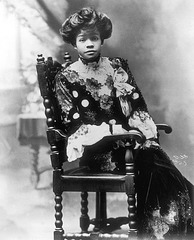
Aida Overton Walker
| 16 Oct 2023 |
|
Aida Overton Walker (1880 - 1914), dazzled early-twentieth-century theater audiences with her original dance routines, her enchanting singing voice, and her penchant for elegant costumes. One of the premiere African American women artists of the turn of the century, she popularized the cakewalk and introduced it to English society. In addition to her attractive stage persona and highly acclaimed performances, she won the hearts of black entertainers for numerous benefit performances near the end of her tragically short career and for her cultivation of younger women performers. She was, in the words of the New York Age's Lester Walton, the exponent of "clean, refined artistic entertainment."
Born in 1880 in New York City, a city in which she gained an education and considerable musical training. At the tender age of fifteen, she joined John Isham's Octoroons, one of the most influential black touring groups of the 1890s, and the following year she became a member of the Black Patti Troubadours. Although the show consisted of dozens of performers, Overton emerged as one of the most promising soubrettes of her day. In 1898, she joined the company of the famous comedy team Bert Williams and George Walker, and appeared in all of their shows—The Policy Players (1899), The Sons of Ham (1900), In Dahomey (1902), Abyssinia (1905), and Bandanna Land (1907). Within about a year of their meeting, George Walker and Overton married and before long became one of the most admired and elegant African American couples on stage.
While George Walker supplied most of the ideas for the musical comedies and Bert Williams enjoyed fame as the "funniest man in America," Aida quickly became an indispensable member of the Williams and Walker Company. In The Sons of Ham, for example, her rendition of Hannah from Savannah won praise for combining superb vocal control with acting skill that together presented a positive, strong image of black womanhood. Indeed, onstage Aida refused to comply with the plantation image of black women as plump mammies, happy to serve; like her husband, she viewed the representation of refined African American types on the stage as important political work. A talented dancer, Aida improvised original routines that her husband eagerly introduced in the shows; when In Dahomey was moved to England, Aida proved to be one of the strongest attractions. Society women invited her to their homes for private lessons in the exotic cakewalk that the Walkers had included in the show. After two seasons in England, the company returned to the United States in 1904, and it was Aida who was featured in a New York Herald interview about their tour. At times Walker asked his wife to interpret dances made famous by other performers—one example being the "Salome" dance that took Broadway by storm in the early 1900s—which she did with uneven success.
After a decade of nearly continuous success with the Williams and Walker Company, Aida's career took an unexpected turn when her husband collapsed on tour with Bandanna Land. Initially Walker returned to his boyhood home of Lawrence, Kansas, where his mother took care of him. In his absence, Aida took over many of his songs and dances to keep the company together. In early 1909, however, Bandanna Land was forced to close, and Aida temporarily retired from stage work to care for her husband, now clearly seriously ill. No doubt recognizing that he likely would not recover and that she alone could support the family, she returned to the stage in Bob Cole and J. Rosamond Johnson's Red Moon in autumn 1909, and she joined the Smart Set Company in 1910. Aida also began touring the vaudeville circuit as a solo act. Less than two weeks after Walker's death in January 1911, Aida signed a two-year contract to appear as a co-star with S. H. Dudley in another all-black traveling show.
Although still a relatively young woman in the early 1910s, Aida began to develop medical problems that limited her capacity for constant touring and stage performance. As early as 1908, she had begun organizing benefits to aid such institutions as the Industrial Home for Colored Working Girls, and after her contract with S. H. Dudley expired, she devoted more of her energy to such projects, which allowed her to remain in New York. She also took an interest in developing the talents of younger women in the profession, hoping to pass along her vision of black performance as refined and elegant. She produced shows for two such female groups in 1913 and 1914—the Porto Rico Girls and the Happy Girls. She encouraged them to work up original dance numbers and insisted that they don stylish costumes on stage.
When Aida Overton Walker died suddenly of kidney failure on October 11, 1914, the African American entertainment community in New York went into deep mourning. The New York Age featured a lengthy obituary on its front page, and hundreds of shocked entertainers descended on her residence to confirm a story they hoped was untrue. Walker left behind a legacy of polished performance and model professionalism. Her demand for respect and her generosity made her a beloved figure in African American theater circles.
Sources: Jazz: Black Musical Theater in New York, 1890-1915. Washington, D.C., Smithsonian Institution Press, 1989, Thomas L Riis
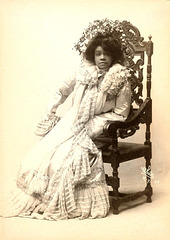
Aida Overton Walker
| 16 Oct 2023 |
|
Aida Overton Walker (1880-1914), dazzled early 20th century theater audiences with her original dance routines, her enchanting singing voice, and her penchant for elegant costumes. One of the premiere African American women artists of the turn of the century, she popularized the cakewalk and introduced it to English society. In addition to her attractive stage persona and highly acclaimed performances, she won the hearts of black entertainers for numerous benefit performances near the end of her tragically short career and for her cultivation of younger women performers. She was, in the words of the New York Age's Lester Walton, the exponent of "clean, refined artistic entertainment."
Born in New York City, where she gained an education and considerable musical training. At the tender age of fifteen, she joined John Isham's Octoroons, one of the most influential black touring groups of the 1890s, and the following year she became a member of the Black Patti Troubadours. Although the show consisted of dozens of performers, Overton emerged as one of the most promising soubrettes of her day. In 1898, she joined the company of the famous comedy team Bert Williams and George Walker, and appeared in all of their shows—The Policy Players (1899), The Sons of Ham (1900), In Dahomey (1902), Abyssinia (1905), and Bandanna Land (1907). Within about a year of their meeting, George Walker and Overton married and before long became one of the most admired and elegant African American couples on stage.
While George Walker supplied most of the ideas for the musical comedies and Bert Williams enjoyed fame as the "funniest man in America," Aida quickly became an indispensable member of the Williams and Walker Company. In The Sons of Ham, for example, her rendition of Hannah from Savannah won praise for combining superb vocal control with acting skill that together presented a positive, strong image of black womanhood. Indeed, onstage Aida refused to comply with the plantation image of black women as plump mammies, happy to serve; like her husband, she viewed the representation of refined African American types on the stage as important political work. A talented dancer, Aida improvised original routines that her husband eagerly introduced in the shows; when In Dahomey was moved to England, Aida proved to be one of the strongest attractions. Society women invited her to their homes for private lessons in the exotic cakewalk that the Walkers had included in the show. After two seasons in England, the company returned to the United States in 1904, and it was Aida who was featured in a New York Herald interview about their tour. At times Walker asked his wife to interpret dances made famous by other performers—one example being the "Salome" dance that took Broadway by storm in the early 1900s—which she did with uneven success.
After a decade of nearly continuous success with the Williams and Walker Company, Aida's career took an unexpected turn when her husband collapsed on tour with Bandanna Land. Initially Walker returned to his boyhood home of Lawrence, Kansas, where his mother took care of him. In his absence, Aida took over many of his songs and dances to keep the company together. In early 1909, however, Bandanna Land was forced to close, and Aida temporarily retired from stage work to care for her husband, now clearly seriously ill. No doubt recognizing that he likely would not recover and that she alone could support the family, she returned to the stage in Bob Cole and J. Rosamond Johnson's Red Moon in autumn 1909, and she joined the Smart Set Company in 1910. Aida also began touring the vaudeville circuit as a solo act. Less than two weeks after Walker's death in January 1911, Aida signed a two-year contract to appear as a co-star with S. H. Dudley in another all-black traveling show.
Although still a relatively young woman in the early 1910s, Aida began to develop medical problems that limited her capacity for constant touring and stage performance. As early as 1908, she had begun organizing benefits to aid such institutions as the Industrial Home for Colored Working Girls, and after her contract with S. H. Dudley expired, she devoted more of her energy to such projects, which allowed her to remain in New York. She also took an interest in developing the talents of younger women in the profession, hoping to pass along her vision of black performance as refined and elegant. She produced shows for two such female groups in 1913 and 1914—the Porto Rico Girls and the Happy Girls. She encouraged them to work up original dance numbers and insisted that they don stylish costumes on stage.
When Aida Overton Walker died suddenly of kidney failure on October 11, 1914, the African American entertainment community in New York went into deep mourning. The New York Age featured a lengthy obituary on its front page, and hundreds of shocked entertainers descended on her residence to confirm a story they hoped was untrue. Walker left behind a legacy of polished performance and model professionalism. Her demand for respect and her generosity made her a beloved figure in African American theater circles.
Sources: Jazz: Black Musical Theater in New York, 1890-1915. Washington, D.C., Smithsonian Institution Press, 1989, Thomas L Riis; Introducing Bert Williams by Camille F. Forbes, Luther S. White, Photographer; James Weldon Johnson Collection in the Yale Collection of American Literature, Beinecke Rare Book and Manuscript Library
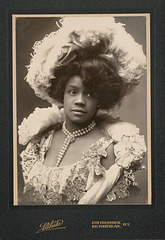
Aida Overton Walker
| 01 Jan 1970 |
|
Aida Overton Walker is a name that should be more familiar to vaudeville and theater lovers than it is for she was the foremost African-American star of her generation which comprised the early years of the 20th century. Her national and even international fame was such that she was a living legend of black show business and in fact her vision of a world with dignified and respected black show business artists who did not have to demean themselves onstage was years ahead of reality. Her work helping young black artists and especially black women to become super-achievers and her own remarkable talents as singer, dancer, actress, comedienne and choreographer caused her to be one of the most admired and respected black women in America.
Aida was born in 1880 in New York City and became known quickly for her talent as a dancer and singer as well as her great natural beauty. By 1895 she was a member of the famous black touring company disparagingly known as John Isham’s Octoroons and then joined the Black Patti Troubadours. This famous group was headed by Matilda Sissieretta Joyner Jones, known as Sissieretta Jones, who became a famous soprano. She was called the “Black Patti” after the famous white soprano Adelina Patti, who was one of the foremost superstars of opera of her time. Her troupe, the Troubadours, consisted of a whole show that entertained black and sometimes also white audiences throughout the country. The show had some 40 performers but Adelina emerged as one of its leading stars.
In 1898 she joined the rapidly rising comedy team of Bert Williams and George Walker, being featured in all of their landmark black performances including The Policy Players (1899), The Sons of Ham (1900), the very famous In Dahomey (1902), Abyssinia (1905) and Bandanna Land (1907). Walker and Overton married soon after they began performing together.
Her performance of Miss Hannah from Savannah in Sons of Ham caused a national sensation and furthermore Aida did the choreography for all of these big shows and emerged as the glue or catalyst that made the Walker-Williams shows work so well, as she worked behind the scenes with her husband supplying the themes and basic ideas for the shows, which then featured the great humor of Bert Williams. Although forgotten today, whereas Williams and Walker are more remembered, the three of them formed the most popular trio of “colored” entertainers in the world in the early years of the 20th century. Aida was also in demand as a choreographer for other shows such as Bob Cole and J. Rosamond Johnson’s The Red Moon (1909).
In these shows, although she performed in blackface, Aida refused to play black plantation stereotypes and an essential part of her political activism was to make the black woman stand tall and be an object of dignity and respect, even though she would attempt to make this statement through comedy and song. She became a huge hit in England from 1902 to 1904 with In Dahomey and was frequently hired for major society parties because she became known as the Queen of the Cakewalk from her dancing in the show and the British wanted to learn this remarkable dance so-named because originally those black dancers who did it well might receive a cake for a prize. In 1903 she played a command performance at Buckingham Palace for King Edward VII which added to her international reputation.
In the midst of this success her husband allegedly contracted syphilis through affairs with other women and he collapsed during the run of Bandanna Land in 1908. She was able to fill in for her ailing husband, performing his part in drag and managing to save the company, but eventually he grew more ill and died in 1911 as the disease, which had symptoms of stuttering and memory loss was incurable at this time. Bert Williams went on to solo success with the Ziegfeld Follies and Aida was forced to develop into a solo artist as well, leading to her work as choreographer and featured star in Red Moon and she joined the famous African-American Smart Set Company in 1910 while her husband was still gravely ill. What she must have thought of her husband’s behavior is not recorded but her indomitable will to survive and continue her art and her work even despite his situation is clear. Ten days after her husband’s death she signed a contract to star with S. H. Dudley in an all-black traveling show. Walker was buried in his home town of Lawrence, Kansas, one of many black superstars of the time to die of syphilis which almost reached epidemic proportions in the black theatrical community around this time.
Her post-Walker career was also distinctive as she emerged as a female superstar and was often invited to prominent white social gatherings to demonstrate the latest dances suitable for such events. Only Bert Williams among other black performers was able to do this and to work with white performers. For example she played the lead in Oscar Hammerstein’s 1912 revival of Salome at the Victoria Theater in New York, a role she had essayed in the black theater since the initial Salome craze of the early years of the century.
Aida was also an activist for black causes years and years before this was something that was popularly accepted. She raised significant funds for the Industrial Home for Colored Working Girls and worked to promote opportunities for young black women in the entertainment business through her connections. She hoped to promote a new generation of refined and elegant black performers free of the hamstringing stereotypes of the previous decades. To this end in 1913 and 1914 she promoted the Porto Rico Girls and the Happy Girls and produced shows for these troupes to show black women as original creative talent. This she did despite suffering from a number of disabling illnesses that beset her after the death of her husband.
In the 1910s she was described by critics as “the best Negro comedienne today” and “the most fascinating and vivacious female comedy actress the Negro race has ever produced”. Her ability to mesmerize an audience and her standard numbers performed in drag which she perfected while filling in for her ailing husband were legendary. Indeed each of her performances in shows or in vaudeville featured one of her famous drag numbers.
And then just as suddenly it was all over. Just 34 years of age, Aida died quickly on October 1, 1914 from kidney failure and hundreds of people came to her house to honor her and to grieve. A true legend of black vaudeville and theater had passed. Every black female entertainer of note in this world owes a great debt to this pioneering entertainer who envisioned a world which honored and respected black talent and who died at the height of her fame.
Sources: The American Vaudeville Museum & UA Collection; James Weldon Johnson Collection in the Yale Collection of American Literature, Beinecke Rare Book and Manuscript Library
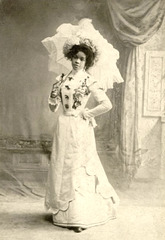
Aida Overton Walker
| 26 Mar 2024 |
|
|
Aida Overton Walker is a name that should be more familiar to vaudeville and theater lovers than it is for she was the foremost African-American star of her generation which comprised the early years of the 20th century. Her national and even international fame was such that she was a living legend of black show business and in fact her vision of a world with dignified and respected black show business artists who did not have to demean themselves onstage was years ahead of reality. Her work helping young black artists and especially black women to become super-achievers and her own remarkable talents as singer, dancer, actress, comedienne and choreographer caused her to be one of the most admired and respected black women in America.
Aida was born in 1880 in New York City and became known quickly for her talent as a dancer and singer as well as her great natural beauty. By 1895 she was a member of the famous black touring company disparagingly known as John Isham’s Octoroons and then joined the Black Patti Troubadours. This famous group was headed by Matilda Sissieretta Joyner Jones, known as Sissieretta Jones, who became a famous soprano. She was called the “Black Patti” after the famous white soprano Adelina Patti, who was one of the foremost superstars of opera of her time. Her troupe, the Troubadours, consisted of a whole show that entertained black and sometimes also white audiences throughout the country. The show had some 40 performers but Adelina emerged as one of its leading stars.
In 1898 she joined the rapidly rising comedy team of Bert Williams and George Walker, being featured in all of their landmark black performances including The Policy Players (1899), The Sons of Ham (1900), the very famous In Dahomey (1902), Abyssinia (1905) and Bandanna Land (1907). Walker and Overton married soon after they began performing together.
Her performance of Miss Hannah from Savannah in Sons of Ham caused a national sensation and furthermore Aida did the choreography for all of these big shows and emerged as the glue or catalyst that made the Walker-Williams shows work so well, as she worked behind the scenes with her husband supplying the themes and basic ideas for the shows, which then featured the great humor of Bert Williams. Although forgotten today, whereas Williams and Walker are more remembered, the three of them formed the most popular trio of “colored” entertainers in the world in the early years of the 20th century. Aida was also in demand as a choreographer for other shows such as Bob Cole and J. Rosamond Johnson’s The Red Moon (1909).
In these shows, although she performed in blackface, Aida refused to play black plantation stereotypes and an essential part of her political activism was to make the black woman stand tall and be an object of dignity and respect, even though she would attempt to make this statement through comedy and song. She became a huge hit in England from 1902 to 1904 with In Dahomey and was frequently hired for major society parties because she became known as the Queen of the Cakewalk from her dancing in the show and the British wanted to learn this remarkable dance so-named because originally those black dancers who did it well might receive a cake for a prize. In 1903 she played a command performance at Buckingham Palace for King Edward VII which added to her international reputation.
In the midst of this success her husband allegedly contracted syphilis through affairs with other women and he collapsed during the run of Bandanna Land in 1908. She was able to fill in for her ailing husband, performing his part in drag and managing to save the company, but eventually he grew more ill and died in 1911 as the disease, which had symptoms of stuttering and memory loss was incurable at this time. Bert Williams went on to solo success with the Ziegfeld Follies and Aida was forced to develop into a solo artist as well, leading to her work as choreographer and featured star in Red Moon and she joined the famous African-American Smart Set Company in 1910 while her husband was still gravely ill. What she must have thought of her husband’s behavior is not recorded but her indomitable will to survive and continue her art and her work even despite his situation is clear. Ten days after her husband’s death she signed a contract to star with S. H. Dudley in an all-black traveling show. Walker was buried in his home town of Lawrence, Kansas, one of many black superstars of the time to die of syphilis which almost reached epidemic proportions in the black theatrical community around this time.
Her post-Walker career was also distinctive as she emerged as a female superstar and was often invited to prominent white social gatherings to demonstrate the latest dances suitable for such events. Only Bert Williams among other black performers was able to do this and to work with white performers. For example she played the lead in Oscar Hammerstein’s 1912 revival of Salome at the Victoria Theater in New York, a role she had essayed in the black theater since the initial Salome craze of the early years of the century.
Aida was also an activist for black causes years and years before this was something that was popularly accepted. She raised significant funds for the Industrial Home for Colored Working Girls and worked to promote opportunities for young black women in the entertainment business through her connections. She hoped to promote a new generation of refined and elegant black performers free of the hamstringing stereotypes of the previous decades. To this end in 1913 and 1914 she promoted the Porto Rico Girls and the Happy Girls and produced shows for these troupes to show black women as original creative talent. This she did despite suffering from a number of disabling illnesses that beset her after the death of her husband.
In the 1910s she was described by critics as “the best Negro comedienne today” and “the most fascinating and vivacious female comedy actress the Negro race has ever produced”. Her ability to mesmerize an audience and her standard numbers performed in drag which she perfected while filling in for her ailing husband were legendary. Indeed each of her performances in shows or in vaudeville featured one of her famous drag numbers.
And then just as suddenly it was all over. Just 34 years of age, Aida died quickly on October 1, 1914 from kidney failure and hundreds of people came to her house to honor her and to grieve. A true legend of black vaudeville and theater had passed. Every black female entertainer of note in this world owes a great debt to this pioneering entertainer who envisioned a world which honored and respected black talent and who died at the height of her fame.
Sources: James Weldon Johnson Collection in the Yale Collection of American Literature, Beinecke Rare Book and Manuscript Library; Kansas City Museum Collection; Hall Studio (NY) , circa 1909
Ida Forsyne as 'Topsy'
| 14 Apr 2016 |
|
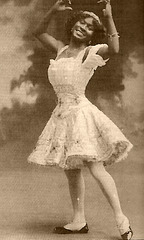
Dancer Ida Forsyne as "Topsy," with Abbie Mitchell's Tennessee Students in London, England.
Ida Forsyne, jazz dancer who was named by poet Langston Hughes as one of the twelve best dancers of all time, was born in Chicago, Illinois. Her mother became a domestic servant when she was two years old, after the disappearance of her father. At the age of ten, she was dancing and singing for small sums of money at the local candy store and house-rent parties, and she cakewalked for twenty-five cents a day at the Chicago World's Fair, traveling through the festival site in a wagon with a ragtime band to drum up trade.
Many shows originated in Chicago at the time, and so Forsynes haunted the Alhambra Theater, watching rehearsals of such shows as Coontown 400 and The South before the War. At age fourteen Forsyne ran away with a tab show, The Black Bostonians, in which everyone did their own specialties. She sang "My Hannah Lady" and also performed a Buck Dance in her inimitable eccentric style that includes rhythmic stepping and legomania. The finale of the show was a plantation scene that included the entire cast. When the show broke up in Bute, Montana, Forsyne adopted a five-year-old boy as a "prop" and sang her way back home to Chicago by walking down the aisles of the railroad coaches, hand-in-hand with him, harmonizing "On the Banks of the Wabash" as she passed the child's hat and collected enough money to pay fare and little more.
In 1898 the fifteen-year-old joined Sisseretta Jones' Black Patti Troubadours. "A girl in the show was sick, so I went down and did my number, ‘My Hannah Lady,' and got the job at $15 a week," Forsyne told Marshall Stearns. "I was the only young girl in the company of twenty-six. For my specialty, I pushed a baby carriage across the stage and sang a lullaby, ‘You're Just a Little Nigger but You're Mine All Mine,' and no one thought of objecting in those day." The show had a cakewalking contest at every performance and Forsyne and partner won it seven nights straight in a row by adding legomania and tumbling in the breaks.
Forsyne had the ability to perform any step she saw. In 1899, on her sixteenth birthday, Forsyne and the Black Patti troupe arrived in San Francisco, and remembers that they stayed at a fine white hotel and ate together at a long table, and that "everyone was so nice to us." Returning to New York, she easily got jobs working in Atlantic City, New Jersey, and Coney Island, working in minstrel-styled shows such as Henderson's Big Theater (at Coney Island) with famous acts like Eddie Cantor. It was at Coney Island that Forsyne lost her voice in an "all song-and-dance" format in which performers would sing a verse of the song, then a chorus, and then dance a chorus. "I was like a coon shouter until my voice gave out," she said about her voice which was in a strong alto-range. She thereafter learned how to put a song across by "sort of talking it."
In 1902, Forsyne joined the original Smart Set, an all- colored show by the white producer Gus Hill and featuring Ernest Hogan, Billy McClain, and the Hun Brothers, and in which she talked the song, "Moana" and performed a solo jazz dance. She then joined Will Marion Cook's The Southerners on the New York Roof Garden, with a mixed cast of thirty-five performers. In 1905 she went abroad with The Tennessee Students, a troupe of seventeen performers (including Abbie Mitchell, comedy dancer Ernest Hogan, and sand dancer Henry Williams), many of whom played stringed instruments and sang in a transitional style between ragtime and jazz. When the show opened at the Palace Theater in London in 1906, Forsyne (her picture on the front cover of the program) was the billing star, singing "Topsy, the Famous Negro Dancer." With her radiating personality and facial expression, she was immediately noticed. Wrote the Daily Telegraph: "If Topsy is not soon the talk of the town we are very much mistaken." For the succeeding nine years. Forsyne toured Europe under the management of the Marinelli Agency, the largest in Europe, in what would be the peak of her career. The entire first year she played the Moulin Rouge in Paris, singing and dancing her fast mixture of eccentric steps. She was then booked throughout England where for the first time she saw Bill Robinson and Ralph Cooper. At the Alhambra Theatre in London, she introduced her Sack dance to special music with a ballet company. A stagehand carried her onstage in a big potato sack; she threw one leg out, then an arm, and so on until, dumped in the middle of the stage, she danced before a backup chorus line of ballet dancers who were paid extra to appear in blackface. While the performance was considered "arty," Forsyne was improvising jazz steps. She quickly rose to such fame that she gave a command performance for the Royal family.
In 1911, in the middle of her Moscow dance program, tiny Forsyne (she wore a size two shoe) suddenly inserted a series of improvised kazotsky kicks into her routine and brought the house down; she was immediately hailed as the "greatest Russian dancer of then all." She thereafter closed her act with kazotsky kicks-- which began from a squat, arms folded at the chest, and legs kicking out, first one leg and then another. Though Russian dancers usually stood up between steps, Forsyne could not wait. She changed steps and traveled across the stage in a crouch, working out new combinations. She flung both legs out in front of her and touched her toes with her hands before coming down in time with the music. She also mixed down-steps with up-steps, and cross-ankle steps, and as a finale, would kazotsky all the way across the stage, and return backwards. European theaters booked Forsyne for nine years without a break. Forsyne popularized Russian dancing in the United States, after pioneering that style abroad. But she was, above and beyond, a jazz dancer. She remembered many early jazz tap steps, among them "Going to the World's Fair," which was strut in which one put both feet together and moved forward on the toes. Another step was "Scratchin' the Gravel," or the "Sooey," a short sliding motion alternately on each foot; Forsyne described it as a two-step with a dip.
In 1914, Forsyne returned to New York from touring abroad and performed at the Lincoln and Lafayette theaters. High class society people went to the Lafayette and the management didn't present of-color blues singers, comedians and Shake dancers from T.O.B.A., as did at the Lincoln." In 1916, Forsyne saw Darktown Follies and remembers that it was the talk of the town. "Eddie Retor was featured in his smooth military routine, and Toots Davis was doing his Over the Top and Through the Trenches, and they were new steps then," she told Marshall Stearns. For two years (from 1920 to 1922), Forsyne worked as a personal maid, onstage and off, to Sophie Tucker, earning $50 a week. Onstage, Tucker sang thirteen songs, accompanied by pianist Al Seeger, and wanted a dancer to help whip up applause at the end of the show—and Forsyne filled that position. The act broke up in Washington, D.C. where, on the Keith circuit, new rules disallowed black performers to appear onstage with a white performer unless they wore blackface. Furthermore, no performer of color working backstage was permitted to watch the show. Tucker refused to have Forsyne don blackface, and while Forsyne was banned from the show, she was permitted to watch the show from the wings.
By 1924, Forsyne was back on the T.O.B.A. black vaudeville circuit as one of six dancing girls with blues singer Mamie Smith's act. After touring the South with the late version of The Smart Set, Forsyne returned to New York where Harlem nightclubs were thriving. Refused after auditioning at the Cotton Club, Connie's Inn, and the Nest, because of the preference for light-skinned and scantily-clad chorus girls, Forsyne was promised a job at Small's Paradise, which never panned out. As did a job working at the New World Club in Atlantic City in 1927, which was recommended to her by Jack "Legs" Diamond. Forsyne was apparently rejected for not approving of the abbreviated costumes which were de rigeur for female jazz dancers. Back on T.O.B.A., Forsyne earned $35 a week working with Bessie Smith, a show that allowed her to reprise her Russian specialty. She left Smith's company in 1928, vowing she would never tour the South again. After working three-and-a-half years as a domestic, and then as an elevator girl, Forsyne quit dancing. In 1963, however, she played the part of Mrs. Noah in Green Pastures. That same year, she appeared with Rex Ingraham in The Emperor Jones. As late as 1951, Forsyne assisted Ruthanna Boris for the choreography for the New York City Ballet's "The Cakewalk," choreographed by George Balanchine.
In 1962, at the age of seventy-nine, Forsyne could still perform a cartwheel. She devoted most of her spare time to visiting various hospitals where she entertained and cheered up sick friends. By 1966 she herself retired to the Concord Baptist Nursing Home in Brooklyn, where she died in 1983, at the age of 100.
Sources: Marshall and Jean Stearns, Jazz Dance: The Story of American Vernacular Dance (1968); Cary D. Wintz and Paul Finkelman, Encyclopedia of the Harlem Renaissance, Vol I. (2004); Blacks in Blackface: A Sourcebook on Early Black Musical Shows (Vol 1, 2nd ed.) by Henry T Sampson
Jump to top
RSS feed- Kicha's latest photos with "Choreographer" - Photos
- ipernity © 2007-2026
- Help & Contact
|
Club news
|
About ipernity
|
History |
ipernity Club & Prices |
Guide of good conduct
Donate | Group guidelines | Privacy policy | Terms of use | Statutes | In memoria -
Facebook
X
