

Kicha's photos with the keyword: Publisher

John Jones
| 17 Oct 2023 |
|
In 1816 John Jones was born a free man in Green City, North Carolina. Little is known about Jones's youth. It is known that his mother was a black woman who used the surname of Jones, and his father was a German named Bromfield. Jones moved from North Carolina to Memphis, Tennessee, then finally to Chicago in 1845. It was here that Jones started his well-known tailoring shop at 119 Dearborn Street in Chicago.
It was with only $3.50 in their pockets, the Joneses and their only child Lavinia moved to Chicago. They took a circuitous route, traveling first by stage to Ottawa, then by canal to Chicago. Throughout the journey, they feared slave catchers, who were on the lookout for fugitive slaves. They were also harassed due to their race and detained at one point, until the stagecoach driver vouched for their free status.
Jones was firmly against slavery as well as the Black Codes or Black Laws, in Illinois. These laws denied rights to blacks. A self-educated man, Jones decided something had to be done about the Black Codes and slavery. He published a 16 page pamphlet entitled, "The Black Laws of Illinois and Why They Should Be Repealed."
It was also during that time that he had made a fortune from his tailoring shop. Jones and his wife (Mary Richardson, a free African American woman from Memphis, Tennessee), had just purchased an extremely beautiful and large home. His house as well as his office on Dearborn were used as stops on the Underground Railroad through Chicago.
Jones's home also served as a meeting place for local and national abolitionist leaders including Alan Pinkerton, Frederick Douglass, and John Brown. When Brown's eleven slaves arrived in Chicago, they were met by the renowned detective Alan Pinkerton, who invited them into his home and fed them. Pinkerton later directed Brown and his men to John Jones.
Jones not only housed slaves in protest of slavery, but he also fought slavery by using the law. Jones knew the laws fairly well and followed them. However, he knew what was right as well as how to use the laws to his advantage. Eventually, he led the fight to repeal the Illinois Black Laws by speaking, writing, organizing blacks and whites, and lobbying the state legislature. It was a lot of hard work for Jones and the other abolitionists keeping everything a secret. But over all, their work paid off in more ways than one. Jones accomplished his goal of helping the escaped slaves. He owned his own successful business, and became one of the richest blacks of his time. He also was elected Cook County Commissioner, not once, but twice. He held office from 1872 through 1875.
While he was in office, he did what he thought was necessary to make the community a better place to live. While in office, he helped secure the law that abolished local segregated schools. After his term, Jones continued to run his tailor shop until he died in 1879 (his wife Mary died in 1910). Following his death, the Chicago Tribune reported that he had been the most prominent black citizen in the city. Jones's tailoring business was operated until 1906 by his son-in-law, Lloyd G. Wheeler, the first black to pass the Illinois Bar. As one historian noted, "John Jones is buried in Graceland Cemetery where Alan Pinkerton, Dr. C. V. Dyer, and other abolitionists lie close to him in death as they stood with him in life."
Because of Jones and his contribution to end the Black Codes, African-Americans gained the right to vote, testify in court, and serve on juries. Today where his tailoring shop once stood, now stands the State of Illinois Building. John Jones is an important figure in Illinois history who will be long remembered.
Photo: Chicago History Museum
Bio: Chronology of African-American History, by Alton Hornsby, Jr.,
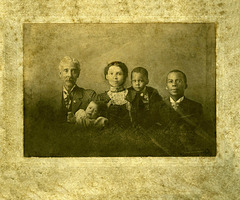
The Benjamin's Last Family Portrait
| 16 Oct 2023 |
|
The following paragraph comes from The Freeman Newspaper (Dec. 22, 1900): "Last Picture of the Benjamin Family" --- R.C.O. Benjamin was assassinated October 2, 1900. This picture represents his family group taken during the visit of Mrs. Benjamin's father, W.S. Robinson, of Alabama. September 19, 1900 twelve days before the tragedy. The ages in years of the Benjamins are: Robert Charles O'Hara, 45; Lulu Maria 27; Robinson Charles O'Hara (called Robin, bearing his father's full initials), 4; Lillian Allen, 8 months. The children's grandfather, aged 53 years, is on the left; their father at the right. Mr. Benjamin was one of the most remarkable Negroes that ever lived --- Editor, Lawyer, Preacher, Teacher, Author, Poet, Orator, Humorist, Lecturer, Politician, Traveler, Thirty-Third Degree Mason and member of all the leading Secret and Benevolent Societies. Duplicate photographs will be sold at 25 cents each for the benefit of the Orphan Fund. Address The Standard, Lexington, Kentucky, a newspaper edited by R.C.O. Benjamin until the night of his martyrdom, and now published by his widow.
The following biography comes from American National Biography Online, "Robert Charles O'Hara Benjamin" by George C Wright : Robert Charles O'Hara Benjamin, (1855 - 1900), journalist and lawyer, was born on the island of St. Kitts in the West Indies. Details about his early life, including the names of his parents and his education, are not known. In the fall of 1869 he arrived in New York, where he worked as soliciting agent for the New York Star and then as city editor for the Progressive American.
Benjamin apparently became a U.S. citizen in the early 1870s, and in 1876 he gave speeches in support of Rutherford B. Hayes, the Republican candidate for president. He was rewarded with a position as a letter carrier in New York City but quit after nine months and moved to Kentucky, where he taught school. While there, Benjamin also took up the study of law. He continued his studies after being named principal of a school in Decatur, Alabama, and was admitted to the bar at Nashville, Tennessee, in January 1880.
Before and after his admission to the bar, Benjamin continued his career in journalism. In total, he edited and/or owned at least eleven black newspapers, including the Colored Citizen of Pittsburgh; The Chronicle of Evansville, Illinois; the Nashville Free Lance (where, as contributing editor, he wrote under the name "Cicero"); the Negro American of Birmingham, Alabama; the Los Angeles Observer; and the San Francisco Sentinel. When Benjamin worked at each of these papers is unclear. He was apparently in Birmingham in 1887, Los Angeles in 1888, and San Francisco in 1891. He also worked for the Daily Sun, a white-owned newspaper in Los Angeles.
In addition to his journalism, Benjamin also published a number of books and pamphlets that reflected the wide range of his interests. In 1883 he published Poetic Gems, a small collection of poetry, and in 1888 he published Life of Toussaint L'Ouverture. He was perhaps best known for Southern Outrages: A Statistical Record of Lawless Doings (1894). In 1886 Benjamin traveled to Canada on a speaking tour.
For twenty years Benjamin maintained a legal practice in the cities where he edited newspapers. One of his cases received widespread publicity: in Richmond, Virginia, in 1884 he won an acquittal of a black woman charged with murder. At a time when most white newspapers spoke of blacks in derogatory and racist terms, Benjamin's skills as a lawyer drew favorable comment from white newspapers in Richmond, Los Angeles, and Lexington.
Benjamin, however, did not court white opinion, although he well understood the risk that African Americans ran in challenging whites in civil rights, politics, and race relations. Benjamin was a vocal critic of racial discrimination and went much further than most black leaders; instead of simply denouncing Jim Crow legislation, he urged blacks to defend themselves when attacked by whites. Such an outspoken attitude led to Benjamin being forced to leave Brinkley, Arkansas, in 1879 and Birmingham in 1887. Irvine Garland Penn, author of The Afro-American Press and Its Editors (1891), said of Benjamin: "He is fearless in his editorial expression; and the fact that he is a negro does not lead him to withhold his opinions upon the live issues of the day, but to give them in a courageous manner."
In December 1892 Benjamin married Lula M. Robinson; they had a son and a daughter. The family settled in Lexington, Kentucky, in 1897. To the dismay of some whites, Benjamin quickly became involved in local politics. On October 2, 1900 he argued with Michael Moynahan, a Democratic precinct worker, over the white man's harassment of blacks wishing to register to vote. Late that evening Moynahan killed Benjamin. At the trial several days later, he pleaded not guilty by reasons of self-defense. The judge accepted Moynahan's claim and dismissed the case, even though Benjamin had been shot in the back.
Because of his militant stance, his journalism and other writings, and his legal career, R. C. O. Benjamin deserves serious attention from scholars. His tragic death is also a reminder that throughout American history even highly respected black leaders have been vulnerable to white violence.
He is buried in African Cemetery No. 2 in Lexington, Kentucky.
Source: Joshua Soule Smith papers, 1863-1905
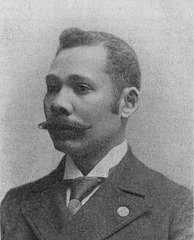
Edward Elder Cooper
| 16 Oct 2023 |
|
The Colored American began publishing in 1893 under the ownership of Edward Elder Cooper, who had distinguished himself as the founder of the Indianapolis Freeman, the first illustrated African American newspaper. The Colored American operated its presses at 459 C Street in Washington's northwest quadrant. The weekly publication promoted itself as a national Negro newspaper and it carried lengthy feature stories on the achievements of African Americans across the country. Publisher Cooper relied on contributions from such prominent black journalists such as John E. Bruce and Richard W. Thompson to sustain the national scope of his paper, which readers could obtain for a $2.00 annual subscription.
The Colored American included a regular column called "City Paragraphs" that highlighted events in the nation's capital and routinely featured articles on religion, politics, education, military affairs, and black fraternal organizations. The paper distinguished itself by its use of original reporting rather than relying on boiler-plate, filler material taken from other publications. Like other papers, however, it included advertising, much of it geared to black consumers.
The paper ran editorials and political cartoons that championed improved social conditions in the black community and expanded rights for African Americans. Although it held a reputation for political independence, the Colored American was actually staunchly Republican. Cooper allied himself and his paper with Booker T. Washington, and the publisher looked to the famous black educator for financial assistance. Another financial backer was lecturer and activist Mary Church Terrell, a noted African American civil rights advocate who wrote a column for the paper titled "The Women's World," under the pseudonym Euphemia Kirk.
Unfortunately for the Colored American, Cooper proved to be a poor businessman and, because of some unorthodox business practices and extensive debts to creditors, financial problems plagued the paper. It ceased publication in November 1904.
Image: Schomburg Center for Research in Black Culture
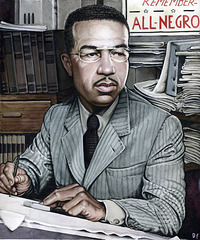
Orrin C Evans
| 16 Oct 2023 |
|
When Orrin C. Evans died in 1971 at the age of 68 he was eulogized in the New York Times as ‘the dean of black reporters’. From our vantage point of another quarter century, we can also say he was the father of black comic books.
Mr Evans was born in 1902 in Steeleton, Pennsylvania, the eldest son of George J. Evans Sr, and Maude Wilson Evans. Mr Evans Sr., was employed by the Pennsylvania Railroad, his wife was the first black person to graduate from the Williamsport Teachers’ College,and the family lived in white neighborhoods. However, despite this stable home life the every day realities of Northern racism were never far from their door. Mr Evans Sr. passed for white in order to provide a better living for his family than the menial jobs available to blacks would allow, but this forced him to carry the pretense to the inevitable ends of hiding the darker skinned Orrin in a back room while Maude donned an apron and pretended to be a maid when friends from his work dropped by. On other occasions, his father was not able to acknowledge Orrin at his workplace. Years later Orrin was visibly moved when relating these episodes. As Orrin’s friend, Claude Lewis wrote in 1971 ‘There was no National Association for the Advancement of Colored People back then, there was no Urban League. Like others of his time, Orrin Evans was out there on his own. And what he had to suffer was more than anyone I know could endure’.
His first job was on the Sportsman’s Magazine at age 17, and his first real newspaper experience was with the Philadelphia Tribune, the oldest black paper in the country. From there, in the early nineteen-thirties, he decided to break the color barrier and landed a writing position on the Philadelphia Record, becoming the first black writer to cover general assignments for a mainstream white newspaper in the United States. In 1944 at the Record he wrote a series of articles about segregation in the armed services, which were read into the congressional record, and helped end the practice. He won an honorable mention in that year’s Hayword Hale Broun award, but also drew some unwelcome attention. To criticize the government during wartime, even to point out the obvious hypocrisy of segregating troops putting their lives on the line to defend a country where democracy supposedly makes all men equal was considered treasonous by some and he and his family received death threats. His daughter Hope remembers their house being protected in a 24 hour a day vigil by a congregation of Orrin’s friends, both black and white, until the threats subsided.
This was not the only time Orrin was threatened because of his color and position. Once at the Philadelphia Police Precinct at 55th and Pine a police sergeant pulled his revolver and ordered him out of the station, not believing a black man had any legitimate place on the front side of the bars, and the national hero and Nazi sympathizer Charles Lindbergh once held up a press conference during the infamous kidnapping of his son to have Orrin ousted because he was black.
For Orrin to note the lack of black heroes in the popular culture was a singular feat in itself. As Claude Lewis said in a recent interview ‘We weren’t very conscious about being left out, it was just the way things were. We identified with Superman, Batman, Submariner and the rest of them without giving much thought to it. If you’ve never seen a black hero you don’t spend a lot of time wondering where they are. Today you would, but back then, there were no blacks in ads. It just didn’t happen’. Orrin wanted to change all this. He considered himself an urban American born in the twentieth century, fully integrated into the western world. He and his wife were long time supporters of the NAACP and the Urban League. The works of WEB Du Bois spoke more to him than did those of Marcus Garvey. He possessed a library said to be possibly the finest in the black community with volumes not only of Afrocentric interest or white commentaries on what was termed ‘the Negro problem’, but a library that represented his own wide range of interests, and he wanted to produce a comic that would reflect these values.
All Negro Comics # 1 carries a cover date of June 1947. No information about the press run or distribution remains, but it is believed that the comic was distributed outside of the Philadelphia area.
A second issue was planned and the art completed, but when Orrin was ready to publish he found that his source for newsprint would no longer sell to him, nor would any of the other vendors he contacted. Though Orrin was unyielding in his support of integration and civil rights he was moderate in his methods of achieving these goals. He believed in the general fairness of the system he had been born into. He was not a man given to conspiratorial thinking, but his family remembers that his belief was that there was pressure being placed on the newsprint wholesalers by bigger publishers and distributors who didn’t welcome any intrusions on their established territories.
Orrin Evans returned to the newspaper business. He was an editor at the Chester Times, and later at the Philadelphia Bulletin, where he worked with Claude Lewis who recently said ‘Orrin had many contacts throughout the city of Philadelphia and the region. He knew the people who were running the city and he knew the people who were at the bottom, and he was equally at ease in either community. He was well liked and well versed and that made him a very valuable person in a newsroom’. During his lifetime Mr Evans was featured in articles in Jet and Ebony magazines. He was a director of the Philadelphia Press Association, and an officer of the Newspaper Guild of Greater Philadelphia. In 1966 he won the Inter Urban League of Pennsylvania Achievement Award. He covered more National Urban League and NAACP conventions than any other reporter and the month before his death he was honored in a resolution at the annual NAACP convention in Minneapolis and a scholarship was created in his name.
Illustration by Drew Friedman
Sources: Interviews Hope Evans Boyd, George J. Evans Jr, Claude Lewis, George Evans. Article Philadelphia Tribune 15 Feb 77, Pg 21: Orrin Evans, A Black Who Refused to Be Bitter.
Entry In Black and White (reference) Pg 306, Obituary NY Times 8 Aug 7, Pg 58, Obituary Philadelphia Bulletin 8 Aug 71; Charles Lindburg reference is from American Swastika by Charles Higham, Doubleday Publishers,1985. Garden City, NY., TomChristopher.com.
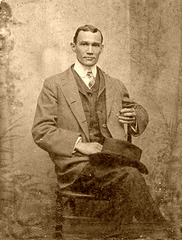
Alex Manly
| 04 Jun 2016 |
|
Photograph comes from the Alex L. Manly Papers, 1898-1899 Manuscript Collection #65, East Carolina University, Joyner Library.
Alex Manly was the editor of the Wilmington Daily Record of Wilmington, North Carolina during the late 19th century. He was forced to flee the city on the eve of the 1898 Wilmington Race Riot. He later settled in Philadelphia, Pennsylvania.
Like many children of former slaves, Alexander L. Manly (1866-1944) was partially descended from a slave-owner. Born in North Carolina, Manly was reportedly the grandson of Charles Manly, who after emigrating from England had become the governor of North Carolina in 1849. Manly studied printing at Hampton University, and then settled in Wilmington, where he and his brothers established The Wilmington Daily Record, at the time perhaps the only daily newspaper run by African-Americans in the country.
In August 1898, Manly published an editorial as a response to a white-owned paper’s racially charged article. Manly printed his op-ed piece at a politically and racially divisive time preceding the 1898 North Carolina elections. After losing political control of the state to an interracial coalition of Black Republicans and White Populists in 1896, Democrats had determined to regain power in the upcoming November 10, 1898 state elections, thereby thwarting Black enfranchisement and solidifying their white-supremacist agenda. In order to stave off another political defeat, Wilmington Democrats planned to stir as many as 2,000 members of the white population to riot, employing violence to intimidate Black voters and essentially seize power from the city government, slated to be in power for another year. Focusing their rage on him because of his editorial, the mob descended upon Manly’s office in order to destroy it, and lynch him. Milo recalled hearing from his father:
“It was a planned deal. And the result of this riot was a few people got killed. All sorts of things happened at that time. The Negroes, to escape the mob shootings and so forth, left. My father and a friend, who was a part of the newspaper got in my father’s buggy, which of course, the Cadillac of the day, horse and buggy, and they headed out of town. But the mob that had been set up had put a circle around the town…because they were coming in to lynch ‘this nigger, Manly.’” – Milo Manly, 1984.
The mob killed approximately twenty-five Black people during the insurrection, although some estimate that hundreds died. Fortunately, for Manly, a white friend warned him about the plot on his life. Because of his European heritage, he was able to pass for white, which helped aid his escape.
“Well, a German grocer, who knew my father…got in touch with my father, and says, ‘Look, you’ve got to get out of town.’ He says, ‘Now, they don’t know who you are or what you are.’ Said, ‘This gang, there’s all these people out there, but they’ve lined it up that nobody can leave the vicinity of this area, with this cordon, unless they have a certain password.’ He said, ‘Now, if it ever got known that I gave you the password, they’d kill me. But I know you. I trust you. I want you to get out of here.’ He gave my father the password. My father… come up the line. They stopped him. ‘Where are you going?’ He said—named a town up there. ‘What are you going up there for?’ ‘Going up there to buy some horses,’ he said, ‘There’s an auction up there.’ Or something like that. ‘Oh, all right.’ He gave the password. ‘Okay,’ he said, ‘But if you see that nigger Manly up there, shoot him.’ And they gave him two rifles. That’s right. Off away he went.” – Milo Manly, 1984.
The Wilmington Riot gained national attention, and it directly resulted in Black disenfranchisement by requiring measures such as poll taxes and literacy tests, and the establishment of Jim Crow laws. Like Manly, thousands of Blacks fled North Carolina to seek refuge and employment in the North.
Soon after fleeing, Manly made his way to Washington D. C. and then to Philadelphia where he worked as a painting contractor and participated in the establishment in 1906 of the Armstrong Association, a forerunner of the National Urban League, created to broaden employment opportunities for skilled African-American building trade workers from the South.
“And my father, who had given them the idea, they decided to call it the Armstrong Association, named for Colonel [Samuel Chapman] Armstrong, who set up—organized and put together Hampton. My father had come from Hampton, and since it was a school set up to train mechanics, they felt that that would be a good tribute to Armstrong, and that’s why it was called the Armstrong Association.” – Milo Manly, 1984
During the Great Migration, Manly worked as a labor agent to help ease the transition of black laborers from the South. Sent south by the Armstrong Association, Manly used his experience and education in dealing with local ministers, who would recruit the laborers. Here again, Milo recalled, his light complexion helped him travel.
“They needed labor. So it was decided my father would take a swing around through the South because he had contacts, of course, from his days of being editor and owner of a newspaper in the South. And so he made a tour. And then on top of that, my father looked like a white man. Nobody would expect anything … he was accepted anywhere he went.” – Milo Manly, 1984
In the 1920s, Manly remained active with the Armstrong Association and authored articles on its activities for Opportunity. He suffered the loss of his painting and decorating contracting business in the aftermath of the stock market crash of 1929, and he died in 1944. He utilized the tools at his disposal—his education, his experience, and even his appearance—in order to better the lot of African Americans from his native South, and in his adopted home of Philadelphia.
Bio: Goin North: The Life of Alexander L. Manly
Jump to top
RSS feed- Kicha's latest photos with "Publisher" - Photos
- ipernity © 2007-2026
- Help & Contact
|
Club news
|
About ipernity
|
History |
ipernity Club & Prices |
Guide of good conduct
Donate | Group guidelines | Privacy policy | Terms of use | Statutes | In memoria -
Facebook
X
