

Kicha's photos with the keyword: Author

Margaret Walker Alexander
| 16 Oct 2023 |
|
Margaret Abigail Walker was born of July 7, 1915, in Birmingham, Alabama. She was the eldest of five children born to Sigismund C. Walker, a Methodist minister, professor, and linguist who loved literature, and Marion Dozier Walker, a musicologist and professor. Young Margaret grew up in a close-knit family where religion, education, racial pride, music and literature were greatly emphasized by her parents. She grew to delight in the stories of slave life in rural Georgia told to her by her maternal grandmother and acquired a zest for literature and aesthetic knowledge that paralleled her father's. Her mother instilled within her daughter a love of all forms of music from classical works to those traditional melodies that permeate African-American culture. By the time Margaret Walker reached adolescence she was immersed in writing daily. Her parents encouraged and supported her interest in poetry and writing and her father purchased for her first journal. This journal served as the first permanent recording of her poems and her grandmother's stories. With the impetus to write and her parents encouragement, Walker began at age 13 to nurture a talent she would soon come to master.
By the time she was sixteen, Walker had completed high school and was halfway through college. Her parents had accepted teaching posts at New Orleans College, now Dillard University, and moved the family from Alabama to Louisiana. During her sophomore year in college, Walker had the opportunity to meet renowned poet Langston Hughes. Hughes advised Walker's parents to have their daughter educated in the North and encouraged Walker to continue working and refine her style. Consequently, in 1932 Walker transferred to Northwestern University in Evanston, Illinois where she received her Bachelor of Arts in English in 1935. During her enrollment, an encounter with W.E.B. DuBois led to her first publication in the May 1934 edition of The Crisis, a magazine of the NAACP. Margaret Walker was already a published author at age 19.
Jubilee, a novel published in 1966, represents the fruition of Walker's lifelong dream to publish her grandmother's stories. In addition, the novel served as her doctoral dissertation in 1965. It is the story of her maternal great grandmother as told to her by her grandmother, a story that Margaret had written for much of her life. Moreover, it is a personal document of her family's history as well as a historical text that outlines crucial years in American history. Jubilee, a tripartite narrative, chronicles the story of Vyry, a mulatto slave girl and her struggle and survival during the antebellum period, the Civil War and Reconstruction. It represents approximately forty years of the author's planning, research, dreaming, writing, and revision. Moreover it is a permanent recording of the oral tradition of storytelling in African-American culture. What began as the inquisitive curiosity of a twelve-year old girl listening to the marvelous tales of her grandmother has been transformed into a classic piece of literature to be enjoyed by generations to come.
Although Margaret Walker Alexander has never received the national acclaim of other contemporary writers of her stature and contribution, she is held in high critical regard. The focus of her writing has always been the Black experience. Walker's racial pride allowed her to dedicate over seven decades of her life to this experience, dealing with such themes as time, racial equality, love, and freedom. Her work has a powerful message, despite having fallen through the cracks of literary recognition; many agree that she has proven herself to be a literary great. Since the publication of her award winning collection of poetry in 1942, Walker's peers, reviewers, and critics have rarely commented negatively on her work. Having a style similar to that of Walt Whitman, Walker's work focuses on the intricacies of everyday life. Through her rhythmic verses and strong imagery, Walker reintroduces the mores and folkways of the southern heartland to contemporary America. Critics continually praise her for her straightforward and simplistic writing style, her inclusion of Biblical allusions, and the deep sincerity of all her poems. Negative criticism surrounding Walker comes from those who disapprove of her style of writing sonnets. Some critics are highly approving of her innovative style, while others believe she has created an idiosyncratic style of her own. Nevertheless, the sonnet seems to be the backbone of her career since some of her greatest works exemplify this form.
Before her death in November, 1998, Walker had written more than 10 books and an unknown number of poems, short stories, essays, letters, reviews, and speeches. Walker was honored with a host of awards and accolades as well as four honorary degrees. Jackson, Mississippi, her home for much of her life, has honored her by naming July 12th, "Margaret Walker Day."
VG: Voices from the Gaps
Women Artists and Writers of Color,
An International Website
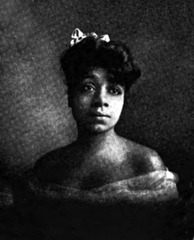
Atholene Peyton
| 16 Oct 2023 |
|
Miss Atholene Peyton (1880-1951), was the author of the earliest Kentucky cookbook written by an African American. Her father was Dr. W. T. Peyton, a well known practitioner and educator.
Her book, 'Peytonia Cook Book,' was published in Louisville in 1906. She had deep roots in the city. Peyton was an 1897 graduate of Louisville's Central Colored High School and then went on to the Colored Normal School. She served on the domestic science faculty of the segregated Central Colored High School and was the faculty sponsor of the Girls' Cooking Club. In one of her applications on file om the Jefferson County Public schools archives she noted under "honors": Wrote the first Negro Cook Book in Kentucky." Her career at Central Colored High School lasted from 1904 until her death in April 1951. Peyton also taught domestic science at the Neighborhood Home and Training School for Colored Boys and Girls, located on Fifteenth Street in Louisville. The Training School was supported by the Neighborhood Circle of the King's Daughters. Peyton also represented the Louisville schools at an event in Frankfort featuring Dr. Booker T Washington, held to commemorate the construction of a new dormitory at Kentucky State University, from which she earned a degree in 1935.
Peyton also served on the domestic science faculty of the summer Chautauqua of the National Training School for Women and Girls in Washington DC. This was organized by the Woman's Convention, an auxiliary of the National Baptist Convention, which was and remains an important African American religious organization. The president of the training school was the well known African American educator Nannie Helen Burroughs, who advocated for the improvement of African American women's marketable skills.
According to a news item in the Indianapolis Freeman (1907), The Peytonia Cook Book "has achieved a wonderful degree of popularity among the best authorities on the culinary art." The cookbook itself includes a warm introduction by Nannie Helen Burroughs.
Sources: Kentucky's Cookbook Heritage: Two Hundred Years of Southern Cuisine and Culture, written by John van Willigen (2014); Colored American Magazine (1906 edition)
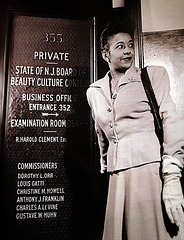
Christine Moore Howell
| 16 Oct 2023 |
|
For twenty-eight years Christine Moore Howell (1901 - 1972), catered to a very high class and particular clientele. Adjoining her salon was a laboratory where she produced her hair and skin care products. Clients came from great distances to take advantage of her special talent for cutting curly hair. In 1935 Mrs. Howell helped to create New Jersey's State Board of Beauty Culture and served as a State Commissioner of the Board of Beauty Culture Control. And was elected Chairman of the commission for three terms. In 1936 she wrote, the "Beauty Culture and Care of the Hair."
Sources: Monkmeyer Press Photo Service; Courtesy of Anita Duncan
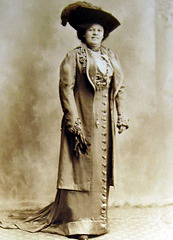
Maggie Rogers
| 18 Oct 2023 |
|
Margaret 'Maggie' Rogers (1874 - 1953), was a maid at the White House who served for 30 years (1909-1939), during the administrations of Taft, Wilson, Harding, Coolidge, Hoover, and part of FDR's four terms, eventually rising to head housemaid. Her years of service were memorialized in the book 'My Thirty Years Backstairs at the White House' with the help of her daughter, Lillian Rogers Parks (1897 - 1997), who worked as a seamstress, also in the White House. The story was later produced as a TV miniseries in 1979. Maggie Rogers is buried at Lincoln Memorial Cemetery in Suitland, Maryland.
Source: whitehousehistory.org
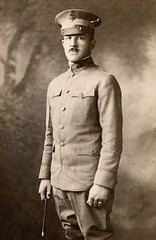
T. Montgomery Gregory
| 18 Oct 2023 |
|
While a professor at Howard University, T. Montgomery Gregory was active in establishing a training camp for black Army officers during World War I. He became a lieutenant. (Family photo).
On May 3, 1917, a letter appeared in a Washington newspaper posing a stark question: “What of the Negro?”
The letter’s author was T. Montgomery Gregory, an English professor at Howard University who had been moved to write by events that were rapidly unspooling in the capital. A month earlier, the United States had declared war on Germany, joining a conflict that had already been raging in Europe for nearly three years.
Our military was relatively small then. It was estimated that some 2 million American men would need to be conscripted into the Army in the coming year. Black men had fought in American wars since before the country was a country, a fact Gregory pointed out, writing, “The unbroken loyalty of the negro to the country of his adoption, yes even to the owners of his body, is one of the remarkable facts of history.”
With the United States girding for war, Gregory wondered how men such as himself would be involved. “What part is he to play in this fighting phalanx?” Gregory asked.
Thomas Montgomery Gregory was born in 1887 on the campus of Howard University, where his father, James Monroe Gregory, was a dean and Latin professor. The elder Gregory had been in Howard’s first graduating class. T. Montgomery Gregory earned his undergraduate degree not from Howard but from Harvard — Class of 1910 — but the historically black college was to play an important role in what came next.
As the United States prepared to enter the Great War, the Army announced that 14 officer training camps would be established. Supporters of integration — including such figures as Joel E. Spingarn, a white New Yorker active in the NAACP, and W.E.B. Du Bois , editor of its magazine, the Crisis — believed these camps should include African Americans. The Army disagreed: No black volunteers would be allowed at the camps.
Activists started mobilizing to secure what they saw as the next best thing: a camp to train black officers. A group called the Central Committee of Negro College Men was formed to push for this.
“The headquarters of this group was the basement of the chapel at Howard University,” said Sheila Gregory Thomas, T. Montgomery Gregory’s daughter.
Gregory chaired the group, which sprang into action. Members of the committee lobbied Congress, going from office to office on Capitol Hill to make their case to representatives. If a congressman refused to see them, they left behind a card outlining the situation and pledging the support of the African American community.
Letters and articles appeared in the black press and in the white-owned press. (Gregory’s letter was in the old Washington Times.)
The committee employed stirring language in its plea for a black officer corps: “Let us not mince matters; the race is on trial. It needs every one of its red-blooded, sober minded men. Doctors, lawyers, teachers, business men, and all men who have graduated from high school. Let the college student and graduate come and demonstrate by their presence the principles of virtue and courage learned in the academic halls. Up, brother, our race is calling.”
The effort extended to many fronts in the African American community.
“The colored churches in the District of Columbia were interested,” wrote Emmett J. Scott, an assistant to Secretary of War Newton Baker and the highest-ranking African American member of President Woodrow Wilson’s administration. “Frequent mass meetings were held by the Howard students; and when additional funds were needed a concert was given in the chapel.”
Figures at the Tuskegee-Normal and Industrial Institute were active, too.
Barely a week after Gregory’s letter appeared, 1,500 black American men had put their names forward. Most were college students or college graduates.
On May 19, the War Department announced that the 17th Provisional Training Regiment would be established for black officer candidates at Fort Des Moines. It was a remote location, chosen, some thought, because it was far from East Coast journalists who would be watching the experiment closely.
T. Montgomery Gregory was among those who attended the camp. He was commissioned as a lieutenant and served stateside in intelligence, his daughter said.
What was the outcome of the campaign launched in a Howard University basement? Or, as Scott put it in a chapter at the end of his 1919 history on black participation in the Great War: “Did the Negro soldier get a square deal?”
Any student of American history probably knows the answer. Two units of black troops — the 92nd and 93rd divisions — served in France. The officers graduated from Fort Des Moines faced discrimination throughout World War I: hazed, denied promotion, denied command, bivouacked in lesser quarters, prohibited from interacting with French civilians.
It wasn’t until 1948 that President Harry S. Truman integrated the armed forces.
Source: Washington Post, article by John Kelly (Feb. 5, 2019), "When WWI raged, a D.C. professor fought for Black officers' participation"
Hughes Allison
| 23 Aug 2016 |
|
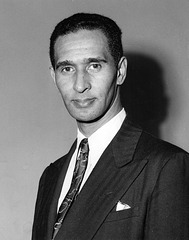
Hughes Allison, author of the first black detective story in ‘Ellery Queen’s Mystery Magazine,’ pictured in 1950. [ Hughes Allison Archive, Newark Public Library ]
In September of 1950, Hughes Allison, a playwright and writer of pulp fiction, responded to a manuscript sent by a writer who requested that he reply via the Mystery Writers of America. The author, Polly MacManus, singled out Allison for a reason: He was black, she was white, and she wanted his advice on how to write from the point of view of a black detective.
Allison warned MacManus he would be “brutally frank” in his letter: “I urge you to abandon the attempt to write about Negroes.” He felt MacManus’s detective “neither talks nor acts nor thinks like any college-trained Negro I’ve ever met.” Another black character in the manuscript, a maid, “is the most unrealistic chauvinist I’ve ever encountered in fiction. And in real life, she would be regarded by the Negro detectives whom I know as the kind of stool pigeon only heaven could spawn.”
He then followed up with what he considered to be one of the major pitfalls white writers face when writing black characters: "When you begin handling Negroes as major characters in fiction you immediately enter into that big and enormous and important and most complex area of American life called the Negro Question—where no answer can be secured from any part of that question if conjecture is allowed to play even a small part. You can’t guess. You have to know. You have to know Negro life as Negroes live it—and they live on numerous political, economic, social, and intellectual levels growing out of cause-and-effect patterns, the character of which is historical. The history of this matter is well documented—so well documented that those who are informed can tell at a glance who knows and who is guessing."
MacManus may have had good intentions, but those, Allison wrote, “are seldom consistent with the harsh facts of history.”
In a 1950 interview with the Newark Evening News, Allison explained: “It’s a battle to get a story about a Negro detective published in a national magazine, you know. I send the publisher a page-by-page explanation of what I’m doing in the story, and how I know what I’m talking about. He has to be ready in case some letters of protest arrive from Mississippi or Georgia.”
Literary erasure is not always deliberate, but literary championing must be. Rachel Howzell Hall wrote earlier this year about being one of the few black mystery writers at annual genre conferences in an essay titled “Colored and Invisible” for The Life Sentence, a web site for crime and noir writers: “It can be lonely in those grand ballrooms, in those lesser ballrooms, at that reception. And there have been times when I’ve retreated to my hotel room, emotionally exhausted from being visibly invisible all day.”
For a moment in the 1990s, after Walter Mosley and Devil in a Blue Dress, crime fiction made room for more black writers. But then writers like Eleanor Taylor Bland, Penny Mickelbury, Paula Woods, Charlotte Carter, and others perhaps fell away in the relentless turnover of the publishing industry: canceled contracts, merged companies, and shifting editorial priorities. In recent years, few black crime-genre writers have reached Mosley’s level of popularity. To date, there are no available statistics on how well, or how badly, they are represented in the industry.
Recognizing the problem and addressing it accordingly takes work, and time. Yet it is frustrating, even shameful, how few writers of color get through the mystery corridors with a fictional representation of their own experiences. The door opened, briefly, for Hughes Allison. Before editorial neglect slammed it shut, Allison showed, years before Mosley, Himes, or any black detective fiction writer, what it was to live in his character’s skin.
Hughes Allison was born in Greenville, South Carolina in 1908. His family moved to Newark, New Jersey in 1919. Allison attended Bergen Street Grammar School, Barringer High School, and Upsala College. His first short story was published in Challenge Magazine in 1935.
By 1937, Allison’s first play, The Trial of Dr. Beck was being produced on Broadway, which starred famous white actor, William Bendix. Also throughout the 1930s, Allison worked as a reporter for True Story Magazine. Later he authored a series of articles about school segregation for the Newark Evening News. He wrote over 2,000 radio scripts.
Allison’s most famous character is African-American detective Joe Hill, who was modeled after the real Newark Police Homicide Detective Carlton B. Norris. Allison was married to Elitea Bulkley Allison, a children’s librarian at the Newark Public Library. He died on August 26, 1974 at Presbyterian Hospital in Newark.
Info: 'The Case of the Disappearing Black Detective Novel,' by Sarah Weinman and 'Newark's Literary Lights'
Lucretia H. Newman Coleman
| 24 Jul 2016 |
|
|
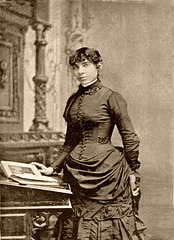
In her 1890 book, "Poor Ben: A Story of Real Life," based on the life of Benjamin William Arnett, the seventeenth bishop of the AME Church. In the dedication section she wrote: "I dedicate this work with sincere love for my race. To the colored young men and women of America, with the hope that it may contribute something to that Christian knowledge, which is the very breath of all true nobility." ~ The Author
Lucretia H. Newman Coleman lived in Appleton, Wisconsin for only a short time, from around 1867 to about 1876. Her family moved to Appleton, from Cincinnati after the death of the family’s patriarch, Baptist Minister and Abolitionist, Reverend William P. Newman in 1866.
She entered Lawrence University as a freshman in September, 1872, enrolling in a scientific course and staying for about two years. She was one of the earliest African American students to enroll at Lawrence. Some biographies state she graduated from Lawrence, but the University Archives has no record of her being awarded a degree. Lucretia was born in Dresden, Ontario, Canada around 1854. Her family moved from Canada to the West Indies, then back to Cincinnati and finally to Appleton. She married Robert J. Coleman in Des Moines, Iowa in 1884 and soon moved to Minneapolis where her daughter Roberta was born. Eventually she and Roberta moved to Chicago where her entry in 1920 census listed her occupation as dressmaker.
She had a distinguished career as an author in the 1880s and into the 1890s, writing articles published primarily in African American journals such as Our Women and Children and the A.M.E. Review, in addition to a biographical novel and poetry. In The Afro-American Press and Its Editors (1891), Irvine Penn states that her writings were “rich in minute comparisons, philosophic terms, and scientific principles.” Martin Dann writes in The Black Press 1827-1890: The Quest for National Identity (1971) that her poem “Lucille of Montana” (1883) was praised at the time as being “full of ardor, eloquence and noble thought.” A contemporary account in the journal The American Baptist said “As a writer, her fame is spreading, not only in one or two states, but throughout the United States. Should she continue with the same success in the past, she will be equal to Harriet Ward Beecher Stowe, if not her superior.” And in Noted Negro Women, Their Triumphs and Activities (1893), Monroe Alphus Majors writes she contributed to black journals with her “usual fascination for saying things in her own way.”
Bio: Neighborhood News (The Newsletter of the Old Third Ward Neighborhood Association, Inc.,) Winter 2016 editors Antoinette Powell and Linda Muldoon.
Josephine Baker
| 05 Apr 2016 |
|
|
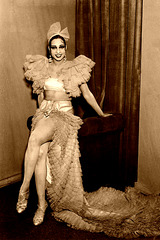
This was taken when Josephine performed in Finland along with her 16 piece orchestra.
Born Freda Josephine McDonald on June 3, 1906, in St. Louis, Missouri, Josephine Baker spent her youth in poverty before learning to dance and finding success on Broadway. In the 1920s she moved to France and soon became one of Europe's most popular and highest-paid performers. She worked for the French Resistance during World War II, and during the 1950s and '60s devoted herself to fighting segregation and racism in the United States. After beginning her comeback to the stage in 1973, Josephine Baker died of a cerebral hemorrhage on April 12, 1975, and was buried with military honors. [bio.com]
Jump to top
RSS feed- Kicha's latest photos with "Author" - Photos
- ipernity © 2007-2026
- Help & Contact
|
Club news
|
About ipernity
|
History |
ipernity Club & Prices |
Guide of good conduct
Donate | Group guidelines | Privacy policy | Terms of use | Statutes | In memoria -
Facebook
X
