

Kicha's photos with the keyword: Journalist

Jackie Ormes: Creator of Torchy Brown
| 16 Oct 2023 |
|
The first African American female cartoonist, Jackie Ormes (1917 - 1986), began her journalistic career as a sports writer for the Pittsburgh Courier in 1938 covering the John Henry Louis & Joe Lewis heavyweight boxing match. On May 1, 1937, Ormes' created her earliest cartoon. It was an action, romance, and soap opera comic featuring a Black heroine named Torchy Brown. Torchy Brown became a full-color Sunday feature. In its first episode, Torchy Brown in Dixie to Harlem, she was a teen-ager with a family.
In the late 1950s she started Torchy Brown Heartbeats that tackled issues such as sexism, racism & environmental pollution particularly perpetuated upon Black populated areas. Torchy was a woman of color that was not only sensuously drawn in contrast to the genre of the day that depicted black women as maids & mammies, she was portrayed as smart, brave and daring to stand up to the powers that be for justice.
Ormes also designed and marketed a line of cutout fashions for a paper doll version of her character, called Torchy's Togs. During its five year run, Torchy was very popular. Young girls liked her as a paper doll, while older girls who could sew, made their own versions of Torchy's togs. Young men in the armed forces found a use for Torchy as an attractive pin-up girl who was brown-skinned. In 1942, she then came to work for the Chicago Defender in a non-artistic position.
In 1946, Ormes introduced another strip, a single panel cartoon titled; Patty Jo `n Ginger. Patty Jo was a precocious, socially aware little girl living with her much older adult sister Ginger. The Patty Jo character went on to become this nation's first positive image 'Negro' character doll that hit the toy stores in time for Christmas (1948). The Patty Jo dolls are now collector’s items. In the late 70s, arthritis limited her artistic work, however Ormes remained a serious artist, painting murals, portraits (specializing in children's faces) & panels that decorated her home. She was also a passionate doll collector & member of the Chicago Chapter of the United Federation of Doll Clubs. In the 1950’s as her arthritis became worse, doll collecting began.
Retiring from cartooning in the 1960s Ormes had approximately 150 dolls, including a German-made doll, which was the predecessor to the Barbie of today. The oldest in her collection was 50 years old. Ormes was celebrated in Chicago's black social & fashion circles. She was also on the board of directors of the DuSable Museum of African-American History and Art. Ormes’ strips were syndicated in black newspapers across the country, making her the only nationally syndicated black woman cartoonist until the 1990s. She died in Chicago on January 2, 1986.
Sources: Black Women in America: An Historical Encyclopedia
Volumes 1 and 2, edited by Darlene Clark Hine

Fannie Barrier Williams
| 16 Oct 2023 |
|
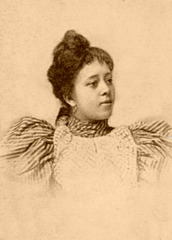
Fannie Barrier Williams (Feb. 12, 1855 - March 4, 1944) was an African American teacher, social activist, clubwoman, lecturer, and journalist who worked for social justice, civil liberties, education, and employment opportunities, especially for black women. A talented speaker, writer, and musician, she was welcomed in cultured white society in the North, but remained loyal to people of color, knowing that the advantages she enjoyed were not given to other blacks.
She was born in Brockport, New York, six years before the Civil War, in one of the few black families in town. Her father, Anthony Barrier, a barber and part-time coal merchant, was well-respected in the community and a long-time lay leader in the First Baptist Church. Her mother Harriet taught Bible classes and Fannie played the piano for Sunday services.
A bright, personable child, talented in both music and art, Fannie attended public school with her siblings Ella and George. Ella became a teacher and principal in Washington, D.C.; George was an inspector for the Detroit Board of Public Works and a leader in local politics. They were well-liked students who associated freely with white classmates. Fannie was unaware at the time of the racial prejudice that prevailed in other parts of the country, having experienced none in Brockport. Fannie graduated from the State Normal School (now SUNY-College at Brockport) in 1870, the first African American to do so.
When the Civil War ended, the Federal government established schools to educate newly freed slaves. Inspired by her parents' friend Frederick Douglass, the former slave and abolitionist who lived in nearby Rochester, and now more knowledgeable about the oppression of blacks, Fannie obtained a teaching position in the South. For the first time she experienced the daily degradations—segregation, intimidation, and physical assaults—suffered by many African Americans. At first she tried to adapt to the dreadful conditions, but said in "A Northern Negro's Autobiography," 1904, "I had missed the training that would have made this continued humiliation possible."
She went to Boston to study piano at the New England Conservatory of Music, but was asked to leave because Southern white students objected to her presence. "I never quite recovered from the shock and pain of my first bitter realization," she wrote, "that to be a colored woman is to be discredited, mistrusted and often meanly hated."
Fannie then went to Washington, D.C. to teach. She socialized with other educated blacks, studied portrait painting at the School of Fine Arts, and met S. (Samuel) Laing Williams, an outstanding African American law student. They were married in Brockport, New York, in 1887, and moved to Chicago where they became leaders in the African American community. Although housing was racially segregated, they made friends with white reformers, such as Jane Addams, founder of the southside settlement, Hull-House; Mary McDowell, the director of the University of Chicago Social Settlement; and meatpacker and philanthropist Philip D. Armour, who employed without discrimination many black workers in his plants.
The Williamses, who had no children, soon took up numerous projects. S. Laing was successful as a lawyer. He organized the Prudence Crandall Study Club, limited to 25 couples from the African American elite. Fannie was its director of art and music. With a generous donation from Armour, in 1891 the Williamses helped establish Provident Hospital. This had a bi-racial staff and clientele, and a nurses' training school for black students who were barred from all others.
Fannie and her husband joined All Souls (Unitarian) Church in Chicago. They may have first been attracted by the Abraham Lincoln Center, a reform settlement which the church sponsored. The minister was Jenkin Lloyd Jones, a free-thinker, pacifist, activist for women and blacks' civil rights, and a founder of the World's Parliament of Religions. Fannie's friend, the Unitarian minister, Celia Parker Wooley, was a member.
Williams came to national prominence at the 1893 Columbian Exposition in Chicago. Black women leaders had protested their exclusion from the fair's planning. To appease them, Williams was appointed to gather exhibits for the women's hall. More importantly, she presented two courageous and controversial addresses, one to the World's Congress of Representative Women, and the other to the World's Parliament of Religions.
In the first, "The Intellectual Progress of Colored Women of the United States Since the Emancipation Proclamation," Williams argued, before a mostly white audience, that black women were eager to gain the education and skills denied during slavery, were cheerful and hopeful despite the "distressing burden of mean and unreasonable discrimination," were hard-working in their determination to find jobs and support themselves and their families, and had come amazingly far in less than 30 years. "Few of the happy, prosperous, and eager living Americans," she said, "can appreciate what it all means to be suddenly changed from irresponsible bondage to the responsibility of freedom and citizenship!" While praising those who worked to uplift the downtrodden "colored women," she chastised privileged citizens who were "impatient with ignorance and poverty" and urged them to help rather than hinder the progress of those striving to better their lives, to judge individuals by their worth and not by race or custom. She also observed that black women were becoming interested in a variety of religious institutions "from the Catholic creed to the no-creed of Emerson."
In her second speech, published as "Religious Duty to the Negro," Williams excoriated the Christians who brought Africans to this country as slaves and preached a "false, pernicious, demoralizing Gospel" to make them docile and dependent. The masters dared not "open the Bible too wide," however, or the slaves would have recognized the hypocrisy of Christians committing atrocities against a defenseless people. She noted, however, that after Emancipation a number of white "heroic men and saintly women . . . believed in the manhood and womanhood of the negro race" and generously established schools, colleges, and churches in the South. She was grateful for "this significant change in sentiment," but concerned that Northern churches had sent "too many ministers who have had no sort of preparation and fitness for the work assigned them."
Williams challenged her listeners by asking, "What can religion further do to advance the condition of the colored people?" Her answer reflected Unitarian influence: "More religion and less church. . . . Less theology and more of human brotherhood, less declamation and more common sense and love for truth. . . . The tendency of creeds and doctrine to obscure religion, to make complex that which is elemental and simple, to suggest partisanship and doubt in that which is universal and certain, has seriously hindered the moral progress of the colored people of this country." Because "in nothing was slavery so savage and so relentless as in its attempted destruction of the family instincts," she urged ministers and others to do less preaching and instead "open every cabin door and get immediate contact" with Southern blacks, teaching them the "blessed meanings of marriage, motherhood and family" and how a humane religion can impact their daily lives in positive, practical ways.
She also called it a "monstrous thing" that so many Evangelical churches closed their doors to African Americans. "It should be the province of religion," Williams said, "to unite, and not to separate, men and women according to the superficial differences of race lines." In the audience sat the charismatic, 75-year-old Frederick Douglass. Moved by her address, he rose and praised the remarks of this "refined, educated colored lady," saying that "a new heaven is dawning upon us." After the success of these orations, she became a nationally-known writer and lecturer, who sometimes included a piano concert as part of her program.
In her 1895 talk to African American women in Memphis, Tennessee, "Opportunities and Responsibilities of Colored Women," Williams encouraged them to help themselves and each other to the utmost of their abilities, rather than depend on white benevolence. Their religion, she said, should "stand more for love than doctrine, more for human worth than church name. . . . What men and women do, rather than what they say or profess, shall be the standard of religion." She urged them to have sympathy for the most disadvantaged in their community, to set up projects such as day nurseries for mothers who worked full-time, to take pride in their race and gender, and be "self-respectful, ambitious, aspiring for all that is best in human life."
A year earlier, Williams was nominated by several white friends, including Wooley, to be a member of the prestigious Chicago Woman's Club. Although she would be the first black woman in the 800-member organization, she expected no opposition. To her dismay, a vocal minority fought her application for 14 months, drawing national media attention. Not wanting to offend her friends, Williams resisted the pressure to withdraw her name and was eventually voted in by a decisive majority—the group's only African American for the next 30 years.
Williams established clubs to help black women, especially those who emigrated to Northern cities with insufficient knowledge and few resources. In 1893 she helped found the National League of Colored Women. In 1896 this joined other organizations to become the National Association of Colored Women (NACW). The local clubs, over 200 from many states, provided child care centers, classes, employment bureaus, and savings banks. Williams believed that African American women needed to band together to gain confidence, to protect each other "against the libelous attacks upon their characters," and to teach literacy and domestic and job skills. Williams was a lead organizer for the 1899 NACW convention held in Chicago.
S. Laing Williams was a long-time friend of Booker T. Washington, the founder of Tuskegee Institute, who advocated vocational training for Southern blacks. The Williamses emphasized the value of higher education, but also believed that working-class people needed jobs, decent places to live, and help with daily survival. Fannie defended Washington's methods and also urged home economics classes for women. In the preface to his 1907 biography of Frederick Douglass, Washington paid tribute to S. Laing and Fannie Barrier Williams for their "incalculable service in the preparation of this volume." Because of their close relationship with both Douglass and Washington, some have speculated that the Williamses ghostwrote the book.
During this time, the African American sociologist W. E. B. DuBois severely criticized Washington for making an accommodation with Southern white supremacy, thus limiting the education and aspirations of intelligent, talented black youth. The Williamses joined the DuBois campaign to attack racial discrimination and lynching and were early members of the National Association for the Advancement of Colored People (NAACP), founded in 1909. As they however believed the two views on education need not be in conflict, they maintained cordial relationships with both men.
In 1905, with Wooley, who became the director, Williams helped create the Frederick Douglass Center in Chicago, an integrated social settlement. She also helped establish the Phyllis Wheatley Home, a place for young black women to stay, be protected, and find employment when they first moved to the city. The center inspired copies in other urban areas. In addition, she was active in the movement to gain legal rights and the vote for all women. When Susan B. Anthony died in 1907, Williams was the only African American woman to give a eulogy at the National American Women's Suffrage Association convention. She also gave eulogies for Philip D. Armour in 1901 and Celia Parker Wooley in 1918.
In later years Williams concentrated more on writing. She was a reporter for the African American publications Woman's Era, New York Age, and the Chicago Record Herald. She contributed to other newspapers and journals and to several books, including her article, "The Club Movement Among Colored Women of America," in A New Negro for a New Century, 1900.
After her husband died in 1921, Williams continued her activist work. In 1924 she was the first woman and the first African American to be appointed to the board of the Chicago Public Library. Because of declining health, in 1926 she returned to live with her sister Ella in their family home in Brockport (163 Erie Street, now a New York state historical site). She took care of Ella, who became blind, until her own debilitating stroke led to her demise. Ella died a year later. The sisters and their parents were buried in the High Street Cemetery in Brockport. Their brother, George, had died in Detroit in 1907.
For her impassioned work for African American causes, Williams was esteemed by black communities across the land. Because of her genteel manner, organizing talents, and vivacious personality, she was accepted by many Northern white social reformers. Being light-skinned eased her way. Williams recognized the exceptional privileges she experienced as a black woman in her day, but she wrote at the end of her autobiography, "Whether I live in the North or the South, I cannot be counted for my full value." Her heart ached for the bigotry and barriers that confronted African Americans, especially the women whom she considered to be the most oppressed. She dedicated herself to aiding and uplifting those in need, improving interracial relations, and working for justice and equality for all.
Sources: Fannie Barrier Williams By June Edwards (posted March 2005), Unitarian Universalist History & Heritage Society; Paul Tralles, Photographer (Wash DC, 1885); William Henry Richards Collection, Library of Congress Prints and Photographs Division
Lutie A Lytle: First African American to be admitt…
| 16 Oct 2023 |
|
In October 1897 Topekans were buzzing with the news that one of their own was a pioneer in her field. One of only two students in Central Tennessee law school's graduating class of 1897, Lutie A. Lytle was among the first African American woman to earn a law degree.
Lytle was born around 1875 in Murfreesboro, Tennessee, where her father's family had lived for some time. John R., Mary Ann "Mollie", the family's four children and Lutie's grandmother moved to Kansas around 1882, a time when many other African Americans were relocating from Tennessee to Kansas with the Exoduster movement.
The Lytle family lived at 1435 Monroe Street and Lutie and her brothers attended Topeka schools, including Topeka High School. John became active in the Populist Party and ran an unsuccessful campaign for city jailor. His involvement led to Lutie's appointment as the Populist's assistant enrolling clerk for the state legislature. She also worked for one of the African American newspapers in Topeka. It was in this position where she dreamt of higher pursuits.
"I conceived the idea of studying law in a printing office where I worked for years as a compositor," Lutie said during an interview 1897. "I read the newspaper exchanges a great deal and became impressed with the knowledge of the fact that my own people especially were the victims of legal ignorance. I resolved to fathom its depths and penetrate its mysteries and intricacies in hopes of being a benefit to my people."
At the age of 21, Lutie moved to Chattanooga, Tennessee. There she taught school to pay for her tuition at Central Tennessee College in Nashville. While in college, Lutie also became involved other social activities.
"There were a number of young men studying beside her, but she held her own with them all," stated a Nashville newspaper in 1897. "Though she studied hard, she did not shut herself out from the enjoyment of the society of her fellow students. She was a member of the college glee club, and at the numerous musical entertainments given by the students she was invariably relied upon to accompany on the piano."
In September 1897 Lytle was admitted to the Criminal Court in Memphis, Tennessee, after passing an oral exam. Newspaper accounts said that she was the first African American woman to be licensed to practice in Tennessee, and third in the United States. Later that month, after returning to Topeka, she became the first African American woman admitted to the Kansas bar.
Lutie continued to dream of helping other African Americans through the legal system, as she talked of establishing a practice in Chicago or New York. "I like constitutional law because the anchor of my race is grounded on the constitution," Lytle said. "It is the certificate of our liberty and our equality before the law. Our citizenship is based on it, and hence I love it."
"In connection with my law practice I intend to give occasional lectures, but not in any sense for personal benefit," Lytle said. "I shall talk to my own people and make a sincere and earnest effort to improve their condition as citizens. I believe in efficacy of reason to bring about the best results."
For the next year, Lutie lived in Topeka and became involved in the Interstate Literary Association with members from Kansas City, Missouri and Kansas communities. She was invited to lecture for women's groups and local colleges on law related to domestic issues.
"When I was graduated in June, I intended to commence practicing right away, but I found that a rest was what I needed," Lytle said. "Ever since a small girl in High school I have been interested in politics, and hoped some day to be able to take an active part in shaping the great questions of the day."
In fall 1898 Lytle announced that she would join the faculty at Central Tennessee. Newspaper accounts claimed that she was the only woman law instructor in the world. She served one session, 1898 - 1899, in that position.
In 1910 Lytle was living in Brooklyn, New York, with her husband, Alfred C. Cowan, also a lawyer. The couple attended the annual convention of what is now known as the Negro Bar Association in 1913. Media stories said she was the first African American female to become a member of a national bar organization and the first to participate with a spouse.
Lytle returned to Topeka in 1925 and addressed a large audience at St. John's A.M.E. Church, which she had attended in her youth. Lytle told her audience about the progress of African Americans in New York City. She shared examples of integration in the schools and government and told of the vision of Marcus Garvey, considered the father of contemporary Black Nationalism.
She died on November 12, 1955 in Brooklyn and is buried at Saint Charles Cemetery in Suffolk County, New York.
Others in the Lytle family also were well known in Topeka. Lutie's father, John, was a barber in downtown Topeka and also worked as a policeman. Lutie's brother, Charles, operated barbershops at 109 West Fifth and 326 Kansas Avenue. He later opened a drug store in 100 block of East Fourth. Charles had a lengthy career in law enforcement, which included police detective, chief of detectives, and deputy state fire marshal where he held a record for most convictions in arson cases at 236.
Source: Kansapedia: Kansas Historical Society
Michele Clark
| 16 Oct 2023 |
|
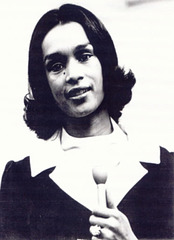
A talented and ambitious young woman, Michele Clark (1943 - 1972), quickly established herself as one of the best and brightest reporters on CBS television in the early 1970s. Within two years of completing her journalism training, she had become a reporter for the Democratic and Republican conventions, and then rose to a position as a national reporter on the network. She was the first black female news correspondent on CBS. Working at a time when television networks were trying to bring minorities and women into visible positions, Clark's rise was swift, her career brief, and her life "a promise unfilled."
Clark graduated from Roosevelt University in Chicago. After graduation she worked a variety of jobs. She considered becoming a lawyer, but decided to enter the field of journalism. In May 1970, she joined CBS at its Chicago affiliate, WBBM-TV, as a newswriter. That summer she completed a program at Columbia University called Broadcast and Print Journalism for Minorities, and she returned the WBBM station as General Assignment Reporter. She was the only woman reporter at the station, a position she held for about one year.
The CBS news staff was immediately impressed with Clark's performance and considered her a good reporter. She received the kind of difficult and prestigious assignments that were usually restricted to men. Still based in Chicago, she was assigned to cover the 1972 presidential primaries. At the Democratic Convention she was promoted to correspondent. Clearly, CBS had big plans for her.
In 1972, Clark was reassigned to Washington DC where she was CBS News Washington correspondent and had a quasi-anchor slot for that summer and fall. She often commuted to Chicago where her family still lived. When she headed home for Christmas in 1972 to spend a month's vacation with her family, she was one of 44 people killed when a United Air Lines plane crashed on December 8th, near Chicago's Midway Airport.
Although a tragic accident ended a seemingly unlimited career, Clark was not to be forgotten. The journalism program she had completed at Columbia University, funded by CBS, NBC, and the Ford Foundation, was renamed the Michele Clark Fellowship Program for Minority Journalists in her honor. From its inception to 1974, when the program closed, 227 minority women and men were trained for employment in print and electronic media. The next year with a grant from the Gannett Foundation, the program was reinstated and relocated at the University of California at Berkley and renamed the Institute for Journalism Education.
When Clark completed her application in 1970 for the Columbia journalism program, she was not to know that her statement would become a credo for journalists of the future.
My vanity requires public recognition; my confidence requires
a mode of expression; my intelligence and training require an intellectual challenge; my fear of boredom requires that routine be avoided; my ego requires that I contribute something and become involved, and my great mistrust and dislike for do-gooders requires that I be paid well for my services .....
There is also a Michele Clark Academic Preparatory Magnet High School located in Chicago in honor of Clark.
Source: Notable Black American Women by Jessie Carney Smith
The Benjamin's Last Family Portrait
| 16 Oct 2023 |
|
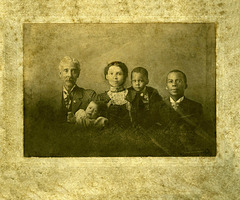
The following paragraph comes from The Freeman Newspaper (Dec. 22, 1900): "Last Picture of the Benjamin Family" --- R.C.O. Benjamin was assassinated October 2, 1900. This picture represents his family group taken during the visit of Mrs. Benjamin's father, W.S. Robinson, of Alabama. September 19, 1900 twelve days before the tragedy. The ages in years of the Benjamins are: Robert Charles O'Hara, 45; Lulu Maria 27; Robinson Charles O'Hara (called Robin, bearing his father's full initials), 4; Lillian Allen, 8 months. The children's grandfather, aged 53 years, is on the left; their father at the right. Mr. Benjamin was one of the most remarkable Negroes that ever lived --- Editor, Lawyer, Preacher, Teacher, Author, Poet, Orator, Humorist, Lecturer, Politician, Traveler, Thirty-Third Degree Mason and member of all the leading Secret and Benevolent Societies. Duplicate photographs will be sold at 25 cents each for the benefit of the Orphan Fund. Address The Standard, Lexington, Kentucky, a newspaper edited by R.C.O. Benjamin until the night of his martyrdom, and now published by his widow.
The following biography comes from American National Biography Online, "Robert Charles O'Hara Benjamin" by George C Wright : Robert Charles O'Hara Benjamin, (1855 - 1900), journalist and lawyer, was born on the island of St. Kitts in the West Indies. Details about his early life, including the names of his parents and his education, are not known. In the fall of 1869 he arrived in New York, where he worked as soliciting agent for the New York Star and then as city editor for the Progressive American.
Benjamin apparently became a U.S. citizen in the early 1870s, and in 1876 he gave speeches in support of Rutherford B. Hayes, the Republican candidate for president. He was rewarded with a position as a letter carrier in New York City but quit after nine months and moved to Kentucky, where he taught school. While there, Benjamin also took up the study of law. He continued his studies after being named principal of a school in Decatur, Alabama, and was admitted to the bar at Nashville, Tennessee, in January 1880.
Before and after his admission to the bar, Benjamin continued his career in journalism. In total, he edited and/or owned at least eleven black newspapers, including the Colored Citizen of Pittsburgh; The Chronicle of Evansville, Illinois; the Nashville Free Lance (where, as contributing editor, he wrote under the name "Cicero"); the Negro American of Birmingham, Alabama; the Los Angeles Observer; and the San Francisco Sentinel. When Benjamin worked at each of these papers is unclear. He was apparently in Birmingham in 1887, Los Angeles in 1888, and San Francisco in 1891. He also worked for the Daily Sun, a white-owned newspaper in Los Angeles.
In addition to his journalism, Benjamin also published a number of books and pamphlets that reflected the wide range of his interests. In 1883 he published Poetic Gems, a small collection of poetry, and in 1888 he published Life of Toussaint L'Ouverture. He was perhaps best known for Southern Outrages: A Statistical Record of Lawless Doings (1894). In 1886 Benjamin traveled to Canada on a speaking tour.
For twenty years Benjamin maintained a legal practice in the cities where he edited newspapers. One of his cases received widespread publicity: in Richmond, Virginia, in 1884 he won an acquittal of a black woman charged with murder. At a time when most white newspapers spoke of blacks in derogatory and racist terms, Benjamin's skills as a lawyer drew favorable comment from white newspapers in Richmond, Los Angeles, and Lexington.
Benjamin, however, did not court white opinion, although he well understood the risk that African Americans ran in challenging whites in civil rights, politics, and race relations. Benjamin was a vocal critic of racial discrimination and went much further than most black leaders; instead of simply denouncing Jim Crow legislation, he urged blacks to defend themselves when attacked by whites. Such an outspoken attitude led to Benjamin being forced to leave Brinkley, Arkansas, in 1879 and Birmingham in 1887. Irvine Garland Penn, author of The Afro-American Press and Its Editors (1891), said of Benjamin: "He is fearless in his editorial expression; and the fact that he is a negro does not lead him to withhold his opinions upon the live issues of the day, but to give them in a courageous manner."
In December 1892 Benjamin married Lula M. Robinson; they had a son and a daughter. The family settled in Lexington, Kentucky, in 1897. To the dismay of some whites, Benjamin quickly became involved in local politics. On October 2, 1900 he argued with Michael Moynahan, a Democratic precinct worker, over the white man's harassment of blacks wishing to register to vote. Late that evening Moynahan killed Benjamin. At the trial several days later, he pleaded not guilty by reasons of self-defense. The judge accepted Moynahan's claim and dismissed the case, even though Benjamin had been shot in the back.
Because of his militant stance, his journalism and other writings, and his legal career, R. C. O. Benjamin deserves serious attention from scholars. His tragic death is also a reminder that throughout American history even highly respected black leaders have been vulnerable to white violence.
He is buried in African Cemetery No. 2 in Lexington, Kentucky.
Source: Joshua Soule Smith papers, 1863-1905

William Monroe Trotter
| 16 Oct 2023 |
|
William Monroe Trotter was a Harvard-educated journalist and activist who championed equal rights for African Americans.
William Monroe Trotter was born on April 7, 1872, in Chillicothe, Ohio, and raised in Hyde Park, Boston. His father, James, was a writer and former civil rights lieutenant who worked in real estate. Trotter excelled in academics growing up, becoming his predominantly-white high school's class president and attending Harvard University in the early 1890s. He made history as Harvard's first African-American student to become a member of the Phi Beta Kappa honor fraternity before graduating magna cum laude from the school in 1895, later earning a master's degree. Stalled from going into banking due to discrimination, Trotter worked in real estate. In 1899, he married Geraldine L. Pindell.
Trotter became a staunch opponent of racial discrimination and found himself in conflict with Booker T. Washington, the era's most popular African-American leader. Washington advocated a more conciliatory approach with the status quo and pushed for African Americans to pursue vocational and agricultural training, which Trotter found to be a problematic stance considering Washington's luminary status among white political leaders.
In 1901, Trotter co-founded the Boston Literary and Historical Association. With colleague George Forbes, he established The Guardian newspaper to disseminate "propaganda against discrimination." The publication pushed for African-American equality and critiqued Washington's views.
In the summer of 1903, Washington visited the AME Zion Church in Boston to give a speech. During the meeting Trotter questioned Washington, which led to a shouting match and ensuing ruckus dubbed "The Boston Riot" by the press. Trotter was arrested, fined and sentenced to a month's imprisonment, during which time he read W.E.B. Du Bois' book The Souls of Black Folk.
Upon release, Trotter co-established the National Negro Suffrage League and in 1905 worked with Du Bois to help organize The Niagara Movement, a group of African-American leaders who gathered in Canada and set forth a manifesto calling for full equal rights for black citizens, with the words, "We claim for ourselves every single right that belongs to a freeborn American, political, civil and social."
Though Trotter later attended the 1909 conference that would lead to the creation of the NAACP, he wouldn't align himself with the civil rights organization due to his insistence on there being an all-black group and thus focused on developing the National Equal Rights League.
Trotter also voiced his opinion in the realm of presidential politics. He had initially supported Woodrow Wilson during his campaign, but protested the administration's policies after seeing that Wilson supported job segregation, with Trotter making his views known at two separate White House meetings. Trotter also led campaigns against the 1915 film Birth of a Nation and its racist messages.
Trotter experienced personal loss in 1918, when his wife passed from the era's flu epidemic. After Wilson refused to appoint an African-American delegate to the Paris Peace Conference of 1919, Trotter crossed the Atlantic by stowing away on a ship as a cook. He wasn't allowed to attend the conference but was able to publish articles for French media.
In the 1920s, Trotter continued his calls and protests for the end of segregation on a governmental and local level and continued to helm The Guardian. Trotter was found on his birthday, April 7, 1934, on the street outside of his home, believed to have fallen or due to depression from his wife's death committed suicide..
Trotter's work is seen as being an important precedent to the direct-action methods used in the Civil Rights Movement of the 1950s and '60s. Information on Trotter's life can be found in the Stephen B. Fox biography The Guardian of Boston. His legacy is also remembered via Harvard's William Monroe Trotter Scholars Program and the William Monroe Trotter Institute at the University of Massachusetts.
Trotter Harvard University Archives; William Monroe Trotter Biography.com, Author Biography.com Editors
Orrin C Evans
| 16 Oct 2023 |
|
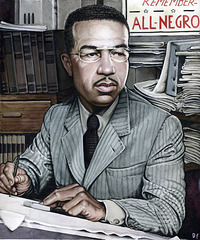
When Orrin C. Evans died in 1971 at the age of 68 he was eulogized in the New York Times as ‘the dean of black reporters’. From our vantage point of another quarter century, we can also say he was the father of black comic books.
Mr Evans was born in 1902 in Steeleton, Pennsylvania, the eldest son of George J. Evans Sr, and Maude Wilson Evans. Mr Evans Sr., was employed by the Pennsylvania Railroad, his wife was the first black person to graduate from the Williamsport Teachers’ College,and the family lived in white neighborhoods. However, despite this stable home life the every day realities of Northern racism were never far from their door. Mr Evans Sr. passed for white in order to provide a better living for his family than the menial jobs available to blacks would allow, but this forced him to carry the pretense to the inevitable ends of hiding the darker skinned Orrin in a back room while Maude donned an apron and pretended to be a maid when friends from his work dropped by. On other occasions, his father was not able to acknowledge Orrin at his workplace. Years later Orrin was visibly moved when relating these episodes. As Orrin’s friend, Claude Lewis wrote in 1971 ‘There was no National Association for the Advancement of Colored People back then, there was no Urban League. Like others of his time, Orrin Evans was out there on his own. And what he had to suffer was more than anyone I know could endure’.
His first job was on the Sportsman’s Magazine at age 17, and his first real newspaper experience was with the Philadelphia Tribune, the oldest black paper in the country. From there, in the early nineteen-thirties, he decided to break the color barrier and landed a writing position on the Philadelphia Record, becoming the first black writer to cover general assignments for a mainstream white newspaper in the United States. In 1944 at the Record he wrote a series of articles about segregation in the armed services, which were read into the congressional record, and helped end the practice. He won an honorable mention in that year’s Hayword Hale Broun award, but also drew some unwelcome attention. To criticize the government during wartime, even to point out the obvious hypocrisy of segregating troops putting their lives on the line to defend a country where democracy supposedly makes all men equal was considered treasonous by some and he and his family received death threats. His daughter Hope remembers their house being protected in a 24 hour a day vigil by a congregation of Orrin’s friends, both black and white, until the threats subsided.
This was not the only time Orrin was threatened because of his color and position. Once at the Philadelphia Police Precinct at 55th and Pine a police sergeant pulled his revolver and ordered him out of the station, not believing a black man had any legitimate place on the front side of the bars, and the national hero and Nazi sympathizer Charles Lindbergh once held up a press conference during the infamous kidnapping of his son to have Orrin ousted because he was black.
For Orrin to note the lack of black heroes in the popular culture was a singular feat in itself. As Claude Lewis said in a recent interview ‘We weren’t very conscious about being left out, it was just the way things were. We identified with Superman, Batman, Submariner and the rest of them without giving much thought to it. If you’ve never seen a black hero you don’t spend a lot of time wondering where they are. Today you would, but back then, there were no blacks in ads. It just didn’t happen’. Orrin wanted to change all this. He considered himself an urban American born in the twentieth century, fully integrated into the western world. He and his wife were long time supporters of the NAACP and the Urban League. The works of WEB Du Bois spoke more to him than did those of Marcus Garvey. He possessed a library said to be possibly the finest in the black community with volumes not only of Afrocentric interest or white commentaries on what was termed ‘the Negro problem’, but a library that represented his own wide range of interests, and he wanted to produce a comic that would reflect these values.
All Negro Comics # 1 carries a cover date of June 1947. No information about the press run or distribution remains, but it is believed that the comic was distributed outside of the Philadelphia area.
A second issue was planned and the art completed, but when Orrin was ready to publish he found that his source for newsprint would no longer sell to him, nor would any of the other vendors he contacted. Though Orrin was unyielding in his support of integration and civil rights he was moderate in his methods of achieving these goals. He believed in the general fairness of the system he had been born into. He was not a man given to conspiratorial thinking, but his family remembers that his belief was that there was pressure being placed on the newsprint wholesalers by bigger publishers and distributors who didn’t welcome any intrusions on their established territories.
Orrin Evans returned to the newspaper business. He was an editor at the Chester Times, and later at the Philadelphia Bulletin, where he worked with Claude Lewis who recently said ‘Orrin had many contacts throughout the city of Philadelphia and the region. He knew the people who were running the city and he knew the people who were at the bottom, and he was equally at ease in either community. He was well liked and well versed and that made him a very valuable person in a newsroom’. During his lifetime Mr Evans was featured in articles in Jet and Ebony magazines. He was a director of the Philadelphia Press Association, and an officer of the Newspaper Guild of Greater Philadelphia. In 1966 he won the Inter Urban League of Pennsylvania Achievement Award. He covered more National Urban League and NAACP conventions than any other reporter and the month before his death he was honored in a resolution at the annual NAACP convention in Minneapolis and a scholarship was created in his name.
Illustration by Drew Friedman
Sources: Interviews Hope Evans Boyd, George J. Evans Jr, Claude Lewis, George Evans. Article Philadelphia Tribune 15 Feb 77, Pg 21: Orrin Evans, A Black Who Refused to Be Bitter.
Entry In Black and White (reference) Pg 306, Obituary NY Times 8 Aug 7, Pg 58, Obituary Philadelphia Bulletin 8 Aug 71; Charles Lindburg reference is from American Swastika by Charles Higham, Doubleday Publishers,1985. Garden City, NY., TomChristopher.com.
Hughes Allison
| 23 Aug 2016 |
|
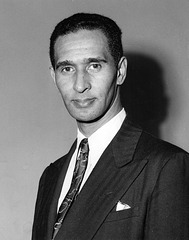
Hughes Allison, author of the first black detective story in ‘Ellery Queen’s Mystery Magazine,’ pictured in 1950. [ Hughes Allison Archive, Newark Public Library ]
In September of 1950, Hughes Allison, a playwright and writer of pulp fiction, responded to a manuscript sent by a writer who requested that he reply via the Mystery Writers of America. The author, Polly MacManus, singled out Allison for a reason: He was black, she was white, and she wanted his advice on how to write from the point of view of a black detective.
Allison warned MacManus he would be “brutally frank” in his letter: “I urge you to abandon the attempt to write about Negroes.” He felt MacManus’s detective “neither talks nor acts nor thinks like any college-trained Negro I’ve ever met.” Another black character in the manuscript, a maid, “is the most unrealistic chauvinist I’ve ever encountered in fiction. And in real life, she would be regarded by the Negro detectives whom I know as the kind of stool pigeon only heaven could spawn.”
He then followed up with what he considered to be one of the major pitfalls white writers face when writing black characters: "When you begin handling Negroes as major characters in fiction you immediately enter into that big and enormous and important and most complex area of American life called the Negro Question—where no answer can be secured from any part of that question if conjecture is allowed to play even a small part. You can’t guess. You have to know. You have to know Negro life as Negroes live it—and they live on numerous political, economic, social, and intellectual levels growing out of cause-and-effect patterns, the character of which is historical. The history of this matter is well documented—so well documented that those who are informed can tell at a glance who knows and who is guessing."
MacManus may have had good intentions, but those, Allison wrote, “are seldom consistent with the harsh facts of history.”
In a 1950 interview with the Newark Evening News, Allison explained: “It’s a battle to get a story about a Negro detective published in a national magazine, you know. I send the publisher a page-by-page explanation of what I’m doing in the story, and how I know what I’m talking about. He has to be ready in case some letters of protest arrive from Mississippi or Georgia.”
Literary erasure is not always deliberate, but literary championing must be. Rachel Howzell Hall wrote earlier this year about being one of the few black mystery writers at annual genre conferences in an essay titled “Colored and Invisible” for The Life Sentence, a web site for crime and noir writers: “It can be lonely in those grand ballrooms, in those lesser ballrooms, at that reception. And there have been times when I’ve retreated to my hotel room, emotionally exhausted from being visibly invisible all day.”
For a moment in the 1990s, after Walter Mosley and Devil in a Blue Dress, crime fiction made room for more black writers. But then writers like Eleanor Taylor Bland, Penny Mickelbury, Paula Woods, Charlotte Carter, and others perhaps fell away in the relentless turnover of the publishing industry: canceled contracts, merged companies, and shifting editorial priorities. In recent years, few black crime-genre writers have reached Mosley’s level of popularity. To date, there are no available statistics on how well, or how badly, they are represented in the industry.
Recognizing the problem and addressing it accordingly takes work, and time. Yet it is frustrating, even shameful, how few writers of color get through the mystery corridors with a fictional representation of their own experiences. The door opened, briefly, for Hughes Allison. Before editorial neglect slammed it shut, Allison showed, years before Mosley, Himes, or any black detective fiction writer, what it was to live in his character’s skin.
Hughes Allison was born in Greenville, South Carolina in 1908. His family moved to Newark, New Jersey in 1919. Allison attended Bergen Street Grammar School, Barringer High School, and Upsala College. His first short story was published in Challenge Magazine in 1935.
By 1937, Allison’s first play, The Trial of Dr. Beck was being produced on Broadway, which starred famous white actor, William Bendix. Also throughout the 1930s, Allison worked as a reporter for True Story Magazine. Later he authored a series of articles about school segregation for the Newark Evening News. He wrote over 2,000 radio scripts.
Allison’s most famous character is African-American detective Joe Hill, who was modeled after the real Newark Police Homicide Detective Carlton B. Norris. Allison was married to Elitea Bulkley Allison, a children’s librarian at the Newark Public Library. He died on August 26, 1974 at Presbyterian Hospital in Newark.
Info: 'The Case of the Disappearing Black Detective Novel,' by Sarah Weinman and 'Newark's Literary Lights'
Lucretia H. Newman Coleman
| 24 Jul 2016 |
|
|
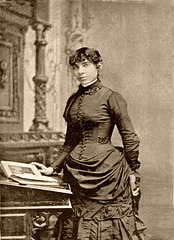
In her 1890 book, "Poor Ben: A Story of Real Life," based on the life of Benjamin William Arnett, the seventeenth bishop of the AME Church. In the dedication section she wrote: "I dedicate this work with sincere love for my race. To the colored young men and women of America, with the hope that it may contribute something to that Christian knowledge, which is the very breath of all true nobility."
Lucretia H. Newman Coleman lived in Appleton, Wisconsin for only a short time, from around 1867 to about 1876. Her family moved to Appleton, from Cincinnati after the death of the family’s patriarch, Baptist Minister and Abolitionist, Reverend William P. Newman in 1866.
She entered Lawrence University as a freshman in September, 1872, enrolling in a scientific course and staying for about two years. She was one of the earliest African American students to enroll at Lawrence. Some biographies state she graduated from Lawrence, but the University Archives has no record of her being awarded a degree. Lucretia was born in Dresden, Ontario, Canada around 1854. Her family moved from Canada to the West Indies, then back to Cincinnati and finally to Appleton. She married Robert J. Coleman in Des Moines, Iowa in 1884 and soon moved to Minneapolis where her daughter Roberta was born. Eventually she and Roberta moved to Chicago where her entry in 1920 census listed her occupation as dressmaker.
She had a distinguished career as an author in the 1880s and into the 1890s, writing articles published primarily in African American journals such as Our Women and Children and the A.M.E. Review, in addition to a biographical novel and poetry. In The Afro-American Press and Its Editors (1891), Irvine Penn states that her writings were “rich in minute comparisons, philosophic terms, and scientific principles.” Martin Dann writes in The Black Press 1827-1890: The Quest for National Identity (1971) that her poem “Lucille of Montana” (1883) was praised at the time as being “full of ardor, eloquence and noble thought.” A contemporary account in the journal The American Baptist said “As a writer, her fame is spreading, not only in one or two states, but throughout the United States. Should she continue with the same success in the past, she will be equal to Harriet Ward Beecher Stowe, if not her superior.” And in Noted Negro Women, Their Triumphs and Activities (1893), Monroe Alphus Majors writes she contributed to black journals with her “usual fascination for saying things in her own way.”
Neighborhood News (The Newsletter of the Old Third Ward Neighborhood Association, Inc.,) Winter 2016 editors Antoinette Powell and Linda Muldoon.
Jump to top
RSS feed- Kicha's latest photos with "Journalist" - Photos
- ipernity © 2007-2026
- Help & Contact
|
Club news
|
About ipernity
|
History |
ipernity Club & Prices |
Guide of good conduct
Donate | Group guidelines | Privacy policy | Terms of use | Statutes | In memoria -
Facebook
X
