

Kicha's photos with the keyword: Businesswoman

Ethel Worthington
| 16 Oct 2023 |
|
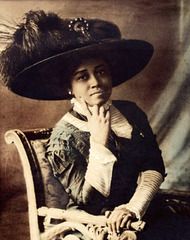
Ethel Worthington was an extraordinary woman in her time. She was an artist and photographer and one of the few black people allowed to display her works at the World Columbian Exposition in 1893. Generally speaking, black people were excluded from all other aspects of the fair from planning to employment. She was not only an artist and photographer, she painted bone China for the Marshall Fields Company. She did everything from start to finish – fired it; glazed it; and painted it. She later went on to sell and display art work at the Chicago Marshall Fields Store on State Street in Chicago. The photo above is as she appeared on the cover of The Pullman Porter's Review magazine in the October 1916 edition.
Source: Information and photograph provided by her nephew Kenneth Worthington
Dr. Ella Mae Piper
| 16 Oct 2023 |
|
Ella Piper (1884 - 1954), was born in Brunswick, Georgia the only daughter of Ned Bailer and Sarah Williams. Dr. Piper held annual Christmas tree parties for children of Dunbar Heights. Her mother, Sarah Williams, started this event in 1915. Thus began an institute over the years that grew from an original gathering of 15 little girls to some 600 boys and girls who romped over her lawn at 1771 Evans Avenue every December 25th.
When Dr. Piper’s mother died in 1926, Dr, Piper carried on the Annual Christmas Party with the assistance of many churches, businesses, and many community friends who assisted with contributions and gifts for the youngsters. The annual Christmas Tree Party has continued uninterrupted since Dr. Piper’s death through the faithful efforts of local citizens.
Dr. Ella Piper was known as a philanthropist. She was instrumental in helping young people in obtaining scholarships to attend Tuskegee Institute, using her personal money to help some of these students she was well known throughout the community and often aided elderly persons, particularly the underprivileged and handicapped. It was this interest, along with the interest of children that led her to leave her property to the City of Fort Myers for the benefit of “young children and senior citizens”.
“She had what I like to call a Rebel Spirit,” said Vivian Hill, A Franklin Park Elementary school teacher who has researched Piper. “She was the type that would show many people, “if I can do it, you can do it.”
But Piper is not remembered for her money or her ability to cross the color line. Nearly 35 years after her death, “Dr. Ella” is remembered for her giving spirit. “She helped in that quiet kind of way, meeting the simple needs of people,” said Ray Jackson Executive Director at the Dr. Ella Piper Center, an Elderly Services Agency established on the property that Dr. Piper left to the City of Fort Myers when she died of a stroke in 1954 at the age of 70.
For instance, a family fallen on hard times might wake up to find groceries on the doorstep or a couple celebrating many years of marriage would have their anniversary party financed by Piper.
Mary Ware remembers that when her oldest son, Walter was ready to go off to College, Piper gave him so much clothing that he was able to share with other students. “She was just down to earth,” said Ware, 79. “She was a beautiful lady in looks and her dealings with you. She loved her people.”
Piper's mother helped pay for her education at Spelman College in Atlanta and later at Professor Rohrer’s World famous Institute of Beauty Culture in New York City. Piper studied as a Beautician and a Podiatrist. Sometime after her graduation in 1915 Piper opened a Beauty Shop in New York City, Hill said. Some of Dr. Piper's clientele were very wealthy and included the wives of Inventors Thomas Edison and Henry Ford.
Mary Ware remembers working in Piper’s shop as a young girl, sweeping up on Saturdays. “She was always ready to help the less fortunate,” Ware said, “But she made her money with the white people.” She poured much of her money back into the community at large by helping to finance such buildings as Jones Walker Hospital, a hospital for blacks and Williams Academy, a local black public school, Hill said. She carried on a tradition started by her mother in 1915, one that still continues today The Annual Christmas Party. Hundreds of children annually gathered at Dr. Piper’s home on Evans Avenue to collect gifts, sing carols and hear the story of Christ’s Birth.
Piper filed for and received the state permission to function as a free dealer. That meant she could buy and sell property and conduct business without her husband’s approval. It was a right not many women white or black exercised at the time.
In addition to her salon, she also owned the Big Four Bottling Company in Fort Myers, which bottled soda and sold it for 4 cents a serving, Hill said. She also was one of the first women to own an automobile in Fort Myers and had a chauffeur, Hill said.
“She was a kind of pioneer both socially and financially,” said Patricia Bartlet, Executive Director of the Fort Myers Historical Museum.
In her will, she left her property to the city of Fort Myers, to be used for children, the poor and the elderly. The city chooses to use it for the elderly, building The Dr. Ella Piper Center there in 1976.
March 8, 2022 “Proclamation Day” honoed the legacy of Dr. Ella Mae Piper by Mayor Kevin Anderson
Dr. Ella Piper Center is a social service center for older clients. Sponsored programs include Foster Grandparents, Senior Companions, Senior Employment and Faith in Action (Transportation). Foster Grandparents offers opportunities to mentor, tutor, and care for children and youth with special needs. Senior Companions provides assistance and friendship to homebound elderly.
Source: The Dr. Piper Center for Social Services, Inc., article by Suzanne D. Jeffries
Lucy Hughes
| 16 Oct 2023 |
|
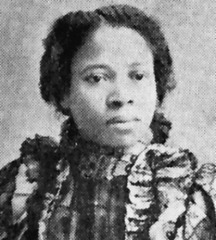
Miss Lucy Hughes ran the Climax Café and Ice Cream Parlor on N. Main in the early 1900s, where she sold “hot and cold lunches at all hours,” while residing with her mother, son, brother, and one male lodger who worked as a kitchen helper. She remained in business until 1917.
Ad for her shop reads:
The Climax Cafe and Ice Cream Parlor
Hot and Cold Lunches at All Hours
Also, Nice Clean Rooms
Miss Lucy Hughes, Proprietress
273 N. Main St.
Memphis, Tenn
She died on September 1, 1918 in Memphis at the age of 45 of bladder cancer. She was laid to rest in Zion Cemetery in Memphis, Tennessee.
Source: Restaurant-ing through history blog, by Jan Whitaker
Christine Moore Howell
| 16 Oct 2023 |
|
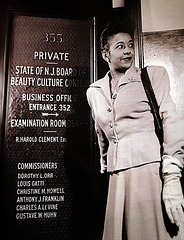
For twenty-eight years Christine Moore Howell (1901 - 1972), catered to a very high class and particular clientele. Adjoining her salon was a laboratory where she produced her hair and skin care products. Clients came from great distances to take advantage of her special talent for cutting curly hair. In 1935 Mrs. Howell helped to create New Jersey's State Board of Beauty Culture and served as a State Commissioner of the Board of Beauty Culture Control. And was elected Chairman of the commission for three terms. In 1936 she wrote, the "Beauty Culture and Care of the Hair."
Sources: Monkmeyer Press Photo Service; Courtesy of Anita Duncan

Tate Travel Club
| 18 Oct 2023 |
|
Merze Tate is the woman with the white hat holding the banner) formed her travel club in the 1940s.
Vernie Merze Tate grew up in west Michigan the only black student in her class. She graduated with honors from Western Michigan University and later was the first African-American to graduate from Oxford University in 1932. Tate traveled the globe as a writer, and eventually became a teacher at an all-black high school in Indiana. While there Tate started a travel club for her students.
She taught as a history teacher at Crispus Attucks High School in Indianapolis, Indiana from 1927-32.
As a teacher she wanted her students to see the world they learned about. Her determination led to her founding the school travel club which went to such places as Washington D.C., Niagara Falls, and Pennsylvania. One news article criticized her efforts of taking these students into the world, as they were not expected to be more than domestics. Tate proved them wrong. All of the members of the club were honor roll students and many went on to college.
Source: Western Michigan University Archives

No Rest for the Weary
| 18 Oct 2023 |
|
An unknown African American woman at her laundry and mending business. It was taken at an unidentified location in Alaska or the Yukon Territory sometime between 1897 and 1906.
While some women traveled to the gold fields with their husbands, others made the trip on their own. Women worked on mining claims, taught school, or set up businesses of their own. They did laundry, cooked meals, ran hotels and dance halls, and otherwise provided services to others in the community.
Seattle Historical Society/Museum of History & Industry
Anna Louise James
| 16 Oct 2023 |
|
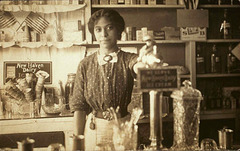
Anna Louise James stands behind the soda fountain in the James' pharmacy.
She was born on January 19, 1886, in Hartford, Connecticut. The daughter of a Virginia plantation slave who escaped to Connecticut, she grew up in Old Saybrook. Dedicating her early life to education, Anna became, in 1908, the first African American woman to graduate from the Brooklyn College of Pharmacy in New York. She operated a drugstore in Hartford until 1911, when she went to work for her brother-in-law at his pharmacy, making her the first female African American pharmacist in the state.
The pharmacy where James worked started out as a general store for the Humphrey Pratt Tavern in 1790. The store moved to its current location at the corner of Pennywise Lane in 1877, where it became Lane Pharmacy. Peter Lane, one of only two black pharmacists in early Connecticut, added a soda fountain to his establishment in 1896.
When Peter got called away to fight in World War I, he left the pharmacy in the care of his sister-in-law, Anna Louise James. In 1917, Anna took over the operations and renamed her business James Pharmacy. Anna, known to local residents as “Miss James,” operated the business until 1967.
After her retirement, Anna Louise James kept residence in an apartment in the back of the pharmacy until her death in 1977.
The store itself remained vacant from 1967 until 1980, when it was renovated and reopened in 1984. Although the building has changed owners numerous times over the years, the former pharmacy, now primarily an ice cream shop, retains much of the character James instilled in it.
In 1994, the James Pharmacy received a listing on the National Register of Historic Places.
Source: Historical Society of Connecticut/Schlesinger Library, Radcliffe Institute, Harvard University
The White Family
| 18 Oct 2023 |
|
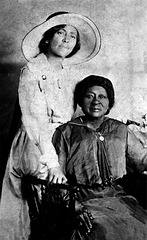
Lovely family portrait of Eartha M. M. White and her mother Clara English White.
Eartha Mary Magdalene White, a prominent African-American resident of Jacksonville, Florida, was widely known for her humanitarian and philanthropic endeavors in northeast Florida. Born on November 8, 1876, and reared by her adoptive, altruistic mother, Clara English White, Eartha White displayed a lifelong commitment to helping others. Her adoptive father, Lafayette, left little influence on her life as he died in 1881, five years after her birth. After the death of her husband, Clara White, the daughter of two former slaves, was left with the necessity of supporting her daughter and herself through work as a maid and later as a hotel and steamboat stewardess. A pious woman and fervent humanitarian, Clara White was a prime role model, and mother and daughter became a deeply committed team in their unflagging dedication to helping others. Indeed, Eartha White later embraced her mother's motto as her own: "Do all the good you can, in all the ways you can, in all the places you can, for all the people you can, while you can."
In 1893, upon graduation from Stanton School in Jacksonville, Eartha White moved to New York City for a brief period, to avoid a yellow fever quarantine in Jacksonville. She attended the Madam Hall Beauty School and the National Conservatory of Music. The latter affiliation led to a job with the Oriental American Opera Company, called the first African-American opera company in the United States. A lyric soprano, she sang under the direction of J. Rosamond Johnson (brother of James Weldon Johnson), and in the company of musical luminaries of the time such as Madam Plato and Sidney Woodward. After a highly successful opening on Broadway in New York City, the troupe traveled widely for a year throughout the United States and Europe.
Upon returning to Florida in 1896, she decided to continue her education and subsequently graduated from Florida Baptist Academy. With degree in hand, she embarked on a sixteen-year teaching career in Bayard, Florida, and later at Stanton School in Jacksonville.
At the same time, Miss White also displayed considerable business acumen, as evidenced by her various entrepreneurial endeavors, including the ownership of a dry goods store, an employment and housecleaning bureau, a taxi company, and a steam laundry with the catchy motto: "Put your duds in our suds, we wash anything but a dirty conscience." Her versatility and determination also enabled her to become a licensed real estate broker, the first woman employee of the Afro-American Life Insurance Company in Jacksonville, and a charter member of the National Negro Business League and Jacksonville Business League. Due to her numerous businesses and astute real estate transactions, it is estimated that she accumulated over one million dollars in assets throughout her lifetime. According to Dr. Daniel Schafer, biographer of Eartha White, she donated most of these profits from private investments to finance her humanitarian works and, as a consequence, struggled financially throughout her life.
Her work and influence also extended to political activities, through her participation in the Republican Party and her formation of the Colored Citizens Protective League in Jacksonville. In 1941, she joined with A. Philip Randolph to protest job discrimination. But, it was particularly in her later years that she became an influential force whom Jacksonville politicians consulted on diverse issues and who routinely granted her social welfare requests. To wit, former Jacksonville mayor Hans Tanzler was quoted, in a 1982 Florida Times-Union article, "At least once a month she'd come to my office at City Hall. She was irrepressible and undeniable. She could not be denied. She only came up to my waist but she'd point that little finger at me and she'd tell me, `God has chosen you and you must do this, that and the other thing.' "
As admirable as Eartha White's diverse educational and business activities may have been, her enduring legacy continues to be focused on her social welfare work and zeal for helping the underprivileged. Her accomplishments in this arena are astounding: extensive social work with prison inmates, the establishment of an orphanage for African-American children, a home for unwed mothers, a nursery for children of working mothers, a tuberculosis rest home, a nursing home for elderly African-Americans (1902), the Boys' Improvement Club (1904), and the Clara White Mission for the Indigent (1928). A major achievement and fulfillment of a lifelong dream was the dedication of the Eartha M. M. White Nursing Home in 1967 to replace the Mercy Hospital for the Aged. To assure its construction, she doggedly pursued and was approved for a $300,000 loan.
Her development of the Clara White Mission in particular encapsulates her commitment to humanity. The Mission began in the 1880's under the informal tutelage of Clara White and primarily consisted of a soup kitchen to feed the needy. In 1932, during the depression years, Eartha White recognized the need for a larger facility to feed, shelter, and counsel the homeless. With the help of friends, she moved the mission into its present building on Ashley Street in downtown Jacksonville. In 1944, a fire destroyed much of the building but, with her customary resolve, Miss White raised the funding to rebuild and even expand the original structure. In addition to community services the mission served several other functions during the ensuing years before her death: Works Progress Administration office, orphanage, and a home for unwed mothers.
Indeed the heartbeat of the Mission, she lived on its second floor until her later years. Many notable figures, such as James Weldon Johnson, Booker T. Washington, Mary McCleod Bethune and Eleanor Roosevelt visited her at the Mission. Interestingly enough, the Clara White Mission, in addition to its many other social and civic services, is still noted for being the only non-profit organization serving daily mid-day meals to the needy in Jacksonville.
Aptly nicknamed the "Angel of Mercy", friends recall her countless acts of charity. She was often called to aid traveling families who had broken down on Jacksonville roads. Her work with Duval County Stockade inmates was legendary: for more than forty years, she visited them in jail, arranged for religious and social activities, and provided counseling and other personal services for them. During World War I and II, her many patriotic activities included intensive work with the Red Cross to aid both soldiers and their families. Showing her less serious if not downright athletic side, the ubiquitous Miss White organized a baseball team during World War II to entertain troops at Camp Blanding.
All these activities left little time for a private life. By her own words, "I never married. I was too busy - What man would put up with me running around the way I do?" According to Charles E. Bennett, author of Twelve On The River St. Johns, she was briefly engaged, at age 20, to James Jordan, a railroad employee from South Carolina. Letters from the collection attest to their love for each other but, unfortunately, he tragically died a month before their impending marriage in June 1896.
As to be expected, awards and honors were numerous towards the end of her life. In 1970, at the age of ninety-four, she received national recognition by being named the recipient of the 1970 Lane Bryant Award for Volunteer Service. Not stopping there, in 1971, the indefatigable Miss White was appointed to the President's National Center for Voluntary Action. After a reception at the White House with President Nixon, she quite characteristically responded to the question of how she would spend the cash award, "I've already decided I want it to serve humanity. What would I do with it? Sit around the Plaza Hotel? I'm too busy."
Eartha White died of heart failure at age ninety-seven on January 18, 1974.
Florida Memory Project; UNF Thomas G Carpenter Library/Special Collections Manuscripts and Personal Papers/Eartha M. M. White Collection
Lois K. Alexander-Lane
| 17 Oct 2023 |
|
|
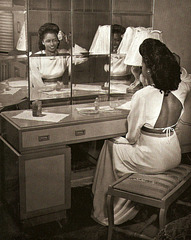
Lois Marie Kindle (1916 - 2007), was born in Little Rock, Arkansas where as a young woman she liked peering into department store windows to sketch dress designs. She later started custom-wear boutiques in Washington DC and Harlem.
She was a 1938 graduate of what is now Hampton University in Virginia. In the 1950s, she did freelance photography for black newspapers and was vice president of the Capital Press Club, an organization for black journalists.
She founded the National Association of Milliners, Dressmakers and Tailors and was a former president of the National Association of Fashion and Accessory Designers. She also was a charter member of the National Council of Negro Women.
She started a fashion institute and museum in New York's Harlem neighborhood to interest blacks in the garment trade and highlight their contributions to the industry.
She had a home in Washington DC., through much of her working life but settled in New York in the early 1960s to complete a master's degree in retailing, fashion and merchandising at New York University.
Her thesis explored the history of blacks in retailing, and her research led to discoveries of many unheralded African American dressmakers. Her continued interest led her to start the Harlem Institute of Fashion in 1966 and the Black Fashion Museum in 1979.
The institute gave free courses in dressmaking, millinery and tailoring as well as courses in English, mathematics and African American history. It brought Mrs. Alexander Lane many community honors, including the 1992 Josephine Shaw Lowell Award for her efforts to improve the lives of New York's poorest residents.
The museum, an arm of the institute started with a National Endowment for the Arts grant, exhibited clothing designed, sewn or worn by blacks since the 19th century.
One highlight was a collection of dresses the late Ann Lowe designed for patrons such as the Rockefellers, Roosevelts and DuPonts. Lowe also designed the wedding gown of future first lady Jacqueline Kennedy.
"In the process we discovered that few Americans -- black or white -- are aware of the contributions made by black Americans in the creative fields of fashion," Mrs. Alexander Lane told The Washington Post in 1981. "There is an oft-quoted myth that black people are 'new-found talent' in the fashion field and we want to change that."
Mrs. Lane's daughter, Joyce Bailey along with her husband Norman Bailey opened the Black Fashion Museum in 1994 in the District of Columbia's Shaw neighborhood. Unfortunately, it struggled to find an audience and closed in 2009. However, its collections are now part of the National Museum of African American History & Culture at the Smithsonian Institute.
Lois K. Alexander-Lane died at the age of 91 on September 29, 2007 at the Magnolia Center nursing home in Lanham, Maryland.
Washington Post Staff Writer Adam Bernstein
Robert H. McNeill, Photographer, 'Posing Beauty' by Deborah Willis, Courtesy of Susan McNeill and the Estate of Robert H. McNeill
Leah Pitts
| 18 Oct 2023 |
|
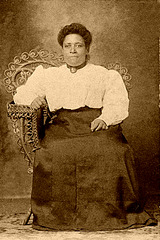
Leah Pitts of Jones County, Georgia wears a shirtwaist and long skirt trimmed with ribbon; more than likely she made both items of clothing. Though blind she was known throughout her county as an excellent seamstress. [ Georgia Historical Society ]
Helen 'Curl' Harris
| 16 Oct 2023 |
|
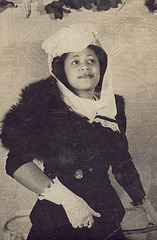
Helen 'Curl' Harris (1912 - 2005), was an entrepreneur at a time when women (let alone African-American women) were a rarity in business. A self-made graduate of the Skidmore Vocational School and the Philadelphia Charm and Model School, she ran and operated numerous beauty businesses in Philadelphia (Curl's Beautyrama, Curl's Beauty Salon and Charm Service, and Curl's Moderne Beautyrama) as well as created her own line of make-up and hair products. Ella Fitzgerald and Josephine Baker were among her clients.
Source: Emory University Library
Annie Mae Manigault
| 16 Oct 2023 |
|
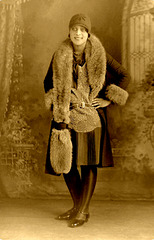
Annie Mae Manigault Hurley (1907 - 1976), graduated from the Renouard School of Embalming in New York City, and then began her fifty-year career by working with her parents (Annie Rivers and William Manigault) in the Manigault Funeral Home in Columbia, South Carolina.
In 1917, William and Annie Manigault (Annie Mae's parents) helped found the Manigault-Gaten-Williams Funeral Home, in Columbia, South Carolina. In 1923, the funeral home was renamed Manigault's Funeral Home. Both William and Annie were funeral directors and worked hard to serve families in need during a time when it was not easy for African American people to be in business.
Annie and William also founded the Congaree Casket Company, which employed more blacks during that time than any other black-owned business in South Carolina.
In the early 1950’s, William and Annie's daughter, Anna Mae, took over the family business, which she ran along with her son, Anthony.
Today, the Manigault-Hurley Funeral Home is run by Anthony Manigault Hurley, Alice Wyche Hurley, Michelle Manigault Hurley Johnson, and Kelly Lynn Hurley.
Sources: Richard S. Roberts, Photographer; University of South Carolina
Jacksonville Old Folks Home
| 18 Oct 2023 |
|
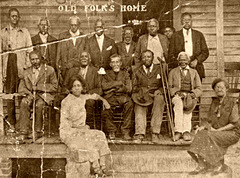
Eartha M.M. White (in white) along with residents of the Jacksonville Old Folks Home.
Eartha Mary Magdalene White was born in Jacksonville, Florida on November 8, 1876. She was adopted by Lafayette and Clara English White. Mr. White died in 1881 when Eartha was five years old. Clara White, who was born a slave on Harrison Plantation in Nassau County, Florida, worked at various times as a maid and as a stewardess at hotels in Jacksonville and on steamboats operating from Jacksonville to various ports north at the height of the tourist industry in north Florida. A charter member of Bethel Baptist Institutional Church, Clara White was a dedicated humanitarian who had an enormous influence on her daughter. In the 1880′s, Clara White began operating a soup kitchen at her residence to feed underprivileged people in the community. This activity continued in various locations and was eventually moved to 611-15 Ashley Street in the early 1930′s. The facility was named the Clara White Mission by Miss Eartha White to honor her mother who had died in 1920.
Eartha White graduated from the Stanton School in 1893 and moved to New York City to avoid a Yellow Fever outbreak in Jacksonville. There, she attended the Madam Hall Beauty School and the National Conservatory of Music. She was selected as a member of the Oriental American Opera Company, the first African American opera company in the United States. The Oriental American included Madam Plato and Sidney Woodward and was directed by J. Rosamond Johnson, a native of Jacksonville and brother of James Weldon Johnson. The Company opened on Broadway in New York and then toured extensively for a year throughout the United States and Europe. In 1896, Miss White returned to Jacksonville to attend classes at and graduate from Florida Baptist Academy. After graduating with a college degree, she began a sixteen year teaching career in Bayard, Florida and later at her alma mater, the Stanton School in Jacksonville.
During this period, Miss White also engaged in various business enterprises including the ownership of a dry goods store on the east side of Jacksonville, an employment and housekeeping bureau, a steam laundry and a taxi company. She was a charter member of the National Negro Business League, the first woman employee of the Afro-American Life Insurance Company and a real estate broker. She had extensive real estate holdings throughout these years and used them to partially finance her businesses and settlement work activities.
In 1902, Eartha White established the Colored Old Folks’ home for indigent, elderly African Americans in Duval County that eventually became the Eartha M. M. White Nursing Home in 1967. On the same campus with the Home, she operated the only orphanage for African-American children in the State of Florida at that time. She also sponsored a home for unwed mothers, established Mercy Hospital for tuberculosis patients, pioneered public recreation programs for African American children in Jacksonville and did extensive work with prisoners. She was a member of and leader in the Negro Women’s Club Movement working along side Mrs. Booker T. Washington and Mrs. Mary McLeod Bethune among others. She was a member of the Republican Party and was a well recognized political “power broker” throughout her long life.
The Clara White Mission was headquarters for the WPA’s Negro Division and ran numerous programs to help relieve the effects of the Depression. Cultural programs, including music and art activities, occurred at that time. During WWII, Miss White established a USO for Colored servicemen and women and participated in the activities of the Red Cross. After the War and into the 1970′s, the Clara White Mission continued to provide programs for the needy, adapting to the changes in the national and local political landscape, and the social changes taking place around it.
Miss White received the 1970 Lane Bryant Award for Volunteer Service, a national award presented to her by President Richard M. Nixon. The award was accompanied by a cash gift which Miss White used for the Clara White Mission’s work. She was appointed to the President’s National Center for Volunteer Action in 1971. Eartha M.M. White never married. She died on January 18, 1974, in Jacksonville, Florida, at the age of 97.
Sources: Florida African American Heritage Network; State Archives of Florida, Florida Memory
Bertha Hansbury
| 18 Oct 2023 |
|
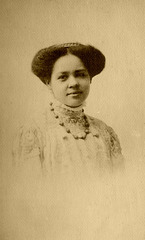
Bertha Allena Hansbury was born and educated in Detroit. After graduating from the Detroit Conservatory of Music, she did post-graduate work in Berlin, Germany. Upon her return to this country in 1909, she established a popular music studio where she taught over three hundred students. In 1925 she established the Bertha Hansbury School of Music at 544 Frederick in the Cultural Center.
After the end of slavery, African-American leaders focused much of their attention on education, seeking to lift up their students and achieve a measure of dignity and respect that had been previously denied them. Teachers and students seeking to raise up themselves and the broader Black community looked to existing educational models, many of which emphasized German language, philosophy, and music. Increasing numbers of students, most notably W.E.B. Du Bois but also musicians like Clarence Cameron White, Felix Weir, Will Marion Cook, and Hazel Harrison, also began traveling to Germany to pursue their studies, hoping to accrue cultural capital that they could deploy to help their communities rise up in the face of a system that still denigrated them.
Bertha Hansbury Phillips (1888-1976), was an important figure on the Detroit musical scene who sought out German study. After graduating from the Detroit Conservatory of Music in 1908, she studied in Berlin for a year. When she returned from Germany, Hansbury established a music studio in Detroit and in 1925 founded the first African-American music school in Michigan. She hoped “to give her people not only a place for the student class to attain cultural value” but also provide an opportunity for talented musicians and teachers to develop their talents when they might otherwise have laid them aside, “fearing there would be no future use for them.” The school was an important cultural institution for a time but was forced to close during the Great Depression.
Hansbury continued to exercise a broader influence not least through her daughter, Ruth (Aruthia Elizabeth Phillips) Mason (1923-2011). Mason became well-known as a disc jockey in Harlem and later helped develop the pathbreaking jazz label Blue Note Records, founded by her German husband Alfred Lion.
Sources: E. Azalia Hackley Collection of African Americans in the Performing Arts, Detroit Public Library (detroityes.com) (E. Azalia Hackley Collection of African Americans in the Performing Arts, Detroit Public Library); Black Central Europe, Jeff Bowersox.
Katherine Dunham performing in Floyd's Guitar Blue…
| 16 Oct 2023 |
|
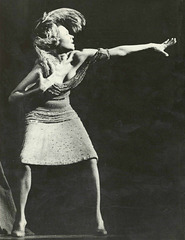
Katherine Dunham as she appeared in the 1956 production of "Floyd's Guitar Blues." Courtesy of Special Collections Research Center, Morris Library, Southern Illinois University, Carbondale.
Born in Chicago, and raised in Joliet, Illinois, Katherine Dunham did not begin formal dance training until her late teens. In Chicago she studied with Ludmilla Speranzeva and Mark Turbyfill, and danced her first leading role in Ruth Page's ballet "La Guiablesse" in 1933. She attended the University of Chicago on scholarship (B.A., Social Anthropology, 1936), where she was inspired by the work of anthropologists Robert Redfield and Melville Herskovits, who stressed the importance of the survival of African culture and ritual in understanding African-American culture. While in college she taught youngsters' dance classes and gave recitals in a Chicago storefront, calling her student company, founded in 1931, "Ballet Negre." Awarded a Rosenwald Travel Fellowship in 1936 for her combined expertise in dance and anthropology, she departed after graduation for the West Indies (Jamaica, Trinidad, Cuba, Haiti, Martinique) to do field research in anthropology and dance. Combining her two interests, she linked the function and form of Caribbean dance and ritual to their African progenitors.
The West Indian experience changed forever the focus of Dunham's life (eventually she would live in Haiti half of the time and become a priestess in the "vodoun" religion), and caused a profound shift in her career. This initial fieldwork provided the nucleus for future researches and began a lifelong involvement with the people and dance of Haiti. From this Dunham generated her master's thesis (Northwestern University, 1947) and more fieldwork. She lectured widely, published numerous articles, and wrote three books about her observations: JOURNEY TO ACCOMPONG (1946), THE DANCES OF HAITI (her master's thesis, published in 1947), and ISLAND POSSESSED (1969), underscoring how African religions and rituals adapted to the New World.
And, importantly for the development of modern dance, her fieldwork began her investigations into a vocabulary of movement that would form the core of the Katherine Dunham Technique. What Dunham gave modern dance was a coherent lexicon of African and Caribbean styles of movement -- a flexible torso and spine, articulated pelvis and isolation of the limbs, a polyrhythmic strategy of moving -- which she integrated with techniques of ballet and modern dance.
When she returned to Chicago in late 1937, Dunham founded the Negro Dance Group, a company of black artists dedicated to presenting aspects of African-American and African-Caribbean dance. Immediately she began incorporating the dances she had learned into her choreography. Invited in 1937 to be part of a notable New York City concert, "Negro Dance Evening," she premiered "Haitian Suite," excerpted from choreography she was developing for the longer "L'Ag'Ya." In 1937-1938 as dance director of the Negro Unit of the Federal Theatre Project in Chicago, she made dances for "Emperor Jones" and "Run Lil' Chillun," and presented her first version of "L'Ag'Ya" on January 27, 1938. Based on a Martinique folktale (ag'ya is a Martinique fighting dance), "L'Ag'Ya" is a seminal work, displaying Dunham's blend of exciting dance-drama and authentic African-Caribbean material.
Dunham moved her company to New York City in 1939, where she became dance director of the New York Labor Stage, choreographing the labor-union musical "Pins and Needles." Simultaneously she was preparing a new production, "Tropics and Le Jazz Hot: From Haiti to Harlem." It opened February 18, 1939, in what was intended to be a single weekend's concert at the Windsor Theatre in New York City. Its instantaneous success, however, extended the run for ten consecutive weekends and catapulted Dunham into the limelight. In 1940 Dunham and her company appeared in the black Broadway musical, "Cabin in the Sky," staged by George Balanchine, in which Dunham played the sultry siren Georgia Brown -- a character related to Dunham's other seductress, "Woman with a Cigar," from her solo "Shore Excursion" in "Tropics." That same year Dunham married John Pratt, a theatrical designer who worked with her in 1938 at the Chicago Federal Theatre Project, and for the next 47 years, until his death in 1986, Pratt was Dunham's husband and her artistic collaborator.
With "L'Ag'Ya" and "Tropics and Le Jazz Hot: From Haiti to Harlem," Dunham revealed her magical mix of dance and theater -- the essence of "the Dunham touch" -- a savvy combination of authentic Caribbean dance and rhythms with the heady spice of American showbiz. Genuine folk material was presented with lavish costumes, plush settings, and the orchestral arrangements based on Caribbean rhythms and folk music. Dancers moved through fantastical tropical paradises or artistically designed juke-joints, while a loose storyline held together a succession of diverse dances. Dunham aptly called her spectacles "revues." She choreographed more than 90 individual dances, and produced five revues, four of which played on Broadway and toured worldwide. Her most critically acclaimed revue was her 1946 "Bal Negre," containing another Dunham dance favorite, "Shango," based directly on "vodoun" ritual.
If her repertory was diverse, it was also coherent. "Tropics and le Jazz Hot: From Haiti to Harlem" incorporated dances from the West Indies as well as from Cuba and Mexico, while the "Le Jazz Hot" section featured early black American social dances, such as the Juba, Cake Walk, Ballin' the Jack, and Strut. The sequencing of dances, the theatrical journey from the tropics to urban black America implied -- in the most entertaining terms -- the ethnographic realities of cultural connections. In her 1943 "Tropical Revue," she recycled material from the 1939 revue and added new dances, such as the balletic "Choros" (based on formal Brazilian quadrilles), and "Rites de Passage," which depicted puberty rituals so explicitly sexual that the dance was banned in Boston.
Beginning in the 1940s, the Katherine Dunham Dance Company appeared on Broadway and toured throughout the United States, Mexico, Latin America, and especially Europe, to enthusiastic reviews. In Europe Dunham was praised as a dancer and choreographer, recognized as a serious anthropologist and scholar, and admired as a glamorous beauty. Among her achievements was her resourcefulness in keeping her company going without any government funding. When short of money between engagements, Dunham and her troupe played in elegant nightclubs, such as Ciro's in Los Angeles. She also supplemented her income through film. Alone, or with her company, she appeared in nine Hollywood movies and in several foreign films between 1941 and 1959, among them CARNIVAL OF RHYTHM (1939), STAR-SPANGLED RHYTHM (1942), STORMY WEATHER (1943), CASBAH (1948), BOOTE E RIPOSTA (1950), and MAMBO (1954).
In 1945 Dunham opened the Dunham School of Dance and Theater (sometimes called the Dunham School of Arts and Research) in Manhattan. Although technique classes were the heart of the school, they were supplemented by courses in humanities, philosophy, languages, aesthetics, drama, and speech. For the next ten years many African-American dances of the next generation studied at her school, then passed on Dunham's technique to their students, situating it in dance mainstream (teachers such as Syvilla Fort, Talley Beatty, Lavinia Williams, Walter Nicks, Hope Clark, Vanoye Aikens, and Carmencita Romero; the Dunham technique has always been taught at the Alvin Ailey studios).
During the 1940s and '50s, Dunham kept up her brand of political activism. Fighting segregation in hotels, restaurants and theaters, she filed lawsuits and made public condemnations. In Hollywood, she refused to sign a lucrative studio contract when the producer said she would have to replace some of her darker-skinned company members. To an enthusiastic but all-white audience in the South, she made an after-performance speech, saying she could never play there again until it was integrated. In São Paulo, Brazil, she brought a discrimination suit against a hotel, eventually prompting the president of Brazil to apologize to her and to pass a law that forbade discrimination in public places. In 1951 Dunham premiered "Southland," an hour-long ballet about lynching, though it was only performed in Chile and Paris.
Toward the end of the 1950s Dunham was forced to regroup, disband, and reform her company, according to the exigencies of her financial and physical health (she suffered from crippling knee problems). Yet she remained undeterred. In 1962 she opened a Broadway production, "Bambouche," featuring 14 dancers, singers, and musicians of the Royal Troupe of Morocco, along with the Dunham company. The next year she choreographed the Metropolitan Opera's new production of "Aida" -- thereby becoming the Met's first black choreographer. In 1965-1966, she was cultural adviser to the President of Senegal. She attended Senegal's First World Festival of Negro Arts as a representative from the United States.
Moved by the civil rights struggle and outraged by deprivations in the ghettos of East St. Louis, an area she knew from her visiting professorships at Southern Illinois University in the 1960s, Dunham decided to take action. In 1967 she opened the Performing Arts Training Center, a cultural program and school for the neighborhood children and youth, with programs in dance, drama, martial arts, and humanities. Soon thereafter she expanded the programs to include senior citizens. Then in 1977 she opened the Katherine Dunham Museum and Children's Workshop to house her collections of artifacts from her travels and research, as well as archival material from her personal life and professional career.
During the 1980s, Dunham received numerous awards acknowledging her contributions. These include the Albert Schweitzer Music Award for a life devoted to performing arts and service to humanity (1979); a Kennedy Center Honor's Award (1983); the Samuel H. Scripps American Dance Festival Award (1987); induction into the Hall of Fame of the National Museum of Dance in Saratoga Springs, N.Y. (1987). That same year Dunham directed the reconstruction of several of her works by the Alvin Ailey American Dance Theater and "The Magic of Katherine Dunham opened Ailey's 1987-1988 season.
In February 1992, at the age of 82, Dunham again became the subject of international attention when she began a 47-day fast at her East St. Louis home. Because of her age, her involvement with Haiti, and the respect accorded her as an activist and artist, Dunham became the center of a movement that coalesced to protest the United States' deportations of Haitian boat-refugees fleeing to the U.S. after the military overthrow of Haiti's democratically elected President Jean-Bertrand Aristide. She agreed to end her fast only after Aristide visited her and personally requested her to stop.
Boldness has characterized Dunham's life and career. And, although she was not alone, Dunham is perhaps the best known and most influential pioneer of black dance. Her synthesis of scholarship and theatricality demonstrated, incontrovertibly and joyously, that African-American and African-Caribbean styles are related and powerful components of dance in America.
Snippet from Floyd's Guitar Blues (no sound): loc.gov/item/ihas.200003819
Source: PBS.ORG bio by Sally Sommer
Lucretia ‘Aunt Lou’ Marchbanks
| 27 Nov 2016 |
|
Lucretia Marchbanks was one of the most interesting and most beloved people in Deadwood, South Dakota’s pioneer days.
She was born into slavery on March 25, 1832, in Putman County, Tennessee, the oldest of eleven children. She was the bondswoman of Martin Marchbanks, whose father had settled near Turkey Creek east of Algood, Tennessee. Her father, of mixed racial heritage, was a half-brother of Martin Marchbanks.
Prior to the enactment of the 13th Amendment, before the firing of the guns at Fort Sumter had announced the opening of the U. S. Civil War, her liberty-loving father had purchased his freedom with $700 which he had saved over the years.
Lucretia Marchbanks, who acquired her father’s frugal industrious habits, grew to womanhood on the master’s estate where she was fully trained in housekeeping and the culinary arts.
Her master, Martin Marchbanks, gave Lucretia to his youngest daughter whom she accompanied to the Western frontier, reputed a land of gold, fortune and romance. They traveled and lived for a period time in California, and later, a free woman, she returned to her old home in Tennessee. Once again, Lucretia set out again for the untamed west where she remained for the rest of her life. Like many others, she was lured into the Black Hills by reports of gold. Lucretia joined the “Black Hills Gold Rush,” arriving in historic Deadwood Gulch, a bustling mining camp, on June 1 1876, where she secured a job, working as the kitchen manager in the Grand Central Hotel. Soon, the hotel, which really wasn’t that grand, was better known for the great food served by Lucretia in the frontier hotel’s restaurant.
“Aunt Lou,” as she was known, labored hard to make her way in a sometimes unforgiving boomtown of the West. Except for “Aunt Sally” Campbell, who came with the George Armstrong Custer Black Hills Expedition in 1874, most believe that Lucretia Marchbanks was the first black woman to live in the Black Hills of the Dakota Territory.
After she left the kitchen, Lucretia worked for four successive mine superintendents for the small sum of $40 per month. That was a small price, a real bargain for anyone who could afford to employ a woman with her ability and training.
Two years later she was offered a better position as a cook for the Golden Gate Mine in nearby Lead. Her work ethic, loyalty to duty and fine character were evident to all who knew her. She then left Deadwood to become the manager of the Rustic Hotel at the DeSmet Mine. Gossip of her culinary skills spread like a wildfire and she was soon hired away again as a cook and housekeeper for a boarding house owned by Harry Gregg in Sawpit Gulch, also in Lead. They catered to the DeSmet Mine workers.
One historical account tells that when she was late getting back from a meeting, she was still able to fix an evening meal for the miners in 25 minutes, plus lunch buckets for all on the night shift. Contrary to what was seen on the HBO series “Deadwood,” Lucretia Marchbanks was never an employee of George Hearst, the owner of the world famous Homestake Mine. Her final employer was Harry Gregg, with whom she worked until 1883 when she resigned and opened her own establishment, the Rustic Hotel at the mouth of Sawpit Gulch located just down the road from Deadwood.
She was considered to be the finest cook in the Black Hills at that time. She has been regaled for her excellent plum puddings, among other culinary delights. A Mr. William A. Reamer, who boarded with her, asked her for the recipe and she replied, “Oh, just a handful of this and a handful of that.” Lucretia was more commonly known throughout Deadwood and the Black Hills as “Aunt Lou.” She was also lovingly known to some people of the area as “Mahogany Lou” Marchbanks.
For example: The New York Stock Exchange in discussing a Black Hills Mining News article asked “Who is Aunt Lou?” The Black Hills Daily Times answered in an article entitled “We’ll Tell You Who She Is” - Aunt Lou is an old and respected colored lady who has had charge of the superintendent’s establishment of the DeSmet mine as housekeeper, cook and the 'superintendent of all superintendents’ who have ever been employed at the mine. Her accomplishments as culinary artist are beyond all praise. She rules the house where she presides with autocratic power by Divine right brooking no cavil or presumptuous interference. The mine superintendent may be a big man in the mines or the mill but the moment he sets foot within her realm he is but a meek and ordinary mortal.
“She is a skillful nurse as well as a fine cook and housekeeper, her services to the victims of mountain fever never received an even part of the praise to which they are entitled.” There was a festival in the City Hall of Golden Gate in 1880 for the purpose of the raising of funds for the Congregational church, a prize of a diamond ring was raffled off and then given to the most popular woman in the Black Hills. Her competitors for this high honor were a sizable number of popular white women. Many men and women, citizens of all walks of life voted with their money for their favorite woman: “Aunt Lou.” She easily won and was awarded the coveted prize.
She was however, was more than just a kind friendly woman with great cooking skills; she was also a tough and demanding kitchen manager and stood no intimidation from her rowdy patrons. It is said that on one day she proved that when a Mexican man came into the restaurant boasting that he had killed an Indian and acting as though he’d like to do the same again … kill someone else. While nervous customers looked on, “Aunt Lou” confronted him while brandishing a large knife and in no time, the stranger was quick to take his leave.
Lucretia finally decided that she had cooked long enough. She retired from the Rustic Hotel business in 1885 and sold the hotel to a Mrs. A.M. Porter. “Aunt Lou” purchased a ranch at Rocky Ford, Wyoming, (between Sundance and Beulah) from A. C. Settle. She moved to the ranch that same year and was very active in raising cattle and horses. She with the help of a hired hand named George Baggely, who worked for Lucretia for 20 years and managed the ranch. Various historical records show that she conducted her ranch in the very businesslike manner everyone would have expected.
She died in 1911 and is buried in Beulah Cemetery.
Black Hills Pioneer, Destination Deadwood, by David K Whitlock

Agnes Carver Jones
| 08 Oct 2016 |
|
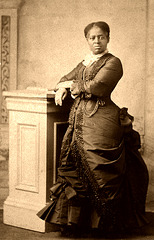
History of the America Negro and his Institutions (Virginia Edition, 1917) : The story of Mrs. Agnes Carver Jones of Falls Church, Virginia is a story of hard work and many struggles, but also a story of usefulness and of success.
Mrs. Jones, whose maiden name was Agnes Gilbert, was born in Centerville, Virginia on December 3, 1870. Her father, William Gilbert, was a farmer. He was the son of James Gilbert. The mother of Mrs. Jones was, before her marriage, Jennie Mellon, daughter of John Mellon. There is a strain of Indian blood on the mother's side.
Mrs. Jones began her schooling at the Centerville public school, but this was interrupted by the necessity of work. Her family eventually moved to Washington DC.
She has lost her father a few years back, and her mother was now an invalid. She went to school when she could but attended to her mother with loving care when required. She had at that time two things in mind. One was to become "a first class cook, the other was to be a first class Christian woman."
Mrs. Jones has been married twice. The first marriage was to Robert Carver in 1895. The second marriage was to E.J. Jones in 1919. By the first marriage there were three children, all of whom have passed away. The last surviving child, Raymond, was well equipped and educated in the work of life. He has grown to manhood and had reached the place where he could be of comfort to his mother. After the outbreak of war he went into training, but sickened and died before he saw active service.
Mrs. Jones early conceived the idea of a training school for girls and in this way has been the means of helping many girls to better their condition in life.
As the years went by she began purchasing property. She is now regarded as one of the substantial business women of the race.
Mrs. Jones was a pioneer in another important matter. That was in her protest against the injustice of the Jim Crow car. As a result she was imprisoned, but she made a brave fight, winning a victory for herself and for her race in 1911.
She has been a leader in all forms of uplift work. She believes the best interests of the race are to be promoted by temperance, education and the cultivation of race pride.
Fannie Robinson
| 21 Jan 2016 |
|
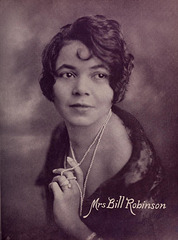
Fannie Clay was born in Ripley, Tennessee in 1891, the daughter of former slaves Elen Gilliland Clay and Hugh Clay. In 1910 she graduated from Lauderdale County Training School and relocated to Memphis, Tennessee with her family. She eventually relocated to Chicago, where she studied to become a pharmacist. While working at a drug store to pay for her education she met the man who would become her husband of twenty-one years. Fannie Clay and Bill “Bojangles” Robinson were married January 27, 1922, (she was his 2nd wife). No longer focusing on her career she worked as her husband's secretary and business manager. She's credited as playing a significant role in his success by working behind the scenes. They divorced June 25, 1943 due to his gambling, womanizing, and Fannie’s desire to have him slow down due to his heart condition. When they divorced Fannie is quoted as having said they “agreed to disagree" but remained the best of friends. The couple never had children. In the 2001 movie “Bojangles” Gregory Hines played the lead and Fannie's character was portrayed by Kimberly Elise.
Photo: National Vaudeville Artists Fund (1929)
Source: blackripley.com
Jump to top
RSS feed- Kicha's latest photos with "Businesswoman" - Photos
- ipernity © 2007-2026
- Help & Contact
|
Club news
|
About ipernity
|
History |
ipernity Club & Prices |
Guide of good conduct
Donate | Group guidelines | Privacy policy | Terms of use | Statutes | In memoria -
Facebook
X
