

Kicha's photos with the keyword: Vaudevillians
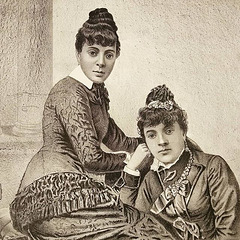
Hyers Sisters
| 18 Oct 2023 |
|
Anna Madah Hyers and Emma Louise Hyers were pioneers of black musical theater who toured the United States from the late 1860s through the turn of the century. They possessed remarkable voices and over their long careers collaborated with notable African American artists like Billy Kersands, Pauline Hopkins, and Sam Lucas on a string of successful productions.
Source: Harvard Theatre Collection
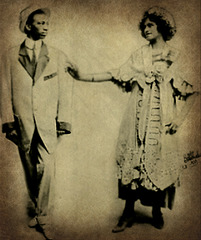
An Overlooked Blues and Jazz Pioneer
| 18 Oct 2023 |
|
From 1909 to 1918 Bradford performed in a song-and-dance act with Jeanette Taylor (known as Bradford and Jeanette).
Blues and vaudeville songwriter, publisher and musical director, was born John Henry Perry Bradford (1895 - 1970) in Montgomery, Alabama, the son of Adam Bradford, a bricklayer and tile setter, and Bella (maiden name unknown), a cook. Early in his youth Bradford learned to play piano by ear. In 1901 his family moved to Atlanta, where his mother cooked meals for prisoners in the adjacent Fulton Street Jail. There he was exposed to the inmates' blues and folk singing. He would often visit Decatur Street, the black district in Atlanta, to learn singing, dancing and piano from the black entertainers. In 1906 he joined Allen's New Orleans Minstrels, and then worked briefly as a solo pianist in Chicago.
From about 1909 to 1918 he performed in a song-and-dance act with Jeanette Taylor calling themselves Bradford and Jeanette. They traveled widely and Bradford absorbed more black culture which he incorporated into the songs he wrote. A shrewd entrepreneur, he initially published his songs as sheet music, to be sold after his performances. This informal method of distribution was caused in part by the racist structure of the publishing industry, which put roadblocks in the paths of aspiring African American songwriters.
In 1918 he settled in New York City and, instead of peddling his own sheet music, sold his songs to white publisher, Frederick V. Bowers. In that same year, to publicize his songs, he and other actors produced the Made in Harlem Revue which featured cabaret singer, Mamie Smith, singing his title song, Harlem Blues.
Bradford was impressed with Mamie, and felt she could help him sell his conviction that there was a huge, untapped black audience eager to buy authentic black recordings sung by blacks.
"I thought our folks had a story to tell, and it only could be told in vocal, not instrumental, recordings."
He finally convinced Fred Hager at OKeh Records to schedule a recording session for February 14, 1920, to record Mamie Smith singing two Bradford songs, That Thing Called Love and You Can't Keep A Good Man Down. Both songs were backed by OKeh's white studio band, the Milo Rega Orchestra. Essentially these were two Pop songs with a slight Jazz and Blues feel. The two songs sold 10,000 copies within a month, which was enough to prove Bradford's point, and to warrant a follow-up session, on August 10, 1920, to record another two of Bradford's songs, It's Right Here For You and Crazy Blues. But this time both songs were backed by Bradford's hand-picked African American band, the Jazz Hounds.
Crazy Blues was a sensation, quickly selling 75,000 copies. Other record labels scrambled to sign black female singers. This marked the beginning of the Classic Blues era and, more importantly, opened the door for all black Blues and Jazz musicians on the newly-created "race" labels.
From this momentous high, Bradford's career slowly began to decline. Bradford's publishing problems started with the success of Crazy Blues. The lyrics of this song were identical to his Harlem Blues, a song for which he sold the publishing rights. In fact, by his own admission, ". . . I feared what would happen if the song became a big hit, because I had used the same lyrics three times before." In 1921 he was sued for selling a song to more than one publisher. This was settled out-of-court. In 1922 he was again sued: this time for publishing a song owned by another publisher. This suit also involved perjury of a character witness. Bradford was sentenced to four months in prison.
At some point he decided life might be simpler if he kept the rights to his songs and built his own publishing empire. He was very aware of the money to be made in publishing based on royalties received as a songwriter. Consequently, through the 1920s, he built four publishing companies that eventually owned the publishing rights to about 1,400 songs. But this proved to be his undoing. As a publisher he needed to market records, but his catalog of songs was blackballed by the recording industry. As Bradford didn't have the resources to manufacture and distribute his own records, he was left out in the cold.
Through the 1920s Bradford was active with several early Jazz bands. In 1923, needing to do something exceptional to put his career back on track, Bradford assembled a Jazz band with greats such as Louis Armstrong, James P Johnson and Buster Bailey. Perry Bradford and his Jazz Phools recorded from 1923–1927 without much success. Bradford continued composing for musical revues through the 1920s without much impact. In 1927 he was moved to write, All I Have is Gone. In 1940, Bradford copyrighted Keep A-Knockin', there were several versions of the song prior to 1940. It was a big hit for Little Richard in 1957.
Little Richard had this to say: "Everything happens for a reason. Who knew that the style Perry was developing in the 1920s would lead to Rock and Roll."
In 1965, feeling like an outcast in the very music he fostered, Bradford felt compelled to publish his book, Born With The Blues, in which he describes "the true story of the pioneering Blues singers and musicians in the early days of Jazz." In this book he attempts to debunk much music history as we know it. Perry Bradford the man whose historic song, Crazy Blues, opened the door for commercial black music lived on relief and worked in New York as a mailman at Queens General Hospital, where he died after having spent his last years in ill health and confined to a nursing home. He died on April 20, 1970.
In 1994 Crazy Blues was inducted into the Grammy Hall of Fame.
Sources: Harlem Renaissance Lives from the African American National Biography, edited by Henry Louis Gates and Evelyn Brooks Higginbotham
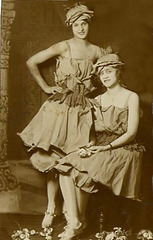
Montrose Sisters
| 18 Oct 2023 |
|
These two young ladies were dancers on the vaudeville stage. Photographed at Penn Studio. Pennsylvania Historical Society

Hyers Sisters
| 16 Oct 2023 |
|
Anna Madah Hyers and Emma Louise Hyers were pioneers of black musical theater who toured the United States from the late 1860s through the turn of the century. They possessed remarkable voices and over their long careers collaborated with notable African American artists like Billy Kersands, Pauline Hopkins, and Sam Lucas on a string of successful productions.
Source: Harvard Theatre Collection
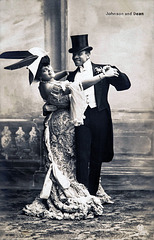
Johnson and Dean
| 17 Oct 2023 |
|
In October 1901, the dancers Dora Dean and Charles Johnson, newly arrived from New York City, made their Berlin debut in the Wintergarten Theater. Their costumes were luxurious, their movements exaggerated, their music syncopated. It was the Cakewalk, performed in the city in all likelihood for the first time. Originally, enslaved African Americans had developed the Cakewalk as a parody of the white, slaveholding upper class. Through Vaudeville, Cakewalk became popular throughout the US, before Black Americans brought the dance to Europe at the turn of the century.
Dean and Johnson had a perfect partnership, with his “rubberlegs” dance moves and ability to twinkle and caper and captivate the audience, often while she struck an admiring pose. Neither sang especially well — they would talk through their songs — but it didn’t matter. Dean was gorgeous. She had a wonderfully pleasing personality, and she radiated vivaciousness on stage. She was magnetic. A painter in Berlin, possibly Ernst Heilman, bought the entire show’s contract so that she had two weeks free and he could paint her portrait.
As a black teenager in the 1880s, Johnson shined shoes at the old Nicollet House hotel in Downtown Minneapolis and earned tips for his buck and wing dancing. He went to amateur nights at local theatres and then heard about a new kind of minstrel show, featuring other black (not blackface) performers and, for the first time, women. He was hired and there he met Dean.
She was from Kentucky, perhaps born with the name of Luella Babbige. While with The Creole Show, Dean and Johnson perfected their routine, a cakewalk, but soon struck out on their own. In the world of black dance, they set several firsts. They were the first to make the jump from black vaudeville to top billing in white vaudeville circuits. They were the first to perform the cakewalk on Broadway. Johnson said in 1951, using the vocabulary of the day, “The walk goes back to slavery days. The best strutting couple in the Negro festivals was awarded a cake for the elegant bearing of the gentleman and the grace of the lady.” When they stepped onto the stage that first time in New York, Johnson said, “Well, we just strutted. The crowd went wild.”
Another of their calling cards was that public display of elegance and grace. They determined from the start to be “a class act.” No dancers before them — black or white — performed the cakewalk in evening clothes. Dean changed her costume a few times during their act and wore dresses that cost $1,000. Her clothes were copied by the likes of Sarah Bernhardt. Johnson wore a monocle and top hats and tails in purple or white. Their earnings went into their costumes and jewelry. He had a six-carat diamond pin. Her earrings cost $10,000.
The cakewalk dance began with enslaved African Americans dancing to imitate and mock the stiff and formal progressions of white dancing. As blackface minstrelsy developed in the mid-19th century, cakewalk became the signature showpiece of the finale of a minstrel show. Even when African Americans performed in minstrel shows, either as themselves or in blackface, the cakewalk was performed as a cartoonish imitation. Johnson and Dean’s class act transformed the cakewalk into a stylish dance that white people eagerly took to. The dance was enormously popular in Europe and America, where it became more exaggerated and, again, cartoonish. White people imitated black people imitating white people.
When vaudeville wound down as a primary entertainment, the spotlight on Johnson and Dean faded. They broke up the act, and each tried to create a new performing career. Neither was the success they hoped for. Eventually, Dean came back to Minneapolis and to Johnson. They tried a comeback and had a bit of success until he injured his leg. It healed slowly. They lived in a modest house at 811 E. 36th St., where they once owned most of the houses on the block. Dean had a long illness and died in her sleep in 1943. Johnson passed away in his 80s in 1956. They are both buried at Lakewood Cemetery.
Sources: Johnson and Dean, “Achwiesüss” [Ohhowsweet], ca. 1905, © Stadtmuseum Berlin By: Georg Gerlach & Co., Berlin; Southwest Journal article by Karen Cooper (Feb. 2020)

Dudley and Grady
| 16 Oct 2023 |
|
Vaudeville duo of S. H. Dudley in blackface and his partner, Lottie Grady. Lottie Grady, toured with Chicago's Pekin Theatre and worked for the Foster Photoplay Company also based in Chicago.
McIntosh and King
| 16 Oct 2023 |
|
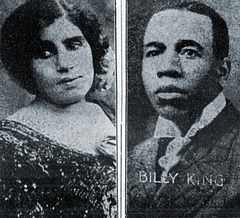
Kansas City Sun (June 1915): Hattie McIntosh, who is giving a remarkable exhibition of her histrionic ability in the classical plays now being put on at the Criterion theater. She is queen of her profession not only in physique but in art as well.
The Only "Billy" King. The greatest of them all, who is now the sole proprietor of the Criterion theater, and who is crowding the house nightly with his excellent play.
Hattie McIntosh
From minstrelsy to vaudeville to the Broadway stage, Hattie McIntosh was one of the first black women to make a profession of the theater. She was born in Detroit, Michigan around 1860. She first performed in 1884 in McIntosh and Sawyer's Colored Callender Minstrels. Her husband, Tom McIntosh, was part-owner of the company and one of the country's leading black showmen. At a time when there were few black women onstage, many were wives of performers and producers; it was considered somewhat more respectable for a woman to go onstage with her husband than alone. There was very real protection in marriage, as well, from the hardships and dangers of touring.
In the early 1890s, the McIntoshes created a vaudeville act called "Mr. and Mrs. McIntosh in the King of Bavaria." In the next few years, they performed with the three important companies that broke out of the minstrel format and included women in their casts as well as men. In 1894, their act played with Sam T. Jack's Creole Shows, and they joined the legendary Black Patti's Troubadours in 1896. After that, they toured with John Isham's Octoroons Company. Hattie McIntosh soon had a leading role in Isham's King Rastus Company.
After the turn of the century, she joined the Williams and Walker Company, going to England in 1902 In Dahomey. Her husband, Tom McIntosh died in 1904. The following year, Hattie was in Chicago, as a member of Bob Mott's Pekin Theater Stock Company. Bob Mott was a saloon owner who turned his saloon into a music hall in 1904. He built a new building in 1905 calling it the Pekin Theater. He then formed a stock company to perform at the Pekin; eventually the company also toured the East and Midwest. It is not clear how long McIntosh stayed at the Pekin, but in 1909 she was back with Bert Williams in Mr. Lode of Koal. That was her last performance with the musical comedy great. In about 1911, she formed a vaudeville team with another woman, Cordelia McClain.
McClain and McIntosh took their act to the Billy King Stock Company in 1912, which toured the South and then opened at the Grand Theater in Chicago in 1915 or 1916. McIntosh married Billy King the same year that she and McClain joined the company. Hattie McIntosh died in Chicago in December of 1919.
Billy King
Born in Whistler, Alabama, in 1875 on a large farm, where at the gae of ten he was considered one of the best plough hands. But this rural labor dd not satisfy little Billy, who dreamed of being a show performer. So one day, he ran away from home, hopping a freight car for he knew not where. Drifting about the country, Billy eventually fell in with some actors. A little later, he organized his own minstrel company, which was billed as "King and Bush, Wide Mouth Minstrels." They toured the South in the early 1890s. After the closing of his company, Billy joined Richards ad Pringle, Rosco and Holland's Georgia Minstrel Company. At the time, Billy Kersands was the star. After a season with this company, King became stage manager and producer of the company, Billy Kersands, Clarence Powell, James Crosby, and King were known as the "Big Four" comedians.
After King quit the Georgia Minstrels, he made his home in Chicago, where he opened an office for booking and producing shows and vaudeville acts. The season of 1911 found Billy King teamed with James Mobley in a successful vaudeville act. The next season King formed his first stock company in Atlanta, Georgia. Billy wrote and produced all of the company's plays and engaged a very talented group of artists. In 1913, he went to the Lyric Theatre in Kansas City, Missouri, and organized another successful stock company.
In 1915, King moved his company to the Grand Theatre in Chicago, where he produced shows for the next eight seasons. King's company put on a new show each week and King was responsible for bringing many new innovations into musical comedy, including girls clowning at the end of chorus lines. The latter routine was used by Josephine Baker to gain her first real notice in the chorus of Sissle and Blake's "Chocolate Dandies." King also wrote popular songs, several of which were introduced by his protegee, Gertrude Saunders. He married fellow vaudevillian Hattie McIntosh in 1912. King died in 1951.
Sources: Kansas City Sun (June 1915); Black Women in America: Theater Arts and Entertainment, Encyclopedia of Black Women in America by Kathleen Thompson; Blacks in Blackface: A Sourcebook on Early Black Musical Shows by Henry T. Sampson
Walker & May
| 16 Oct 2023 |
|
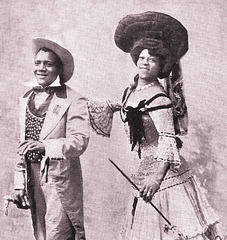
Charles (C.W.) Walker and his wife, Ida May, had arrived with McAdoo's Georgia Minstrels at the start in June 1899 on the SS Moana . They were billed together as "America's Gold Medal Champion Cakewalkers." They continued to play the Tivoli circuit, in Sydney, Melbourne (Bijou Theatre and New Opera House) and Adelaide (New Tivoli) until March 1902. Apart from the Cakewalk, they were variously billed as coon singers, comedians, and along with Billy and Cordelia McClain as the Four American Minstrels, "who not only contribute their individual turn but conclude the part with a cakewalk."
They lived at 69 Mostyn Road between 1904-1906 before moving to Ackerman Road then back to 30 Mostyn Road. Born in Chicago, Charles had performed in America since childhood and when he married 15 year old Ida from Ohio she joined him professionally.
Charles Walker and Ida May, billed as "America's champion gold medal cakewalkers and specialty artists," were the only African Americans on the bill. After returning to Sydney and the Tivoli during August and September, Walker and May spent four months in Perth and regional WA, until February 1903. Back in Melbourne, they played the Opera House until July 3, 1903, sharing the bill at one stage with an "eccentric American juggler," one W.C. Fields. On conclusion of the Opera House engagement they departed for England, the last of that round of stayovers to depart.
During an exhausting three year tour of Australia, at the age of thirty-three, Charles, began to lose his sight due to atrophy of the optic nerve while at the Melbourne Opera House in 1903. The couple travelled to London to get treatment. Tragically he went fully blind on the journey and didn’t recover. Not deterred, Charles and Ida continued full force with their comedy song and dance act. For eighteen months in England he successfully concealed his handicap from theatre managers. Using aural information from the position of the orchestra instruments, and whispered comments from his wife, he was able to dance, sing, and tell jokes. The pair was still performing successfully in England in 1908.
They were known as the first black couple to perform the 'cakewalk' a style of popular dance. After Charles went blind, he and Ida worked out a secret code that enabled him to know exactly where on the stage he needed to be. Worried about audience reaction, they didn’t tell anyone for over a year, but their popularity soared when it became public. Charles became known as the great blind comedian. In 1909, their 18 year old daughter Leonora Walker made her first stage performance with them at the Brixton Empress. In the 1911 census they are staying in small lodgings rooms at 100 Ackerman Road but this is almost certainly short term digs. For reasons not entirely clear Charles (fifty-two) & Ida (forty-nine) were deported to America in 1918, and sailed 3rd class back to the country they hadn’t lived in for 20 years.
Sources: African American Entertainers in Australia and New Zeland: A History, 1788-1941 (Bill Egan); Layers of London article by Chris Beddoe
Something Good Negro Kiss
| 16 Oct 2023 |
|
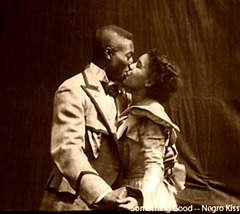
Saint Suttle and Gertie Brown (members of Brewer & Suttle's Rag-Time Four) embrace in a 1898 film, a depiction of genuine black affection that stands out from a cinematic era filled with stereotypes and racist caricatures.
UChicago scholar helps identify 1898 film as earliest depiction of African-American affection ....
They are on screen for less than 30 seconds, a couple in simple embrace. The man, dressed in a suit and bow tie, and the woman in a frilled dress. They hug and kiss, swing wide their clasped hands, and kiss again.
Titled Something Good-Negro Kiss , the newly discovered silent film from 1898 is believed to be the earliest cinematic depiction of African-American affection. Thanks to scholars at the University of Chicago and the University of Southern California, the footage is prompting a rethinking of early film history.
The film was announced December 12, 2018 as a new addition to the Library of Congress’ National Film Registry—one of 25 selected for their enduring importance to American culture, along with Jurassic Park, Brokeback Mountain and The Shining. The 29-second clip is free of stereotypes and racist caricatures, a stark contrast from the majority of black performances at the turn of the century.
“It was remarkable to me how well the film was preserved, and also what the actors were doing,” said UChicago’s Allyson Nadia Field, an expert on African-American cinema who helped identify the film and its historical significance. “There’s a performance there because they’re dancing with one another, but their kissing has an unmistakable sense of naturalness, pleasure, and amusement as well.
“It is really striking to me, as a historian who works on race and cinema, to think that this kind of artifact could have existed in 1898. It’s really a remarkable artifact and discovery.”
An associate professor in UChicago’s Department of Cinema and Media Studies, Field first saw scanned frames of the film in January 2017. The footage was discovered by USC archivist Dino Everett, who found the 19th-century nitrate print within a batch of silent films he had acquired from a Louisiana collector nearly three years earlier.
In examining the film, Everett noticed physical characteristics that led him to believe the film was made prior to 1903.
“I told students, ‘I think this is one of the most important films I’ve come across,’” Everett said. “But my expertise is not in African-American cinema. I didn’t know if something like this was already out there.”
To find out, Everett reached out to Field, whom he had worked with when she was faculty at UCLA.
A scholar who specializes in both silent and contemporary African-American film, Field is the author of Uplift Cinema: The Emergence of African American Film & The Possibility of Black Modernity. Her 2015 book examined archival materials, such as memos and publicity materials, to explore how black filmmakers used cinema as a method of civic engagement in the 1910s.
To uncover the origins of Everett’s footage, Field relied on inventory and distribution catalogs, tracing the film to Chicago. This was where William Selig—a vaudeville performer turned film producer—had shot it on his knockoff of a Lumière Cinématographe. That camera produced the telltale perforation marks which had tipped Everett off to the print’s age.
With help from the Museum of Modern Art in New York, Field identified Saint Suttle and Gertie Brown, who in the clip are dressed in stage costumes common for minstrel performers.
Their performance is a reinterpretation of Thomas Edison’s “The Kiss,” featuring May Irwin and John Rice. Added to the National Film Registry nearly two decades ago, the 1896 film contained the very first on-screen kiss, and was also one of the first films to be publicly shown.
But less discussed is the fact that Irwin herself was a well-known minstrel performer—a fact that, Field argues, would have shaped how viewers understood both the Irwin-Rice kiss and Something Good-Negro Kiss. Indeed, the discovery of Something Good-Negro Kiss could prompt scholars to reevaluate their perceptions of the time period.
“This artifact helps us think more critically about the relationship between race and performance in early cinema,” Field said. “It’s not a corrective to all the racialized misrepresentation, but it shows us that that’s not the only thing that was going on.”
The discovery also offers a reminder to archivists and film scholars that cinematic knowledge is based on an incomplete record—and the hope that other significant pieces live on, tucked away in basements and storage units.
“I’m optimistic that lost films are just currently lost,” Everett said. “They’re not necessarily wiped off planet Earth. We can still make a lot of important finds.”
Something Good A Negro Kiss (1898) 49 seconds:
www.youtube.com/watch?v=Y1FvpEeUBQo
Sources: uchicagonews.com; USC School of Cinematic Arts
The Cakewalking Couple: Johnson and Dean
| 16 Oct 2023 |
|
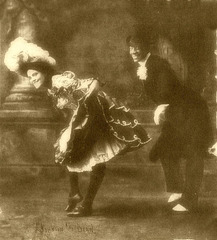
Dean, whose birth name was Dora Babbige, was born in Covington, KY. In London, Dean was known as "The Black Venus," a title Josephine Baker would later inherit. She was married to Charles E. Johnson, and they performed as a couple, often billed as the creators of the Cake Walk dance. Dean and Johnson were a stylish and graceful dance team who perfected the Cake Walk into a high-stepping swank. They also performed soft shoe and wing dancing; they were stars of "The Creole Show," emphasizing couples dancing.
Dean and Johnson were the first African American couple to perform on Broadway. They were also the first to perform in evening attire; and they were also considered the best dressed couple on stage. Dean was described as possessing a plump, striking figure; she posed for German painter Ernest von Heilmann, and the painting was unveiled in 1902 at the coronation of King Edward VII and exhibited at the Paris Expo.
Dora even had a few songs written about her one such song was titled, 'Have You Met Miss Dora Dean, Prettiest Girl You've Ever Seen.'
The couple was also the first to use steel taps on their shoes and the first to use strobe lighting. Beginning in 1903, they lived and performed mostly in Europe and some in Australia and the U.S. They returned home in 1913. The couple had divorced in 1910, and once back in the U. S. they continued performing but did not perform together for a long while. In 1930, Dean had an acting role in the film Georgia Rose, an all African American talkie by white director Harry Gant. Dean and Johnson reunited as a team and a couple in 1934, and both retired by 1942. They spent the remainder of their lives in Minneapolis, Minnesota.
Dean had a long illness and died in her sleep in 1943. Johnson passed away in his 80s in 1956.
Sources: Babylon Girls: Black Women Performers and the Shaping of the Modern by Jayna Brown (2008); Southwest Journal article by Karen Cooper (Feb. 2020)
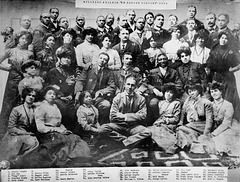
Williams and Walker "In Dahomey" Company Cast of 1…
| 19 Apr 2016 |
|
1. Bessie Vaughn
2. Ida Day
3. 'Tiny' Jones
4. Charles Moore
5. Kate Jones
6. ?
7. Jessie Ellis
8. Maggie Davis
9. Hattie Hopkins
10.Bert Williams
11.? Harris
12.George Walker
13.Hattie McIntosh
14.?
15.Renie Norris
16.?
17.Daisy Tapley
18.Lottie Williams (Bert Williams' wife)
19.? Tuck
20.Aida Overton Walker (George Walker's wife)
21.Ella Anderson
22.Lizzie Avery
23.Lavina Rogers
24.Jim Vaughn
25.William C. Elkins
26.Walter Richardson
27.Richard Conners
28.? Barker
29.Will Accoe
30.George Catlin
31.Chip Ruff?
32.Jimmie ?
33.John Lubrie Hill
34.Henri Green Tapley (Daisy Tapley's husband)
35.Henry Troy
36.Marshall Craig
37.Theodore Pankey
38.Harry Stafford
39.Charles L. Saulsbury?
40.Alex C. Rogers
In Dahomey was the first full-length musical written and played by an entirely Black cast to be performed on Broadway. The play was based on a libretto by Jesse A. Shipp, with music by Will Marion Cook and lyrics by Paul Laurence Dunbar and Alex Rogers. Cook’s music would become to be considered by many as the ‘turning point for African American representation’.
Source: Robert Kimball Archives
More information can be found here: www.africansinyorkshireproject.com/in-dahomey.html
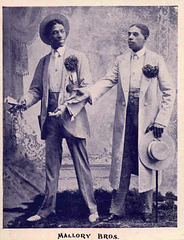
The Mallory Brothers
| 16 Oct 2023 |
|
Frank and Edward Mallory were an outstanding novelty instrumental music, singing and dancing team, active on the minstrel and vaudeville stage, from the 1880s to the early 1900s. Their act included hand bells, saxophones and other brass instruments. Famed for their ability to imitate an entire brass band, they were considered one of the top vaudeville acts. As each brother married, he included his wife in the act and changed the name of the group accordingly. When Edward married Maizie Brooks (a harpist and singer), the name of the group changed to The Mallory Bros. & Brooks. When Frank married Grace Halliday (pianist, violinist, singer and dancer), the group's name changed to the Mallory Bros. Brooks and Halliday.
Both Frank and Edward began their careers with Billy Kersands' Genuine Colored Minstrels (1885-1889), of which Frank was the end man and drum major of Kersands Minstrel Band. The two brothers next toured for a 20-week season with Richards & Pringle's Minstrel Show. The brothers next joined The Creole Show (1894-1896) as featured instrumentalists, in which they were praised for "their mandolin songs and dances and musical melange." Edward's wife, Maizie, was also in the chorus of this show.
As the Mallory Bros. & Brooks, the three toured with The Octoroons show (1895-1897); next they joined Williams & Walker's Senegambian Carnival (1898), during which Frank's wife, Grace, also became a part of their act. Now calling themselves the Mallory Bros., Brooks & Halliday, they toured in Williams & Walker's A Lucky Coon show (1898-1899), of which Frank was also stage manager and played the title role, after which the four Mallory's toured in Williams & Walker's The Policy Players (1899-1900).
After leaving Williams & Walker's company, the Mallory Brothers and their wives joined the King Rastus show (1900-1902), then were a featured act with the Fenberg Stock Co. (a white company), from 1902 -1904. And finally took their novelty musical act on tour of the Orpheum Circuit (a chain of white owned vaudeville and movie theatres) until Grace's (Frank's wife), death in 1906, after which the three remaining members of the group retired from the stage, making their home in Jacksonville, Florida.
The Freeman, (Aug. 28, 1909) : Upon leaving the stage the Mallory Brothers, have made good use of money earned. They now possess some of the best property owned by colored people in Florida. They have eight rental houses in the city and one large two-story brick building in the business part of town, worth not less than $8,000. All of their property is well situated, and is always occupied by paying tenants. Since they left the stage they have been engaged in the broker business, and they run a first and second-hand mercantile establishment. They are constantly in demand also to furnish music for entertainment for whites and colored, as they keep an orchestra of eight persons constantly on hand. Maizie Brooks (Mrs. Ed Mallory), has permanent engagement with the leading (white) theater in Jacksonville.
Sources: Profiles of African American Stage Performers and Theatre People (1816-1960) by Bernard L. Peterson; The Freeman Newspaper (August 1909)
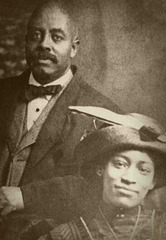
Mr. and Mrs. Hendrix
| 16 Oct 2023 |
|
Zenora “Nora” Moore, Jimi’s paternal grandmother, was born on November 19, 1883 in Georgia to Fanny Moore, originally from Ohio, and Robert Moore Sr., a Georgia native. Fanny Moore was half Cherokee and half African American. Robert Moore Sr. was a freed slave. Together they worked to make a life for their family, relocating to Tennessee, where Nora was raised.
By the beginning of the 20th Century, Nora, now a teenager, noticed the growing popularity of touring vaudeville acts and immediately took an interest in this form of entertainment. She thoroughly enjoyed the music, dancing, comedy routines and the excitement of the stage. By her early twenties she began performing. Along with her sister, whose stage name was Belle Lamar, Nora joined a traveling vaudeville group as a chorus girl/dancer. For the next several years, Nora and Belle toured the country as part of this lively body of entertainers who quickly became known for their extravagant costumes.
Nora Moore and Bertram Philander Ross Hendrix met on the road. The two found themselves traveling around the country together as part of the same Dixieland vaudeville troupe. Their troupe included six band members plus a cast of seventeen actors, comedians, and dancers as well as stagehands such as Ross Hendrix. As Nora performed her act onstage, a bond was developing offstage between the entertainer and the stage hand. As the tour began to concentrate in the Pacific Northwest with the entertainers often traveling between Portland, Oregon and Seattle, Washington, both Nora and Ross began to view the area as a permanent home. Financial difficulties brought the tour to an end in Seattle in 1912, but that end proved to be the beginning of a new life for Ross and Nora as they decided to marry in that city.
Non-stage work, however, soon proved difficult to obtain in Seattle. On the advice of an acquaintance known only as Mr. Cohen, Ross and Nora Hendrix moved to Vancouver, British Columbia where he would find work. Cohen recommended Ross to a friend who was affiliated with The American Club in Vancouver. Ross obtained employment there.
With employment, Ross and Nora started a new family and a new life. All four of their children were born in Canada. Nora gave birth to the couple’s first son, Leon Marshall Hendrix, on April 12, 1912 (he passed away in March 1932). A daughter, Patricia Rose Hendrix, was born on May 3, 1914 and a few years later, two more sons, Frank Hendrix on October 3, 1917 and James Allen Ross Hendrix on June 10, 1919, were born. James Allen (“Al”) Ross Hendrix would later become the father of Jimi Hendrix who was born in Seattle on November 27, 1942. A fifth child, Orville Ronald Hendrix, was born on January 25, 1926, but passed away two months later on March 31, 1926.
Finding Vancouver to be a comfortable place to work and raise their four children, Ross petitioned the Canadian Government to become a Canadian citizen. On November 28, 1922, Ross and Nora Hendrix were officially naturalized and became Canadian citizens. Ross also became very active in Vancouver’s Fountain Chapel, the local African Methodist Episcopal (AME) Church. Being a “people person,” he enjoyed his work as a steward in some of Vancouver’s most prestigious clubs including the American Club and the Transportation Club of Vancouver. In 1925 he accepted the position of first porter at the newly opened Quilchena Golf & Country Club which was located in one of the most posh neighborhoods on the outskirts of Vancouver. Ross held this position at Quilchena until March 21, 1934, when he passed away because of a ruptured aorta.
Following the death of their father, the Hendrix children went in separate directions. James “Al” Hendrix, the youngest child, performed several odd jobs in Vancouver and in Victoria on neighboring Vancouver Island. Al also became a fierce competitor in the boxing ring, even participating in a Golden Gloves boxing event in Seattle in 1936. In addition to the fights, Al shared his parents’ love of music and dancing and regularly participated in some of the city’s jitterbugging contests. Ambition would eventually drive him to permanently relocate in Seattle, Washington for work in 1940. His mother, Nora Hendrix, remained in Vancouver for several decades, moving to Seattle in the 1980s with her son Al Hendrix and family. She later returned to Canada where she lived until her passing due to cancer on July 24, 1984 at the age of 100.
Jimi Hendrix’s career was clearly influenced by his grandparents and particularly his grandmother, Nora. Although Nora and Jimi performed in vastly different musical eras, they were united by their love of entertainment, their penchant for flamboyant costumes, their desire to perfect their talents, and their dedication to their audiences despite the trials of performing on the road. The roots of Jimi Hendrix’s enormous success lie in the blood of his paternal vaudevillian grandparents, Nora and Ross Hendrix.
Independent Historian
Janie L Hendrix (Jimi's Half Sister)
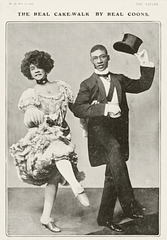
The Cake Walkers
| 16 Oct 2023 |
|
Aida Overton Walker pictured along with her hubby George A Walker in a publicity photo depicting their version of the famous Cakewalk in the 1903 play In Dahomey performed at the Shaftesbury Theatre in London, England.
The play was written by Will Marion Cook, Jesse A Shipp and Paul Laurence Dunbar. Synopsis: A musical comedy about a fraudulent scheme to return discontented Blacks to Africa. It was performed by a cast of about one hundred African American actors, and made a huge impact not only on the theatre but on fashion. Its display of dances such as the 'Cakewalk' and 'Buck and Wing' helped them become the latest dance hall crazes in the UK. Despite the show’s misrepresentations of Africa, it was a milestone because it was created and performed by an all-black cast and was the first to introduce an African theme to the musical genre.
A few historical facts about the play In Dahomey :
It was the first African American musical play.
It was created and performed by an all African American cast.
The show had 53 performances in New York,.
Had a seven month run in England.
The play ran between the years 1902 and 1905.
All music and lyrics were written by African Americans, Will Marion Cook and Paul Laurence Dunbar.
Source: V&A Theatre Collection
Jump to top
RSS feed- Kicha's latest photos with "Vaudevillians" - Photos
- ipernity © 2007-2026
- Help & Contact
|
Club news
|
About ipernity
|
History |
ipernity Club & Prices |
Guide of good conduct
Donate | Group guidelines | Privacy policy | Terms of use | Statutes | In memoria -
Facebook
X
