

Kicha's photos with the keyword: Johnson and Dean

Dora Dean Johnson
| 17 Oct 2023 |
|
Miss Dora Dean’s portrait was exhibited in Paris in 1900. A copy of the original portrait hung in Dean and Johnson’s home. Its whereabouts are unknown today.
“Have you seen Miss Dora Dean, sweetest gal I’ve ever seen?” That was a lyric of a song written about her in 1896, when she and her husband and partner, Charles E. Johnson, were at the very top of the world of vaudeville. Their song-and-dance act took them abroad for months on end, touring Europe and even Australia. They performed in Hungary and Russia, even for England’s King Edward VII.
Dean and Johnson had a perfect partnership, with his “rubberlegs” dance moves and ability to twinkle and caper and captivate the audience, often while she struck an admiring pose. Neither sang especially well — they would talk through their songs — but it didn’t matter. Dean was gorgeous. She had a wonderfully pleasing personality, and she radiated vivaciousness on stage. She was magnetic. A painter in Berlin, possibly Ernst Heilman, bought the entire show’s contract so that she had two weeks free and he could paint her portrait.
As a black teenager in the 1880s, Johnson shined shoes at the old Nicollet House hotel in Downtown Minneapolis and earned tips for his buck and wing dancing. He went to amateur nights at local theatres and then heard about a new kind of minstrel show, featuring other black (not blackface) performers and, for the first time, women. He was hired and there he met Dean.
She was from Kentucky, perhaps born with the name of Luella Babbige. While with The Creole Show, Dean and Johnson perfected their routine, a cakewalk, but soon struck out on their own. In the world of black dance, they set several firsts. They were the first to make the jump from black vaudeville to top billing in white vaudeville circuits. They were the first to perform the cakewalk on Broadway. Johnson said in 1951, using the vocabulary of the day, “The walk goes back to slavery days. The best strutting couple in the Negro festivals was awarded a cake for the elegant bearing of the gentleman and the grace of the lady.” When they stepped onto the stage that first time in New York, Johnson said, “Well, we just strutted. The crowd went wild.”
Another of their calling cards was that public display of elegance and grace. They determined from the start to be “a class act.” No dancers before them — black or white — performed the cakewalk in evening clothes. Dean changed her costume a few times during their act and wore dresses that cost $1,000. Her clothes were copied by the likes of Sarah Bernhardt. Johnson wore a monocle and top hats and tails in purple or white. Their earnings went into their costumes and jewelry. He had a six-carat diamond pin. Her earrings cost $10,000.
The cakewalk dance began with enslaved African Americans dancing to imitate and mock the stiff and formal progressions of white dancing. As blackface minstrelsy developed in the mid-19th century, cakewalk became the signature showpiece of the finale of a minstrel show. Even when African Americans performed in minstrel shows, either as themselves or in blackface, the cakewalk was performed as a cartoonish imitation. Johnson and Dean’s class act transformed the cakewalk into a stylish dance that white people eagerly took to. The dance was enormously popular in Europe and America, where it became more exaggerated and, again, cartoonish. White people imitated black people imitating white people.
When vaudeville wound down as a primary entertainment, the spotlight on Johnson and Dean faded. They broke up the act, and each tried to create a new performing career. Neither was the success they hoped for. Eventually, Dean came back to Minneapolis and to Johnson. They tried a comeback and had a bit of success until he injured his leg. It healed slowly. They lived in a modest house at 811 E. 36th St., where they once owned most of the houses on the block. Dean had a long illness and died in her sleep in 1943. Johnson was a model for art students at the Walker and at MCAD before he passed away in his 80s in 1956. He thought the modeling gave him a tiny bit of “on-stage”; he was always planning a comeback. They are both buried at Lakewood Cemetery.
But what of that painting — the life-size portrait of Dean — a copy of which hung in their home? It was still there a few decades ago, and was probably there when Johnson died. But where did it go? Have any of you seen Miss Dora Dean?
Sources: Southwest Journal article by Karen Cooper (Feb. 2020); Hennepin County Library
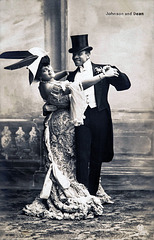
Johnson and Dean
| 17 Oct 2023 |
|
In October 1901, the dancers Dora Dean and Charles Johnson, newly arrived from New York City, made their Berlin debut in the Wintergarten Theater. Their costumes were luxurious, their movements exaggerated, their music syncopated. It was the Cakewalk, performed in the city in all likelihood for the first time. Originally, enslaved African Americans had developed the Cakewalk as a parody of the white, slaveholding upper class. Through Vaudeville, Cakewalk became popular throughout the US, before Black Americans brought the dance to Europe at the turn of the century.
Dean and Johnson had a perfect partnership, with his “rubberlegs” dance moves and ability to twinkle and caper and captivate the audience, often while she struck an admiring pose. Neither sang especially well — they would talk through their songs — but it didn’t matter. Dean was gorgeous. She had a wonderfully pleasing personality, and she radiated vivaciousness on stage. She was magnetic. A painter in Berlin, possibly Ernst Heilman, bought the entire show’s contract so that she had two weeks free and he could paint her portrait.
As a black teenager in the 1880s, Johnson shined shoes at the old Nicollet House hotel in Downtown Minneapolis and earned tips for his buck and wing dancing. He went to amateur nights at local theatres and then heard about a new kind of minstrel show, featuring other black (not blackface) performers and, for the first time, women. He was hired and there he met Dean.
She was from Kentucky, perhaps born with the name of Luella Babbige. While with The Creole Show, Dean and Johnson perfected their routine, a cakewalk, but soon struck out on their own. In the world of black dance, they set several firsts. They were the first to make the jump from black vaudeville to top billing in white vaudeville circuits. They were the first to perform the cakewalk on Broadway. Johnson said in 1951, using the vocabulary of the day, “The walk goes back to slavery days. The best strutting couple in the Negro festivals was awarded a cake for the elegant bearing of the gentleman and the grace of the lady.” When they stepped onto the stage that first time in New York, Johnson said, “Well, we just strutted. The crowd went wild.”
Another of their calling cards was that public display of elegance and grace. They determined from the start to be “a class act.” No dancers before them — black or white — performed the cakewalk in evening clothes. Dean changed her costume a few times during their act and wore dresses that cost $1,000. Her clothes were copied by the likes of Sarah Bernhardt. Johnson wore a monocle and top hats and tails in purple or white. Their earnings went into their costumes and jewelry. He had a six-carat diamond pin. Her earrings cost $10,000.
The cakewalk dance began with enslaved African Americans dancing to imitate and mock the stiff and formal progressions of white dancing. As blackface minstrelsy developed in the mid-19th century, cakewalk became the signature showpiece of the finale of a minstrel show. Even when African Americans performed in minstrel shows, either as themselves or in blackface, the cakewalk was performed as a cartoonish imitation. Johnson and Dean’s class act transformed the cakewalk into a stylish dance that white people eagerly took to. The dance was enormously popular in Europe and America, where it became more exaggerated and, again, cartoonish. White people imitated black people imitating white people.
When vaudeville wound down as a primary entertainment, the spotlight on Johnson and Dean faded. They broke up the act, and each tried to create a new performing career. Neither was the success they hoped for. Eventually, Dean came back to Minneapolis and to Johnson. They tried a comeback and had a bit of success until he injured his leg. It healed slowly. They lived in a modest house at 811 E. 36th St., where they once owned most of the houses on the block. Dean had a long illness and died in her sleep in 1943. Johnson passed away in his 80s in 1956. They are both buried at Lakewood Cemetery.
Sources: Johnson and Dean, “Achwiesüss” [Ohhowsweet], ca. 1905, © Stadtmuseum Berlin By: Georg Gerlach & Co., Berlin; Southwest Journal article by Karen Cooper (Feb. 2020)
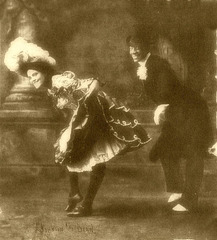
The Cakewalking Couple: Johnson and Dean
| 16 Oct 2023 |
|
Dean, whose birth name was Dora Babbige, was born in Covington, KY. In London, Dean was known as "The Black Venus," a title Josephine Baker would later inherit. She was married to Charles E. Johnson, and they performed as a couple, often billed as the creators of the Cake Walk dance. Dean and Johnson were a stylish and graceful dance team who perfected the Cake Walk into a high-stepping swank. They also performed soft shoe and wing dancing; they were stars of "The Creole Show," emphasizing couples dancing.
Dean and Johnson were the first African American couple to perform on Broadway. They were also the first to perform in evening attire; and they were also considered the best dressed couple on stage. Dean was described as possessing a plump, striking figure; she posed for German painter Ernest von Heilmann, and the painting was unveiled in 1902 at the coronation of King Edward VII and exhibited at the Paris Expo.
Dora even had a few songs written about her one such song was titled, 'Have You Met Miss Dora Dean, Prettiest Girl You've Ever Seen.'
The couple was also the first to use steel taps on their shoes and the first to use strobe lighting. Beginning in 1903, they lived and performed mostly in Europe and some in Australia and the U.S. They returned home in 1913. The couple had divorced in 1910, and once back in the U. S. they continued performing but did not perform together for a long while. In 1930, Dean had an acting role in the film Georgia Rose, an all African American talkie by white director Harry Gant. Dean and Johnson reunited as a team and a couple in 1934, and both retired by 1942. They spent the remainder of their lives in Minneapolis, Minnesota.
Dean had a long illness and died in her sleep in 1943. Johnson passed away in his 80s in 1956.
Sources: Babylon Girls: Black Women Performers and the Shaping of the Modern by Jayna Brown (2008); Southwest Journal article by Karen Cooper (Feb. 2020)
Jump to top
RSS feed- Kicha's latest photos with "Johnson and Dean" - Photos
- ipernity © 2007-2026
- Help & Contact
|
Club news
|
About ipernity
|
History |
ipernity Club & Prices |
Guide of good conduct
Donate | Group guidelines | Privacy policy | Terms of use | Statutes | In memoria -
Facebook
X
