

Kicha's photos with the keyword: Race Relations

Detroit's Wall of Shame
| 18 Oct 2023 |
|
Children standing in front of half a mile of concrete in Detroit. The wall was built with a simple aim: separate homes planned for middle-class whites from blacks who had already built small houses or owned land with plans to build in the neighborhood. It couldn’t separate people on its own, people and policies would see to that, but it was enough to satisfy the Federal Housing Administration to approve and back loans.
This 1941 photo shows a group of unknown children standing in front of half a mile of concrete in Detroit. The wall was built with a simple aim: separate homes planned for middle-class whites from blacks who had already built small houses or owned land with plans to build in the neighborhood. (Image: AP Photo/Library of Congress, John Vachon)
When Eva Nelson-McClendon first moved to Detroit’s Birwood Street in 1959, she didn’t know much about the wall across the street. At 6 feet tall and a foot thick, it wasn’t so imposing, running as it did between houses on her street and one over. Then she started to hear the talk. Neighbors told her the wall was built two decades earlier with a simple aim: to separate homes planned for middle-class whites from blacks who had already built small houses or owned land with plans to build.
“That was the division line,” Nelson-McClendon, now, 79, says from the kitchen of her tidy, one-story home on the city’s northwest side. “Blacks lived on this side, whites was living on the other side … that was the way it was.”
That’s not the way it is anymore. But the wall remains, a physical embodiment of racial attitudes that the country long ago started trying to move beyond. And slowly, in subtle ways, it is evolving into something else in its community, something unexpected: an inspiration.
To those in the know, it goes by different names. For some, it’s simply “The Wall.” Others call it “Detroit’s Wailing Wall.” Many like “Birwood Wall,” because it refers to the street and sounds like the “Berlin Wall.”
Aside from the mural that now appears at the wall’s midpoint, much of it is easy to miss. In fact, it’s impossible to follow it completely as the wall disappears behind homes and in spots is overgrown by vegetation. Where it’s exposed, it’s whitewashed or a drab earth tone — and sometimes marred by gang graffiti. On one corner it says, “Only 8 Mile,” referring to the divisive road just yards to the north.
The wall never fell, but it didn’t really have to. The area became primarily African-American in the decades to come, as most whites and some blacks left. The pattern was replicated across much of the 139-square-mile city that was built for two million people but fell to about 700,000 in the 2010 Census.
The story of the wall has been largely lost in larger narratives, such as the 1943 and 1967 race riots and Eight Mile Road. The wall ends, almost invisible, just shy of the thoroughfare that serves as the boundary between Detroit and its suburbs and symbolically represents the divide between black and white.
Still, the wall is not forgotten. An artist descended on it several years ago with an army of about 100 fellow artists and community volunteers to create a vast, eye-popping mural with images and messages of equality and justice on a section overlooking a playground. And now, a faith-based nonprofit is giving work to men who have struggled to keep a job or a home, having them make sets of coasters that incorporate images from the wall and use materials from abandoned homes that were razed in the city. Every sale of a $20 set of coasters helps to make something good out of something bad.
Tightly clustered one-story homes dominate the neighborhood around the wall, which still has well-kept houses like Nelson-McClendon’s but also suffers from a rising number of vacant, gutted structures. More tear-downs in the making. And, perhaps, more wood for the coasters.
Many blacks had moved into the area in the 1920s and 1930s because there was so much vacant land. By 1940, the gap had closed. A developer of a proposed all-white subdivision managed to hammer out a compromise with federal housing officials: The loans and mortgage guarantees would come in exchange for constructing a wall. It was the closest thing Detroit had to the segregated fountains or to the white-only swimming pools of the deep South.
Nobody had to tell Nelson-McClendon, who moved to Michigan from Alabama in 1951. “It was the same thing,” she says. “Separation.”
When it comes to the wall, Eva Nelson-McClendon knows about perseverance. For her, it was and remains the only option.
“Did it make me angry to see that wall up there? It was something you grow accustomed to seeing, you know, although you don’t like it. Getting angry over it is not going to solve anything,” McClendon says. “What was important to me was bringing up my kids and getting them to get an education so they wouldn’t have to be bothered with things like that in the future.”
She thinks about progress, and acknowledges some. But she knows there are still neighborhoods, mostly in the suburbs now, where African-Americans can move but they aren’t welcomed with open arms.
But on this day, she takes solace that people didn’t stay in place. Even if the wall did.
“It all depends on the people, the individual, the heart,” she says. “You’re not going to stop progress, don’t care how hard you try.”
Sources: AP Photo/Library of Congress, John Vachon; Detroit Associated Press

The Wait
| 17 Oct 2023 |
|
A teenager (name unknown) being educated via television during the period Little Rock, Arkansas schools were closed by whites to avoid integration.
Source: U.S. News & World Report Magazine Photograph Collection.

The Children of Little Rock
| 17 Oct 2023 |
|
Seated on the floor from left to right: Thelma Mothershed, Elizabeth Eckford, and Melba Pattilo; seated on the sofa from left to right: Jefferson Thomas, Ernest Green (my Mom knew him), Annie Jean Brown, Carlotta Walls, Terrence Roberts and Gloria Ray.
The Little Rock Nine was a group of African-American students who were enrolled in Little Rock Central High School in 1957. The ensuing Little Rock Crisis, in which the students were initially prevented from entering the racially segregated school by Arkansas Governor Orval Faubus, and then attended after the intervention of President Eisenhower, is considered to be one of the most important events in the African-American Civil Rights Movement.
The Little Rock Nine
They didn't start out being known as the Little Rock Nine but now they are in America's history books. Here is a brief glimpse at these former students and what they are doing today, 40 years after this momentus year.
These nine students are unanimous in proclaiming the true heroes of the crisis at Central High School were their parents, who supported them and kept the faith that the process was right and that what they endured would give them opportunities they deserved.
Ernest Green
In 1958, he became the first black student to graduate from Central High School. He graduated from Michigan State University and served as Assistant Secretary of Housing and Urban Affairs under President Jimmy Carter. He currently is a managing partner and vice president of Lehman Brothers in Washington, D.C.
Elizabeth Eckford
The only one of the nine still living in Little Rock, Elizabeth made a career of the U.S. Army that included work as a journalist. In 1974, she returned to the home in which she grew up and is now a part-time social worker and mother of two sons.
Jefferson Thomas
He graduated from Central in 1960, following a year in which Little Rock's public high schools were ordered closed by the legislature to prevent desegregation. Today, he is an accountant with the U.S. Department of Defense and lives in Anaheim, California. He died in 2010 of pancreatic cancer.
Dr. Terrence Roberts
Following the historic year at Central, his family moved to Los Angeles where he completed high school. He earned a doctorate degree and teaches at the University of California at Los Angeles and Antioc College. He also is a clinical psychologist.
Carlotta Walls Lanier
One of only three of the nine who eventually graduated from Central, she and Jefferson Thomas returned for their senior year in 1959. She graduated from Michigan State University and presently lives in Englewood, Colorado, where she is in real estate.
Minnijean Brown Trickey
She was expelled from Central High in February, 1958, after several incidents, including her dumping a bowl of chili on one of her antagonists in the school cafeteria. She moved with her husband to Canada during the Vietnam War protests of the 1960s and today is a writer and social worker in Ontario. Winterstar Productions is presently filming a documentary on her life.
Gloria Ray Karlmark
She graduated from Illinois Technical College and received a post-graduate degree in Stockholm, Sweden. She was a prolific computer science writer and at one time successfully published magazines in 39 countries. Now retired, she divides her time between homes in Amsterdam, The Netherlands, and Stockholm, where her husband's family lives.
Thelma Mothershed-Wair
She graduated from college, then made a career of teaching. She lives in Belleville, Illinois, where she is a volunteer in a program for abused women.
Melba Pattillo Beals
She is an author and former journalist for People magazine and NBC and lives in San Francisco.
Bio: CentralHigh57.org
'Freedom: A Photographic History of the African American Struggle.' by Phaidon

One Little Girl
| 17 Oct 2023 |
|
One little girl and her bus driver. Why is she alone? This was the result when white parents wouldn't allow their children to ride with a non-white human being. She was the the first African American to attend an integrated school in Charlotte, North Carolina.
Source: Charlotte Observer

Unfair Grounds
| 16 Oct 2023 |
|
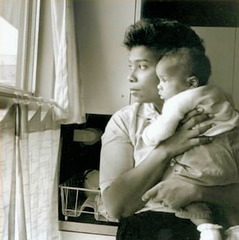
At the Greene County Fair in Greensboro, Georgia ... white school children were admitted free one day and black school children were allowed the next day.
Jack Delano, Photographer
Trouble in Levittown
| 16 Oct 2023 |
|
Levittown, Pennsylvania August 1957
Bill and Daisy Myers moved into a pink Levittowner Type 2 model home at 43 Deepgreen Lane in the Dogwood Hollow section of Levittown in Bristol Township.
The Myers were young, college educated and the parents of three small children. Their move would not have been unusual, except that they were black and Levittown was for whites only.
“We were not out to break the color line to make a point. The main purpose for buying that house was that we needed a third bedroom because we had just had a little girl. We were not political exhibitionists. Even today, I would not think of going out and marching or protesting. We were quiet, family people,” said Daisy Myers, 83, a retired elementary school principal who lives in York, south-central Pennsylvania. Bill Myers died in 1987.
That day — Aug. 13, 1957 — alarms were set off by the mailman who, learning that the Myers had bought the house, went down Deepgreen Lane shouting, “It's happened! [blacks] have moved into Levittown!”
The mailman did not use the word “blacks.”
At first, knots of housewives gathered across the street. Daisy Myers saw them spit and curse. By nightfall, some 300 people milled about the house. They threw rocks and smashed windows.
Crowds came nightly. There were daily death threats. Eight crosses were burned, one of them on the lawn of next-door neighbors Lew and Bea Wechsler, who had defended the Myers' right to live in Levittown.
The Levittown Betterment Committee was formed specifically to force the Myers out, peacefully if possible. If peace didn't work, other “options” would be considered, the group's leader ominously warned.
The Ku Klux Klan created a Klavern in Levittown. The Klan's chief recruiter kept applications in his family Bible at his Levittown home.
Bristol Township Police Chief John R. Stewart claimed he was doing what he could for the Myers, though privately he called Bill Myers a communist, according to Daisy Myers.
Stewart demoted one of his sergeants when the officer complained publicly that the chief had ordered the police to direct the rubberneckers through the neighborhood, and nothing more.
Large bottles filled with gasoline and topped with cotton wicks were discovered in bushes near the bedroom of the Myers' youngest child, Lynda, who was 2 months old.
The family fled their home three times within the first two weeks.
“It was frightening, but it was our home and we had a right to live there,” Daisy Myers recalled.
Gov. George Leader, fed up with Stewart's inaction, sent the state police to restore order, protect the Myers and prosecute harassers.
The Myers moved to York in 1961. Bristol Township publicly apologized in 1999.
“We could never really put Levittown behind us,” Daisy Myers said. “It was like a deep wound that healed. But like a wound, there are aftereffects. There is always something that triggers a memory. Has 50 years gone by? So quick,” she said.
She holds no grudges.
“We knew most of the people in Levittown were good but were probably too frightened to say anything,” she said. “The troublemakers were just a handful.”
Occasionally, when she speaks publicly, Daisy Myers quotes a statistic from the 2000 census.
Eighty-six percent of white Americans live in suburban neighborhoods where less than 1 percent of the population is black. Today, Levittown's population is 3 percent black.
“Well, that's some progress,” she said.
Daisy D Myers, "Sticks n Stones: The Myers Family in Levvittown"

Platt Family
| 16 Oct 2023 |
|
Allen Platt photographed with his wife and children. His kids were forced out of public school because white parents felt threatened that they may in fact be black.
The Allen Platt Case:
This school segregation case, which received national media attention at the time, involved Allen Platt, who moved his family (including five children and a niece) from Holly Hill, South Carolina to Mount Dora (Lake County), Florida in October, 1954. Platt and his family considered themselves of Croatan Indian and Irish descent. The children began to attend White schools in Mount Dora (as they had in South Carolina), but some of their classmates commented to their parents about the Platt children’s dark skin. The sheriff of Lake County, Willis V. McCall, a White supremacist, visited the Platt home, rudely examined and photographed the children, and “deciding that they were Black” advised them to stay away from school until he could “investigate”. His action was supported by the principal, superintendent, and school board. Platt insisted that he was a blend of Irish and Native American descent and had absolutely no black blood. Platt also wrote the governor of Florida that “If the children never see the inside of another school, they will not go to a Negro school." The Platts’ landlord received a threat that their house might burn down if they were not evicted—so he asked the family to move.
The local newspaper, The Topic edited by Mable Norris Reese covered the story extensively and featured Platt’s side of the controversy, resulting in crosses burned on Reese’s lawn and subscriptions to her newspaper canceled. Some people, however, contributed to a legal fund for Platt, and three lawyers volunteered to handle the case. The lawyers filed suit in Circuit Court, requesting a declaratory judgment asserting that the Platt children could attend White schools. The attorneys for the school board were unable to get the case dismissed on technical grounds, and their appeal to the state Supreme Court was denied.
When the family moved to nearby Orange County, the White schools would not admit the children until the Lake County School Board had resolved its dispute with the family. The Mount Dora Christian Home and Bible School researched the family’s background and decided to admit the children. Sheriff McCall then wrote the governor of Florida protesting that “if the Platt children are taken into classes of Christian Home and Bible School, everyone connected with it could be sued and prosecuted.”
When the court case was tried, the school board’s attorneys’ and Sheriff McCall’s evidence that the Platts were Black was flimsy compared to the Platts’ lawyers’ evidence that they were not. The school board’s attorneys’ primary argument was that on some records the Platts were listed as Croatan Indians, and Webster’s Dictionary defined Croatans as people with mixed Indian, White, and Negro blood.
The court found (on October 18, 1955) that the Platt children could attend Mount Dora’s White schools. The school board first voted to appeal the decision to the Florida Supreme Court; but before doing so, it voted again and accepted the circuit court’s ruling. In the meantime, someone had set fire to the Platts’ cottage. The children finished school at the Mount Dora Christian Home and Bible School.
Sources: The Lumbee Indians: An Annotated Bibliography; Life Magazine, Photographer, Robert W. Kelley

Brave Heart
| 16 Oct 2023 |
|
A teenager (name unknown) shooting daggers at a guard during the 1965 Selma to Montgomery March for Voting Rights.
Selma to Montgomery March
The Selma-to-Montgomery March for voting rights ended three weeks--and three events--that represented the political and emotional peak of the modern civil rights movement. On "Bloody Sunday," March 7, 1965, some 600 civil rights marchers headed east out of Selma on U.S. Route 80. They got only as far as the Edmund Pettus Bridge six blocks away, where state and local lawmen attacked them with billy clubs and tear gas and drove them back into Selma. Two days later on March 9, Martin Luther King, Jr., led a "symbolic" march to the bridge. Then civil rights leaders sought court protection for a third, full-scale march from Selma to the state capitol in Montgomery. Federal District Court Judge Frank M. Johnson, Jr., weighed the right of mobility against the right to march and ruled in favor of the demonstrators. "The law is clear that the right to petition one's government for the redress of grievances may be exercised in large groups...," said Judge Johnson, "and these rights may be exercised by marching, even along public highways." On Sunday, March 21, about 3,200 marchers set out for Montgomery, walking 12 miles a day and sleeping in fields. By the time they reached the capitol on Thursday, March 25, they were 25,000-strong. Less than five months after the last of the three marches, President Lyndon Johnson signed the Voting Rights Act of 1965--the best possible redress of grievances.
In 1996 the Selma-to-Montgomery National Historic Trail was created by Congress under the National Trails System Act of 1968. Like other "historic" trails covered in the legislation, the Alabama trail is an original route of national significance in American history. An inter-agency panel of experts recommended, and the Secretary of Transportation designated the trail an "All-American Road"--a road that has national significance, cannot be replicated, and is a destination unto itself. This designation is the highest tribute a road can receive under the Federal Highway Administration's National Scenic Byways Program, created by the Intermodal Surface Transportation Efficiency Act of 1991.
Sources: We Shall Overcome: Historic Places of the Civil Rights Movement; Bob Adelman/Corbis

The Rhinelander Trial
| 16 Oct 2023 |
|
Alice Rhinelander getting moral support from her parents and sisters as they await the verdict.
The annulment trial of Leonard “Kip” Rhinelander and his wife, Alice Jones Rhinelander, was a much publicized issue in the 1920s which highlighted white America’s definitions of race, class, and marriage.
Alice Jones was the daughter of working-class English immigrants. Her mother was known to be white, while her father’s ancestry was “mixed.” Leonard “Kip” Rhinelander was descended from a wealthy, white New York family.
Rhinelander and Jones met in 1921, fell in love, and married in 1924. Because of the Rhinelander family prestige, the union soon became public. In the social atmosphere of the 1920s, it was scandalous that Rhinelander would marry a woman of lower socioeconomic class, or who possessed any “non-white” blood. Rhinelander’s father pushed the annulment lawsuit brought by his son only weeks after the wedding, in which Rhinelander, Jr. charged Mrs. Rhinelander with deceiving him as to her race. The prosecution argued that if Leonard had known she was “not white,” he would not have married Alice. A leading issue in the trial thus became what Alice Rhinelander’s true race was, bringing into sharp focus the arbitrary nature of white America’s obsession with racial classification during that period.
Attorneys on each side attempted to answer this question using Alice Jones Rhinelander’s social network, her father’s ancestry, and even her language as evidence of her racial status. The Rhinelander attorneys attempted to paint Leonard as a “dupe” victimized by a “vamp,” playing on sexualized stereotypes of African American women, while defense counsel resorted to desperate means to prove that Rhinelander must have known his bride was not “white” when they induced a stricken Alice to disrobe before the jury.
The Rhinelander Trial held the public in its grip for the better part of 1925, with both black and white press weighing in with varying opinions. Ultimately, on December 6, 1925, the jury ruled in Mrs. Rhinelander’s favor. Playing on the notion that race can be visually established, the defense attorney successfully “showed” Mrs. Rhinelander to be “colored,” argued that she could not have deceived her husband, and therefore his claims for annulment were invalid.
The couple never reunited, and legally separated in 1930. Leonard Rhinelander died in 1936 and Alice died in 1989.
Sources: © Bettmann/CORBIS (NY); Love On Trial: An American Scandal in Black and White written by Earl Lewis and Heidi Ardizzone

Hannah Elias: The Black Enchantress Who Was At One…
| 16 Oct 2023 |
|
Late 19th century blackmail trials revealed unexpected class and gender entanglements, but said nothing about the crossing of racial boundaries. That was to be expected, given that in England there was only a tiny non-white population that in America Jim Crow segregation made interracial relations unlikely. In the 20th century, however, with the mixing of races and sexes in cities came heightened concern over possible confusion of identities. Blackmail stories by the earlier 20th century did more than warn middle-class men that if they sought sexual adventures outside their class they ran the risk of being compromised. In a radical departure from the older script, sensational cases in both the United States and England demonstrated that those who dared to cross racial lines could also find themselves victimized.
In 1904 eighty-four year old John R. Platt charged in a New York court that Hannah Elias, "a negress and courtesan," had extorted from him the enormous sum of $685,385. Platt, the last president of the New York volunteer fire department. He first met his "octoroon girl" in the Tenderloin in 1884 when she was only sixteen. Their paths crossed again in 1896 when he went to a massage parlor (because of rheumatism, he said), and at this point he became "interested in her welfare." He claimed that he believed she was single and set her up in a boardinghouse. She said that she loved him; but, he told the court, she later threatened to tell his married daughters and her Pullman Porter husband of their adulterous affair. As a result Platt felt obliged to give her money, including the lawyer's fee for her divorce.
The press informed the public that what began as a private romance ended in sensational public scandal. Platt had sometimes called himself "Mr. Green" when secretly visiting Elias at her fashionable home on 230 Central Park West. In the fall of 1903 Cornelius Williams, a discarded and insanely jealous "Negro" admirer of Elias, mistakenly murdered an Andrew H. Green, believing him to be Platt. Elias threatened to use the sensational circumstances of the murder, Platt asserted, as yet another weapon with which to extort money from him. He had finally had enough.
Hannah Elias defied Platt's June 3, 1904, civil order for her arrest and barricaded her home. Finally on June 8th the police prevailed upon Platt to swear out a criminal warrant. Thousands watched as four policemen broke into Elias's home and arrested her.
The press gave a detailed account of the appearance of the short, self possessed, elegant woman whose race, it declared, was "obvious" and of her three month old baby, the baby's white nurse, and Kato, the Japanese houseboy.
The publicity of the case meant Elias’s life became more complicated as her wealthy Central Park West white neighbors of three years discovered that she was black rather than their assumption that she was “Cuban” or “East Indian” or that she was an ”Oriental princess exiled temporarily from her own country.”
Elias's position plummeted dramatically, as the New York Times maliciously noted, from Central Park West to the female tier of "Coon Row" in the Tombs Prison, where she was held on $50,000 bail. Kato, "the Jap," insisted to reporters that Platt showered Elias with money but that she never resorted to extortion. Indeed, according to Kato, she had been the victim of white men (including the lawyer who handled her divorce) who threatened to make public her irregular relationship with Platt. Elias took the moral high ground and said that despite Platt's vindictiveness she felt sorry for the octogenarian and saddened by the press's fixation on the color of her skin: "I have all my life made white people my friends and have never had much to do with my own race." At the arraignment Platt clearly under the hectoring pressure of his children to pursue the case appeared confused and embarrassed at having to testify, and in the end stubbornly refused to admit to being "bled." The case against Elias collapsed. When Platt left the courtroom a large crowd jeered and catcalled.
Platt's family were not through with Hannah Elias. They proceeded to file a civil suit against her, which came to court in 1905. Once again huge crowds turned out to hear how Elias had made her way from being a cook earning $3 a week to being the mistress of a man who paid $20,000 to the lawyer who secured her divorce, Elias, represented by former New York state governor Frank S. Black, insisted that she had been Platt's devoted mistress and friend, pointing out that he had even given her his deceased wife's watch and pocketbook. The court again found in Elias's favor, concluding that there was no proof of threats. Moreover, it stated that judges did have the duty of enforcing immoral contracts. John R. Platt admitted to being a fool, getting the very publicity he had paid hundreds of thousands of dollars to avoid.
After the two trials Elias moved to Harlem, where she helped John Nail, a black real estate developer, turn the neighborhood into an enclave for New York's black residents.
Sources: Sexual Blackmail: A Modern History By Professor of History Angus McLaren (Harvard University Press 1st edition 2002); Black Enchantress: an upcoming book, Hannah Elias, Interracial Sex, Murder, and Civil Rights in Jim Crow New York, By Dr. Cheryl Hicks; Black Fortunes: The Story of the Six African Americans who Escaped Slavery and Became Millionaires; Star Tribune (Minneapolis, MN) 1903
Wrightsville Survivors
| 16 Oct 2023 |
|
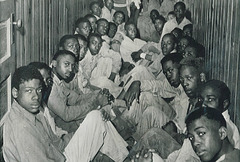
In 1959, sixty-nine African American teenage boys were padlocked into their dormitory for the night at the Negro Boys Industrial School in Wrightsville, Arkansas. Twenty-one died in a mysterious fire that night. Pictured above are the survivors.
Fourteen bodies lie side by side and unmarked in a mass grave at Haven of Rest Cemetery on Twelfth Street. The only proof of their burial is a page from the graveyard's 1959 records.
The fourteen were teenagers when they burned to death in a fire March 5, 1959, at the Negro Boys Industrial School in Wrightsville. In all, twenty-one boys between the ages of 13 and 16 perished, incinerated in a dorm room whose doors were padlocked on the outside.
The teens had been incarcerated (“Industrial School” was euphemistic) for homelessness, petty theft and pranks — one boy had been caught soaping windows during Halloween. Many were raised in single family homes and turned over by their parents. Forty-eight of the boys who were in the “Big Boys Dorm” managed to escape what press reports called the “holocaust.”
Seven boys had private funerals. The remaining 14 — burned so badly their bodies could not be identified individually — were buried five days after the fire, their interment paid for by the state of Arkansas. During the funeral, the Arkansas Gazette reported, a mother cried out, “Oh Lord! You done burned up my baby!”
In her anguish, she may have blamed the Lord. But a Pulaski County grand jury finding issued the following September said the state employees in charge of the training school, the legislature, the governor and even “the people of Arkansas, who did nothing about” conditions at the decrepit facility, were responsible for the deaths. The General Assembly should have been “ashamed,” the grand jury report said.
Responsible — but not liable. The grand jury returned no indictment. No criminal charges were ever filed, despite the fact that Gov. Orval Faubus, standing by the smoldering ruins at dawn the day of the fire, declared the tragedy “inexcusable.”
Forty-nine years later, the event is little remembered. But Luvenia Lawrence, 81, whose son, Lindsey Cross, died in the fire, and Lindsey's brother Frank Lawrence, who was 4 years old when his brother perished, remember. They found the record of the graves at Haven of Rest. At their request, the graves, hard by a ditch, are now marked with yellow flagging tape.
Frank Lawrence, who plans to make a documentary film about the event, has taken the story to print and television media in Little Rock. Two TV stations have aired interviews with Lawrence in recent weeks, and he's working with the Mosaic Templars Cultural Center to record the story there.
At one time, Luvenia Lawrence says, a stone at Rest Haven marked the graves. A stone would be a start in reminding the people of Arkansas of the terrible event, she and her son say.
Lindsey Cross was 15 when he was trapped by the fire. He'd been sent to Wrightsville after a neighbor of the Lawrences — in the Tie Plant area of North Little Rock — told authorities he'd stolen money from a store's cash register while two other boys distracted the white owner.
Luvenia Lawrence said she could only remember going to “an office” before her son was sent to Wrightsville. It seemed strange to her that there had been no trial.
But there wouldn't have been. It took a lawsuit, filed by Grif Stockley for Legal Aid in the late 1980s, to create legal redress for juveniles in Arkansas. Until then, county judges had jurisdiction, appointing referees (usually not lawyers) to decide the fate of juveniles. Pulaski County's referee — Judith Rogers, who later became a juvenile judge — testified for Stockley. In 1987, the state Supreme Court ruled the system unconstitutional and ordered juvenile cases heard in chancery courts (now circuit courts).
Also buried at Haven of Rest: Charles L. Thomas, 15, of Little Rock; Frank Barnes, 15, Lake Village; R.D. Brown, 16, Emerson; Jessie Carpenter Jr., 16, Forrest City; Joe Crittenden, 16, Blytheville; John Daniel, 16, El Dorado; Willie G. Horner, 16, North Little Rock; Roy Chester Powell, 16, Forrest City; Cecil Preston, 17, Blytheville; Carl E. Thornton, 15, North Little Rock; Johnnie Tillison, 16, LaGrange (Lee County); Edward Tolston Jr., 15, Wilmot, and Charles White, 15, Malvern.
Two of the dead boys were only 13 years old. One of those children, William Loyd Piggee of DeWitt, had been sent to Wrightsville after he'd been seen riding a bike that belonged to a white boy.
But William Piggee often rode that bike, which had belonged to a white friend whose family his mother worked for. The friend had a new bike, and the two boys used to ride their bikes together.
The mother of the white boy had reported the bike stolen. But when she discovered William had taken it, she told authorities that it was all right for him to ride it. But, according to William's brother, Larry Piggee of Houston, Texas, the police insisted that the bike was stolen and William had to pay. He paid big.
After the fire, “police came to our house at 5 a.m. and knocked on our door. They talked with my mother and father, told them they needed someone to come down and take a look.”
“They had a number of bodies stretched out,” Piggee said. His mother and father “picked out the body of a person that had a Bible in the breast pocket because my brother always carried one.”
Larry Piggee left Arkansas when he was 16. “I didn't look at it as an accident myself,” he said of the fire.
The other 13-year-old who died was O.T. Meadows of El Dorado. The remaining dead were 15-year-olds Henry Daniels of Little Rock, John Alfred George of North Little Rock, Roy Hegwood of El Dorado, Willie Lee Williams of Helena and 16-year-old Amos Guice.
Most of the bodies were found piled in the corner farthest from the doors to the room.
Frank Lawrence doesn't get sentimental standing over his brother's grave. He doesn't believe any of the coffins actually contain bodies. “Their ashes blew over Wrightsville,” he said. “They're part of Wrightsville.”
The building burned entirely to the ground.
The fire broke out in what was known as the “Big Boys Dorm” between 3:15 a.m. and 4 a.m., news reports said. A vocational teacher who normally slept in a room next to the dorm had been in the hospital for two weeks before the fire broke out.
There were only two exits from the dorm, and both were padlocked, so that exit from the inside was impossible. The boys who escaped did so by prying loose mesh metal screens from two of the dorm windows.
The Arkansas Democrat, then an afternoon paper, ran a picture of the fire as it raged on its front page. A photograph of Faubus, standing amid the rubble by the window screens, accompanied the front page story in the Arkansas Gazette the following morning.
Stories told by employees of the Industrial School — all of whom were black — conflicted. School Superintendent L.R. Gaines first told the press the doors to the dorm had been locked, but later in the day said one door had been open. School farm manager Wilson Hall first said he'd been sleeping in the classroom adjacent to the dorm when the smoke woke him up, but later told the school board that he'd discovered the fire when he went to the building to make sure the substitute caretaker was there.
Hall said he found the dorm doors locked when he arrived, so he ran to the windows and “started pulling screens.”
“They were screaming and hollering in there,” the Gazette quoted Hall as saying. “You couldn't make out any words or anything.”
Lee Andrew Austin, the livestock supervisor, told the board that he'd left the building — which included the dorm, a chapel, the caretaker's office and workshop — in the middle of the night because the lights went out and he needed to fetch a flashlight from his home, which was near the dorm.
So though Hall, Austin and Gaines all had keys to the door, according to Gaines, none, apparently, was in the dorm when the blaze began.
A transcript of the school board's interviews with school employees shows that the board believed Austin was negligent. “Isn't it a fact that had you functioned properly, this tragedy would not have occurred?” chairman Alfred Smith asked Austin.
“Well, Mr. Smith,” Austin replied, “I would like to know how I could have prevented it.”
The Little Rock Fire Department — which initially declined to answer the call to the fire since it was outside the city limits — said the blaze probably started in the attic above the empty caretaker's room off the classroom and close to the entrance to the dorm. One teen-ager died at the door to the dorm; when the door collapsed in the fire, the body fell partially into the classroom.
A survivor told the Gazette that the boys fought each other to get out the windows. “There was a whole lot of screaming,” he said. He saw four boys hitting at the mesh-covered windows trying to escape. The boys who did escape stood barefoot in the cold and stunned, watching as the building burned to the ground.
The Sunday after the Thursday fire, a headline in the Gazette proclaimed “Constant Fire Vigil Is Kept at White Industrial School.” The article quoted the superintendent of the school, located in Pine Bluff, as saying the building was fireproof, doors were never locked, and that the house parents never left the dorm at night.
Superintendent Gaines and his wife, Mary, a school teacher who was also on the payroll at Wrightsville, resigned in April. Gaines did not testify before the grand jury; he was reported in ill health and living in Chicago.
News of the fire made front pages across the nation. Faubus was already known to the country as the governor who'd sent troops to Central High to keep nine black students from attending school. News of the fire fueled national sentiment that Arkansas put little value on the life of its black residents.
A letter to Faubus from Los Angeles: “Your support of a policy of segregation and of second-class citizenship for the Negro people helped to create this holocaust.”
From “not a Negro”: “It sure must have made you happy to have those boys roasted alive.”
From London, England: “We feel that this unfortunate mishandling of human lives cannot be wholly divorced from the prevailing race attitudes and conflict under your administration. The psychological impact of this case will be terrific here in Europe. It is the sort of thing these people do not forget easily.”
From Virginia: “I hope your measly heart is capable of feeling the sting of the race hate you as a leader of your gang started last fall.”
From Detroit: “You are just as responsible as if you had struck the match.”
From California: “Each time I see in the newspaper a by-line [sic] ‘Little Rock, Arkansas' I shudder, because I know it means another atrocity against the Negroes.”
Faubus also got a letter from a woman who had not heard whether her son had survived the fire. Later, she sent another letter, saying her son had helped boys escape and pleading for his release on that account.
What value did the state officially put on the life of black teen-agers?
Most of the survivors filed claims with the state Claims Commission seeking $25,000; one asked for $50,000 and there were claims for sums in between. The commission, ruling in September 1959, awarded $2,500 to the estates of each of the 21 boys. It reached that amount, it said, by reasoning that “negro boys, all minors, incarcerated … [were] contributing little and often nothing to the support of their parents. The Supreme Court of Arkansas has often affirmed the verdict of juries awarding $2,000 to $3,000 damages for the death of a child.”
It's hard to say if the sum was out of line. In February 1960, the commission awarded a boy who was disfigured in a car accident caused by Highway Department negligence $5,000, in anticipation of future medical costs. But it gave only $6,138.71 to the widow of a man who'd plunged in his car from a bridge into Village Creek because the state Highway Department failed to erect a sign warning the bridge was out.
The commission found that the “direct and proximate cause of the death of the 20 [sic] decedents was the carelessness and negligence of the officers, agents and employees of the State of Arkansas, employed at the Arkansas Negro Boys' Industrial School,” and cited the facts that the boys were locked in with no means of escape, that there were no buckets, water or fire extinguishers, fire drills or other safety precautions.
“The State in its composite wisdom has seen fit to create schools for both races and for both sexes commonly referred to as Industrial Schools, where youths may be sent for correctional training. It is the custom of Arkansas to place negro supervisors over the negro children under the supposition that members of that race would be best able to cope with the problem and give to their wards the best training available in order to prepare the inmates for worthy citizenship. … So far as the record in this case indicates the persons in authority had every right to believe that L.R. Gaines and his assistants would operate the school in a proper, safe and efficient manner. … However, on the night of said holocaust, L.R. Gaines and his staff ignored their duty to their wards … .”
Though commission records show that the family of Lindsey Cross was awarded $3,400 — the estate award plus $600 to Luvenia Lawrence for mental anguish and $300 to his estranged father, Charlie Cross — Lawrence says she only got $1,000, from a white man who showed up at her door one day and gave her a check.
She claims she took the check to the Square Deal Pawn Shop to cash it, where the owner, Robert Itzkowitz, asked, “Is this all Faubus gave you for killing your son?”
Total claims paid by the state ranged from $3,300 to $5,900.
In 2002, the Justice Department sued the state of Arkansas for deficiencies at the Alexander Youth Services Center (now the Arkansas Juvenile Treatment and Assessment Center).
The Alexander facility had racked up a number of incidents of neglect and abuse, including a couple of suicides, and had failed to provide adequate education. Also cited by the Justice Department: fire hazards. Under the terms of the 2003 settlement with the state, the Division of Youth Services agreed to install sprinklers in dormitories and educational facilities, smoke detection devices and fire alarms. It also agreed to train personnel in what to do in case of fire, and to remove flammable materials on which gas generators had been stored.
Frank Lawrence thinks the more people know about what happened in 1959, the more they'll take an interest in what's going on today.
Sources: KATV Little Rock, Arkansas; Arkansas Times Staff (March 2008)
You're Not Welcome Here
| 16 Oct 2023 |
|
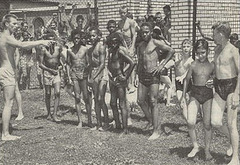
African American children enter Fairgrounds Park Pool in St. Louis, Missouri in 1949. They were the first African American swimmers to enter the pool, and they were assaulted by angry white residents soon after the photo was taken.
The Fairgrounds Park Riot - African Americans were permitted to swim for the first time at St. Louis, Missouri's Fairgounds Park Pool on June 21, 1949. While approximately forty African American children swam at the pool that afternoon, nearly 200 whites surrounded the pool fence. Violence broke out later that day as the swimmers left the pool. Several men, women and children of both races were hospitalized; however, no one was killed.
Following the riot, segregation was re-instituted and remained in effect for the next twelve months. A federal court ruling in July 1950 by Judge Rubey M. Hulen mandated racial integration.
Source: St. Louis Globe
Mississipppi Goddamn
| 16 Oct 2023 |
|
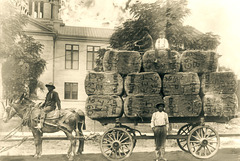
The photograph shows African American men and a boy posed with a horse-drawn wagon loaded with bales of cotton in front of the Leflore County, Mississippi, courthouse, circa, 1920. (Library of Congress).
A century ago, Mississippi’s Senate voted to send all the state’s Black people to Africa
Washington Post
By Joshua Benton
Feb. 2022
One hundred years ago, the Mississippi state Senate voted to evict the state’s Black residents — the majority of its total population — not just out of Mississippi, but out of the country.
The Senate voted 25 to 9 on Feb. 20, 1922, to ask the federal government to trade some of the World War I debts owed by European countries for a piece of colonial Africa — any part would do — where the government would then ship Mississippi’s Black residents, creating “a final home for the American negro.”
The act is a reminder of just how long after the end of slavery some White Southerners were pushing not just to strip African Americans of their political rights but also to remove them from the land of their birth.
What opposition there was to the proposal in the all-White Mississippi legislature came not from people who believed in racial equality but from plantation owners who feared losing their cheap, brutalized labor force. And remarkably, the proposal had a few Black supporters: Black separatists who preferred a move to Africa over the violence and abuse that African Americans faced in Jim Crow Mississippi.
Senate Concurrent Resolution No. 21 was written by Sen. Torrey George McCallum, a former mayor of Laurel in Jones County. The county has achieved some measure of Hollywood fame as the “Free State of Jones,” a pocket of Unionist sentiment during the Civil War, but the McCallums were deeply engaged in the institution of slavery. Torrey’s grandfather Archibald enslaved 51 people on his plantation in 1860 and had a net worth of $80,000, about $2.5 million today.
More than 1,700 congressmen once enslaved Black people. This is who they were, and how they shaped the nation.
McCallum’s proposal came in the aftermath of World War I. The relatively late entry of the United States into the war and the devastation of the conflict left many of its European allies deep in debt to Washington. In all, European countries owed $10.35 billion, the equivalent of $174 billion today.
Although short on cash, those countries had plenty of colonial territory — particularly in Africa, where the major European powers had scrambled to divvy up the continent’s land and resources. McCallum saw the makings of a deal.
His resolution argued in flowery language that “the spirit of race consciousness” had grown with a postwar increase in nationalistic feelings worldwide and that it was “our most earnest desire to reach a just, fair, amicable, and final settlement” to what some White people then called “the Negro question.”
It concluded with a request that President Warren G. Harding “acquire by treaty, negotiation or otherwise from our late war allies sufficient territory on the continent of Africa to make a suitable, proper and final home for the American Negro, where under the tutelage of the American government he can develop for himself a great republic, to become in time a free and sovereign state and take its place at the council board of the nations of the world.”
McCallum made clear that “the spirit of race consciousness” he cared about belonged to White people. The goal, he wrote, was “that our country may become one in blood as it is in spirit, and that the dream of our forefathers may be realized in the final colonization of the American Negro on his native soil.” The resolution does not specifically state whether the proposed mass migration would be voluntary. But its use of language like a “final settlement,” “the final colonization,” and the United States becoming “one in blood” makes clear the aim was total removal.
Not consulted in this process: Mississippi’s Black residents, who in the 1920 Census made up 52 percent of the state’s population. During Reconstruction, Mississippi’s Black majority had sent three African Americans to Congress and more than 60 to the state legislature. That had all ended, though, first with rampant White violence in the 1870s and 1880s, then with the passage of a new state constitution in 1890 that effectively disenfranchised Black people.
In some ways, it felt like the post-Reconstruction era was returning: Another spike in anti-Black violence had followed World War I, especially during the Red Summer of 1919, and the Ku Klux Klan was suddenly reborn.
Black newspapers nationwide mocked McCallum’s proposal, just as African Americans had generally resisted the previous century’s attempts at colonization. “Only one thing seems to have been overlooked by the Hon. Senator, and that is, how even the Mississippi colored people will be induced or enabled by the Mississippi Legislature to go to Africa,” wrote the Broad Ax, a Black Chicago newspaper. After generations of rape of enslaved women by White men, it wrote, “the intervening shades are so numerous and various, it may be a question to determine who is a colored person. Of course, such things don’t bother McCallum.”
“We see that representatives in Mississippi would colonize the American Negro in Africa,” wrote the Southern Indicator of Columbia, S.C. “Poor fools.”
The one exception was Negro World, the national newspaper published by Marcus Garvey’s Universal Negro Improvement Association, which embraced McCallum’s proposal. Garvey believed that members of the African diaspora would never be treated fairly in a White-controlled country and that the solution was a new African homeland.
“Hurrah for Senator McCallum,” its headline blared. “Work of Universal Negro Improvement Assn. Bearing Fruit.”
Garvey gave a speech at Liberty Hall in New York endorsing McCallum’s plan: “The Negro should not delude himself … by the belief that the future will mean happiness and contentment for him in this country, since it is the undoubted spirit and intention of the white man that this shall in truth be white man’s country."
Garvey was becoming known for seeking strange bedfellows in his quest for Black autonomy abroad. A few months later, he went to the offices of the resurgent Ku Klux Klan in Atlanta for a cordial meeting with Imperial Wizard Edward Young Clarke, sparking outrage from Black leaders and newspapers. (Garvey was under indictment on charges of mail fraud at the time, so he also may have been motivated to curry favor with White officials.)
Mississippi’s largest newspaper, the Clarion Ledger — once called “the most racist newspaper in the nation” — happily ran the full text of a telegram Garvey sent McCallum offering his “congratulations” for “the splendid move” he had made.
But Garvey seemed aware of who he was teaming up with. McCallum, he said in a speech, “is the same Southern senator who would object and stand behind the objection, with his whole life and with the last drop of his blood, for a Negro in the United States of America to dine with the President of the United States at the White House.”
McCallum was far from the only racist White leader interested in sending Black people “back” to an Africa they had never seen.
The impulse dates to well before the Civil War, to the early days of state colonization societies, which built colonies in what is today Liberia. The Mississippi Colonization Society created Mississippi-in-Africa on the Pepper Coast, sending several hundred freed slaves there to face what became the highest mortality rates of any society in recorded human history. Some advocates of colonization considered it a more humane option than slavery, but more viewed it as a way to rid their states of free Blacks who might encourage rebellions among enslaved people.
As the Civil War approached, debates over slavery were not limited to the two extremes — continuing and expanding slavery on one hand, and making African Americans free and full political citizens on the other.
Some White people argued for freeing the enslaved but still denying them the vote, just as it was then denied to most free Blacks in North and South alike. Others wanted to create a limited class of Black voters, restricted only to the educated or to those who had fought for the Union. And many thought the only solution to the “Negro question” was to send them away — either voluntarily or by force — to a new colony in the Caribbean or “back” to Africa.
Hinton Rowan Helper, the most prominent anti-slavery activist in the South, was nonetheless a virulent racist and advocate of expulsion. As he wrote in the early weeks of the war: “Death to Slavery! Down with the Slaveholders! Away with the Negroes!”
Among those interested in colonization was Abraham Lincoln, who was drawn repeatedly to the idea. In 1862, Congress passed a bill allocating $600,000 for the colonization of formerly enslaved people living in the District of Columbia. Lincoln sent a young free Black man named John Willis Menard to British Honduras (now Belize) to scout it as a potential location; the Danish Virgin Islands, British Guiana, and Dutch Surinam also were considered.
Lincoln struck a deal to set up a colony in the Chiriquí Province of what is now Panama, but strenuous objections from Central American countries led him to scuttle the plan. He eventually signed off on a disastrous experiment that sent 453 free Virginia Blacks to the Haitian island of Île-à-Vache. High rates of disease and a mutiny led to its collapse and 350 survivors sailing back to Virginia less than a year later.
During Reconstruction and afterward, a trickle of Black people continued to leave the South for various promised lands: Liberia, Haiti, Kansas, California. But it took until World War I for the Great Migration of African Americans to Northern and Western cities to start in earnest, driven by job opportunities and the desire to escape Jim Crow.
Still, that was not the end of the idea of colonization, in the minds of either White racists of Black separatists. U.S. Sen. Theodore G. Bilbo of Mississippi, a proud member of the Ku Klux Klan, carried colonization forward to a new generation, proposing in 1939 what he called the Greater Liberia Act. It was modeled on McCallum’s 1922 resolution, offering France and the U.K. relief for their war debt in exchange for 400,000 square miles adjoining Liberia’s borders. Greater Liberia was to be run by a U.S. military governor.
The bill went nowhere — but it again drew the support of an aging Marcus Garvey, as well as the vocal support of Black separatists including Mittie Maude Lena Gordon, the founder of the Peace Movement of Ethiopia.
The Mississippi Senate vote 100 years ago was as far as the state’s attempt to exile its African Americans would go. After passing the Senate, the resolution went to the state House of Representatives. Its Committee on Federal Relations reported the resolution out favorably on March 1, 1922. On March 10, McCallum went to the House floor to advocate for passage.
“He wanted it understood that it was not written, nor was it intended as a reflection in the least on the negro,” a Biloxi newspaper reported, “but was intended to settle him in a country of his own and where he could make himself a home under laws of own making. He said he simply wanted to settle for all time to come a great problem confronting this country and in the interest of the negro.”
But the speech wasn’t enough, and the House voted the resolution down, 40 to 32.
Most of the chamber’s debate over the bill has been lost to history, but a newspaper reporter did record a representative named John Holmes Sherard explaining his opposition: “He did not like any such propaganda as this meant the loss of labor of his part of the state, the Delta, where the negro was needed. … He asserted that he had 500 negroes on his plantation in Coahoma County, and had never had a quarrel with them.”
One of the regulars at Sherard’s plantation commissary in Coahoma County was a young man named McKinley Morganfield, who picked cotton at a neighboring plantation. At Sherard’s and elsewhere around Coahoma, men like Robert Johnson and Son House were playing what would become known as the Delta blues. In 1941, Morganfield found his own escape from Mississippi — not to Africa, but to Chicago, where he became known as Muddy Waters.
Waters’s songs sometimes romanticized the simpler life back in the Delta, but when asked directly if he ever planned on moving back, his response was clear: “I wanted to get out of Mississippi in the worst way, man. Go back? What I want to go back for?”
Mississippi Goddamn by Nina Simone:
www.youtube.com/watch?v=LJ25-U3jNWM
The Killing of Eugene Williams
| 16 Oct 2023 |
|
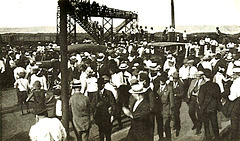
The photograph depicts a white mob leaving Chicago's 29th Street Beach. The site of the stoning and subsequent drowning of 17 yr old Eugene Williams. The incident touched off the Chicago Race Riot.
1919 Chicago Race Riot , On the afternoon of July 27, 1919, Eugene Williams, a black youth, drowned off the 29th Street Beach. A stone throwing melee between blacks and whites on the beach prevented the boy from coming ashore safely. After clinging to a railroad tie for a lengthy period, he drowned when he no longer had the strength to hold on. This was the finding of the Cook County Coroner's Office after an inquest was held into the cause of his death.
William Tuttle, Jr.'s book, Race Riot: Chicago in the Red Summer of 1919, includes a 1969 interview with an eyewitness. This witness was one of the boys swimming and playing with Eugene Williams in Lake Michigan between 26th Street and the 29th Street Beach. He recalled having rocks thrown at them by a single white male standing on a breakwater 75 feet from their raft. Eugene was struck in the forehead and as his friend attempted to aid him, Eugene panicked and drowned.
The man on the breakwater left, running toward the 29th Street Beach. By this time rioting had already erupted there precipitated by vocal and physical demonstrations against a group of blacks who wanted to use the beach in defiance of its tacit designation as a "white" beach. The rioting escalated when a white police officer refused to arrest the white man, by now identified as the perpetrator of the separate incident near 26th Street. Instead he arrested a black individual. Anger over this, coupled with rumors and innuendos that spread in both camps regarding Eugene Williams' death led to 5 days of rioting in Chicago that ultimately claimed the lives of 23 blacks and 15 whites, with 291 wounded. The Coroner's Office spent 70 day sessions and 20 night sessions on inquest work and in examining 450 witnesses. Those findings, reported in the Coroner's Report of 1919 are followed by his recommendations to deal with the festering social and economic conditions that were the underlying factors of the riots. Anita Gonzalez & Ian Granick
Growing Racial Tensions , The "Red Summer" of 1919 marked the culmination of steadily growing tensions surrounding the great migration of African Americans from the rural South to the cities of the North that took place during World War I. When the war ended in late 1918, thousands of servicemen returned home from fighting in Europe to find that their jobs in factories, warehouses and mills had been filled by newly arrived Southern blacks or immigrants. Amid financial insecurity, racial and ethnic prejudices ran rampant. Meanwhile, African-American veterans who had risked their lives fighting for the causes of freedom and democracy found themselves denied basic rights such as adequate housing and equality under the law, leading them to become increasingly militant.
In this fraught atmosphere, the white supremacist Ku Klux Klan organization revived its violent activities in the South, including 64 lynchings in 1918 and 83 in 1919. In the summer of 1919, race riots would break out in Washington, D.C.; Knoxville, Tennessee; Longview, Texas; Phillips County, Arkansas; Omaha, Nebraska and--most dramatically--Chicago. The city's African-American population had increased from 44,000 in 1909 to more than 100,000 as of 1919. Competition for jobs in the city's stockyards was particularly intense, pitting African Americans against whites (both native-born and immigrants). Tensions ran highest on the city's South Side, where the great majority of black residents lived, many of them in old, dilapidated housing and without adequate services.
A Drowning in Lake Michigan , On July 27, 1919, a 17-year-old African American boy named Eugene Williams was swimming with friends in Lake Michigan when he crossed the unofficial barrier (located at 29th Street) between the city's "white" and "black" beaches. A group of white men threw stones at Williams, hitting him, and he drowned. When police officers arrived on the scene, they refused to arrest the white man whom black eyewitnesses pointed to as the responsible party. Angry crowds began to gather on the beach, and reports of the incident--many distorted or exaggerated spread quickly.
Violence soon broke out between gangs and mobs of black and white, concentrated in the South Side neighborhood surrounding the stockyards. After police were unable to quell the riots, the state militia was called in on the fourth day, but the fighting continued until August 3. Shootings, beatings and arson attacks eventually left 15 whites and 23 blacks dead, and more than 500 more people (around 60 percent black) injured. An additional 1,000 black families were left homeless after rioters torched their residences.
Lasting Impact , In the aftermath of the rioting, some suggested implementing zoning laws to formally segregate housing in Chicago, or restrictions preventing blacks from working alongside whites in the stockyards and other industries. Such measures were rejected by African-American and liberal white voters, however. City officials instead organized the Chicago Commission on Race Relations to look into the root causes of the riots and find ways to combat them. The commission, which included six white men and six black, suggested several key issues —including competition for jobs, inadequate housing options for blacks, inconsistent law enforcement and pervasive racial discrimination—but improvement in these areas would be slow in the years to come.
President Woodrow Wilson publicly blamed whites for being the instigators of race-related riots in both Chicago and Washington, D.C., and introduced efforts to foster racial harmony, including voluntary organizations and congressional legislation. In addition to drawing attention to the growing tensions in America's urban centers, the riots in Chicago and other cities in the summer of 1919 marked the beginning of a growing willingness among African Americans to fight for their rights in the face of oppression and injustice.
Sources: "Race Riot: Chicago in the Red Summer of 1919" by William Tuttle, Jr., Atheneum Press, NY, 1970], [ history.com ]
Thomas P Kelly vs. Josephine Kelly
| 16 Oct 2023 |
|
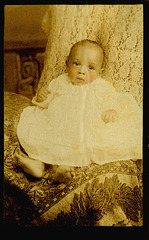
Photograph of Josephine Kelly's son submitted as evidence to prove that the baby's father must be an African American, Prince George County Chancery Cause 1893-001, Thomas P. Kelly vs. Josephine Kelly.
The case of Thomas P. Kelly vs. Josephine Kelly, 1893-001, there is also a bit of baby daddy drama. The divorce suit involves Norfolk, Virginia native Thomas Kelly, who had been for many years enlisted as a machinist in the United States Navy. During the year 1888, Thomas Kelly was stationed on board the monitor fleet lying at anchor at City Point in Prince George County. There he met Josephine Hodges, who was sixteen years of age. As Kelly would later testify in the chancery cause, their relationship began as a friendship and culminated in intimacy. Kelly confessed that he had sexual intercourse with her on or about the 17th day of June 1888 and also with more or less frequency from that date until he was transferred with the fleet to Richmond in October of the same year.
About the first of January 1889, Thomas was informed that Josephine was pregnant and that her condition was attributed to him. Her friends and her mother’s friends, including the pastor of her church, made repeated and urgent endeavors to have Thomas agree to marry her, but as there had been no promise of marriage and no undue advantage taken by him, he refused to comply with their wishes. Finally it was urged that the suggested marriage would not only save the girl from ruin but would relieve his child from the stain of illegitimacy. Thomas finally gave in and they were married on the night of 5 January 1889. A few hours after the marriage, Josephine was in labor, and about 9 or 10 o’clock the next night she delivered a son, who was named after his father, Thomas P. Kelly. Thomas was at first greatly surprised the child would be born so soon, but supposing that its birth was prematurely brought on by the excitement of the marriage, he dismissed from his mind all thoughts suggesting improper conduct on the part of his wife and cared for her and his child “with all the tenderness of which he was capable, giving freely of his time, attention, and money to provide for their welfare and comfort.”
Although its mother and father were both fair, the baby’s coloring was dark, but Thomas Kelly did not have his attention drawn specially to the baby’s appearance until sometime after its birth because his duties with the navy kept him away from home most of the time. Thomas visited his wife and son on 5 November 1889 and was struck with the fact that the child had grown very dark in color, which caused him great uneasiness and aroused his suspicion. In discussing the matter with his wife, “she bullied him into quietude by her positive assurance that the child’s peculiar complexion was due to the fact she had taken large quantities of medicine before its birth.” Thomas, not doubting her statement, went back to his port of duty and did not return again to City Point, where his wife and his child had always resided, until 18 January 1890.
Upon his return, Thomas found the “child was blacker than ever, its lips were grown thick, its nose flat, and its hair having the unmistakable wooly kink – altogether showing plainly that Negro blood flowed in its veins.” Thomas, though shocked at the evidence which was presented to his own eyes, hesitated at first to communicate to his wife the connections he was making. But the more he tried to down the thought, the firmer hold it had upon him, and in his desperation, he stated to his wife that he was satisfied the child was not his. “A scream followed and amid tears of anguish” his wife confessed to him that he was not the father and that the real father was an African American named James Laundy. (However, a deposed witness identified the father as “General Sherman,” whose real name was thought to be William.) Josephine admitted she had sexual intercourse with another man on 11 April 1888 – the same confession being afterwards made to her mother and to other members of her family. In an instance the “whole scheme of deception” became apparent to Thomas Kelly and “in righteous indignation” he immediately left his wife and refused to recognize the marital relation existing between them. After separating from his wife, Thomas was informed by many people living at and near City Point that they had for some time believed that the “child was begotten by a Negro, but in consequence of the delicate nature of the case did not feel justified in expressing their opinions to him.”
In his bill for divorce filed in 1890, Thomas Kelly charged that at the time of his marriage on 5 January 1889 his wife was with child by some person other than him and that he believed that such other person was a Negro. As evidence to support his claims, Thomas submitted a photograph of his wife’s son. Thomas also claimed that after he left his wife, she had disposed of her child to certain African Americans in the city of Petersburg with the understanding that they would rear him as their own “thus emphasizing the grievous wrong which she perpetrated on her unsuspecting husband” in an attempt to hide her own disgrace. Thomas turned to the courts seeking the relief afforded by divorce stating that “the road of affliction had been laid heavily upon him and that his cup was full of bitterness,” but in 1893, for reasons not stated in the case, he requested that the divorce suit be dismissed.
Source: Sherri Bagley, Local Records Archivist, Prince George's County, Maryland

The Well
| 16 Oct 2023 |
|
Opening scene of the 1951 movie The Well. This was considered a film noir that tackled race issues and collective behavior.
Synopsis : An black little girl headed for school goes skipping through a meadow and falls into a well whose opening was hidden by some high weeds growing around it. Her distraught parents report her absence to a genuinely-concerned Sheriff, who in turn begins a routine search. When it's reported that an adult white male had bought the little girl some flowers that morning, things begin to unravel, and the routine search turns into a major operation!
Synopsis by 'Film Noir of the Week' by HJ: On the surface, the town (probably Midwestern) appears to have no racial problems of significant proportions, but when the Black population hears that a white man was last seen with little Carolyn, racial tensions surface. And when the white man is discovered and subjected to a vigorous and accusatory interrogation by the Sheriff and his deputies, the reactionaries among the white populace begin fomenting violence against the African-American citizens. The African-American community is incensed that a white man may be responsible for the disappearance of little Carolyn and begins to confront the white racists.
The Sheriff sees the very real threat of a full-blown race riot and asks the Mayor to request State Militia assistance, while beginning to arm both black and white Civil Defense volunteers with riot guns. This missing little girl has become less of an immediate issue than the mounting racial tensions.
Fortunately a little boy and his dog happen to be going through the meadow in which the well is located and find evidence that little Carolyn may be in the well. The child gets the word to the adults, and a rescue effort is mounted.
The racist owner of Packard's Construction Company, Sam Packard, makes all his equipment and laborers available for the exploration and rescue effort. And Sam Packard's nephew Claude Packard (played by Harry Morgan who later portrayed Colonel Potter in MASH), thought to be involved in Carolyn's disappearance, swallows the anger he feels at his treatment to become very personally involved in the effort to rescue the little girl.
Award Nominations :
1951: 2 Nominations for Oscar: Best Editing, Story and Screenplay
1951: Golden Globes: Nominated for Best Motion Picture Score
The Well (1951) www.youtube.com/watch?v=3gtpG5Bu8-M
Jump to top
RSS feed- Kicha's latest photos with "Race Relations" - Photos
- ipernity © 2007-2026
- Help & Contact
|
Club news
|
About ipernity
|
History |
ipernity Club & Prices |
Guide of good conduct
Donate | Group guidelines | Privacy policy | Terms of use | Statutes | In memoria -
Facebook
X
