

Tali's photos with the keyword: house sparrow

Nuthatch
| 27 Dec 2025 |
|
|
|
Appearance:
The nuthatch is a small, compact bird with a strong, pointed beak and short tail. Its upperparts are typically bluish-grey, while the underparts range from white to a soft buff-orange. It has a distinctive black eye-stripe running from the beak through the eye, giving it a masked look. The legs and feet are strong, adapted for climbing tree trunks headfirst.
Size and Weight:
Length: 12–14 cm (4.7–5.5 inches)
Wingspan: 20–27 cm (7.9–10.6 inches)
Weight: 18–30 grams (0.6–1.1 ounces)
Lifespan:
In the wild, nuthatches usually live around 2–5 years, though some individuals may reach up to 8 years.
Diet:
Summer: Mainly insects, spiders, and other small invertebrates.
Winter: Seeds, nuts, and occasionally berries. They are known to store food in tree bark crevices for later consumption.
Breeding:
Nuthatches typically breed once per year, although in favorable conditions some may attempt a second brood.
They lay 5–10 eggs per clutch.
Incubation lasts about 13–17 days, mostly by the female.
Fledging occurs around 18–26 days after hatching.
Nest:
Nuthatches usually nest in natural tree cavities or old woodpecker holes.
They line the nest with soft materials such as moss, feathers, and fur.
They often plaster the entrance hole with mud to reduce its size and keep out predators.

European Roller
| 30 Dec 2025 |
|
|
|
European Roller (Coracias garrulus) – Biological Description
The European Roller is a medium-sized, brightly colored bird known for its vivid blue and turquoise plumage, contrasting with chestnut-brown wings and a black bill. In flight, its broad wings show striking blue and black patterns. Juveniles appear duller than adults.
Habitat and Distribution:
The European Roller breeds in southern and eastern Europe and parts of western Asia. Its range includes countries such as Spain, France, Italy, Hungary, Romania, Greece, Turkey, and Ukraine. It inhabits open landscapes like grasslands, farmland, steppes, and sparsely wooded areas. During winter, it migrates to sub-Saharan Africa.
Population:
The global population is estimated at approximately 150,000–300,000 individuals and is currently declining due to habitat loss and reduced insect availability.
Size and Weight:
Length: 29–32 cm
Wingspan: 52–58 cm
Weight: 120–180 g
Lifespan:
Up to 10–12 years in the wild.
Diet:
In summer, it mainly feeds on insects such as beetles, grasshoppers, crickets, and caterpillars. In wintering areas, it also eats small reptiles, amphibians, and occasionally small rodents.
Reproduction:
The European Roller breeds once per year. It lays 4–6 eggs per clutch. Both parents care for the chicks, which fledge after about 26–30 days.
Nest:
Nests are placed in natural tree cavities, holes in cliffs, or nest boxes, usually without added nesting material.
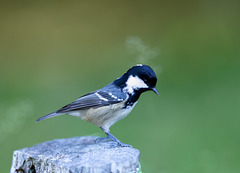
Coal tit
| 01 Jan 2026 |
|
|
|
Biological description of the Coal Tit (Periparus ater)
The coal tit is a small passerine bird with a compact body and a relatively large head. It has a black cap and bib, white cheeks, a distinctive white patch on the nape, and greyish upperparts with buff or whitish underparts. Its wings show two pale wing bars.
Habitat and range:
Coal tits inhabit mainly coniferous and mixed forests, but they also occur in woodland edges, parks, and gardens. Their range covers most of Europe, parts of North Africa, and large areas of temperate Asia, making them widespread across the Eurasian continent.
Population:
The global population is very large, estimated at tens of millions of individuals. It is considered stable overall, and the species is classified as Least Concern by the IUCN.
Size and weight:
Adults measure about 10–11.5 cm in length, with a wingspan of around 17–21 cm. Their weight typically ranges from 8 to 10 grams.
Age:
Most coal tits live only a few years, but in the wild they can reach a maximum age of around 9–10 years.
Diet:
In summer, their diet consists mainly of insects, spiders, and other small invertebrates. In winter, they rely more on seeds, especially conifer seeds, and may also visit bird feeders.
Breeding:
Coal tits usually breed once per year, but in favorable conditions they may raise two broods. The female lays 6–11 eggs per clutch.
Nest and offspring:
Nests are built in tree holes, wall crevices, or nest boxes and are lined with moss, hair, and feathers. Chicks hatch after about two weeks and are fed by both parents until they fledge.

Chaffinch
| 29 Dec 2025 |
|
|
|
A chaffinch rests on the gravestone—
the stone shaped like a grieving human, bowed in silence.
But the bird draws the light: a small flame of feathers,
rosy breast and sharp song, alive against the weight of loss,
as if hope had briefly learned to perch. ;)

Crested tit
| 28 Dec 2025 |
|
|
|
Crested Tit (Lophophanes cristatus)
The Crested Tit is a small, distinctive songbird with a prominent black-and-white crest. Its upperparts are mostly brownish-grey, while the underparts are pale with a subtle buff tone. The face features a striking black “mask” and a small black bib under the beak.
Habitat & Distribution:
This species is primarily found in coniferous forests across Europe, especially in Scotland, Scandinavia, and Central Europe, with some populations in southern Europe. It favors mature pine and spruce forests with dense undergrowth.
Population & Size:
The European population is stable, estimated in the hundreds of thousands. Crested Tits are about 11–12.5 cm long, with a wingspan of 17–20 cm. Adults weigh around 9–12 g. Lifespan typically ranges from 2 to 5 years in the wild, though some individuals may reach 8 years.
Diet:
In summer, their diet mainly consists of insects, spiders, and other small invertebrates. In winter, they switch to seeds, especially from conifers, and occasionally berries.
Reproduction:
Crested Tits breed once a year, usually between April and June. The female lays 7–10 eggs in a nest hidden in tree cavities or old woodpecker holes, lined with moss, feathers, and fur. Eggs incubate for about 14–16 days. Chicks fledge around 18–21 days after hatching.
If you want, I can also make an even more compact version under 1200 characters that still includes all key facts—perfect for quick reference or a report. Do you want me to do that?

Red squirrel
| 27 Dec 2025 |
|
|
|
A Red squirrel, lost in thought, contemplates the nature of nuts.
Biological Description of the Red Squirrel (Sciurus vulgaris)
The red squirrel is a small tree-dwelling rodent known for its reddish-brown fur, white or cream-colored belly, and long, bushy tail. Its coat color varies seasonally, becoming darker and thicker in winter. A distinctive feature is the tufted ears, especially visible during colder months. The tail is used for balance and warmth.
Habitat and Distribution:
Red squirrels inhabit coniferous, mixed, and deciduous forests. They are native to Europe and northern Asia, ranging from the British Isles and Scandinavia across Russia to parts of China and Mongolia. They prefer woodland areas with abundant trees for food and nesting.
Population:
Globally, the species is classified as Least Concern, but populations are declining in some regions (e.g. the UK) due to habitat loss and competition with the invasive grey squirrel.
Size and Weight:
Body length: 18–24 cm (tail: 15–20 cm)
Weight: 250–350 g
Lifespan:
Typically 3–6 years in the wild, though some individuals can reach up to 10 years.
Diet:
In summer, red squirrels eat seeds, nuts, berries, fruits, buds, fungi, and occasionally insects or bird eggs.
In winter, they rely mainly on stored food (cones, nuts, seeds) hidden in caches.
Reproduction:
Red squirrels usually breed 1–2 times per year, in late winter and/or summer.
Gestation lasts about 38 days.
Offspring:
A litter contains 2–5 young, born blind and hairless. They are weaned after 8–10 weeks.
Nest:
Nests, called dreys, are built high in trees from twigs, leaves, moss, and bark, often placed in tree forks or cavities.
Jump to top
RSS feed- Tali's latest photos with "house sparrow" - Photos
- ipernity © 2007-2026
- Help & Contact
|
Club news
|
About ipernity
|
History |
ipernity Club & Prices |
Guide of good conduct
Donate | Group guidelines | Privacy policy | Terms of use | Statutes | In memoria -
Facebook
X
