

Jon Searles' photos with the keyword: rail railway transit passenger station subway metro U-Bahn t
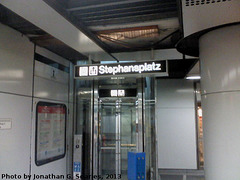
Stephansplatz U-Bahn Station, Wien (Vienna), Austr…
| 03 Nov 2013 |
|
|
|
Stephansplatz U-Bahn Station, in contrast to Rochusgasse, is one of the older stations, having been completed in 1978, although contruction had taken five years. The station was one of the earliest to have been planned, with the original proposals dating to the 1880's. One nearby building, the Palais Equitable, was even given a covered staircase in 1887 that was intended for eventual use as part of the U-Bahn. The square that the station named for is where St. Stephan's Cathedral is, and you can find an interesting photo of the construction here:
en.wikipedia.org/wiki/File:016L08--0675_Stadt,_Stefansdom,_im_Vordergrund_Baugrube_U-Bahn,_Nachtaufnahme.jpg
Of course, at this point, 1978 is long ago enough so that the station looks retro, in its own 1970's way. This is one of the elevators, which captures the period feel even if it has nothing to do with trains. This station encountered a number of unusual circumstances during its construction. One of these circumstances was the sandy ground in the neighborhood. Given how long the area has been urbanized, with concrete, cobbles, foundations, catacombs, and mortar going down quite far, it's surprising to me that this was still an issue in the 1970's, but then I'm not an engineer. For that matter, its surprising that St. Stephen's Cathedral and its associated catacombs, tunnels, and underground chambers could be built at all, particularly in the pre-industrial era. Groundwater was another problem. This is usually a problem when tunnels are involved, and gave rise to the original steam engines in the 17th Century, as they were required pumping water out of coal mines, but in Stephansplatz the groundwater is somewhat unpredictable as well. To deal with the sandy soil during the construction of the station, engineers attempted to mix a binding agent into it, but this now has the side effect of reacting with the groundwater, producing butyric acid, which can be harmful to humans, but which mostly produces a bad smell in the station (I haven't read of any injuries or deaths). There are a few very brief explanations about that here in English:
homepage.univie.ac.at/horst.prillinger/metro/english/faq.html
www.vienna.net/vienna-guide/metro.html
Surprisingly, I couldn't find a technical paper on it.
Supposedly the catacombs also smell quite bad, but that could just as easily be that they're catacombs:
www.cosmotourist.com/travel/d/i/2561403/t/vienna/catacombs-in-st-stephans
However, another underground feature of this neighborhood discovered during the construction was the Virgilkapelle, built in about 1307, but abandoned in 1781 and left forgotten until 1972.
Rochusgasse U-Bahn Station, Wien (Vienna), Austria…
| 03 Nov 2013 |
|
As with the Prague Metro, a number of archeological finds occurred as a result of the Vienna U-Bahn's construction. These columns, which look Roman, but are probably medieval or even Rennaissance. There isn't any historical marker for them that I noticed, but some historical detection work could be done to determine what buildings were in the area during likely time periods. This U-Bahn station, serving Line U3 only, is relatively new compared to some of the others, having opened in 1991.
Jump to top
RSS feed- Jon Searles' latest photos with "rail railway transit passenger station subway metro U-Bahn t" - Photos
- ipernity © 2007-2026
- Help & Contact
|
Club news
|
About ipernity
|
History |
ipernity Club & Prices |
Guide of good conduct
Donate | Group guidelines | Privacy policy | Terms of use | Statutes | In memoria -
Facebook
X
