

RHH's photos with the keyword: anacortes
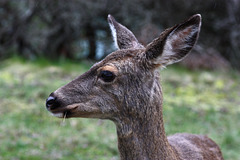
Columbia Blacktail Deer
| 05 Mar 2018 |
|
|
|
The Columbia Blacktail Deer is a subspecies of Mule Deer, smaller than an ordinary Mulie and smaller, too, than a Whitetail Deer. It is the only deer west of the Cascades. There are so many of them where we live that they become pests. This photo was taken near Anacortes, Washington, in Washington Park.
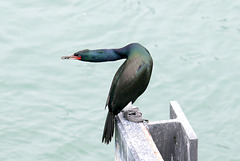
Pelagic Cormorant
| 15 Feb 2018 |
|
|
|
The smallest of our native cormorants, this example was photographed from the Coupeville ferry dock while waiting for the ferry to leave for Port Townsend on the Olympic Penninsula.
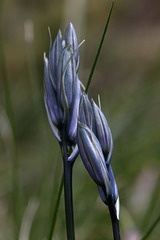
Camas
| 02 Feb 2018 |
|
|
|
Camassia quamash was second only to salmon as a food source among the native Indian tribes of the northwest. In many cases families had their own areas which were handed down from generation to generation, and the bulbs, the edible part of the plant, were very carefully harvested with only the largest bulbs being taken. These flower buds were photographed in Washington Park near Anacortes, Washington.
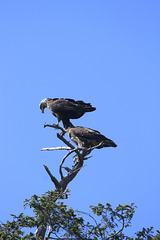
Eagles
| 05 Aug 2011 |
|
|
|
In Explore August 5, 2011, #431.
Young Bald Eagles, our national bird, photographed in Washington Park along the coast near Anacortes, Washington, earlier this spring.
ronaldhanko-orchidhunter.blogspot.com/2011/07/washington-...
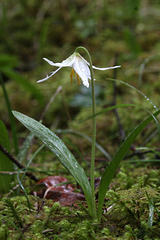
Oregon Fawn Lily
| 08 Apr 2015 |
|
|
|
Erythronium oreganum grows in abundance in several of the coastal park on Fidalgo Island and we make a point of going to see them every spring. This one was photographed in Washington Park near Anacortes, Washington, on what was obviously a wet day.
On another note, we will be away for several days, first in the Olympic Mountains and then in eastern Washington. Commenting and posting may be delayed or sporadic, so please be patient and I'll eventually catch everyone up again. We'll be home again next week Tuesday.
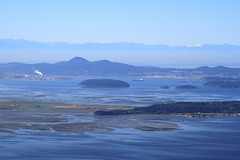
View from Oyster Dome
| 14 Oct 2014 |
|
|
|
The photo was taken from Oyster Dome in the Chuckanut Mountains and looks to the southwest over Padilla Bay, Samish Island and Hat Island, the refinery on Fidalgo Island, the town of Anacortes (also on Fidalgo Island) to Puget Sound and the Olympic Mountains in the background.
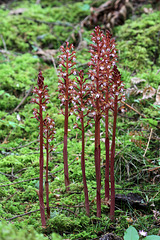
Corallorhiza maculata var. occidentalis
| 21 May 2014 |
|
|
|
I've posted several pictures of Coralroots recently and thought I'd post a picture showing how they grow. These are the Western Spotted Coralroot growing in a nice clump in Washington Park near Anacortes. Notice the lack of leaves (they are leafless) and they are without chlorophyll too.
This will be my last post for a couple of days. I am leaving shortly on a camping trip with a group of 6-8th graders (I'm one of the chaperones) and will catch everyone up with commenting when I return. Until then, may you all have a good day and a good rest of the week.
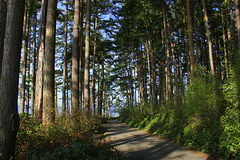
Washington Park
| 18 Apr 2014 |
|
|
|
Washington Park is on Fidalgo Island near Anacortes and is actually a city park, though undeveloped except for a campground and picnic area. There is a one-way road that runs around the perimeter of the park, but which is used as much by walkers as by cars. This is that road on the north side of the park near Green Point.
Green Point, Washington Park
| 16 Apr 2014 |
|
|
|
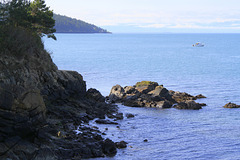
Another shot from Green Point in Washington Park. Just visible on the horizon and mostly hidden by clouds are the Olympic Mountains. This was taken early in the morning as we walked the road through the park.
Green Point, Washington Park
| 14 Apr 2014 |
|
|
|
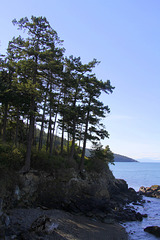
Taken in Washington Park from the northern end of the peninsula and an open area called Green Point. This looks south through the Straits of San Juan de Fuca. This is a city park but not in the sense suggested by the word "park." It is an area of natural beauty which, though heavily used is still a wonderful spot for wildflowers, native trees and great views of the straits.
Death Camas
| 29 Apr 2011 |
|
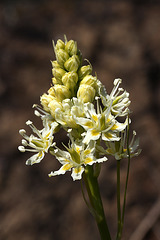
This is Zigadenus venenosus, the Meadow Death Camas, so called because all parts of the plant are poisonous. It is said that members of the Lewis and Clark expedition became ill from eating the bulbs of this plant after confusing it with other edible Camas bulbs.
Because it is often found in open grazing areas, it is a danger to cattle, sheep and horses, though pigs are supposed to be immune to it. It contains a toxic alkaloid, zygadenine, and can cause vomiting, decrease in blood pressure, seizure, coma and death.
These plants were photographed on rocky sunny southern slopes of Washington Park on Fidalgo Island, where they were just beginning to open. I can grow to about 18 inches, but the plants we saw were much shorter. Needless to say, we did not sample them.
Oregon Fawn Lily
| 28 Apr 2011 |
|
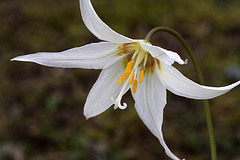
The botanical name for this species is Erythronium oregonum and it is known to as the Fawn Lily because of its beautifully mottled foliage. These were blooming in profusion at Washington Park in Anacortes last Saturday where we went on an excursion with the Washington Native Orchid Society.
The last time I had seen these they were totally without the brown markings at the base of the flower with only a touch of yellow there. These all had the brown markings. They are single-flowered, eight inches to a foot tall and almost always carry their flowers in a nodding position.
In my opinion they are one of the Northwest's most delicate and beautiful wildflowers and it is always a delight to see them, though they are relatively common in the areas where they are found. We had gone to see the Fairy Slippers but these certainly were an added bonus.
More pictures from our hike can be found at: ronaldhanko-orchidhunter.blogspot.com/2011/04/first-nativ... .
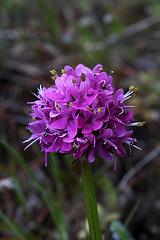
Sea Blush
| 04 May 2011 |
|
A small native wildflower photographed in Washington Park, Anacortes. Its botanical name is Plectritis congesta and it belongs to the Valerian family.
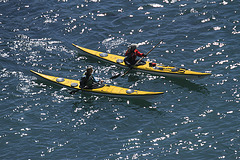
Kayaks
| 06 May 2011 |
|
Taken from the cliffs in Washington Park while hiking there last Saturday with the Native Orchid Society. There were actually four kayakers, but these two were ahead of the others and had been stopped by a partol boat, though we had no idea why. I thought the sunlight on the water and the contrast been water and kayals especially attractive.
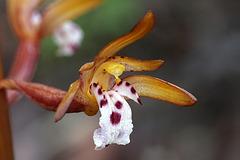
Corallorhiza maculata var. maculata
| 18 Jul 2011 |
|
|
I'm going to be posting pictures of some of the native orchids we've seen this spring and summer. We've had quite a bit of opportunity to get out and have seen again many of the natives as well as some new species.
This was photographed in Washington Park near Anacortes, a park that receives very high use but has a varied and interesting wildflower population including quite a number of the native orchid species. This is the Spotted Coralroot.
The Coralroots are a group of native orchids that are saprophytes, without chlorophyll and leaves, and which get their nourishment from decaying matter in the soil. They were especially abundant this spring and summer.
There are several varieties of this species, and I am not certain that I've correctly identified the variety since the differences are primarily in the shape of the lip. There are also a number of different color forms, this being the brownish form.
The plants are 18-24 inches tall and the flowers from 1/2 inch to an inch in size. They grow in dry, open woodlands, usually in rather shady areas. For more pictures and in formation see: nativeorchidsofthepacificnorthwest.blogspot.com/2011/06/c... .
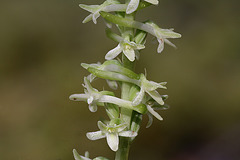
Piperia transversa
| 29 Jul 2011 |
|
This is the Flat-spurred Piperia, the name referring more to the position of the spur rather than its shape. The plant is about a foot tall and the flowers approximately an inch long. These were photographed in Washington Park near Anacortes.
nativeorchidsofthepacificnorthwest.blogspot.com/2011/07/f...
Whale Watching
| 26 Oct 2011 |
|
|
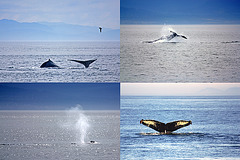
Toward the end of the summer we had one of our grandsons staying with us for several weeks and we took him whale-watching. We had hoped to see Orcas, but the three or four pods of Orcas that frequent Puget Sound had all headed out to sea. We did see, however, two Humpbacks and these pictures are all of them. They spent the time surfacing and diving every five or ten minutes.
It was not the easiest to get pictures from the deck of a moving boat, and this are the best I was able to do. None of the pictures were worth posting alone, so I decided to put them together in a collage, but apologize for its deficiencies. I do so little editing of my photos that I had to find out on line how to put this together and that it is a rather amateurish attempt, I freely acknowledge.
We left from Anacortes and were gone for nearly six hours, having had to travel quite a distance to investigate the reports of these two whales. We did see also some porpoises, a couple of Minke Whales, eagles, and sea lions, the latter at Mermaid Rock. All-in-all it was a great day and what the pictures lack in technical excellence they make up in preserving memories of the day.
ronaldhanko-orchidhunter.blogspot.com/2011/11/whale-watch...
Oregon Fawn Lily
| 08 May 2012 |
|
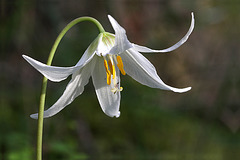
Erythronium oregonum is native to the Pacific Northwest and is one of our most delicate and beautiful wildflowers. It is called the "Fawn Lily" because of its beautifully mottled foliage, not shown here. This plant was photographed in Washington Park on Fidalgo Island near Anacortes, a park we often visit for its beautiful displays of wildflowers. I did not realize until I looked at the picture on my computer that there was a tiny insect on the pistil of the flower.
ronaldhanko-orchidhunter.blogspot.com/2012/05/spring-in-w...
Jump to top
RSS feed- RHH's latest photos with "anacortes" - Photos
- ipernity © 2007-2026
- Help & Contact
|
Club news
|
About ipernity
|
History |
ipernity Club & Prices |
Guide of good conduct
Donate | Group guidelines | Privacy policy | Terms of use | Statutes | In memoria -
Facebook
X
