

Steven Herzberg's photos with the keyword: Assignment124
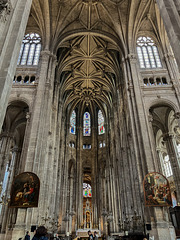
Saint Eustache, Paris - IMG--1711
| 10 Oct 2025 |
|
|
|
Saint Eustache began as a modest chapel built in 1213; it became a parish church in 1223, dedicated to Saint Eustatius, by hosting relics of this Roman martyr donated by the abbey of Saint-Denis. The first stone of the current church was laid on August 19, 1532, under François 1st. On April 26, 1637, the church was finally consecrated by Jean-François de Gondi, Archbishop of Paris.
Saint-Eustache exemplifies a mixture of multiple architectural styles: its structure is Flamboyant Gothic, characterized by elaborate stone tracery covering both the exterior and the interior, windows decorated with a characteristic s-shaped curve, and masonry wall space further reduced as windows grew even larger (a major example includes the northern spire of Chartres Cathedral). The Church’s interior decoration and other details are Renaissance and classical. It is the second largest church in the city, just behind Notre-Dame.
Louis XIV made his First Communion here in 1649. Cardinal Richelieu, Jeanne-Antoinette Poisson (Madame de Pompadour), and Molière were all baptized here; Molière was also married here in 1662. Mozart held his mother's funeral here.

Versailles - Palace from the Fountain of Neptune I…

Colonnes de Buren, Palais-Royal - IMG--9293
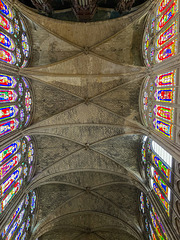
Basilique Saint Denis, Paris- IMG--1718
| 10 Oct 2025 |
|
|
|
Built on the tomb of Saint Denis, the missionary bishop who died around 250 beheaded by the Romans, a first church was probably built in the fifth century. The Saint is often depicted carrying his severed head.
From the death of King Dagobert, in 639, until the nineteenth century, the abbey church of Saint-Denis was the burial place of 40 kings and 26 queens. Many of the bodies were exhumed during the Revolution so the lead coffins could be melted down to make bullets; the bones were reinterred. Surviving tombs include those of Pepin the Short (father of Charlemagne), Henri II and Catherine de Medici, Francis I, Louis XVI and Marie-Antoinette, and Louis XVIII.
In addition to being intimately linked to the history of the kings of France, the building is considered one of the cradles of Gothic art. In order to ensure this abbey church continued to be a fit place for royal burials, in the twelfth century, the Basilica of Saint-Denis established itself as a new architectural masterpiece under the impetus of the Abbot Suger, advisor to Louis VI and Louis VII. It was gradually rebuilt in a new style, with innovative principles for the time, such as ribbed vaults and pointed arches.
The church is bathed in light, a symbol of the divine, thanks to an exceptional glass surface. Considered a major construction of Gothic art, it contributed to the production of new buildings throughout Europe!
The Basilica of the XIIe-XIIIe as we know it today, is 108 metres long and its vaults rise to 29 metres. Its immense transept is illuminated by two sumptuous roses of more than 12 meters in diameter which served as a model for Notre-Dame de Paris.
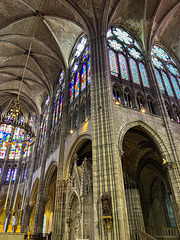
Basilique Cathédrale Saint-Denis - 3 vanishing poi…
| 10 Oct 2025 |
|
|
|
Built on the tomb of Saint Denis, the missionary bishop who died around 250 beheaded by the Romans, a first church was probably built in the fifth century. The Saint is often depicted carrying his severed head.
From the death of King Dagobert, in 639, until the nineteenth century, the abbey church of Saint-Denis was the burial place of 40 kings and 26 queens. Many of the bodies were exhumed during the Revolution so the lead coffins could be melted down to make bullets; the bones were reinterred. Surviving tombs include those of Pepin the Short (father of Charlemagne), Henri II and Catherine de Medici, Francis I, Louis XVI and Marie-Antoinette, and Louis XVIII.
In addition to being intimately linked to the history of the kings of France, the building is considered one of the cradles of Gothic art. In order to ensure this abbey church continued to be a fit place for royal burials, in the twelfth century, the Basilica of Saint-Denis established itself as a new architectural masterpiece under the impetus of the Abbot Suger, advisor to Louis VI and Louis VII. It was gradually rebuilt in a new style, with innovative principles for the time, such as ribbed vaults and pointed arches.
The church is bathed in light, a symbol of the divine, thanks to an exceptional glass surface. Considered a major construction of Gothic art, it contributed to the production of new buildings throughout Europe!
The Basilica of the XIIe-XIIIe as we know it today, is 108 metres long and its vaults rise to 29 metres. Its immense transept is illuminated by two sumptuous roses of more than 12 meters in diameter which served as a model for Notre-Dame de Paris.
Jump to top
RSS feed- Steven Herzberg's latest photos with "Assignment124" - Photos
- ipernity © 2007-2026
- Help & Contact
|
Club news
|
About ipernity
|
History |
ipernity Club & Prices |
Guide of good conduct
Donate | Group guidelines | Privacy policy | Terms of use | Statutes | In memoria -
Facebook
X
