

Daniela Brocca's photos with the keyword: Arch
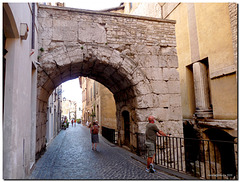
Arco di Druso
| 23 Sep 2020 |
|
|
|
L'arco di Druso e Germanico (detto anche solo "arco di Druso") è un arco romano degli inizi del I secolo situato a Spoleto (antica Spoletium), a ridosso del tempio romano e della chiesa di Sant'Ansano. Costituiva la porta di accesso monumentale al foro della città dalla via Flaminia (ricalcato dall'odierna piazza del Mercato), scavalcando il cardine massimo. L'arco di Druso e Germanico (detto anche solo "arco di Druso") è un arco romano degli inizi del I secolo situato a Spoleto (antica Spoletium), a ridosso del tempio romano e della chiesa di Sant'Ansano. Costituiva la porta di accesso monumentale al foro della città dalla via Flaminia (ricalcato dall'odierna piazza del Mercato), scavalcando il cardine massimo.
L'arco fu eretto nel 23 d.C. dal senato locale in onore di Druso minore e di Germanico, rispettivamente figlio naturale e nipote e figlio adottivo dell'imperatore Tiberio, in occasione della morte di Druso (Germanico era morto nel 19). L'arco è costruito in opera quadrata con blocchi in calcare locale. Fu costruito adottando la misura del piede romano.
----------------------------------------------------------------------------------
The Arch of Drusus and Germanicus (also known as the "Arch of Drusus") is an early first century Roman arch located in Spoleto (ancient Spoletium), close to the Roman temple and the church of Sant'Ansano. It was the monumental gateway to the city's forum from the Via Flaminia (traced from today's Piazza del Mercato), bypassing the maximum pintle. The Arch of Drusus and Germanicus (also known as the "Arch of Drusus") is an early first century Roman arch located in Spoleto (ancient Spoletium), close to the Roman temple and the church of Sant'Ansano. It was the monumental gateway to the city's forum from the Via Flaminia (traced from today's Piazza del Mercato), bypassing the maximum pintle.
The arch was erected in 23 A.D. by the local senate in honour of Drusus minor and Germanicus, respectively natural son and nephew and adopted son of the Emperor Tiberius, on the occasion of the death of Drusus (Germanicus had died in 19). The arch is built in square work with blocks of local limestone. It was built adopting the measure of the Roman foot.
Translated with www.deepl.com/Translator (free version)

Arco degli Incalzi
| 19 Oct 2019 |
|
|
|
L'arco, paragonabile ad una fastosa galleria barocca che collega i due palazzi, un tempo era in legno. Infatti, l'originaria struttura in legno a causa della sua precarietà, nel 1750 si preferì rifarla in pietra. Questo passaggio è riportato sull'iscrizione latina posta in alto sul fastigio. Essa recita così: In origine era un ponte in legno; il vescovo Scoppa lo costruì in muratura affinché, a beneficio di quanti temevano di utilizzarlo, il transito fosse meno pericoloso attraverso un percorso sicuro. Nell'anno del Signore 1750 il canonico Cesi pose questa iscrizione.
-----------------------------------
The arch, comparable to a sumptuous baroque gallery connecting the two buildings, was once made of wood. In fact, the original wooden structure because of its precariousness, in 1750 they preferred to redo it in stone. This passage is shown on the Latin inscription at the top of the fastigium. It reads as follows: Originally it was a wooden bridge; the bishop Scoppa built it in masonry so that, for the benefit of those who feared to use it, the transit was less dangerous through a safe path. In the year of the Lord 1750 Canon Cesi placed this inscription.
Translated with www.deepl.com/Translator
Jump to top
RSS feed- Daniela Brocca's latest photos with "Arch" - Photos
- ipernity © 2007-2025
- Help & Contact
|
Club news
|
About ipernity
|
History |
ipernity Club & Prices |
Guide of good conduct
Donate | Group guidelines | Privacy policy | Terms of use | Statutes | In memoria -
Facebook
X
