

Xata's photos

Hope in the future... DSC2172
| |
|

CHEFCHAOUEN
| |
|
|
|

CHEFCHAOUEN
| |
|
|
|

Cromeleque dos Almendres
| |
|
|
|
The Cromlech of the Almendres (Portuguese: Cromeleque dos Almendres/Cromeleque na Herdade dos Almendres) is a megalithic complex (commonly known as the Almendres Cromlech), located near the village of Nossa Senhora de Guadalupe, in the civil parish of Nossa Senhora da Tourega e Nossa Senhora de Guadalupe, municipality of Évora, in the Portuguese Alentejo. The largest existing group of structured menhirs in the Iberian Peninsula (and one of the largest in Europe), this archaeological site consists of several megalithic structures: cromlechs and menhir stones, that belong to the so-called "megalithic universe of Évora", with clear parallels to other cromlechs in Portela Mogos (in Montemor-o-Novo).[1]
The construction of these structures dates back to the 6th millennium BC. They were rediscovered in 1966 by Henrique Leonor Pina, who was carrying out field work relating to the country's geological charts.[1][3][4][5]
The excavation of the site unearthed a series of both megalithic and neolithic construction phases; Almendres I 6000 BC (Early Neolithic), Almendres II 5000 BC (Middle Neolithic), and Almendres III 4000 BC (Late Neolithic). The relative chronology of the cromlech and menhirs is extremely complex and covers a period from the Neolithic to Chalcolithic. It is believed that the monument either had a religious/ceremonial purpose or functioned as a primitive astronomical observatory.[1][5]
Source: en.wikipedia.org/wiki/Almendres_Cromlech
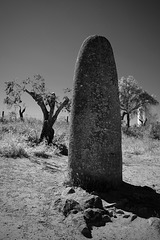
Menir dos Almendres
| |
|
|
|
The Cromlech of the Almendres (Portuguese: Cromeleque dos Almendres/Cromeleque na Herdade dos Almendres) is a megalithic complex (commonly known as the Almendres Cromlech), located near the village of Nossa Senhora de Guadalupe, in the civil parish of Nossa Senhora da Tourega e Nossa Senhora de Guadalupe, municipality of Évora, in the Portuguese Alentejo. The largest existing group of structured menhirs in the Iberian Peninsula (and one of the largest in Europe), this archaeological site consists of several megalithic structures: cromlechs and menhir stones, that belong to the so-called "megalithic universe of Évora", with clear parallels to other cromlechs in Portela Mogos (in Montemor-o-Novo).[1]
The construction of these structures dates back to the 6th millennium BC. They were rediscovered in 1966 by Henrique Leonor Pina, who was carrying out field work relating to the country's geological charts.[1][3][4][5]
The excavation of the site unearthed a series of both megalithic and neolithic construction phases; Almendres I 6000 BC (Early Neolithic), Almendres II 5000 BC (Middle Neolithic), and Almendres III 4000 BC (Late Neolithic). The relative chronology of the cromlech and menhirs is extremely complex and covers a period from the Neolithic to Chalcolithic. It is believed that the monument either had a religious/ceremonial purpose or functioned as a primitive astronomical observatory.[1][5]
Source: en.wikipedia.org/wiki/Almendres_Cromlech
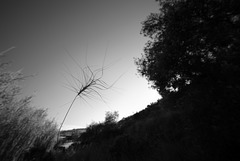
Taeniatherum caput-medusae
| |
|
|
|
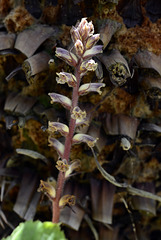
Orobanche hederae
| |
|
|
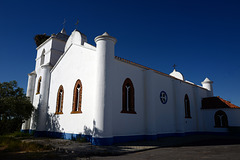
Vale de Açor de Cima, Igreja
| |
|
|
|

Hordeum murinum subsp. leporinum
| |
|
|
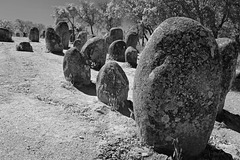
Cromeleque dos Almendres
| |
|
|
|
The Cromlech of the Almendres (Portuguese: Cromeleque dos Almendres/Cromeleque na Herdade dos Almendres) is a megalithic complex (commonly known as the Almendres Cromlech), located near the village of Nossa Senhora de Guadalupe, in the civil parish of Nossa Senhora da Tourega e Nossa Senhora de Guadalupe, municipality of Évora, in the Portuguese Alentejo. The largest existing group of structured menhirs in the Iberian Peninsula (and one of the largest in Europe), this archaeological site consists of several megalithic structures: cromlechs and menhir stones, that belong to the so-called "megalithic universe of Évora", with clear parallels to other cromlechs in Portela Mogos (in Montemor-o-Novo).[1]
The construction of these structures dates back to the 6th millennium BC. They were rediscovered in 1966 by Henrique Leonor Pina, who was carrying out field work relating to the country's geological charts.[1][3][4][5]
The excavation of the site unearthed a series of both megalithic and neolithic construction phases; Almendres I 6000 BC (Early Neolithic), Almendres II 5000 BC (Middle Neolithic), and Almendres III 4000 BC (Late Neolithic). The relative chronology of the cromlech and menhirs is extremely complex and covers a period from the Neolithic to Chalcolithic. It is believed that the monument either had a religious/ceremonial purpose or functioned as a primitive astronomical observatory.[1][5]
Source: en.wikipedia.org/wiki/Almendres_Cromlech

Cromeleque dos Almendres
| |
|
|
|
The Cromlech of the Almendres (Portuguese: Cromeleque dos Almendres/Cromeleque na Herdade dos Almendres) is a megalithic complex (commonly known as the Almendres Cromlech), located near the village of Nossa Senhora de Guadalupe, in the civil parish of Nossa Senhora da Tourega e Nossa Senhora de Guadalupe, municipality of Évora, in the Portuguese Alentejo. The largest existing group of structured menhirs in the Iberian Peninsula (and one of the largest in Europe), this archaeological site consists of several megalithic structures: cromlechs and menhir stones, that belong to the so-called "megalithic universe of Évora", with clear parallels to other cromlechs in Portela Mogos (in Montemor-o-Novo).[1]
The construction of these structures dates back to the 6th millennium BC. They were rediscovered in 1966 by Henrique Leonor Pina, who was carrying out field work relating to the country's geological charts.[1][3][4][5]
The excavation of the site unearthed a series of both megalithic and neolithic construction phases; Almendres I 6000 BC (Early Neolithic), Almendres II 5000 BC (Middle Neolithic), and Almendres III 4000 BC (Late Neolithic). The relative chronology of the cromlech and menhirs is extremely complex and covers a period from the Neolithic to Chalcolithic. It is believed that the monument either had a religious/ceremonial purpose or functioned as a primitive astronomical observatory.[1][5]
Source: en.wikipedia.org/wiki/Almendres_Cromlech
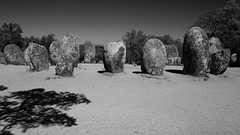
Cromeleque dos Almendres
| |
|
|
|
The Cromlech of the Almendres (Portuguese: Cromeleque dos Almendres/Cromeleque na Herdade dos Almendres) is a megalithic complex (commonly known as the Almendres Cromlech), located near the village of Nossa Senhora de Guadalupe, in the civil parish of Nossa Senhora da Tourega e Nossa Senhora de Guadalupe, municipality of Évora, in the Portuguese Alentejo. The largest existing group of structured menhirs in the Iberian Peninsula (and one of the largest in Europe), this archaeological site consists of several megalithic structures: cromlechs and menhir stones, that belong to the so-called "megalithic universe of Évora", with clear parallels to other cromlechs in Portela Mogos (in Montemor-o-Novo).[1]
The construction of these structures dates back to the 6th millennium BC. They were rediscovered in 1966 by Henrique Leonor Pina, who was carrying out field work relating to the country's geological charts.[1][3][4][5]
The excavation of the site unearthed a series of both megalithic and neolithic construction phases; Almendres I 6000 BC (Early Neolithic), Almendres II 5000 BC (Middle Neolithic), and Almendres III 4000 BC (Late Neolithic). The relative chronology of the cromlech and menhirs is extremely complex and covers a period from the Neolithic to Chalcolithic. It is believed that the monument either had a religious/ceremonial purpose or functioned as a primitive astronomical observatory.[1][5]
Source: en.wikipedia.org/wiki/Almendres_Cromlech
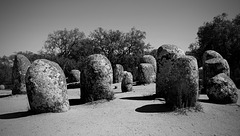
Cromeleque dos Almendres
| |
|
|
The Cromlech of the Almendres (Portuguese: Cromeleque dos Almendres/Cromeleque na Herdade dos Almendres) is a megalithic complex (commonly known as the Almendres Cromlech), located near the village of Nossa Senhora de Guadalupe, in the civil parish of Nossa Senhora da Tourega e Nossa Senhora de Guadalupe, municipality of Évora, in the Portuguese Alentejo. The largest existing group of structured menhirs in the Iberian Peninsula (and one of the largest in Europe), this archaeological site consists of several megalithic structures: cromlechs and menhir stones, that belong to the so-called "megalithic universe of Évora", with clear parallels to other cromlechs in Portela Mogos (in Montemor-o-Novo).[1]
The construction of these structures dates back to the 6th millennium BC. They were rediscovered in 1966 by Henrique Leonor Pina, who was carrying out field work relating to the country's geological charts.[1][3][4][5]
The excavation of the site unearthed a series of both megalithic and neolithic construction phases; Almendres I 6000 BC (Early Neolithic), Almendres II 5000 BC (Middle Neolithic), and Almendres III 4000 BC (Late Neolithic). The relative chronology of the cromlech and menhirs is extremely complex and covers a period from the Neolithic to Chalcolithic. It is believed that the monument either had a religious/ceremonial purpose or functioned as a primitive astronomical observatory.[1][5]
Source: en.wikipedia.org/wiki/Almendres_Cromlech
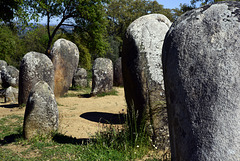
Cromeleque dos Almendres
| |
|
|
|
The Cromlech of the Almendres (Portuguese: Cromeleque dos Almendres/Cromeleque na Herdade dos Almendres) is a megalithic complex (commonly known as the Almendres Cromlech), located near the village of Nossa Senhora de Guadalupe, in the civil parish of Nossa Senhora da Tourega e Nossa Senhora de Guadalupe, municipality of Évora, in the Portuguese Alentejo. The largest existing group of structured menhirs in the Iberian Peninsula (and one of the largest in Europe), this archaeological site consists of several megalithic structures: cromlechs and menhir stones, that belong to the so-called "megalithic universe of Évora", with clear parallels to other cromlechs in Portela Mogos (in Montemor-o-Novo).[1]
The construction of these structures dates back to the 6th millennium BC. They were rediscovered in 1966 by Henrique Leonor Pina, who was carrying out field work relating to the country's geological charts.[1][3][4][5]
The excavation of the site unearthed a series of both megalithic and neolithic construction phases; Almendres I 6000 BC (Early Neolithic), Almendres II 5000 BC (Middle Neolithic), and Almendres III 4000 BC (Late Neolithic). The relative chronology of the cromlech and menhirs is extremely complex and covers a period from the Neolithic to Chalcolithic. It is believed that the monument either had a religious/ceremonial purpose or functioned as a primitive astronomical observatory.[1][5]
Source: en.wikipedia.org/wiki/Almendres_Cromlech
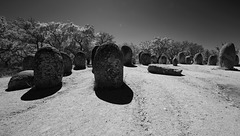
Cromeleque dos Almendres
| |
|
|
The Cromlech of the Almendres (Portuguese: Cromeleque dos Almendres/Cromeleque na Herdade dos Almendres) is a megalithic complex (commonly known as the Almendres Cromlech), located near the village of Nossa Senhora de Guadalupe, in the civil parish of Nossa Senhora da Tourega e Nossa Senhora de Guadalupe, municipality of Évora, in the Portuguese Alentejo. The largest existing group of structured menhirs in the Iberian Peninsula (and one of the largest in Europe), this archaeological site consists of several megalithic structures: cromlechs and menhir stones, that belong to the so-called "megalithic universe of Évora", with clear parallels to other cromlechs in Portela Mogos (in Montemor-o-Novo).[1]
The construction of these structures dates back to the 6th millennium BC. They were rediscovered in 1966 by Henrique Leonor Pina, who was carrying out field work relating to the country's geological charts.[1][3][4][5]
The excavation of the site unearthed a series of both megalithic and neolithic construction phases; Almendres I 6000 BC (Early Neolithic), Almendres II 5000 BC (Middle Neolithic), and Almendres III 4000 BC (Late Neolithic). The relative chronology of the cromlech and menhirs is extremely complex and covers a period from the Neolithic to Chalcolithic. It is believed that the monument either had a religious/ceremonial purpose or functioned as a primitive astronomical observatory.[1][5]
Source: en.wikipedia.org/wiki/Almendres_Cromlech
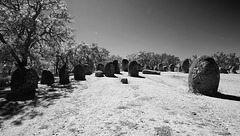
Cromeleque dos Almendres
| |
|
|
|
The Cromlech of the Almendres (Portuguese: Cromeleque dos Almendres/Cromeleque na Herdade dos Almendres) is a megalithic complex (commonly known as the Almendres Cromlech), located near the village of Nossa Senhora de Guadalupe, in the civil parish of Nossa Senhora da Tourega e Nossa Senhora de Guadalupe, municipality of Évora, in the Portuguese Alentejo. The largest existing group of structured menhirs in the Iberian Peninsula (and one of the largest in Europe), this archaeological site consists of several megalithic structures: cromlechs and menhir stones, that belong to the so-called "megalithic universe of Évora", with clear parallels to other cromlechs in Portela Mogos (in Montemor-o-Novo).[1]
The construction of these structures dates back to the 6th millennium BC. They were rediscovered in 1966 by Henrique Leonor Pina, who was carrying out field work relating to the country's geological charts.[1][3][4][5]
The excavation of the site unearthed a series of both megalithic and neolithic construction phases; Almendres I 6000 BC (Early Neolithic), Almendres II 5000 BC (Middle Neolithic), and Almendres III 4000 BC (Late Neolithic). The relative chronology of the cromlech and menhirs is extremely complex and covers a period from the Neolithic to Chalcolithic. It is believed that the monument either had a religious/ceremonial purpose or functioned as a primitive astronomical observatory.[1][5]
Source: en.wikipedia.org/wiki/Almendres_Cromlech
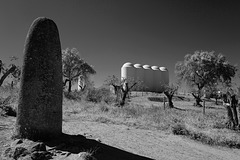
Menir dos Almendres
| |
|
|
The Cromlech of the Almendres (Portuguese: Cromeleque dos Almendres/Cromeleque na Herdade dos Almendres) is a megalithic complex (commonly known as the Almendres Cromlech), located near the village of Nossa Senhora de Guadalupe, in the civil parish of Nossa Senhora da Tourega e Nossa Senhora de Guadalupe, municipality of Évora, in the Portuguese Alentejo. The largest existing group of structured menhirs in the Iberian Peninsula (and one of the largest in Europe), this archaeological site consists of several megalithic structures: cromlechs and menhir stones, that belong to the so-called "megalithic universe of Évora", with clear parallels to other cromlechs in Portela Mogos (in Montemor-o-Novo).[1]
The construction of these structures dates back to the 6th millennium BC. They were rediscovered in 1966 by Henrique Leonor Pina, who was carrying out field work relating to the country's geological charts.[1][3][4][5]
The excavation of the site unearthed a series of both megalithic and neolithic construction phases; Almendres I 6000 BC (Early Neolithic), Almendres II 5000 BC (Middle Neolithic), and Almendres III 4000 BC (Late Neolithic). The relative chronology of the cromlech and menhirs is extremely complex and covers a period from the Neolithic to Chalcolithic. It is believed that the monument either had a religious/ceremonial purpose or functioned as a primitive astronomical observatory.[1][5]
Source: en.wikipedia.org/wiki/Almendres_Cromlech
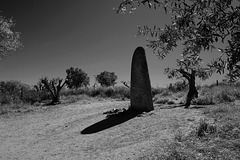
Menir dos Almendres
| |
|
|
|
The Cromlech of the Almendres (Portuguese: Cromeleque dos Almendres/Cromeleque na Herdade dos Almendres) is a megalithic complex (commonly known as the Almendres Cromlech), located near the village of Nossa Senhora de Guadalupe, in the civil parish of Nossa Senhora da Tourega e Nossa Senhora de Guadalupe, municipality of Évora, in the Portuguese Alentejo. The largest existing group of structured menhirs in the Iberian Peninsula (and one of the largest in Europe), this archaeological site consists of several megalithic structures: cromlechs and menhir stones, that belong to the so-called "megalithic universe of Évora", with clear parallels to other cromlechs in Portela Mogos (in Montemor-o-Novo).[1]
The construction of these structures dates back to the 6th millennium BC. They were rediscovered in 1966 by Henrique Leonor Pina, who was carrying out field work relating to the country's geological charts.[1][3][4][5]
The excavation of the site unearthed a series of both megalithic and neolithic construction phases; Almendres I 6000 BC (Early Neolithic), Almendres II 5000 BC (Middle Neolithic), and Almendres III 4000 BC (Late Neolithic). The relative chronology of the cromlech and menhirs is extremely complex and covers a period from the Neolithic to Chalcolithic. It is believed that the monument either had a religious/ceremonial purpose or functioned as a primitive astronomical observatory.[1][5]
Source: en.wikipedia.org/wiki/Almendres_Cromlech
