

Blossom View
Ready to Go.
End Of Bridge Street.
Sunset on Treetops.
Flowering Roses.
Broom and Daisies
Standing Alone.
In Rotorua
Hoping For a Tidbit.
Vines.
In the Rain
On the Fenceline
Just Rising
Against the Sky.
Kindred Spirits
Glasshouse Beauties.
Fly on a Fern Leaf.
Lake Whakamaru
IMG 4481
Covered.
Mangapohue Natural Bridge.
Beauty Above.
Night Light.
In the Pink.
Down the Bank.
Beautiful Bush.
Cat Companions
Fenced Off
Three Pots.
Toi Toi On Hot Water Beach,
Boulder, Weeds and Fern.
Lovely Agapanthus.
All Booked Up
Bouquet.
Box and Beads
Berry Nice
Yellow World
Mysterious.
Hanging About.
Clover All Over.
Baled Up.
Scorched Clouds
Unusual Rock.
Watering Can Cottage
Peek-a-Boo.
See also...
See more...
Keywords
Authorizations, license
-
Visible by: Everyone -
All rights reserved
-
550 visits
Evidence of Spittlebug.
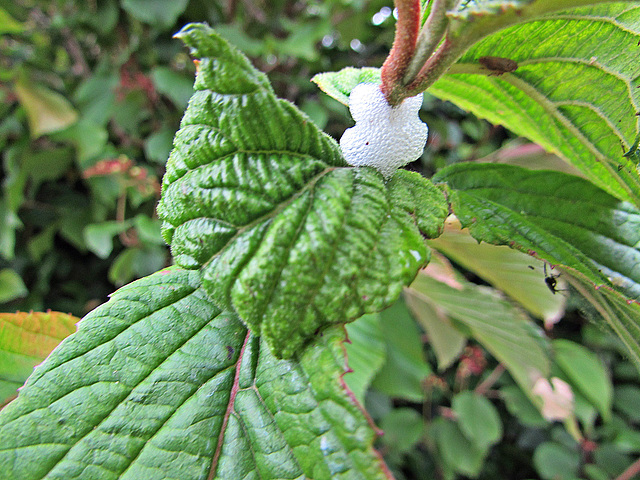

A spittlebug's foamy nest.
There are about 2400 species of spittlebugs or froghoppers worldwide and about 15 in New Zealand
These insects are best known for their nymph stage, which produces a cover of frothed-up plant sap resembling spit. The nymphs are therefore commonly known as spittlebugs or spit bugs, and their froth as cuckoo spit, frog spit or snake spit.
The nymph produces this protective covering in a most remarkable manner by forcing a combination of fluid from the anus and a gluey gland excretion out under pressure, as from a bellows, to make uniform bubbles. The tail pumps up and down to operate the bellows and keep the bubbles coming one every second, and the nymph is soon hidden under a mound of white foam, protected from the sun and from insect predators. The insect can only breath by taking air from one of the larger bubbles or from the air at the surface of the foam. The froth also insulates against heat and cold, thus providing thermal control and also moisture control. Without the froth, the bug would quickly dry up. (- T.E.R:R.A.I.N.)
There are about 2400 species of spittlebugs or froghoppers worldwide and about 15 in New Zealand
These insects are best known for their nymph stage, which produces a cover of frothed-up plant sap resembling spit. The nymphs are therefore commonly known as spittlebugs or spit bugs, and their froth as cuckoo spit, frog spit or snake spit.
The nymph produces this protective covering in a most remarkable manner by forcing a combination of fluid from the anus and a gluey gland excretion out under pressure, as from a bellows, to make uniform bubbles. The tail pumps up and down to operate the bellows and keep the bubbles coming one every second, and the nymph is soon hidden under a mound of white foam, protected from the sun and from insect predators. The insect can only breath by taking air from one of the larger bubbles or from the air at the surface of the foam. The froth also insulates against heat and cold, thus providing thermal control and also moisture control. Without the froth, the bug would quickly dry up. (- T.E.R:R.A.I.N.)
©UdoSm, Andy Rodker, Pam J, Janet Brien and 2 other people have particularly liked this photo
- Keyboard shortcuts:
Jump to top
RSS feed- Latest comments - Subscribe to the comment feeds of this photo
- ipernity © 2007-2026
- Help & Contact
|
Club news
|
About ipernity
|
History |
ipernity Club & Prices |
Guide of good conduct
Donate | Group guidelines | Privacy policy | Terms of use | Statutes | In memoria -
Facebook
X

CUCKOO SPIT !
Sign-in to write a comment.