

.:madworm:.'s photos
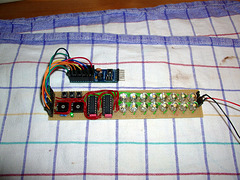
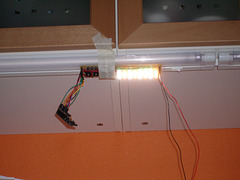
Kitchen lighting perfboard prototype
| |
|
It's got 16 5chip 1/2 LEDs. Most of them are cool-white now. Initially it had 50%/50% cool/warm-white, but the warm-white ones have died prematurely - for unknown reason.
This one still uses an ATtiny2313 as the brain, but I think I'll switch to a Mega48/88 later. It's got a real SPI unit, which can send out the data much quicker than the 2313's USI unit. This is crucial, as the PWM interrupt must finish very quickly for proper performance.
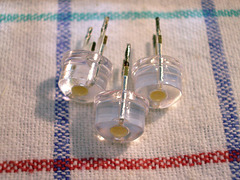
3 of these just failed
| |
|
Initially I was very pleased with these 5 chip 1/2 Watt LEDs I acquired from ebay.
For testing I ordered 10pcs of the warm-white type (100,000 mcd @ 100mA), which are shown here, and 10 pcs of neutral/cool-white (120,000 mcd @ 100mA). NONE of the latter have failed so far.
I use constant current LED drivers, therefore it shouldn't have been over-current that has killed them. 3 in a row.
Now will I use these, or search for equivalent/better SMD types?
As it turns out, I won't use the warm-white type at all, it doesn't look good on the kitchen counter at all.
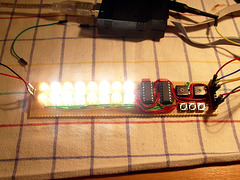
Kitchen lighting perfboard prototype
| |
|
It's got 16 5chip 1/2 LEDs. Most of them are cool-white now. Initially it had 50%/50% cool/warm-white, but the warm-white ones have died prematurely - for unknown reason.
This one still uses an ATtiny2313 as the brain, but I think I'll switch to a Mega48/88 later. It's got a real SPI unit, which can send out the data much quicker than the 2313's USI unit. This is crucial, as the PWM interrupt must finish very quickly for proper performance.
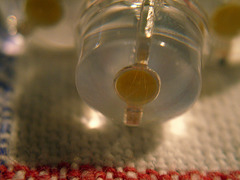
3 of these just failed
| |
|
Initially I was very pleased with these 5 chip 1/2 Watt LEDs I acquired from ebay.
For testing I ordered 10pcs of the warm-white type (100,000 mcd @ 100mA), which are shown here, and 10 pcs of neutral/cool-white (120,000 mcd @ 100mA). NONE of the latter have failed so far.
I use constant current LED drivers, therefore it shouldn't have been over-current that has killed them. 3 in a row.
Now will I use these, or search for equivalent/better SMD types?
Kitchen lighting perfboard prototype
| |
|
It's got 16 5chip 1/2 LEDs. Most of them are cool-white now. Initially it had 50%/50% cool/warm-white, but the warm-white ones have died prematurely - for unknown reason.
This one still uses an ATtiny2313 as the brain, but I think I'll switch to a Mega48/88 later. It's got a real SPI unit, which can send out the data much quicker than the 2313's USI unit. This is crucial, as the PWM interrupt must finish very quickly for proper performance.
Something new every day
Wonders of technology
worn out saddle

Sugru - Shelf life expired
| |
|
It looks a bit like some kind of flower.
Nowadays they print a 'best before' date on each sachet. And it helps to keep it in the fridge. Just to make sure nothing unwelcome leaks out, I keep them in a glass preserving jar.

Sugru - Shelf life expired
| |
|
It's got a distinct rubbery feel and there's quite a smelly oily film covering it.
Nowadays they print a 'best before' date on each sachet. And it helps to keep it in the fridge. Just to make sure nothing unwelcome leaks out, I keep them in a glass preserving jar.

Fixed saddle

Sugru - Shelf life expired
| |
|
Nowadays they print a 'best before' date on each sachet. And it helps to keep it in the fridge. Just to make sure nothing unwelcome leaks out, I keep them in a glass preserving jar.

Black sugru is in much better shape
| |
|
Just a coincidence ?
Nowadays they print a 'best before' date on each sachet. And it helps to keep it in the fridge. Just to make sure nothing unwelcome leaks out, I keep them in a glass preserving jar.

Sugru - Shelf life expired
| |
|
Nowadays they print a 'best before' date on each sachet. And it helps to keep it in the fridge. Just to make sure nothing unwelcome leaks out, I keep them in a glass preserving jar.

Black sugru - still sticky
| |
|
Nowadays they print a 'best before' date on each sachet. And it helps to keep it in the fridge. Just to make sure nothing unwelcome leaks out, I keep them in a glass preserving jar.

Sugruized fingers
PWM again...
| |
|
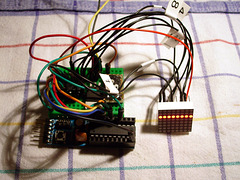
What to do if you favourite microcontroller doesn't have enough hardware PWM pins? Software driven PWM of course.
There many absolutely dumb ways to do it, and I've probably tested all of these. They can be classified as "brute force".
A better way of doing it is to only do any work if there is anything to do. But you already know all of this of course. Calculate when to toggle the lines and let a timer do all of the work. Code can be found on my blog
First on-site test for LED lights in the kitchen
| |
|
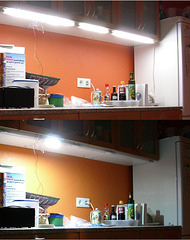
Top: 4 CFL tubes, one not visible on the left side. The long ones consume 14W, the short ones 8W.
The single LED bar in the bottom half takes 3W. Judging from the brightness of the thing and the brightness of the rear wall, I think I could get the same overall illumination with about 6 LED modules, equaling in 18W + power supply losses. But good switchers are quite efficient. This would be a 15V system.
I'm still waiting for a batch of individual 0.5W LEDs in warm/cold white. They'll get a chance to show off as well. If they win the race, I'll be able to use a spare 5V, 2.6A switching power supply for these for the beginning. I've checked it for its stand by power requirements and they were a bit high. 1W standby losses would cost me about 6€ per year. Efficient switchers with low standby losses can be had for 12 to 20€. I've already got one (5-12V, 2.25A) and my power monitor couldn't detect any difference whether it was plugged in or not.
