


New Jersey

The mysterious, magical Garden State on the other side of the Hudson River!

01 Jul 1991
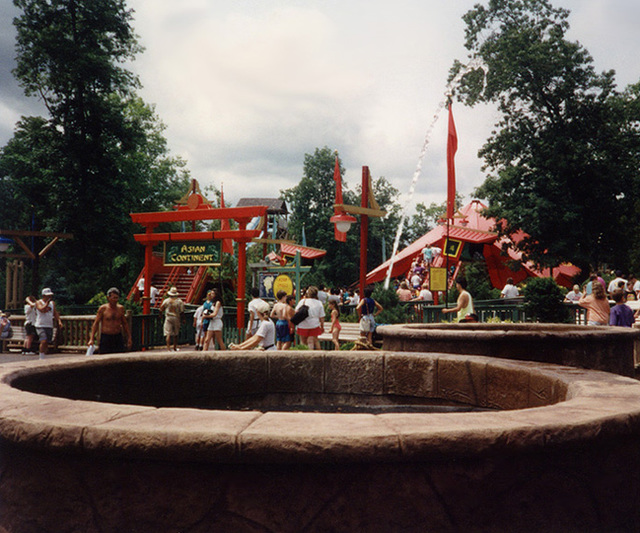
Fountain in the Adventure Rivers area of Great Adventure in NJ circa 1991
Six Flags Great Adventure is a theme park in Jackson Township, New Jersey, located 67 miles from New York City, 58 miles from Newark and 50 miles from Philadelphia, consisting of a theme park area, a Wild Safari area, and a water park, Hurricane Harbor. Because of this location, it serves as the amusement park for one of the biggest and most well-known metropolitan areas in the world. Owned by the Six Flags brand of amusement parks, Great Adventure is known for its roller coasters with brilliant and colorful tracks, such as Nitro, Medusa, The Great American Scream Machine, Rolling Thunder, Batman: The Ride, Superman: Ultimate Flight, the world's tallest and fastest roller coaster Kingda Ka (as of 2005), and the newest coaster, El Toro. According to the Guinness Book of World Records, Six Flags Great Adventure has more rides than any other theme park in the world, with 72 attractions as of 2006.
Text from: en.wikipedia.org/wiki/Six_Flags_Great_Adventure
01 Jul 1991
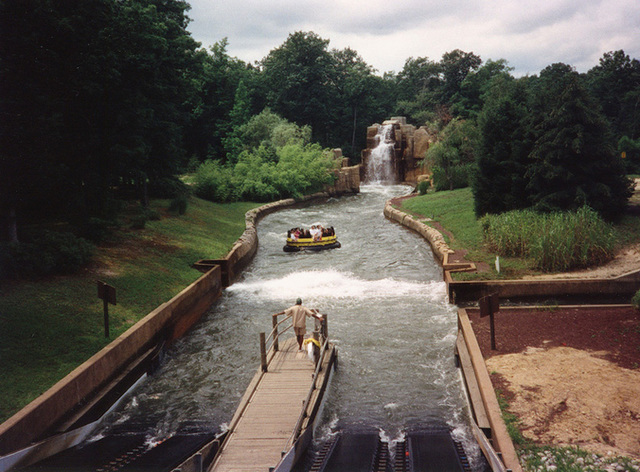
The Roaring Rapids Ride at Great Adventure circa 1991
Six Flags Great Adventure is a theme park in Jackson Township, New Jersey, located 67 miles from New York City, 58 miles from Newark and 50 miles from Philadelphia, consisting of a theme park area, a Wild Safari area, and a water park, Hurricane Harbor. Because of this location, it serves as the amusement park for one of the biggest and most well-known metropolitan areas in the world. Owned by the Six Flags brand of amusement parks, Great Adventure is known for its roller coasters with brilliant and colorful tracks, such as Nitro, Medusa, The Great American Scream Machine, Rolling Thunder, Batman: The Ride, Superman: Ultimate Flight, the world's tallest and fastest roller coaster Kingda Ka (as of 2005), and the newest coaster, El Toro. According to the Guinness Book of World Records, Six Flags Great Adventure has more rides than any other theme park in the world, with 72 attractions as of 2006.
Text from: en.wikipedia.org/wiki/Six_Flags_Great_Adventure
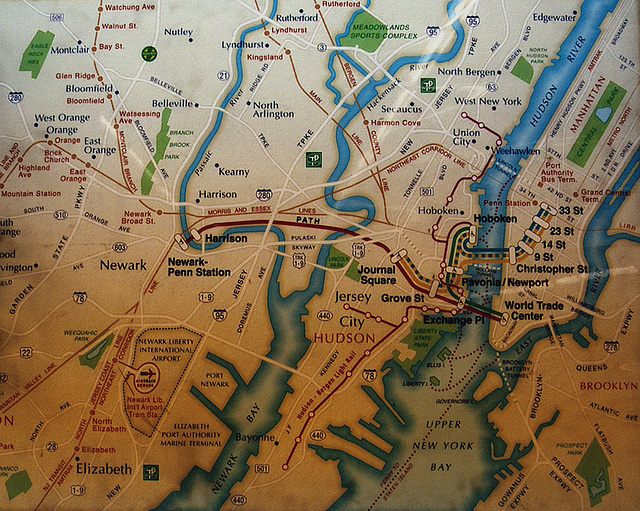
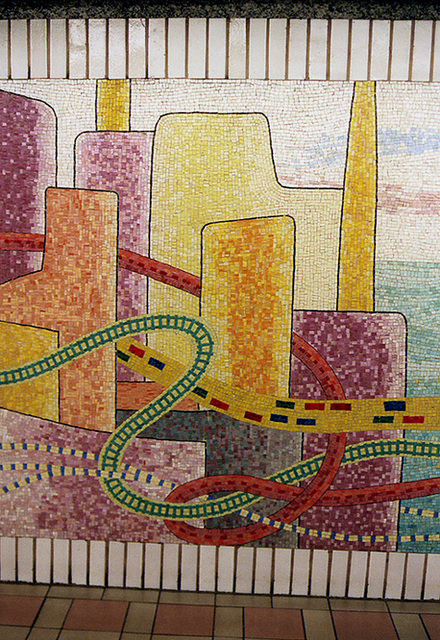
Mosaic in the Pavonia-Newport NJ Path station, April 2007
Pavonia/Newport is a PATH station located on Town Square Place (formerly Pavonia Avenue) at the corner of Washington Boulevard in Newport, Jersey City, New Jersey.
Opened on August 2, 1909 as the Erie station (and later renamed to Pavonia Avenue, a street in the vicinity, until its present name was given in 1988), Pavonia/Newport has undergone a number of transformations. The station was originally constructed to connect to the Erie Railroad Terminal, which stood above the station. (The capitals of the station's columns still display the "E" of the Erie Railroad.) During this period, the station was so busy that a second platform had to be added to manage the flow of passengers from the over 30 passenger trains that ran in and out of the station hourly.
The desire to reuse old caissons (from previous tunneling attempts) when building the H&M system meant that the tubes at this location would be located far inland. As a result, the actual station was not closely integrated into the Erie Railroad Terminal above, and the Erie never got around to building a new terminal on top of the underground platforms. Therefore, a lengthy walk through inclined pedestrian tunnels was necessary in order to connect from the H&M to the passenger trains. In response to this, the Hudson and Manhattan Railroad installed in 1954 a 277-foot long moving sidewalk known as "the Speedwalk". It was the first such moving walkway built in the United States if not the world; built by Goodyear, it moved up a 10 percent grade at a speed of 1.5 mph (2.4 km/h). The walkway was removed within a decade due to significant changes happening above ground.
In 1956, the Erie Railroad consolidated their operations with the Lackawanna Railroad and moved to their terminal in Hoboken. A few years later, the small New York, Susquehanna and Western Railway ceased their operations at the Erie Terminal, which was torn down soon afterwards. Without any reason to disembark other than some informal parking lots, ridership at the Erie tube station declined sharply. For nearly 30 years, the station served primarily as a transfer station from one PATH line to another, and was totally closed on evenings and weekends. (At the former World Trade Center station, it was still possible in 2001 to see the abandoned electronic board that indicated with a light whether the Pavonia Station stop was in service or not.)
Beginning in the late 1980s the once-vacant railyards surrounding the station were turned into residential, office, and retail towers, and the neighborhood would later become known as Newport. As part of the redevelopment, Pavonia Station itself was renamed and underwent extensive renovations, including improved lighting, floors, walls, ceilings, artwork, and the installation of a new headhouse with escalators and elevators. The station underwent further renovations in 2001-2003 with the installation of an additional elevator in order to re-open the side platform to regular use after four decades of inactivity.
The open steelwork beside the headhouse is the skeleton for a never-built second level that was to connect to office towers across the street via a skywalk, similar to those at the Gateway complex at Newark Penn Station.
The Port Authority is currently considering whether to fund a long-proposed second entry to the station on the west side of Washington Boulevard to ease congestion.
A third name change may also be in the station's future, given that this isolated section of Pavonia Avenue has been renamed to Town Square Place. (This was done to avoid confusion with three other sections of Pavonia Avenue elsewhere in Jersey City.)
Text from: en.wikipedia.org/wiki/Pavonia/Newport_(PATH_station)

Mosaic in the Pavonia-Newport NJ Path station, April 2007
Pavonia/Newport is a PATH station located on Town Square Place (formerly Pavonia Avenue) at the corner of Washington Boulevard in Newport, Jersey City, New Jersey.
Opened on August 2, 1909 as the Erie station (and later renamed to Pavonia Avenue, a street in the vicinity, until its present name was given in 1988), Pavonia/Newport has undergone a number of transformations. The station was originally constructed to connect to the Erie Railroad Terminal, which stood above the station. (The capitals of the station's columns still display the "E" of the Erie Railroad.) During this period, the station was so busy that a second platform had to be added to manage the flow of passengers from the over 30 passenger trains that ran in and out of the station hourly.
The desire to reuse old caissons (from previous tunneling attempts) when building the H&M system meant that the tubes at this location would be located far inland. As a result, the actual station was not closely integrated into the Erie Railroad Terminal above, and the Erie never got around to building a new terminal on top of the underground platforms. Therefore, a lengthy walk through inclined pedestrian tunnels was necessary in order to connect from the H&M to the passenger trains. In response to this, the Hudson and Manhattan Railroad installed in 1954 a 277-foot long moving sidewalk known as "the Speedwalk". It was the first such moving walkway built in the United States if not the world; built by Goodyear, it moved up a 10 percent grade at a speed of 1.5 mph (2.4 km/h). The walkway was removed within a decade due to significant changes happening above ground.
In 1956, the Erie Railroad consolidated their operations with the Lackawanna Railroad and moved to their terminal in Hoboken. A few years later, the small New York, Susquehanna and Western Railway ceased their operations at the Erie Terminal, which was torn down soon afterwards. Without any reason to disembark other than some informal parking lots, ridership at the Erie tube station declined sharply. For nearly 30 years, the station served primarily as a transfer station from one PATH line to another, and was totally closed on evenings and weekends. (At the former World Trade Center station, it was still possible in 2001 to see the abandoned electronic board that indicated with a light whether the Pavonia Station stop was in service or not.)
Beginning in the late 1980s the once-vacant railyards surrounding the station were turned into residential, office, and retail towers, and the neighborhood would later become known as Newport. As part of the redevelopment, Pavonia Station itself was renamed and underwent extensive renovations, including improved lighting, floors, walls, ceilings, artwork, and the installation of a new headhouse with escalators and elevators. The station underwent further renovations in 2001-2003 with the installation of an additional elevator in order to re-open the side platform to regular use after four decades of inactivity.
The open steelwork beside the headhouse is the skeleton for a never-built second level that was to connect to office towers across the street via a skywalk, similar to those at the Gateway complex at Newark Penn Station.
The Port Authority is currently considering whether to fund a long-proposed second entry to the station on the west side of Washington Boulevard to ease congestion.
A third name change may also be in the station's future, given that this isolated section of Pavonia Avenue has been renamed to Town Square Place. (This was done to avoid confusion with three other sections of Pavonia Avenue elsewhere in Jersey City.)
Text from: en.wikipedia.org/wiki/Pavonia/Newport_(PATH_station)
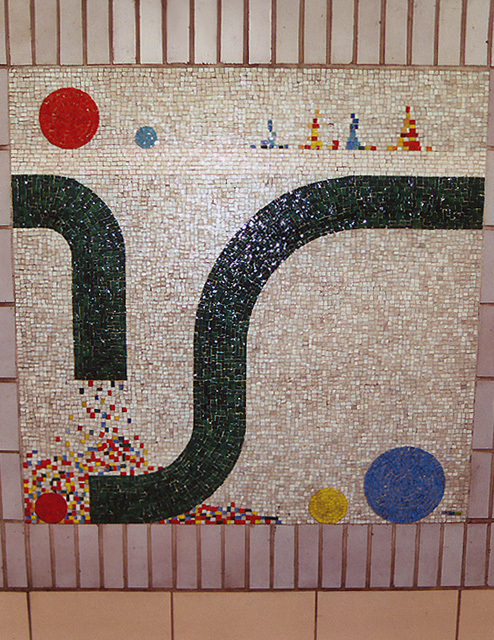
Mosaic in the Pavonia-Newport NJ Path station, April 2007
Pavonia/Newport is a PATH station located on Town Square Place (formerly Pavonia Avenue) at the corner of Washington Boulevard in Newport, Jersey City, New Jersey.
Opened on August 2, 1909 as the Erie station (and later renamed to Pavonia Avenue, a street in the vicinity, until its present name was given in 1988), Pavonia/Newport has undergone a number of transformations. The station was originally constructed to connect to the Erie Railroad Terminal, which stood above the station. (The capitals of the station's columns still display the "E" of the Erie Railroad.) During this period, the station was so busy that a second platform had to be added to manage the flow of passengers from the over 30 passenger trains that ran in and out of the station hourly.
The desire to reuse old caissons (from previous tunneling attempts) when building the H&M system meant that the tubes at this location would be located far inland. As a result, the actual station was not closely integrated into the Erie Railroad Terminal above, and the Erie never got around to building a new terminal on top of the underground platforms. Therefore, a lengthy walk through inclined pedestrian tunnels was necessary in order to connect from the H&M to the passenger trains. In response to this, the Hudson and Manhattan Railroad installed in 1954 a 277-foot long moving sidewalk known as "the Speedwalk". It was the first such moving walkway built in the United States if not the world; built by Goodyear, it moved up a 10 percent grade at a speed of 1.5 mph (2.4 km/h). The walkway was removed within a decade due to significant changes happening above ground.
In 1956, the Erie Railroad consolidated their operations with the Lackawanna Railroad and moved to their terminal in Hoboken. A few years later, the small New York, Susquehanna and Western Railway ceased their operations at the Erie Terminal, which was torn down soon afterwards. Without any reason to disembark other than some informal parking lots, ridership at the Erie tube station declined sharply. For nearly 30 years, the station served primarily as a transfer station from one PATH line to another, and was totally closed on evenings and weekends. (At the former World Trade Center station, it was still possible in 2001 to see the abandoned electronic board that indicated with a light whether the Pavonia Station stop was in service or not.)
Beginning in the late 1980s the once-vacant railyards surrounding the station were turned into residential, office, and retail towers, and the neighborhood would later become known as Newport. As part of the redevelopment, Pavonia Station itself was renamed and underwent extensive renovations, including improved lighting, floors, walls, ceilings, artwork, and the installation of a new headhouse with escalators and elevators. The station underwent further renovations in 2001-2003 with the installation of an additional elevator in order to re-open the side platform to regular use after four decades of inactivity.
The open steelwork beside the headhouse is the skeleton for a never-built second level that was to connect to office towers across the street via a skywalk, similar to those at the Gateway complex at Newark Penn Station.
The Port Authority is currently considering whether to fund a long-proposed second entry to the station on the west side of Washington Boulevard to ease congestion.
A third name change may also be in the station's future, given that this isolated section of Pavonia Avenue has been renamed to Town Square Place. (This was done to avoid confusion with three other sections of Pavonia Avenue elsewhere in Jersey City.)
Text from: en.wikipedia.org/wiki/Pavonia/Newport_(PATH_station)
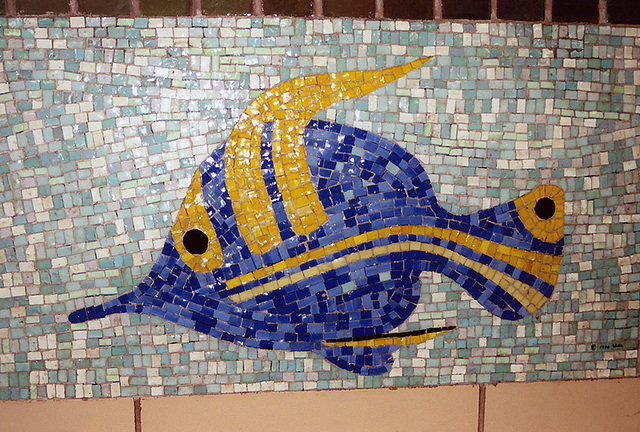
Fish Mosaic in the Pavonia-Newport NJ Path station, April 2007
Pavonia/Newport is a PATH station located on Town Square Place (formerly Pavonia Avenue) at the corner of Washington Boulevard in Newport, Jersey City, New Jersey.
Opened on August 2, 1909 as the Erie station (and later renamed to Pavonia Avenue, a street in the vicinity, until its present name was given in 1988), Pavonia/Newport has undergone a number of transformations. The station was originally constructed to connect to the Erie Railroad Terminal, which stood above the station. (The capitals of the station's columns still display the "E" of the Erie Railroad.) During this period, the station was so busy that a second platform had to be added to manage the flow of passengers from the over 30 passenger trains that ran in and out of the station hourly.
The desire to reuse old caissons (from previous tunneling attempts) when building the H&M system meant that the tubes at this location would be located far inland. As a result, the actual station was not closely integrated into the Erie Railroad Terminal above, and the Erie never got around to building a new terminal on top of the underground platforms. Therefore, a lengthy walk through inclined pedestrian tunnels was necessary in order to connect from the H&M to the passenger trains. In response to this, the Hudson and Manhattan Railroad installed in 1954 a 277-foot long moving sidewalk known as "the Speedwalk". It was the first such moving walkway built in the United States if not the world; built by Goodyear, it moved up a 10 percent grade at a speed of 1.5 mph (2.4 km/h). The walkway was removed within a decade due to significant changes happening above ground.
In 1956, the Erie Railroad consolidated their operations with the Lackawanna Railroad and moved to their terminal in Hoboken. A few years later, the small New York, Susquehanna and Western Railway ceased their operations at the Erie Terminal, which was torn down soon afterwards. Without any reason to disembark other than some informal parking lots, ridership at the Erie tube station declined sharply. For nearly 30 years, the station served primarily as a transfer station from one PATH line to another, and was totally closed on evenings and weekends. (At the former World Trade Center station, it was still possible in 2001 to see the abandoned electronic board that indicated with a light whether the Pavonia Station stop was in service or not.)
Beginning in the late 1980s the once-vacant railyards surrounding the station were turned into residential, office, and retail towers, and the neighborhood would later become known as Newport. As part of the redevelopment, Pavonia Station itself was renamed and underwent extensive renovations, including improved lighting, floors, walls, ceilings, artwork, and the installation of a new headhouse with escalators and elevators. The station underwent further renovations in 2001-2003 with the installation of an additional elevator in order to re-open the side platform to regular use after four decades of inactivity.
The open steelwork beside the headhouse is the skeleton for a never-built second level that was to connect to office towers across the street via a skywalk, similar to those at the Gateway complex at Newark Penn Station.
The Port Authority is currently considering whether to fund a long-proposed second entry to the station on the west side of Washington Boulevard to ease congestion.
A third name change may also be in the station's future, given that this isolated section of Pavonia Avenue has been renamed to Town Square Place. (This was done to avoid confusion with three other sections of Pavonia Avenue elsewhere in Jersey City.)
Text from: en.wikipedia.org/wiki/Pavonia/Newport_(PATH_station)
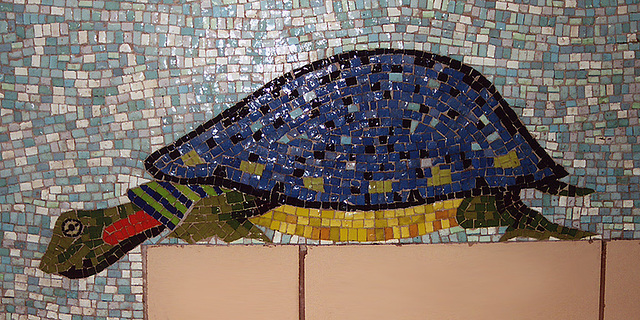
Turtle Mosaic in the Pavonia-Newport NJ Path station, April 2007
Pavonia/Newport is a PATH station located on Town Square Place (formerly Pavonia Avenue) at the corner of Washington Boulevard in Newport, Jersey City, New Jersey.
Opened on August 2, 1909 as the Erie station (and later renamed to Pavonia Avenue, a street in the vicinity, until its present name was given in 1988), Pavonia/Newport has undergone a number of transformations. The station was originally constructed to connect to the Erie Railroad Terminal, which stood above the station. (The capitals of the station's columns still display the "E" of the Erie Railroad.) During this period, the station was so busy that a second platform had to be added to manage the flow of passengers from the over 30 passenger trains that ran in and out of the station hourly.
The desire to reuse old caissons (from previous tunneling attempts) when building the H&M system meant that the tubes at this location would be located far inland. As a result, the actual station was not closely integrated into the Erie Railroad Terminal above, and the Erie never got around to building a new terminal on top of the underground platforms. Therefore, a lengthy walk through inclined pedestrian tunnels was necessary in order to connect from the H&M to the passenger trains. In response to this, the Hudson and Manhattan Railroad installed in 1954 a 277-foot long moving sidewalk known as "the Speedwalk". It was the first such moving walkway built in the United States if not the world; built by Goodyear, it moved up a 10 percent grade at a speed of 1.5 mph (2.4 km/h). The walkway was removed within a decade due to significant changes happening above ground.
In 1956, the Erie Railroad consolidated their operations with the Lackawanna Railroad and moved to their terminal in Hoboken. A few years later, the small New York, Susquehanna and Western Railway ceased their operations at the Erie Terminal, which was torn down soon afterwards. Without any reason to disembark other than some informal parking lots, ridership at the Erie tube station declined sharply. For nearly 30 years, the station served primarily as a transfer station from one PATH line to another, and was totally closed on evenings and weekends. (At the former World Trade Center station, it was still possible in 2001 to see the abandoned electronic board that indicated with a light whether the Pavonia Station stop was in service or not.)
Beginning in the late 1980s the once-vacant railyards surrounding the station were turned into residential, office, and retail towers, and the neighborhood would later become known as Newport. As part of the redevelopment, Pavonia Station itself was renamed and underwent extensive renovations, including improved lighting, floors, walls, ceilings, artwork, and the installation of a new headhouse with escalators and elevators. The station underwent further renovations in 2001-2003 with the installation of an additional elevator in order to re-open the side platform to regular use after four decades of inactivity.
The open steelwork beside the headhouse is the skeleton for a never-built second level that was to connect to office towers across the street via a skywalk, similar to those at the Gateway complex at Newark Penn Station.
The Port Authority is currently considering whether to fund a long-proposed second entry to the station on the west side of Washington Boulevard to ease congestion.
A third name change may also be in the station's future, given that this isolated section of Pavonia Avenue has been renamed to Town Square Place. (This was done to avoid confusion with three other sections of Pavonia Avenue elsewhere in Jersey City.)
Text from: en.wikipedia.org/wiki/Pavonia/Newport_(PATH_station)

Newport Centre Mall in Jersey City, April 2007
Newport Centre Mall is a shopping mall in Jersey City, New Jersey that opened in 1987. One of eleven shopping malls in New Jersey owned by Simon Property Group, Inc., it is located at 30 Mall Drive West, and is bound by Luis Muñoz Marín Boulevard on the west, Mall Drive East on the east, 6th Street on the south, and Newport Parkway on the north. The mall has a gross leasable area of 1,149,147 ft².The one-million plus square-foot regional mall is the first of its size in Hudson County.
There are three floors to the mall complex, which houses a number of stores, including anchor stores JCPenney, Kohl's , Macy's and Sears. The top floor has a food court and a Cineplex Odeon movie theater complex. The mall is a part of the Newport Complex, which includes the Newport Tower, the third tallest building in Jersey City. Both it and the Hudson Mall are in an "Urban Enterprise Zone," reducing the state sales tax on purchases from 7% to 3.5% (with no sales tax on clothing).
Payment is required to park in the mall garage. The mall is easily reachable via the Hudson-Bergen Light Rail and PATH systems, and is terminus point for jitney buses that travel there from the Northern New Jersey towns of Guttenberg, North Bergen, West New York and Union City.
Text from: en.wikipedia.org/wiki/Newport_Centre_Mall
Jump to top
RSS feed- Latest items - Subscribe to the latest items added to this album
- ipernity © 2007-2026
- Help & Contact
|
Club news
|
About ipernity
|
History |
ipernity Club & Prices |
Guide of good conduct
Donate | Group guidelines | Privacy policy | Terms of use | Statutes | In memoria -
Facebook
X
