Title: Musée Guimet Decouvertes Archéologiques en Afghanistan et Indochine
Artist: Jean Buhot
Date: 1938
Culture: France
Medium: Lithographic print mounted on linen
Dimensions: Image: 28 15/16 × 20 1/2 in. (73.5 × 52 cm)
Framed: 31 x 41 x 1 1/2 in. (104.1 x 78.7 x 3.8 cm)
Classification: Prints
Credit Line: Purchase, Carol Collins Malone Gift, 2023
Object Number: 2023.139
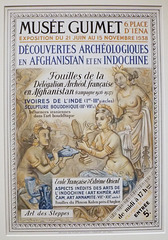
This lithographic poster marks the 1938 exhibition in Paris of objects from the newly excavated city of Begram, in northern Afghanistan. Among the finds were Deccan ivory panels, carved in a hybrid style to appeal to an international clientele, as well as Alexandrian Roman bronzes and painted glass, plaster-cast emblemata or ornaments, and Han-dynasty Chinese lacquer. The French artist Jean Buhot adapted the motif of the aristocratic woman at her toilette, attended by servants, to illustrate the Begram ivory figure types in this poster.
Text from: www.metmuseum.org/art/collection/search/894248
Musee Guimet Poster in the Metropolitan Museum of…
Title: Musée Guimet Decouvertes Archéologiques en Afghanistan et Indochine
Artist: Jean Buhot
Date: 1938
Culture: France
Medium: Lithographic print mounted on linen
Dimensions: Image: 28 15/16 × 20 1/2 in. (73.5 × 52 cm)
Framed: 31 x 41 x 1 1/2 in. (104.1 x 78.7 x 3.8 cm)
Classification: Prints
Credit Line: Purchase, Carol Collins Malone Gift, 2023
Object Number: 2023.139
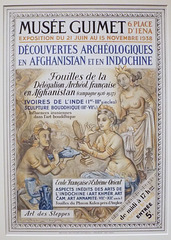
This lithographic poster marks the 1938 exhibition in Paris of objects from the newly excavated city of Begram, in northern Afghanistan. Among the finds were Deccan ivory panels, carved in a hybrid style to appeal to an international clientele, as well as Alexandrian Roman bronzes and painted glass, plaster-cast emblemata or ornaments, and Han-dynasty Chinese lacquer. The French artist Jean Buhot adapted the motif of the aristocratic woman at her toilette, attended by servants, to illustrate the Begram ivory figure types in this poster.
Text from: www.metmuseum.org/art/collection/search/894248
Fragment from a Railing Pillar with the Face of a…
Title: Fragment from a railing pillar with face of a yakshi
Period: Shunga
Date: ca. 150–100 BCE
Culture: India, Bharhut Great Stupa, Satna district, Madhya Pradesh
Medium: Sandstone
Dimensions: H. 9 13/16 in. (25 cm); W. 4 3/4 in. (12 cm); D. 4 5/16 in. (11 cm)
Classification: Sculpture
Credit Line: Lent by National Museum, New Delhi
Object Number: TS.383
This relief of a tree spirit, sharply chiseled to maximize the play of light and shadow, is a rich record of Shunga-era imagery. We see the power imbued in the goddess revealing herself in anthropomorphic form. The distinctive facial markings, likely tattooed, include auspicious solar markings and a hocked device, perhaps an elephant goad. This tool of elephant commanders likely references Indra, the Vedic god of storms, who rides a celestial elephant in the monsoon clouds and brings rain to the earth. The goddess’s markings and jewelry were noted by Alexander Cunningham in 1873 as still worn by local women, nearly two millennia later. The patterned cloth headcover is interwoven with strands of fragrant flowers from the sala tree.
Text from: www.metmuseum.org/art/collection/search/819858
Fragment from a Railing Pillar with the Face of a…
Title: Fragment from a railing pillar with face of a yakshi
Period: Shunga
Date: ca. 150–100 BCE
Culture: India, Bharhut Great Stupa, Satna district, Madhya Pradesh
Medium: Sandstone
Dimensions: H. 9 13/16 in. (25 cm); W. 4 3/4 in. (12 cm); D. 4 5/16 in. (11 cm)
Classification: Sculpture
Credit Line: Lent by National Museum, New Delhi
Object Number: TS.383
This relief of a tree spirit, sharply chiseled to maximize the play of light and shadow, is a rich record of Shunga-era imagery. We see the power imbued in the goddess revealing herself in anthropomorphic form. The distinctive facial markings, likely tattooed, include auspicious solar markings and a hocked device, perhaps an elephant goad. This tool of elephant commanders likely references Indra, the Vedic god of storms, who rides a celestial elephant in the monsoon clouds and brings rain to the earth. The goddess’s markings and jewelry were noted by Alexander Cunningham in 1873 as still worn by local women, nearly two millennia later. The patterned cloth headcover is interwoven with strands of fragrant flowers from the sala tree.
Text from: www.metmuseum.org/art/collection/search/819858
Yaksha Abducting a Woman in the Metropolitan Museu…
Title: Yaksha abducting a woman
Period: Shunga
Date: 1st century BCE
Culture: India, Gangetic region, probably Kaushambi, Uttar Pradesh
Medium: Clay
Dimensions: H. 3 1/4 in. (8.3 cm); W. 2 7/8 in. (7.3 cm); D. 3/8 in. (1 cm)
Classification: Ceramics
Credit Line: Lent by a private collection
Object Number: TS.422
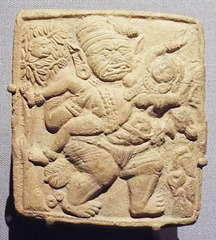
Abduction in times of civil disorder was an ever-present threat to women in early India. This fear found expression in a genre of clay votives that depict a grotesque yaksha stealing a woman from her home and kin. The demon personifies the dangers of the natural world—remote hills, water holes, and rivers. Offerings of meat and alcohol appeased his violent and poisoned nature.
Text from: www.metmuseum.org/art/collection/search/890109
Mauryan Possible Donor Portrait from Sarnath in th…
Title: Portrait of a donor (?)
Period: Maurya
Date: 3rd–2nd century BCE
Culture: India, Sarnath, Uttar Pradesh
Medium: Sandstone
Dimensions: H. 5 in. (12.7 cm); W. 5 3/4 in. (14.6 cm); D. 1 1/2 in. (3.8 cm)
Classification: Sculpture
Credit Line: Lent by National Museum, New Delhi
Object Number: TS.239
Scholars of early India once identified any anonymous renderings of a human as a personified nature spirit; however, it is now clear that portraits of individuals existed alongside images of nature deities. The head seen here was excavated in 1914 at Sarnath, the site of the Buddha’s first sermon. It is distinctive in facial features and style of headdress, suggestive of portraiture. Confidently carved in sharp planes that cast deep shadows, ideal for outdoor installation, it wears a patterned-cloth turban and braided hair. Mauryan north India was in close diplomatic contact with Iranian and Hellenistic cultures, in which portraiture had an established place. The heads from Sarnath may then represent high-status Buddhist donors.
Text from: www.metmuseum.org/art/collection/search/772188
Mauryan Possible Donor Portrait from Sarnath in th…
Title: Portrait of a donor (?)
Period: Maurya
Date: 3rd–2nd century BCE
Culture: India, Sarnath, Uttar Pradesh
Medium: Sandstone
Dimensions: H. 5 in. (12.7 cm); W. 5 3/4 in. (14.6 cm); D. 1 1/2 in. (3.8 cm)
Classification: Sculpture
Credit Line: Lent by National Museum, New Delhi
Object Number: TS.239
Scholars of early India once identified any anonymous renderings of a human as a personified nature spirit; however, it is now clear that portraits of individuals existed alongside images of nature deities. The head seen here was excavated in 1914 at Sarnath, the site of the Buddha’s first sermon. It is distinctive in facial features and style of headdress, suggestive of portraiture. Confidently carved in sharp planes that cast deep shadows, ideal for outdoor installation, it wears a patterned-cloth turban and braided hair. Mauryan north India was in close diplomatic contact with Iranian and Hellenistic cultures, in which portraiture had an established place. The heads from Sarnath may then represent high-status Buddhist donors.
Text from: www.metmuseum.org/art/collection/search/772188
Head of a Man Probably a Yaksha in the Metropolita…
Title: Drum panel with scenes of the Great Departure and Temptation of the Buddha
Period: Ikshvaku period
Date: first half 3rd century CE
Culture: India, Nagarjunakonda, Guntur district, Andhra Pradesh
Medium: Limestone
Dimensions: H. 56 3/4 in. (144.2 cm); W. 36 1/4 in. (92.1 cm); D. 6 in. (15.2 cm); Wt. 854 lbs. (387.5 kg)
Classification: Sculpture
Credit Line: Fletcher Fund, 1928
Object Number: 28.105
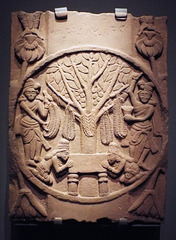
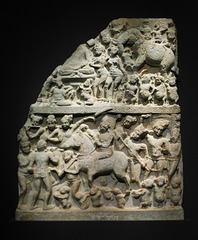
Of the many moments in the life of the historical Buddha told in the canonical biographies, two were especially favored for stupa decoration: the Great Departure and the Temptation. Both narratives are depicted on this drum panel from Nagarjunakonda. Each epitomizes the negation of desire, represented below by Prince Siddhartha’s renunciation of privilege to become an ascetic seeker of knowledge—the beginning of his spiritual journey—and above, by his resistance of the temptations offered by Mara, the force of darkness.
Text from: www.metmuseum.org/art/collection/search/38239
Drum Panel Scenes of the Great Departure and Tempt…
Title: Drum panel with scenes of the Great Departure and Temptation of the Buddha
Period: Ikshvaku period
Date: first half 3rd century CE
Culture: India, Nagarjunakonda, Guntur district, Andhra Pradesh
Medium: Limestone
Dimensions: H. 56 3/4 in. (144.2 cm); W. 36 1/4 in. (92.1 cm); D. 6 in. (15.2 cm); Wt. 854 lbs. (387.5 kg)
Classification: Sculpture
Credit Line: Fletcher Fund, 1928
Object Number: 28.105
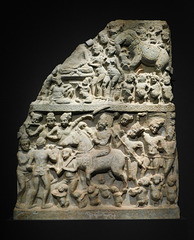
Of the many moments in the life of the historical Buddha told in the canonical biographies, two were especially favored for stupa decoration: the Great Departure and the Temptation. Both narratives are depicted on this drum panel from Nagarjunakonda. Each epitomizes the negation of desire, represented below by Prince Siddhartha’s renunciation of privilege to become an ascetic seeker of knowledge—the beginning of his spiritual journey—and above, by his resistance of the temptations offered by Mara, the force of darkness.
Text from: www.metmuseum.org/art/collection/search/38239
Buddha Footprints in the Metropolitan Museum of Ar…
Title: Buddha footprints (buddhapada)
Period: Ikshvaku
Date: late 3rd–4th century CE
Culture: India, Phanigiri, Suryapet district, Telangana
Medium: Limestone
Dimensions: H. 16 in. (40.6 cm); W. 16 in. (40.6 cm); D. 6 in. (15.2 cm)
Classification: Sculpture
Credit Line: Lent by State Museum Hyderabad
Object Number: TS.199
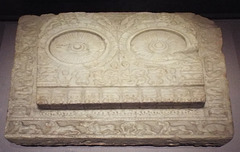
A symbol of the Buddha's presence, a stone slab depicting his footprints (buddhapada) was a regular feature of Buddhist monastic architecture in southern India. In a religious setting, reverence for the footprint alludes to a profound respect for higher knowledge-wisdom, witnessed by devotees prostrating themselves before the feet of a spiritual mentor. This buddhapada was excavated from a semicircular (apsidal) shrine at the Phanigiri monastery. It carries a one-line inscription that honors the donor’s gift and asserts his lineage. The footprints display numerous auspicious marks of a Great Man (mahapurusa), most prominently the Dharma-wheel on the soles of the feet.
Text from: www.metmuseum.org/art/collection/search/772148
Help & Contact|Club news|About ipernity|History|ipernity Club & Prices|Guide of good conduct Donate|Group guidelines|Privacy policy|Terms of use|Statutes|In memoria