


Metropolitan Museum of Art Tudors Exhibition

Folder: Metropolitan Museum of Art

Detail of the Portrait of King Henry VII in the Me…
| |
|

Detail of the Portrait of King Henry VII in the Me…
| |
|
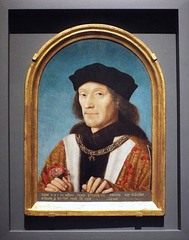
Portrait of King Henry VII in the Metropolitan Mus…
| |
|
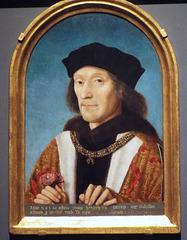
Portrait of King Henry VII in the Metropolitan Mus…
| |
|
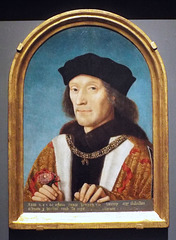
Portrait of King Henry VII in the Metropolitan Mus…
| |
|

Portrait of Henry VII in the Metropolitan Museum o…
| |
|

Heneage Jewel by Hilliard in the Metropolitan Muse…
| |
|

Heneage Jewel by Hilliard in the Metropolitan Muse…
| |
|

Angels Bearing Candlesticks by Benedetto da Rovezz…
| |
|

Angels Bearing Candlesticks by Benedetto da Rovezz…
| |
|
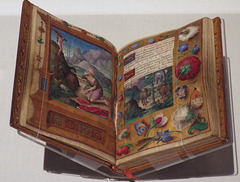
Book of Hours of Mary of England, Queen of France…
| |
|
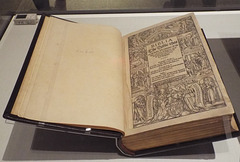
Coverdale Bible in the Metropolitan Museum of Art,…
| |
|
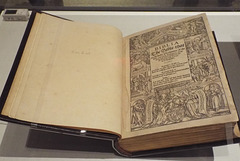
Coverdale Bible in the Metropolitan Museum of Art,…
| |
|
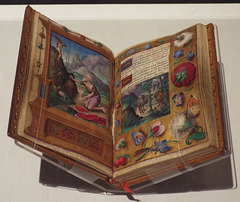
Book of Hours of Mary of England, Queen of France…
| |
|

Detail of the Field Armor for King Henry VIII in t…
| |
|
Title: Field Armor of King Henry VIII of England (reigned 1509–47)
Date: ca. 1544
Geography: Milan or Brescia
Culture: Italian, Milan or Brescia
Medium: Steel, gold, textile, leather
Dimensions: H. 72 1/2 in. (184.2 cm); W. 33 in. (83.8 cm); D. 14 1/2 in. (36.8 cm); Wt. 50 lb. 8 oz. (22.91 kg)
Classification: Armor for Man
Credit Line: Harris Brisbane Dick Fund, 1932
Object Number: 32.130.7a–l
Curatorial Department: Arms and Armor
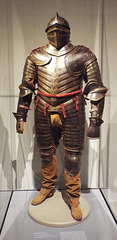
This impressive armor was made for Henry VIII (reigned 1509–47) toward the end of his life, when he was overweight and crippled with gout. Constructed for use both on horse and on foot, it was probably worn by the king during his last military campaign, the siege of Boulogne in 1544, which he commanded personally in spite of his infirmities. Originally, the harness was fitted with a detachable reinforcing breastplate, to which a lance-rest was attached, and a reinforce for the left pauldron (shoulder defense). A pair of exchange vambraces (arm defenses) remains in the Royal Collection at Windsor Castle.
The armor is described in the postmortem inventory of the king’s possessions, drawn up in 1547, as “of italion makinge.” Possibly, it was supplied by a Milanese merchant known in England as Francis Albert, who was licensed by Henry to import luxury goods, including armor, into England for sale. Subsequently, the armor was given to William Herbert (ca. 1507–1570), first earl of Pembroke, Henry’s esquire and an executor of his will. It is recorded at Wilton House, seat of the Pembroke family, from 1558 until it was sold in the 1920s. By the end of the eighteenth century, and until very recently, the armor was erroneously identified as having belonged to Anne de Montmorency (1493–1567), Constable of France, its royal English ownership having been forgotten.
The armor is an early example of the “anime” type, in which the breastplate and backplate are constructed of horizontal overlapping plates connected and made flexible by rivets and internal leather straps. The decoration, consisting of foliage, putti, running dogs, and Renaissance candelabra and grotesque ornament, is typically Italian.
Text from: www.metmuseum.org/art/collection/search/23936
Field Armor for King Henry VIII in the Metropolita…
| |
|
Title: Field Armor of King Henry VIII of England (reigned 1509–47)
Date: ca. 1544
Geography: Milan or Brescia
Culture: Italian, Milan or Brescia
Medium: Steel, gold, textile, leather
Dimensions: H. 72 1/2 in. (184.2 cm); W. 33 in. (83.8 cm); D. 14 1/2 in. (36.8 cm); Wt. 50 lb. 8 oz. (22.91 kg)
Classification: Armor for Man
Credit Line: Harris Brisbane Dick Fund, 1932
Object Number: 32.130.7a–l
Curatorial Department: Arms and Armor
This impressive armor was made for Henry VIII (reigned 1509–47) toward the end of his life, when he was overweight and crippled with gout. Constructed for use both on horse and on foot, it was probably worn by the king during his last military campaign, the siege of Boulogne in 1544, which he commanded personally in spite of his infirmities. Originally, the harness was fitted with a detachable reinforcing breastplate, to which a lance-rest was attached, and a reinforce for the left pauldron (shoulder defense). A pair of exchange vambraces (arm defenses) remains in the Royal Collection at Windsor Castle.
The armor is described in the postmortem inventory of the king’s possessions, drawn up in 1547, as “of italion makinge.” Possibly, it was supplied by a Milanese merchant known in England as Francis Albert, who was licensed by Henry to import luxury goods, including armor, into England for sale. Subsequently, the armor was given to William Herbert (ca. 1507–1570), first earl of Pembroke, Henry’s esquire and an executor of his will. It is recorded at Wilton House, seat of the Pembroke family, from 1558 until it was sold in the 1920s. By the end of the eighteenth century, and until very recently, the armor was erroneously identified as having belonged to Anne de Montmorency (1493–1567), Constable of France, its royal English ownership having been forgotten.
The armor is an early example of the “anime” type, in which the breastplate and backplate are constructed of horizontal overlapping plates connected and made flexible by rivets and internal leather straps. The decoration, consisting of foliage, putti, running dogs, and Renaissance candelabra and grotesque ornament, is typically Italian.
Text from: www.metmuseum.org/art/collection/search/23936
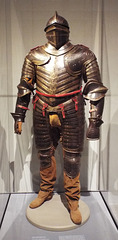
Field Armor for King Henry VIII in the Metropolita…
| |
|
Title: Field Armor of King Henry VIII of England (reigned 1509–47)
Date: ca. 1544
Geography: Milan or Brescia
Culture: Italian, Milan or Brescia
Medium: Steel, gold, textile, leather
Dimensions: H. 72 1/2 in. (184.2 cm); W. 33 in. (83.8 cm); D. 14 1/2 in. (36.8 cm); Wt. 50 lb. 8 oz. (22.91 kg)
Classification: Armor for Man
Credit Line: Harris Brisbane Dick Fund, 1932
Object Number: 32.130.7a–l
Curatorial Department: Arms and Armor
This impressive armor was made for Henry VIII (reigned 1509–47) toward the end of his life, when he was overweight and crippled with gout. Constructed for use both on horse and on foot, it was probably worn by the king during his last military campaign, the siege of Boulogne in 1544, which he commanded personally in spite of his infirmities. Originally, the harness was fitted with a detachable reinforcing breastplate, to which a lance-rest was attached, and a reinforce for the left pauldron (shoulder defense). A pair of exchange vambraces (arm defenses) remains in the Royal Collection at Windsor Castle.
The armor is described in the postmortem inventory of the king’s possessions, drawn up in 1547, as “of italion makinge.” Possibly, it was supplied by a Milanese merchant known in England as Francis Albert, who was licensed by Henry to import luxury goods, including armor, into England for sale. Subsequently, the armor was given to William Herbert (ca. 1507–1570), first earl of Pembroke, Henry’s esquire and an executor of his will. It is recorded at Wilton House, seat of the Pembroke family, from 1558 until it was sold in the 1920s. By the end of the eighteenth century, and until very recently, the armor was erroneously identified as having belonged to Anne de Montmorency (1493–1567), Constable of France, its royal English ownership having been forgotten.
The armor is an early example of the “anime” type, in which the breastplate and backplate are constructed of horizontal overlapping plates connected and made flexible by rivets and internal leather straps. The decoration, consisting of foliage, putti, running dogs, and Renaissance candelabra and grotesque ornament, is typically Italian.
Text from: www.metmuseum.org/art/collection/search/23936

Detail of the Field Armor for King Henry VIII in t…
| |
|
Title: Field Armor of King Henry VIII of England (reigned 1509–47)
Date: ca. 1544
Geography: Milan or Brescia
Culture: Italian, Milan or Brescia
Medium: Steel, gold, textile, leather
Dimensions: H. 72 1/2 in. (184.2 cm); W. 33 in. (83.8 cm); D. 14 1/2 in. (36.8 cm); Wt. 50 lb. 8 oz. (22.91 kg)
Classification: Armor for Man
Credit Line: Harris Brisbane Dick Fund, 1932
Object Number: 32.130.7a–l
Curatorial Department: Arms and Armor
This impressive armor was made for Henry VIII (reigned 1509–47) toward the end of his life, when he was overweight and crippled with gout. Constructed for use both on horse and on foot, it was probably worn by the king during his last military campaign, the siege of Boulogne in 1544, which he commanded personally in spite of his infirmities. Originally, the harness was fitted with a detachable reinforcing breastplate, to which a lance-rest was attached, and a reinforce for the left pauldron (shoulder defense). A pair of exchange vambraces (arm defenses) remains in the Royal Collection at Windsor Castle.
The armor is described in the postmortem inventory of the king’s possessions, drawn up in 1547, as “of italion makinge.” Possibly, it was supplied by a Milanese merchant known in England as Francis Albert, who was licensed by Henry to import luxury goods, including armor, into England for sale. Subsequently, the armor was given to William Herbert (ca. 1507–1570), first earl of Pembroke, Henry’s esquire and an executor of his will. It is recorded at Wilton House, seat of the Pembroke family, from 1558 until it was sold in the 1920s. By the end of the eighteenth century, and until very recently, the armor was erroneously identified as having belonged to Anne de Montmorency (1493–1567), Constable of France, its royal English ownership having been forgotten.
The armor is an early example of the “anime” type, in which the breastplate and backplate are constructed of horizontal overlapping plates connected and made flexible by rivets and internal leather straps. The decoration, consisting of foliage, putti, running dogs, and Renaissance candelabra and grotesque ornament, is typically Italian.
Text from: www.metmuseum.org/art/collection/search/23936
Jump to top
RSS feed- Latest items - Subscribe to the latest items added to this album
- ipernity © 2007-2026
- Help & Contact
|
Club news
|
About ipernity
|
History |
ipernity Club & Prices |
Guide of good conduct
Donate | Group guidelines | Privacy policy | Terms of use | Statutes | In memoria -
Facebook
X
