

Tudor Building in Southwark, London, 2004
The Reconstructed Globe Theatre in London, 2004
View of Tower Bridge from the Tower of London, 200…
Kings Cross Platform 9 3/4 in London, 2004
Escalators in the Trocadero in London, 2004
The Escalators in the Trocadero in London, March 2…
Piccadilly Circus, March 2004
Fountain, Picadilly Circus & Haymarket, 2004
Column in front of Temple Church in London, March…
Temple Church in London, 2005
Temple Green in London, March 2005
The Royal Courts in London, March 2005
The Royal Courts in London, March 2005
Chinatown Gate in London, March 2005
Chinatown Gate in London, March 2005
The Lucas Arms Pub near Kings Cross in London, Apr…
H&M and Forever 21 in London, April 2013
Marks & Spencer in London, April 2013
Chinese Restaurant in London, April 2013
Piccadilly Circus in London, April 2013
Piccadilly Circus in London, April 2013
Piccadilly Circus in London, April 2013
We Will Rock You, West End Show in London, April 2…
The National Union of Journalists in London, April…
Telephone Booth in Front of the British Museum in…
Detail of Tower Bridge in London, April 2013
Detail of Tower Bridge in London, April 2013
Detail of Tower Bridge in London, April 2013
View of London from Tower Bridge, April 2013
We Will Rock You, West End Show in London, April 2…
See also...
Keywords
Authorizations, license
-
Visible by: Everyone -
All rights reserved
-
515 visits
Bear-Baiting Ring in Southwark, London, 2004
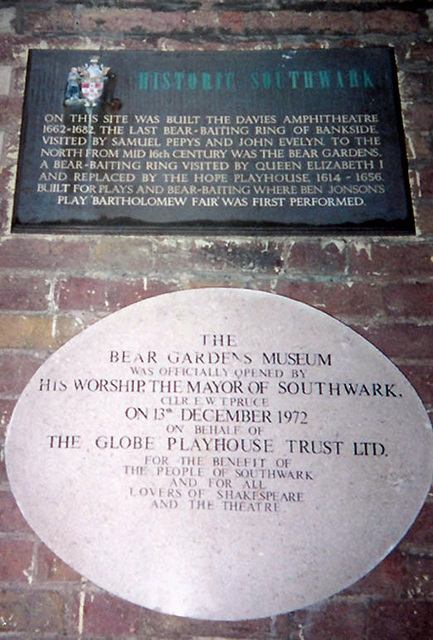

Bear-baiting is a blood sport involving the baiting of bears.
In the most well-known form, there were purpose-built arenas for the entertainment, called in England bear-gardens, consisting of a circular high fenced area, the "pit", and raised seating for spectators. A post would be set in the ground towards the edge of the pit and the bear chained to it, either by the leg or neck. The dogs would then be set on it, being replaced as they tired or were wounded or killed. For a long time, the main bear-garden in London was the Paris Garden at Southwark.
In England, from the 16th century, many herds of bears were maintained for baiting. Henry VIII was a fan and had a pit constructed at Whitehall. Elizabeth I was also fond of the entertainment; it featured regularly in her tours. In 1575, a baiting display for her had thirteen bears, and when an attempt was made to ban baiting on Sundays, she overruled Parliament. A variation was "the whipping of a blinded bear" and certain other animals were also baited, especially bulls but also on one curious occasion a pony with an ape tied to its back was baited and a spectator described that "...with the screaming of the ape, beholding the curs hanging from the ears and neck of the pony, is very laughable".
Attempts to end the entertainment were first made in England by the Puritans, with little effect. In 1849, Thomas Babington Macaulay wrote, "The Puritan hated bearbaiting, not because it gave pain to the bear, but because it gave pleasure to the spectators." The deaths of a number of spectators, when a stand collapsed at the Paris Gardens on January 12, 1583 was viewed by early Puritans as a sign of God's anger, not because of the cruelty but because the bear-baiting was taking place on a Sunday. [1]
By the late 17th century "the conscience of cultivated people seems to have been touched", but it was not until 1835 that baiting were prohibited by Parliament, a ruling that was soon extended across the Empire. Baiting is banned worldwide but can still be found in parts of the Middle East and Pakistan.
Text from Wikipedia: en.wikipedia.org/wiki/Bear-baiting
In the most well-known form, there were purpose-built arenas for the entertainment, called in England bear-gardens, consisting of a circular high fenced area, the "pit", and raised seating for spectators. A post would be set in the ground towards the edge of the pit and the bear chained to it, either by the leg or neck. The dogs would then be set on it, being replaced as they tired or were wounded or killed. For a long time, the main bear-garden in London was the Paris Garden at Southwark.
In England, from the 16th century, many herds of bears were maintained for baiting. Henry VIII was a fan and had a pit constructed at Whitehall. Elizabeth I was also fond of the entertainment; it featured regularly in her tours. In 1575, a baiting display for her had thirteen bears, and when an attempt was made to ban baiting on Sundays, she overruled Parliament. A variation was "the whipping of a blinded bear" and certain other animals were also baited, especially bulls but also on one curious occasion a pony with an ape tied to its back was baited and a spectator described that "...with the screaming of the ape, beholding the curs hanging from the ears and neck of the pony, is very laughable".
Attempts to end the entertainment were first made in England by the Puritans, with little effect. In 1849, Thomas Babington Macaulay wrote, "The Puritan hated bearbaiting, not because it gave pain to the bear, but because it gave pleasure to the spectators." The deaths of a number of spectators, when a stand collapsed at the Paris Gardens on January 12, 1583 was viewed by early Puritans as a sign of God's anger, not because of the cruelty but because the bear-baiting was taking place on a Sunday. [1]
By the late 17th century "the conscience of cultivated people seems to have been touched", but it was not until 1835 that baiting were prohibited by Parliament, a ruling that was soon extended across the Empire. Baiting is banned worldwide but can still be found in parts of the Middle East and Pakistan.
Text from Wikipedia: en.wikipedia.org/wiki/Bear-baiting
- Keyboard shortcuts:
Jump to top
RSS feed- Latest comments - Subscribe to the comment feeds of this photo
- ipernity © 2007-2025
- Help & Contact
|
Club news
|
About ipernity
|
History |
ipernity Club & Prices |
Guide of good conduct
Donate | Group guidelines | Privacy policy | Terms of use | Statutes | In memoria -
Facebook
X

Sign-in to write a comment.