

Justfolk's photos

Road under road
| |
|
The underroad is probably a hundred years old. The overroad is about
forty years old.

The flies find them first
| |
|
There were a dozen flies, mostly near its feet, when I saw this gull
first. When I moved in for the shot all but one disappeared. I think
it was hit by a passing car or truck.

Corner
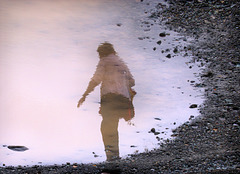
Puddle
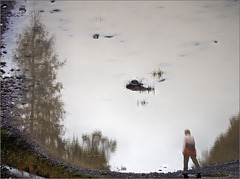
Another world upside-down
| |
|
We were on a dirt road we often walk the length of and back. My wife
was on the other side of a large puddle. This is just the picture
turned upside-down.
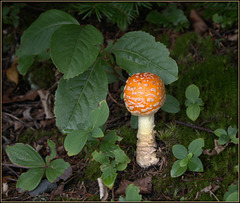
Amanita muscaria
| |
|
|
Amanita muscaria is probably the most easily seen mushroom around
these parts at this time of year, late summer. They were the very
first mushrooms I learnt how to recognise, and very recogniseable they
are.
Most of our A. muscaria specimens mature into bright yellow caps,
unlike (I think) most of the rest of the world where the mature cap is
a bright red. The young mushrooms are often quite deeply orange, like
this one, and some are even red.
I have never used them as fly bait, but they are also called "fly
agaric" for their ablity to attract and kill house flies. Has anyone
reading this tried it?
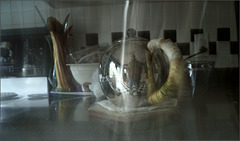
A second in my teapot
| |
|
|
|
My teapot has seen better days. Or at least its handle has. The pot
itself is practically indestructible, despite being used three or four
times a day every day.
Family snap
Coming back down the hill
| |
|
|
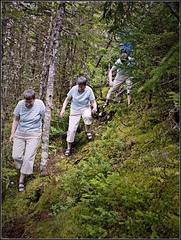
This is my sister and, the flash of blue behind her, her son. We'd just been up this steep path to a lookout and were coming down.
The picture was a bit of a laugh which I sent her the next day.

Family obsession
| |
|
|
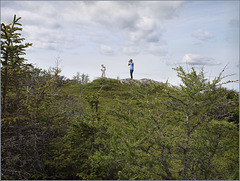
Here are my sister and her son. We were all taking pictures.
This harbour was officially (and locally) known as Fox Harbour, but a
hundred years ago the Newfoundland Post Office got fed up with so many
coves named Fox Harbour (and Long Pond, Caplin Cove, Freshwater, etc.)
that they asked most of them to change their names. Being the harbour
right at the entrance to, and on the south side of, Southwest Arm of
Trinity Bay, the people of this Fox Harbour chose the rather
unlocal-sounding name Southport. Unlocal was what the Post Office
wanted -- so that it would be different from all the other
communities.
A hundred years later it is still Southport, though the name Fox
Harbour was kept in the name of the island just at the left: Fox
Harbour Island, or just Fox Island. No one lived there so the Post
Office didn't care. Just before I took this picture, my sister
pointed out that our ancestors had settled on another Fox Island in
Trinity Bay, but about forty km northeast of this spot. That was in
the 17th century.

E and C clapboarding
| |
|
Our neighbours and friends E and C at work putting clapboard on the
new porch they built on our house. This was nearly a month ago when
it was still hot weather. It got to 32 and higher right there. We had
the hottest July on record, followed by what for some communities is
the wettest August on record. Fish-tailing weather these days.

And, just to prove her point . . .

Bluebells
| |
|
|
|
These are one of the campanula species and are known as bluebells
around these parts. Apparently some people elsewhere call them
harebells. I'm sticking with bluebells. Around here they are a
coastal flower, growing out of anything near the water: soil, grasses,
rocks -- here they are growing in a natural meadow about ten metres
from the Atlantic Ocean.

"Slippery"? TMI?

Wasps in my mast
| |
|
|
We had noticed that there were a lot of wasps around and they were
doing a lot of wood shaving on our back deck. But we didn't notice,
until it was this big, the wasp nest in our electrical service mast.
I usually have a strong feeling of live-and-let-live about wasps, but
we're getting rid of this nest.

Jack in the rain
| |
|
I took these two pictures a moment apart but without the presence of
mind of setting the exposure manually. That would have kept close the
colour and brightness at the join. But, being the half-full/lemonade
sort of guy I am, I put them together anyway. Excuse all the
vignetting; that's my current obsession.
This was on our hike up through Motion Bay two days ago.

Coprology? Is that the word?
| |
|
|
A friend of mine spent a couple of summers as a university student
collecting and analysing turds of wild animals. "Scat," he'd say, "or
traces. Not turds." At the same time another friend studying
archaeology got interested in the preserved turds of earlier peoples.
"Coprolites," he'd say. "Not turds." I don't know anymore -- if I
did back then -- what the proper name for the study of such things is:
coprology seems as good as any other name. Those conversations, forty
years ago, made me into an amateur coprologist -- at least when I am
in the wild. I am always wondering, "Who left this behind?"
My walking friends and I discussed this one. A possibility was that it
was not a turd at all, but something coughed up, as it were, by an owl
or the like. I don't think so. It has no signs of feather, hair or
bone: just seeds and berries. It was about 5 cm long and almost 2 cm
across at the widest. A second one I did not take a picture of was
somewhat bigger again. A large vegan owl, perhaps, but more likely
something with four legs.

At the cape
| |
|
We were just finishing our 11 km walk to Cape Spear when these two
women asked if we could take their picture. I was glad to, taking a
few with their telephone and two with my own camera. We chatted and
went our own ways, but I wish I'd got their names so I could have sent
them this one.
