Justfolk's photos
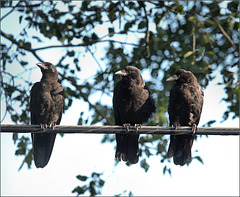
Three corbies
| |
|
These are a parent (in the middle) and, I think, two new crowlets in our
neighbourhood.
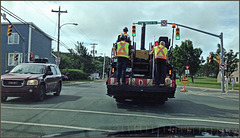
Truck's arse
| |
|
In my continuing accounting of trucks' arses, I was excited to see this
lovely truck's arse crossing an intersection in front of me this morning.
But I was disappointed to have, just five minutes before, reached the end
of the roll of fifteen-years-expired film in the camera on the seat next to
me. So I had to use my telephone to take a picture. Since I really wanted
to have it on film, I dolled up the picture to look a little like what my
expired colour film might have done.
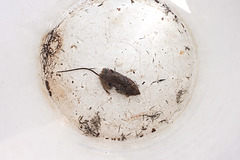
Ex-mouse
| |
|
I was cleaning out a storage shed and, at the back, was an empty, uncovered
twenty-litre bucket. At least, I thought it was empty. But, some time ago,
a mouse had jumped or fallen from the rafters into the bucket. And he
could not get out. His body was largely eaten from the inside, I assume by
fly maggots. And his empty carcase eventually dessicated.

The fledgling losing his fledging feathers
| |
|
I think this is the same bird who showed me his back filled with fledging
feathers two days ago. Today, he has a lot fewer, so he is looking more like
an adult. But his neck is still skinny, and his face still shows signs of
being a young bird.

Show me
| |
|
|
So, I says to the young one out there bawling at her mother who's down
below picking at the peanuts, I says, "Show us yer feathers."
So she turns around, she does, and she puts 'em up.

My pet liverwort
| |
|
While waiting for some nasturtiums to grow out and fill a flower pot left
over from last year, I noticed this growing there. I had no idea what it
was so I posted a picture of it to a local Wildflowers groups. Of course
someone told me right away it is Marchantia, a well-known liverwort. I
like it, so I've been keeping it protected the past couple of weeks. It's
about three cm across now.
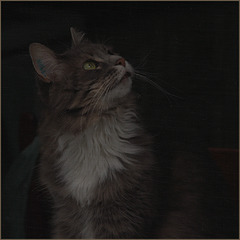
The cat watching birds flying over the neighbour's…
| |
|
I was outside but the cat was inside. She saw the birds over my shoulder,
the ones coming in for a feed of worms eating the leaves on the trees.

Cedar waxwing at supper and extremely underexposed
| |
|
A couple of hours ago, it was getting ready to rain and this cedar
waxwings, with three others, had appeared in our garden to eat the leaf
worms in the trees.
I'm not sure exactly how many stops of underexposure I gave this picture;
probably five. I had forgotten the camera was set at 1/8000 second and,
even though the ISO was high (640) and the aperture wide open (f/2.8), it
wasn't very bright out.
So, it was badly under-exposed. When I first looked at the picture on my
computer it was a black rectangle. I jammed up the brightness, cropt
tightly, adjusted contrast & sharpening, and got this, which looks almost
like the kind of pictures I like so much from expired film. So I gave it a
frame.
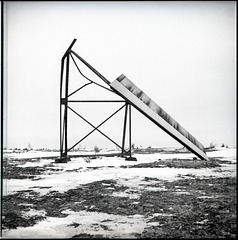
Another view of that tower, on the same day
| |
|
I just posted a picture of this tower, along with an explanation of it.
Here is a different view of it, taken the same foggy day in February 1991.
Ilford FP4 in my Flexo camera. By the way, I accidentally used developer
made 1:7 from concentrate HC100, rather than from stock HC110 in processing
this film. Duhh. That made the developer four times as strong as it should
have been, and probably made for the odd tone this has. A pleasant tone,
methinks.
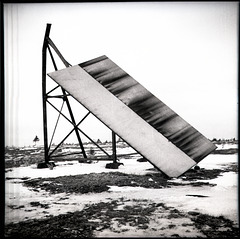
Old technical innovation
| |
|
In the 1980s, I was taking pictures of radio towers. I still do, from time
to time, but they don't change much so I don't make hikes to towers on spec
anymore.
This was a "reflecting tower" for the first local television station in St
John's. The engineer (who I interviewed in the early 1980s) was asked in
1954 to get the signal from the studio, nearly downtown, to the
transmitting tower which was behind a hill five miles to the west. So he
came up with the brilliant idea of building a screen, about thirty feet
high, at the top of another hill, visible to both studio and tower, and
reflecting the (I think) 900 MHz studio signal off it. It worked.
This was the reflecting tower. In the late seventies the station didn't
need it any more (they moved their studio) and it fell into disrepair. I
started documenting its crumble into rust.
This picture was taken in February 1991. Someone had recently put a cable
around the screen and, tied to their truck, hauled it down to the ground.
Ilford FP4 film in my Flexo 6x6cm camera.
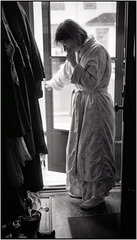
Out one cat, in the other
| |
|
I continue to scan my old negatives, here one from November 1989, my wife
trying to convince one of our cats to come in and another to go out.

Young crow getting the dinosaur dance moves down
| |
|
I guess it is a little like young people learning heritage dances, like
step dance or square dance, when a young crow starts to hop around on the
line looking more or less like his dinosaur ancestors. This is one of, I
think, three new additions to our neighbourhood murder.
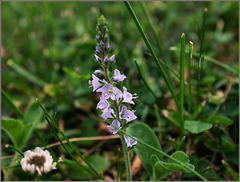
Speedwell, I'm told
| |
|
|
We've apparently got at least two species of speedwell growing at the front
of our house. There's a deep blue one off in one corner, covering about 4
square metres. And there's this more violet one off in another corner,
covering a couple of metres. I never knew either's name before this year.
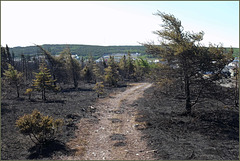
Forest fire stopt
| |
|
Ninety-odd years ago, my grandfather bought a piece of land five miles out of town, and he took his family to live there -- with no electricity, no car, and no running water. They were on a piece of ground that had had some gardens, so he and my father started making gardens themselves. They dug wells and carried water by hand. He bought a horse and my grandmother used that mostly to get to town. My father soon bought a car and he got back and forth that way.
Gradually, during the past two or three decades, my grandfather's land and all the land around it have been changed by housing and commercial developers. Although taxes forced the family to sell a lot of it, we still own a rump piece, a piece of forested land that acts as a green buffer to a neighbourhood of new bungalows. But it feels and sounds very much like part of the city when I go there.
Yesterday, in the middle of some hot dry weather with a very strong wind, a fire started near an illegal shack that teenagers had built, hidden in our woods. The wind took the fire most of a kilometre along our woods and the adjacent properties, literally to the doorsteps of some new houses. Some houses lost their wooden decks to the fire and suffered melted plastic siding. But the firefighters put the fire out pretty readily.
This morning I walked around to see how much damage there was. Nature is pretty resilient and I suspect the couple of hectares of fire damage on our property won't be long in greening up again.

Young blue jay
| |
|
For three or four days we've had three fledgling bluejays hanging around,
learning from their parents how to beg for, eat, and hide, peanuts. This
is one of the bolder ones.
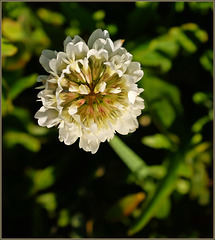
White clover
| |
|
|
Walking along St John's's downtownest street, Water Street, two evenings
ago , I saw there was lotsa clover in bloom.

Ornithogalum umbellatum, Grass lily
| |
|
For most people, night-time is not a time to take pictures of flowers since
so many of them close up shop. This is a good example, the grass lily (or
Star-of-Bethlehem if you like names with religious significance). In the
daylight, each of these flowers opens up spectacularly, but at night they
close up for their nap. One of the names apparently for this is Nap-at-noon
and I have no idea why since it appear wide awake in the day.
It's natively a European and North African species but it has spread to
North America. The distribution map at Wikipedia doesn't show
Newfoundland, but there are plenty of examples of it here. Like this one,
in my friend's garden in St John's.