

San Francisco, California

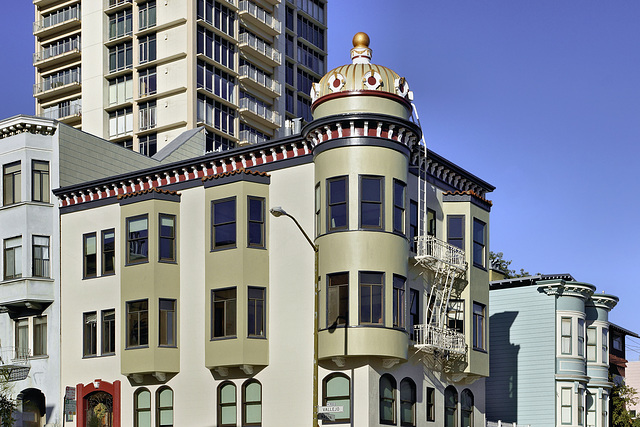

Mason Street at Vallejo – San Francisco, California
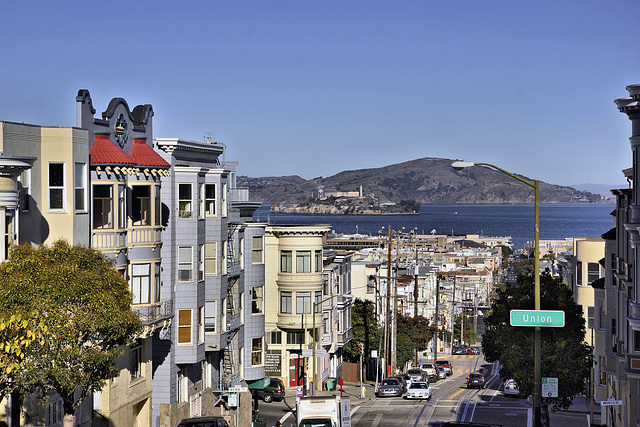
Alcatraz Island – Viewed from Mason and Union Streets, San Francisco, California
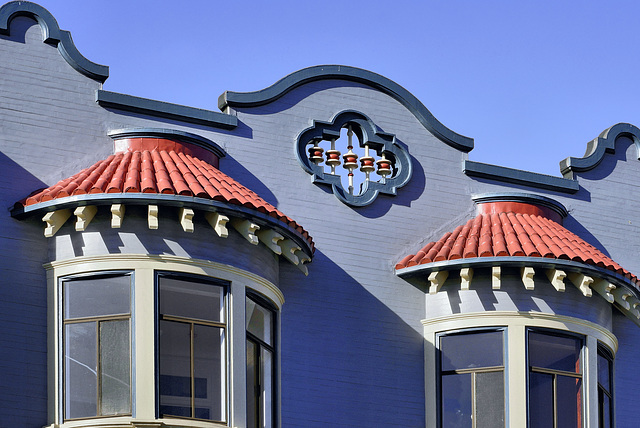
Masonic Cymbalism – Mason Street near Union, San Francisco, California
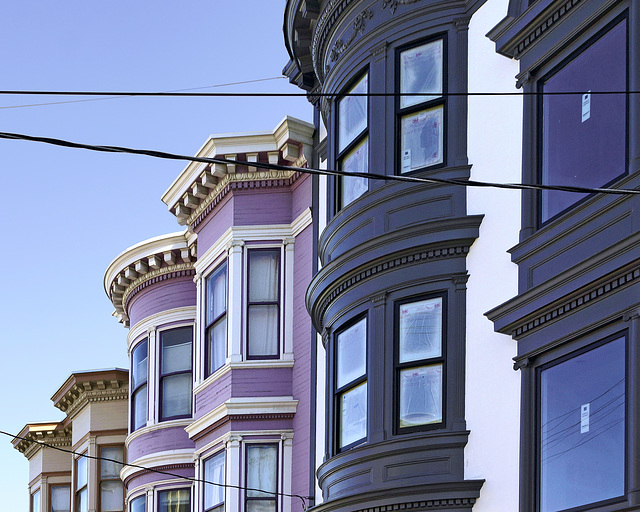
For Oriels Fans – Mason Street near Union, San Francisco, California
If this were Baltimore, would these be Oriole windows?
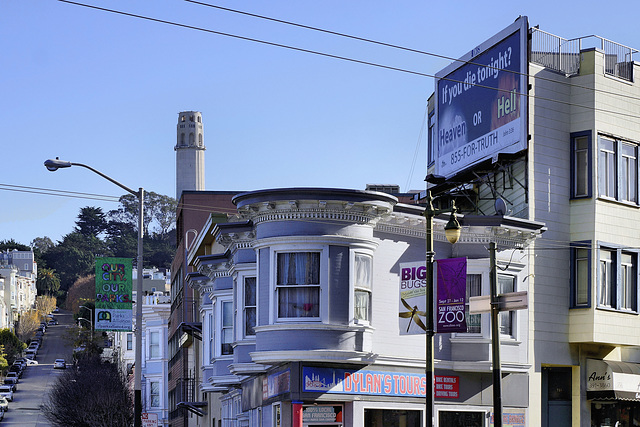
Heaven, Hell and the Coit Tower – Seen from Columbus Avenue at Greenwich Street, San Francisco, California
The Coit Tower (yes, it really is called by that name), also known as the Lillian Coit Memorial Tower, is a 210-foot (64 m) tower in the Telegraph Hill neighbourhood of San Francisco, California. The tower, in the city’s Pioneer Park, was built in 1933 using Lillie Hitchcock Coit’s bequest to beautify the city of San Francisco.
Lillie Hitchcock Coit was a wealthy socialite who loved to chase fires in the early days of the city’s history. Before December 1866, there was no city fire department, and fires in the city, which broke out regularly in the wooden buildings, were extinguished by several volunteer fire companies. Lillie Coit was one of the more eccentric characters in the history of North Beach and Telegraph Hill, smoking cigars and wearing trousers long before it was socially acceptable for women to do so. She was an avid gambler and often dressed like a man in order to gamble in the males-only establishments that dotted North Beach.
Lillie’s fortunes funded the monument four years following her death in 1929. She had a special relationship with the city’s firefighters. At the age of fifteen she witnessed the Knickerbocker Engine Co. No. 5 in response to a fire call up on Telegraph Hill when they were shorthanded, and threw her school books to the ground and pitched in to help, calling out to other bystanders to help get the engine up the hill to the fire, to get the first water onto the blaze. After that Lillie became the Engine Co. mascot and could barely be constrained by her parents from jumping into action at the sound of every fire bell. In October 1863, she was made an honourary member of the engine company. She then rode along with the firefighters when they went to a fire or were in parades, and attended their annual banquets.

The Transamerica Pyramid – Viewed from Stockton Street at Green Street, San Francisco, California
The Transamerica Pyramid is the tallest skyscraper in the San Francisco skyline. The building no longer houses the headquarters of the Transamerica Corporation, who moved their U.S. headquarters to Baltimore, Maryland, but it is still associated with the company and is depicted in the company’s logo. At 853 ft (260 m), on completion in 1972 it was the eighth tallest building in the world.
The Transamerica building was commissioned by Transamerica CEO John (Jack) R. Beckett, with the claim that he wished to allow light in the street below. It is built on the site of the historic Montgomery Block, San Francisco’s first fireproof and earthquake resistant building, which came to be known as a Bohemian centre from the late 19th to the middle of the 20th century. Designed by architect William Pereira, it faced opposition during planning and construction and was sometimes referred to by detractors as "Pereira’s Prick". The building is evocative of San Francisco and has become one of the many symbols of the city. John King of the San Francisco Chronicle summed up the improved opinion of the building in 2009 as "an architectural icon of the best sort - one that fits its location and gets better with age."
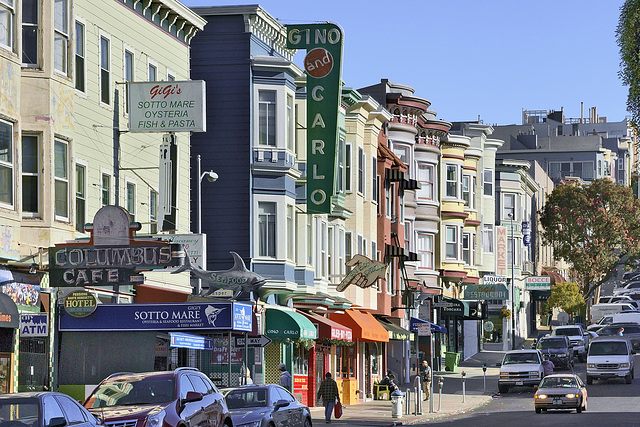
Green Street Near Columbus Avenue – San Francisco, California
Telegraph Hill (elevation 275 feet – 84 meters) is a neighbourhood in San Francisco, California. It is one of San Francisco’s 44 hills, and one of its original "Seven Hills." The neighbourhood is bounded by Vallejo Street to the south, Sansome Street to the east, Francisco Street to the north and Powell Street and Columbus Avenue to the west, where the southwestern corner of Telegraph Hill overlaps with the North Beach neighborhood.
Originally named Loma Alta ("High Hill") by the Spaniards, the hill was then familiarly known as Goat Hill by the early San Franciscans, and became the neighborhood of choice for many Irish immigrants. From 1825 through 1847, the area between Sansome and Battery, Broadway and Vallejo streets was used as a burial ground for foreign non-Catholic seamen.
The hill owes its name to a semaphore, a windmill-like structure erected in September 1849, for the purpose of signaling to the rest of the city the nature of the ships entering the Golden Gate. Atop the newly built house, the marine telegraph consisted of a pole with two raisable arms that could form various configurations, each corresponding to a specific meaning: steamer, sailing boat, etc. The information was used by observers operating for financiers, merchants, wholesalers and speculators. Knowing the nature of the cargo carried by the ship they could predict the upcoming (generally lower) local prices for those goods and commodities carried. Those who did not have advance information on the cargo might pay a too-high price from a merchant unloading his stock of a commodity — a price that was about to drop. On October 18, 1850, the ship Oregon signaled to the hill as it was entering the Golden Gate the news of California’s recently acquired statehood.
The pole-and-arm signals on the Telegraph Hill semaphore became so well known to townspeople that, according to one story, during a play in a San Francisco theater, an actor held his arms aloft and cried, "Oh God, what does this mean?," prompting a rogue in the gallery to shout, "Sidewheel steamer!," which brought down the house. Sailing ships brought cargo to San Francisco, but needed ballast when leaving. Rocks for ballast were quarried from the bay side of Telegraph Hill. Exposed rock from this quarrying is still visible from the Filbert Steps and from Broadway, where there was a large landslide on February 27, 2007 that damaged property and forced the evacuation of many residents. A redundant station was built at Point Lobos in 1853. However, with the advent of the electrical telegraph in 1862, the system quickly became obsolete and was eventually dismantled, but the hill and its surrounding neighborhood have retained the name of Telegraph Hill. Telegraph Hill is now registered as California Historical Landmark #91, marking the location of the original signal station. In the 1920s, Telegraph Hill became with North Beach a destination for poets and bohemian intellectuals, dreaming of turning it into a West Coast West Village.
Today Telegraph Hill is known for supporting a flock of feral parrots, primarily Red-masked Parakeets (Aratinga erythrogenys), descended from escaped or released pets. The flock was popularized by a book and subsequent documentary (2003), both titled The Wild Parrots of Telegraph Hill. The birds, known in the bird trade as Cherry-headed Conures, are native to Peru and Ecuador; they have established a breeding colony, with the support of some residents, as reported in the film The Wild Parrots of Telegraph Hill, and through the help of volunteers with Mickaboo Companion Bird Rescue. They range widely, including along The Embarcadero and in the Presidio. A controversial San Francisco city ordinance passed on June 5, 2007, prohibits the feeding of parrots in public spaces. The feeding ban was championed by Mark Bittner, the birds’ most outspoken supporter who fed them for years and wrote the book The Wild Parrots of Telegraph Hill. Other local conservationists also supported the ban, though some residents continue to object.
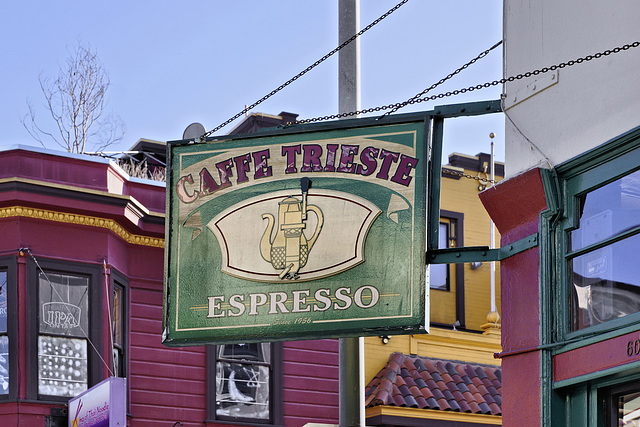
Caffè Trieste – Vallejo Street at Grant Avenue, San Francisco, California
Caffè Trieste was opened in 1956 by Giovanni Giotta (aka "Papa Gianni"), who in 1951 had emigrated to the United States from the small fishing town of Rovigno in Istria (a region – now part of Croatia – that was part of Italy until after World War II). Missing the espresso houses of Trieste, Italy, Giotta opened his own cafe. Caffè Trieste is said to be the first espresso house on the West Coast.
The original Caffè Trieste in San Francisco’s North Beach quickly became popular among the neighborhood’s primarily Italian residents. "It was all Italian people," Giotta said of the neighborhood, "But I got the American people to like cappuccino." Papa Gianni Giotta is known as "The Espresso Pioneer," earning the label by having brought Espresso and Cappuccino to the West Coast, thus starting the Espresso Movement seen today.
The Caffè Trieste also becomes a convenient meeting place for Beat movement writers like Lawrence Ferlinghetti (still a regular), Alan Watts, Jack Kerouac, Allen Ginsberg, Richard Brautigan, Bob Kaufman, Gregory Corso, Michael McClure, Kenneth Rexroth and Neeli Cherkovski, who lived in North Beach in the 1950s and 1960s. Jack Hirschman, former Poet Laureate of San Francisco, has also been a regular patron. In addition to other writers and poets, painters such as Peter Le Blanc and Don Moses and photographers Joe Rosenthal ( a Pulitzer Prize Winner) and Jimo Perini, other celebrities counting themselves among the Trieste aficionados include Bill Cosby, Paul Kantner, Liam Mayclem, Joey Reynolds and Mal Sharpe, to name a few. In 1972, Francis Ford Coppola wrote much of the screenplay for The Godfather while sitting in the Caffè Trieste. The Caffè has been featured in several movies, on television, radio, in magazines, and in dozens of photography, tourism and other books, ranging from local to national and international in scope.

The Stinking Rose – Columbus Avenue between Vallejo and Broadway, San Francisco, California
A great concept; a great sign; a great slogan; and a great city – but unfortunately the restaurant scores badly in the opinion of those of its patrons who have bothered to vote on Urban Spoon.
Jump to top
RSS feed- Latest items - Subscribe to the latest items added to this album
- ipernity © 2007-2026
- Help & Contact
|
Club news
|
About ipernity
|
History |
ipernity Club & Prices |
Guide of good conduct
Donate | Group guidelines | Privacy policy | Terms of use | Statutes | In memoria -
Facebook
X
