

I'd Walk a Mile for a Camel – Golden Gate Park, Sa…
Eve Sans Apple (After Trazetta, the Master) – Clar…
Subway Car – Smithsonian American Art Museum, Wash…
Ant Wars – Clarion Alley, Mission District, San Fr…
Ekspozicio de lignaj ludiloj
Svitavy - historia tolaĵlavado dum la Muzea nokto…
Rara mumio de egipta princino en la Urba Muzeo en…
Litomyšl - Portmoneum
Alkemia laboratorio en la kastelo Moravská Třebová…
Vera kankano en Esperanto-muzeo!
Jurassic – Clarion Alley, Mission District, San Fr…
Aztec Football – 19th Street near Mission Street,…
After the Storm – Balmy Alley, Mission District, S…
The Sun – Balmy Alley, Mission District, San Franc…
Father Richard Purcell, In Loving Memory – Balmy A…
Manjushri – Balmy Alley, Mission District, San Fra…
500 Years of Native Survival – Balmy Alley, Missio…
The Number 14 Bus Blasting Off – Balmy Alley, Miss…
STTES[14] - "King of the Road"
"The Ole Barn Dance ... Music by the 'Mountin' Boy…
"Laffing Sal" – Musée Méchanique, Pier 45, Fisherm…
Life Complements Art – Palace of Fine Arts, Marina…
Lines and Curves – Palace of Fine Arts, Marina Dis…
Musée du Louvre de Lens
Musée du Louvre de Lens
With Your Hearts of Stone – Gift Shop, M.H. de You…
The M.H. de Young Museum – Hagiwara Tea Garden Dri…
Dinosaur
Arthur Putnam's Sphinx – M.H. de Young Museum, Gol…
BEAUBOURG METZ
KHT - SRR Display
WR (O&A) - rudder on view
Miau-miau
Foyer of Performing Arts Museum.
WR (O&A) - at Seaham
TiG - Charabanc
Bonsai Boxwood – United States Botanic Garden, Was…
"Blue Tango" – United States Botanic Garden, Washi…
Big Bad Bug – Le jardin de verre et de métal, Bot…
Metallic Lady Bug – Le jardin de verre et de méta…
A Metallic Ant – Le jardin de verre et de métal,…
Gaudi's Salamander – Mosaïcultures Internationales…
Bees: A Source of Life – Mosaïcultures Internation…
The Bird Tree #2 – Mosaïcultures Internationales d…
The Bird Tree #1 – Mosaïcultures Internationales d…

Location
Lat, Lng:
You can copy the above to your favourite mapping app.
Address: unknown
You can copy the above to your favourite mapping app.
Address: unknown
See also...
See more...
Keywords
Authorizations, license
-
Visible by: Everyone -
All rights reserved
-
851 visits
The Hagiwara Gate – Japanese Tea Garden, Golden Gate Park, San Francisco, California
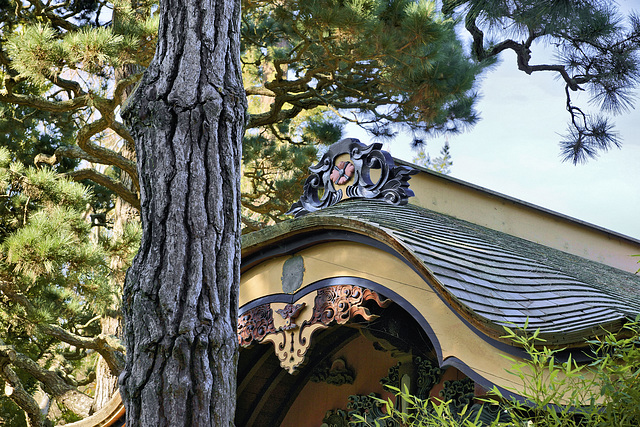

While the majority of the Golden Gate Park design and growth is credited to a man, who is said to have planted two million trees in his lifetime, John McLaren allowed another to design and groom the Japanese Tea Garden. In 1894 a "Japanese Tea Garden" was established to showcase a Japanese Village for the California Midwinter International Exposition (also referred to as the World’s Fair).
In an attempt to share a piece of his culture, an affluent Japanese landscape designer named Makoto Hagiwara wished to transform the temporary World’s Fair exhibit into a permanent fixture of the Golden Gate Park. In the end, Hagiwara was responsible for erecting the Tea House, the garden, and the pavilions. He constructed a large public arena, as well as a small private setting for his family to dwell while he looked after the greenery. The garden was eventually expanded to reach close to five acres, exceeding the original space by four acres of land. Hagiwara not only perfected the landscaping, but also imported a wealth of authentic tributes to his homeland, including rare Japanese birds, goldfish, bronze items, and plants. The new garden was also decorated with an assortment of appealing statues, such as a wooden Buddha, a Shinto Shrine, stately eagles with spread wings, and a porcelain lantern.
Between 1895 and 1942, Hagiwara and his family resided, cared for, and furthered the development of the Japanese Tea Garden, until an unfortunate event occurred. World War II struck and the family was forced from their home and ushered off to concentration camps with other Japanese Americans. The garden was then given the name "The Oriental Tea Garden." During wartime, many of the beautiful arrangements were destroyed or removed, sculptures vanished, and many plants succumbed from lack of care.
In an attempt to share a piece of his culture, an affluent Japanese landscape designer named Makoto Hagiwara wished to transform the temporary World’s Fair exhibit into a permanent fixture of the Golden Gate Park. In the end, Hagiwara was responsible for erecting the Tea House, the garden, and the pavilions. He constructed a large public arena, as well as a small private setting for his family to dwell while he looked after the greenery. The garden was eventually expanded to reach close to five acres, exceeding the original space by four acres of land. Hagiwara not only perfected the landscaping, but also imported a wealth of authentic tributes to his homeland, including rare Japanese birds, goldfish, bronze items, and plants. The new garden was also decorated with an assortment of appealing statues, such as a wooden Buddha, a Shinto Shrine, stately eagles with spread wings, and a porcelain lantern.
Between 1895 and 1942, Hagiwara and his family resided, cared for, and furthered the development of the Japanese Tea Garden, until an unfortunate event occurred. World War II struck and the family was forced from their home and ushered off to concentration camps with other Japanese Americans. The garden was then given the name "The Oriental Tea Garden." During wartime, many of the beautiful arrangements were destroyed or removed, sculptures vanished, and many plants succumbed from lack of care.
Christina Sonnenschein, have particularly liked this photo
- Keyboard shortcuts:
Jump to top
RSS feed- Latest comments - Subscribe to the comment feeds of this photo
- ipernity © 2007-2026
- Help & Contact
|
Club news
|
About ipernity
|
History |
ipernity Club & Prices |
Guide of good conduct
Donate | Group guidelines | Privacy policy | Terms of use | Statutes | In memoria -
Facebook
X

Sign-in to write a comment.