

With Your Hearts of Stone – Gift Shop, M.H. de You…
Musée du Louvre de Lens
Musée du Louvre de Lens
The Hagiwara Gate – Japanese Tea Garden, Golden Ga…
I'd Walk a Mile for a Camel – Golden Gate Park, Sa…
Eve Sans Apple (After Trazetta, the Master) – Clar…
Subway Car – Smithsonian American Art Museum, Wash…
Ant Wars – Clarion Alley, Mission District, San Fr…
Ekspozicio de lignaj ludiloj
Svitavy - historia tolaĵlavado dum la Muzea nokto…
Rara mumio de egipta princino en la Urba Muzeo en…
Litomyšl - Portmoneum
Alkemia laboratorio en la kastelo Moravská Třebová…
Vera kankano en Esperanto-muzeo!
Jurassic – Clarion Alley, Mission District, San Fr…
Aztec Football – 19th Street near Mission Street,…
After the Storm – Balmy Alley, Mission District, S…
The Sun – Balmy Alley, Mission District, San Franc…
Father Richard Purcell, In Loving Memory – Balmy A…
Manjushri – Balmy Alley, Mission District, San Fra…
500 Years of Native Survival – Balmy Alley, Missio…
The Number 14 Bus Blasting Off – Balmy Alley, Miss…
STTES[14] - "King of the Road"
Dinosaur
Arthur Putnam's Sphinx – M.H. de Young Museum, Gol…
BEAUBOURG METZ
KHT - SRR Display
WR (O&A) - rudder on view
Miau-miau
Foyer of Performing Arts Museum.
WR (O&A) - at Seaham
TiG - Charabanc
Bonsai Boxwood – United States Botanic Garden, Was…
"Blue Tango" – United States Botanic Garden, Washi…
Big Bad Bug – Le jardin de verre et de métal, Bot…
Metallic Lady Bug – Le jardin de verre et de méta…
A Metallic Ant – Le jardin de verre et de métal,…
Gaudi's Salamander – Mosaïcultures Internationales…
Bees: A Source of Life – Mosaïcultures Internation…
The Bird Tree #2 – Mosaïcultures Internationales d…
The Bird Tree #1 – Mosaïcultures Internationales d…
TiG[mc] - scamp
Clownfish and Sea Anemone – Mosaïcultures Internat…
Planting a Plane Tree to Attract the Phoenix – Mos…
Mallard Ducks – Mosaïcultures Internationales de M…

Location
Lat, Lng:
You can copy the above to your favourite mapping app.
Address: unknown
You can copy the above to your favourite mapping app.
Address: unknown
See also...
See more...
Keywords
Authorizations, license
-
Visible by: Everyone -
All rights reserved
- Photo replaced on 18 Nov 2014
-
1 081 visits
The M.H. de Young Museum – Hagiwara Tea Garden Drive, Golden Gate Park, San Francisco, California
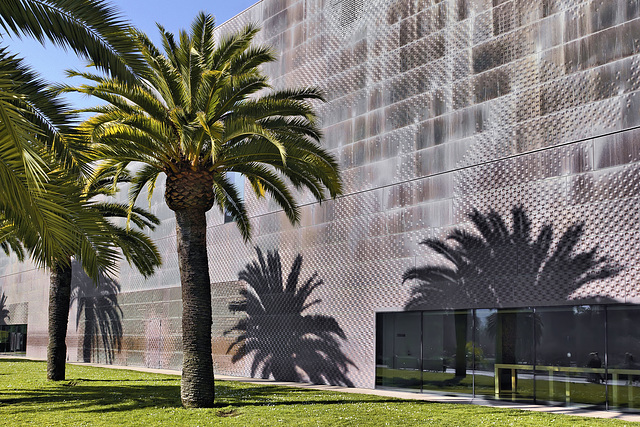

The de Young, a fine arts museum located in San Francisco’s Golden Gate Park. It is named for its founder, early San Francisco newspaperman M. H. de Young. The de Young showcases American art from the 17th through the 21st centuries, international contemporary art, textiles, and costumes, and art from the Americas, the Pacific and Africa.
The museum opened in 1895 as an outgrowth of the California Midwinter International Exposition of 1894 (a fair modeled on the Chicago World’s Columbian Exposition of the previous year). It was housed in an Egyptian revival structure which had been the Fine Arts Building at the fair. The building was badly damaged in the Earthquake of 1906, closing the building for a year and a half for repairs. Before long, the museum’s steady development called for a new space to better serve its growing audiences. Michael de Young responded by planning the building that would serve as the core of the de Young facility through the 20th century. Louis Christian Mullgardt, the coordinator for architecture for the 1915 Panama-Pacific International Exposition, designed the Spanish-Plateresque-style building. The new structure was completed in 1919 and formally transferred by de Young to the city’s park commissioners. In 1921, de Young added a central section, together with a tower that would become the museum’s signature feature, and the museum began to assume the basic configuration that it retained until 2001. Michael de Young’s great efforts were honored with the changing of the museum’s name to the M. H. de Young Memorial Museum. Another addition, a west wing, was completed in 1925, the year de Young died. In 1929 the original Egyptian-style building was declared unsafe and demolished. By 1949, the elaborate cast concrete ornamentation of the original de Young was determined to be a hazard and removed because the salt air from the Pacific had rusted the supporting steel.
As part of the agreement that created the Fine Arts Museums of San Francisco in 1972, the de Young’s collection of European art was sent to the Legion of Honor. In compensation, the de Young received the right to display the bulk of the organization’s anthropological holdings. These include significant pre-Hispanic works from Teotihuacan and Peru, as well as indigenous tribal art from sub-Saharan Africa. The building was severely damaged by the 1989 Loma Prieta earthquake. It in turn was demolished and replaced by a new building in 2005. The only remaining original elements of the old de Young are the vases and sphinxes located near the Pool of Enchantment. The palm trees in front of the building are also original to the site.
The current building was completed by architects Jacques Herzog, Pierre de Meuron and Fong + Chan. To help withstand future earthquakes, the building can move up to three feet (91 centimeters) due to a system of ball-bearing sliding plates and viscous fluid dampers that absorb kinetic energy and convert it to heat. The entire exterior is clad in 163,118 sq ft (15,154.2 m2) of copper, which is expected to eventually oxidize and take on a greenish tone and a distinct texture to echo the nearby eucalyptus trees. In order to further harmonize with the surroundings, shapes were cut into the top to reveal gardens and courtyards where 48 trees had been planted, the giant tree-ferns that form a backdrop for the museum entrance are particularly dramatic. 5.12 acres (20,700 square meters) of new landscaping were planted as well, with 344 transplanted trees and 69 historic boulders. The building is clad with variably perforated and dimpled copper plates, whose patina will slowly change through exposure to the elements.
The museum opened in 1895 as an outgrowth of the California Midwinter International Exposition of 1894 (a fair modeled on the Chicago World’s Columbian Exposition of the previous year). It was housed in an Egyptian revival structure which had been the Fine Arts Building at the fair. The building was badly damaged in the Earthquake of 1906, closing the building for a year and a half for repairs. Before long, the museum’s steady development called for a new space to better serve its growing audiences. Michael de Young responded by planning the building that would serve as the core of the de Young facility through the 20th century. Louis Christian Mullgardt, the coordinator for architecture for the 1915 Panama-Pacific International Exposition, designed the Spanish-Plateresque-style building. The new structure was completed in 1919 and formally transferred by de Young to the city’s park commissioners. In 1921, de Young added a central section, together with a tower that would become the museum’s signature feature, and the museum began to assume the basic configuration that it retained until 2001. Michael de Young’s great efforts were honored with the changing of the museum’s name to the M. H. de Young Memorial Museum. Another addition, a west wing, was completed in 1925, the year de Young died. In 1929 the original Egyptian-style building was declared unsafe and demolished. By 1949, the elaborate cast concrete ornamentation of the original de Young was determined to be a hazard and removed because the salt air from the Pacific had rusted the supporting steel.
As part of the agreement that created the Fine Arts Museums of San Francisco in 1972, the de Young’s collection of European art was sent to the Legion of Honor. In compensation, the de Young received the right to display the bulk of the organization’s anthropological holdings. These include significant pre-Hispanic works from Teotihuacan and Peru, as well as indigenous tribal art from sub-Saharan Africa. The building was severely damaged by the 1989 Loma Prieta earthquake. It in turn was demolished and replaced by a new building in 2005. The only remaining original elements of the old de Young are the vases and sphinxes located near the Pool of Enchantment. The palm trees in front of the building are also original to the site.
The current building was completed by architects Jacques Herzog, Pierre de Meuron and Fong + Chan. To help withstand future earthquakes, the building can move up to three feet (91 centimeters) due to a system of ball-bearing sliding plates and viscous fluid dampers that absorb kinetic energy and convert it to heat. The entire exterior is clad in 163,118 sq ft (15,154.2 m2) of copper, which is expected to eventually oxidize and take on a greenish tone and a distinct texture to echo the nearby eucalyptus trees. In order to further harmonize with the surroundings, shapes were cut into the top to reveal gardens and courtyards where 48 trees had been planted, the giant tree-ferns that form a backdrop for the museum entrance are particularly dramatic. 5.12 acres (20,700 square meters) of new landscaping were planted as well, with 344 transplanted trees and 69 historic boulders. The building is clad with variably perforated and dimpled copper plates, whose patina will slowly change through exposure to the elements.
, Ulrich John, have particularly liked this photo
- Keyboard shortcuts:
Jump to top
RSS feed- Latest comments - Subscribe to the comment feeds of this photo
- ipernity © 2007-2026
- Help & Contact
|
Club news
|
About ipernity
|
History |
ipernity Club & Prices |
Guide of good conduct
Donate | Group guidelines | Privacy policy | Terms of use | Statutes | In memoria -
Facebook
X

Sign-in to write a comment.