

Hotel Villa Flori teasers before the appetizers
Rome, Agrippa - fettucini with lobster
Hotel Villa Flori, Lake Como - pasta and fish
Hotel Villa Flori appetizer and Aperol spritz
Galatoire's Crawfish Maison - Superb!
The Sitting Lady And The Still Life
Rome, Agrippa - fettucini with lobster
Ultimate Sushi Spicy Tuna Macro
Show Bread – The Ferry Building, San Francisco, Ca…
20140607 144130
Cap'n Mikes San Francisco Lox Sandwich – The Ferry…
Persimmons – The Ferry Building Marketplace, San F…
Firenze - Tribute to the Murdered - 053114-005
Autumn bounty
Greve in Chianti Tuscany Ristoro Di Lamole in Lamo…
Paperweights – Grant Avenue near Bush Street, Chin…
Harvest Jewels - Kerstin Frank Texture
Red Stagg Grill's Burger of the Day
Rose focus stacking 071812 - With the heat and hum…
Gnocchi at Agrippa in Rome
Beyond the Fringe – Grant Avenue near Bush Street,…
Lobster stuffed ravioli at Taverna Azzurra in Sorr…
Entwined
Calamari at Taverna Azzurra in Sorrento SOOC 05201…
Barby Meets Betty – Fairfax Street, Berkeley Sprin…
You Must Have Been a Beautiful Baby – Fairfax Stre…
Lake Como Hotel Villa Flori 060814-005
Hotel Degli Orafi Florence breakfast
White Orchids
Rome La Sagrestia pizza - 052214-002
Acupuncture and Handbags – Fairfax Street, Berkele…
Teeny Martini Bar Bottles in Blue
A Planter with Punch – Berkeley Springs, West Virg…
First "Foodie Foto" - Seasons 52, Tampa, Florida
Rocking Chairs in Warm Black and White
Lugano - Bottegone del Vino bruschetta - 060514-02…
Skipping Stone Antiques, #2 – Jefferson Street, P…
Venice - Hosteria Al Vecio Bragosso 060314-002
Positano Sunflower 051914
Venice - Hosteria Al Vecio Bragosso - 060314-003
Lugano Switzerland 060514-004-2
Firenze Hotel Degli Orafi - 053114-003
Villa Bordoni - Greve in Chianti macro 052514-001
Garlic Cloves on Velvet SOOC
Fresh Buffalo Mozzarella at Agrippa 052114

See also...
Keywords
Authorizations, license
-
Visible by: Everyone -
All rights reserved
-
717 visits
Glass Bottles – Fairfax Street, Berkeley Springs, West Virginia
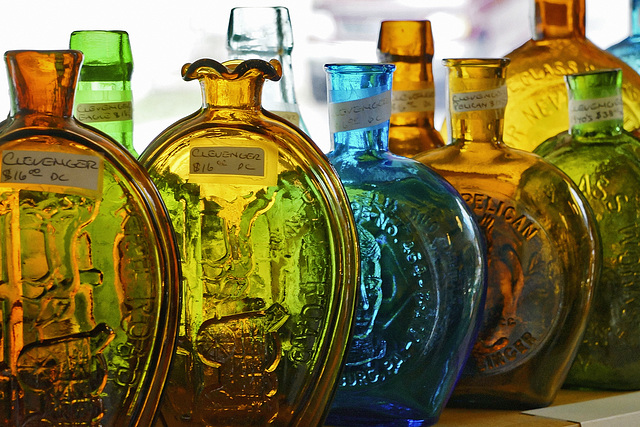

The first successful glasshouse in America was established in 1739 by Casper Wistar in Alloway, New Jersey. Advances in the technology of glass production, including the development of the mechanical glass press and the automatic bottle blowing machine, greatly reduced the demand for skilled glassblowers. By the early 1900’s, the automated bottle machines’ impact led to the closing of many glasshouses in New Jersey and throughout the country. It was one of these factory closings, in 1912, that eventually led to the Clevenger brothers’ establishing their own company.
Henry Thomas (Tom), Lorenzo (Reno) and William Elbert (Allie) Clevenger all followed in their father’s footsteps of working in the glass industry. William Henry Clevenger had moved his family from place to place throughout South Jersey where he worked at several glass companies, before settling in Clayton to work for the Moore Brothers’ Clayton Glass Works. Tom, Reno and Allie all apprenticed at Moore Brothers and continued working at the Clayton factory until it closed in 1912.
Over the next several years, the unemployed trio tried their hands at many different jobs, including rug making. It was not until 1930 that the brothers decided to open their own glass company. So, at the beginning of the Great Depression, Tarn, Reno and Allie constructed a small furnace in a stable in their backyard in Clayton.
The intent of the Clevenger brothers was to carry-on the "South Jersey Tradition" of glassmaking and produce affordable reproductions of this early American glassware. The earliest known catalog of Clevenger glass, "The Renaissance of South Jersey Blown Glass" published by Grant and Lyon in 1934 stated, "South Jersey glass, beloved by all collectors of old American glassware, has been born again. Glass lovers who had believed that this intriguing product had passed into the category of a forgotten art will be thrilled to learn that down in South Jersey, in a glass factory. …, old craftsmen who learned their trade from their forebears in the time hallowed apprentice system are again blowing glass into the same shapes and pattern that made glass history so many years ago."
Clevenger copies were usually much heavier than the originals. They were also made in vibrant colors not associated with early 19th century glassware. The Grant and Lyon 1934 catalog states "the Clevengers make most of their glass in amber, blue and green". By 1939 the Ritter catalog listed "the six original colors" of amber, amethyst, dark green, colonial blue, light green (also known as South Jersey green) and light blue.
Other vivid colors were added to the line such as red, orange, amberina and vaseline (frequently appearing as opaque yellow). Due to lack of strict control in mixing batches and watching over the melts, variations appeared in many of the stock colors. Reds in Clevenger glass can range from almost black to a reddish orange. There are greens that appear to be blue-green. A few extremely rare pieces of clear and milk glass were also produced.
Henry Thomas (Tom), Lorenzo (Reno) and William Elbert (Allie) Clevenger all followed in their father’s footsteps of working in the glass industry. William Henry Clevenger had moved his family from place to place throughout South Jersey where he worked at several glass companies, before settling in Clayton to work for the Moore Brothers’ Clayton Glass Works. Tom, Reno and Allie all apprenticed at Moore Brothers and continued working at the Clayton factory until it closed in 1912.
Over the next several years, the unemployed trio tried their hands at many different jobs, including rug making. It was not until 1930 that the brothers decided to open their own glass company. So, at the beginning of the Great Depression, Tarn, Reno and Allie constructed a small furnace in a stable in their backyard in Clayton.
The intent of the Clevenger brothers was to carry-on the "South Jersey Tradition" of glassmaking and produce affordable reproductions of this early American glassware. The earliest known catalog of Clevenger glass, "The Renaissance of South Jersey Blown Glass" published by Grant and Lyon in 1934 stated, "South Jersey glass, beloved by all collectors of old American glassware, has been born again. Glass lovers who had believed that this intriguing product had passed into the category of a forgotten art will be thrilled to learn that down in South Jersey, in a glass factory. …, old craftsmen who learned their trade from their forebears in the time hallowed apprentice system are again blowing glass into the same shapes and pattern that made glass history so many years ago."
Clevenger copies were usually much heavier than the originals. They were also made in vibrant colors not associated with early 19th century glassware. The Grant and Lyon 1934 catalog states "the Clevengers make most of their glass in amber, blue and green". By 1939 the Ritter catalog listed "the six original colors" of amber, amethyst, dark green, colonial blue, light green (also known as South Jersey green) and light blue.
Other vivid colors were added to the line such as red, orange, amberina and vaseline (frequently appearing as opaque yellow). Due to lack of strict control in mixing batches and watching over the melts, variations appeared in many of the stock colors. Reds in Clevenger glass can range from almost black to a reddish orange. There are greens that appear to be blue-green. A few extremely rare pieces of clear and milk glass were also produced.
Andrew Trundlewagon, Rymie Jolie, Frode, Don Sutherland have particularly liked this photo
- Keyboard shortcuts:
Jump to top
RSS feed- Latest comments - Subscribe to the comment feeds of this photo
- ipernity © 2007-2026
- Help & Contact
|
Club news
|
About ipernity
|
History |
ipernity Club & Prices |
Guide of good conduct
Donate | Group guidelines | Privacy policy | Terms of use | Statutes | In memoria -
Facebook
X

Sign-in to write a comment.