

John Sheldon's photos


27 Mar 2016
Saint Teresa of Ávila at Córdoba Cathedral
An alcove statue of St. Theresa of Avila in the cathedral part of the Mosque–Cathedral of Córdoba.
27 Mar 2016
1 favorite
2 comments
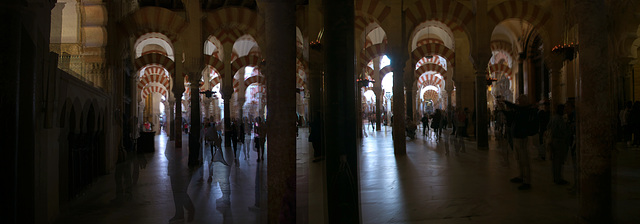
Inside Mezquita de Córdoba
Photo-montage using 4 frames. Must be viewed 'on black'.
The site was originally a small temple of Christian Visigoth origin. When Muslims conquered Spain in 711, the church was first divided into Muslim and Christian halves. This sharing arrangement of the site lasted until 784, when the Christian half was purchased by the Emir 'Abd al-Rahman I, who then proceeded to demolish the original structure and build the grand mosque of Cordoba on its ground. Córdoba returned to Christian rule in 1236 during the Reconquista, and the building was converted to a Roman Catholic church, culminating in the insertion of a Renaissance cathedral nave in the 16th century.
The structure is regarded as one of the most accomplished monuments of Moorish architecture. It is a World Heritage site and regarded (following a recent court case) as a wonder of architecture that 'belongs' to everyone in the world.
27 Mar 2016
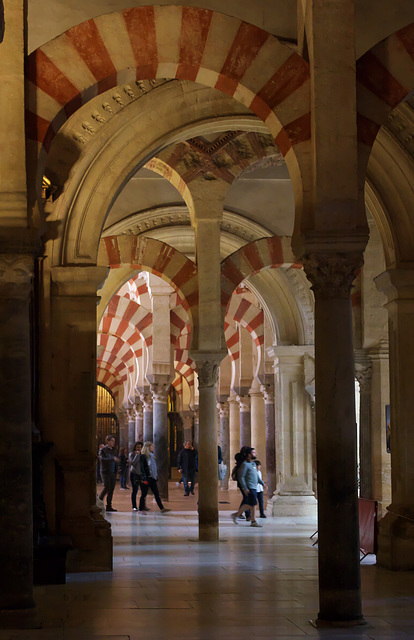
Archway arcades in Mezquita de Córdoba
The site was originally a small temple of Christian Visigoth origin. When Muslims conquered Spain in 711, the church was first divided into Muslim and Christian halves. This sharing arrangement of the site lasted until 784, when the Christian half was purchased by the Emir 'Abd al-Rahman I, who then proceeded to demolish the original structure and build the grand mosque of Cordoba on its ground. Córdoba returned to Christian rule in 1236 during the Reconquista, and the building was converted to a Roman Catholic church, culminating in the insertion of a Renaissance cathedral nave in the 16th century.
The structure is regarded as one of the most accomplished monuments of Moorish architecture. It is a World Heritage site and regarded (following a recent court case) as a wonder of architecture that 'belongs' to everyone in the world.

27 Mar 2016
Visitors La Mezquita-Catedral de Córdoba
The site was originally a small temple of Christian Visigoth origin. When Muslims conquered Spain in 711, the church was first divided into Muslim and Christian halves. This sharing arrangement of the site lasted until 784, when the Christian half was purchased by the Emir 'Abd al-Rahman I, who then proceeded to demolish the original structure and build the grand mosque of Cordoba on its ground. Córdoba returned to Christian rule in 1236 during the Reconquista, and the building was converted to a Roman Catholic church, culminating in the insertion of a Renaissance cathedral nave in the 16th century.
The structure is regarded as one of the most accomplished monuments of Moorish architecture. It is a World Heritage site and regarded (following a recent court case) as a wonder of architecture that 'belongs' to everyone in the world.

27 Mar 2016
Archway with gold leaf decorations in Mezquita de Córdoba
The site was originally a small temple of Christian Visigoth origin. When Muslims conquered Spain in 711, the church was first divided into Muslim and Christian halves. This sharing arrangement of the site lasted until 784, when the Christian half was purchased by the Emir 'Abd al-Rahman I, who then proceeded to demolish the original structure and build the grand mosque of Cordoba on its ground. Córdoba returned to Christian rule in 1236 during the Reconquista, and the building was converted to a Roman Catholic church, culminating in the insertion of a Renaissance cathedral nave in the 16th century.
The structure is regarded as one of the most accomplished monuments of Moorish architecture. It is a World Heritage site and regarded (following a recent court case) as a wonder of architecture that 'belongs' to everyone in the world.

27 Mar 2016
West door of the Mezquita de Córdoba
The site was originally a small temple of Christian Visigoth origin. When Muslims conquered Spain in 711, the church was first divided into Muslim and Christian halves. This sharing arrangement of the site lasted until 784, when the Christian half was purchased by the Emir 'Abd al-Rahman I, who then proceeded to demolish the original structure and build the grand mosque of Cordoba on its ground. Córdoba returned to Christian rule in 1236 during the Reconquista, and the building was converted to a Roman Catholic church, culminating in the insertion of a Renaissance cathedral nave in the 16th century.
The structure is regarded as one of the most accomplished monuments of Moorish architecture. It is a World Heritage site and regarded (following a recent court case) as a wonder of architecture that 'belongs' to everyone in the world.

27 Mar 2016
El Arcángel Rafael en Córdoba
This statue of Archangel Raphael stands on the Roman Bridge at Córdoba, and is looking downstream to the west. In the background Córdoba Cathedral with its Renaissance architecture can be see rising up above the Moorish architecture of the Mezquita.

27 Mar 2016
1 favorite
1 comment
Rio Guadalquivir at Córdoba
The Guadalquivir is the longest river in Andalucia. Picture taken from the Roman Bridge at Córdoba.

27 Mar 2016
Oranges and Lemons
'Just passing through'.
The foyer of a hotel in Cόrdoba, Andalucia, Spain.
