

hanging off the Shard
Snowsfields
sunlight on Snowsfields
architects destroying London
sunlight on St Paul's
Liverpool Street
Anna Laetitia Barbauld Plaque
Buckingham Palace 1955
St Paul's Cathedral 1955
Throgmorton Street 1955
Bank Underground
Cannon Street railway bridge and Bankside chimney
Tower Bridge 1955
light on the shard
DSCF1143
Trio
DSCF1524
Houses of Parliament from Westminster Bridge
London's ruined river view
Shad Thames weather vane
Courage Brewery chimney
London's shame
hit or miss carbuncle?
Boris Johnson's London
DSCF0001
DSCF5724
Oslo/Hackney Central - 7 February 2015
Village Underground (3) - 7 February 2015
DSCF0705
RFA FORT VICTORIA
4 Princelet Street
Johnson Street
Another Colonnade
DSCF2020
DSCF2019
DSCF8471
DSCF0690
mudlark
DSCF7917
Tower House (aka Rowton House)
DSCF9956
DSCF3917
DSCF0036
The View From The Shard
DSCF4019

See also...
See more...
Keywords
Authorizations, license
-
Visible by: Everyone -
All rights reserved
-
321 visits
Bermondsey Watch House
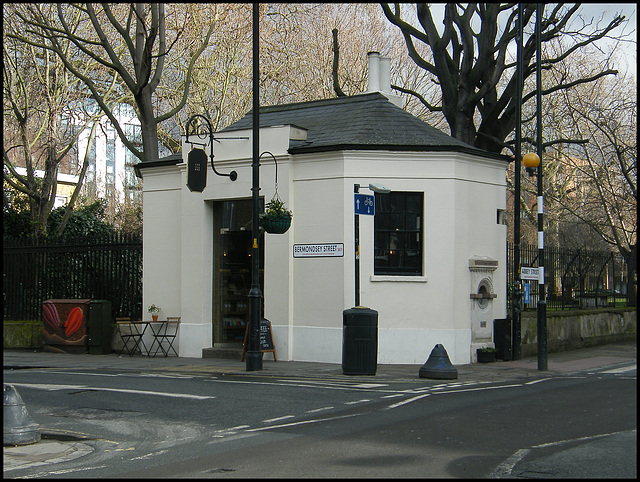

nineteenth century guardhouse to watch for body snatchers in the churchyard
(deleted account) has particularly liked this photo
- Keyboard shortcuts:
Jump to top
RSS feed- Latest comments - Subscribe to the comment feeds of this photo
- ipernity © 2007-2026
- Help & Contact
|
Club news
|
About ipernity
|
History |
ipernity Club & Prices |
Guide of good conduct
Donate | Group guidelines | Privacy policy | Terms of use | Statutes | In memoria -
Facebook
X

You pass the early 19th century (post 1829) rectory, and stop at the Church (originally built for the Abbey servants and lay-people). It was rebuilt between 1680 and 1690 as a parish church - the tower and west front altered 1830 to suit ‘Gothick’ fashion. The Galleries were added in in the 18th Century.
Here is another watch-house built to deter resurrectionists’ or grave robbers who supplied the local hospital medical schools with subjects for dissection.
Tan yards once abutted the church yard which supposedly contains a 1665 plague pit. The Bevingtons (leather manufacturers) contributed generously to restoring and furnishing the church.
It is said that a Puritan rector, Jeremiah Whitaker, here once ended his sermon of sixty-nine pages with the phrase ‘…one hundred and twenty-seventhly…’.
In the crypt: are references to many local people and craftsman including: Joseph Watson, founder of the first public institution for the deaf and dumb in 1792, James Hardwidge, needlemaker to Queen Charlotte, 1819, William Browning, Fellmonger, 1758. Floor memorials include one to a tanner, William Mercer, 1718, and Elizabeth Tyers, 1681 (see Tyer’s Gateway, Bermondsey Street).
The works of the striking clock bear a brass plate on which is inscribed ‘This clock thoroughly repaired and altered to an eight-day by Charles Porter, Southwark, 1841.’
Sign-in to write a comment.