


London

Folder: Britain (Ængland ꝛ Alba)
London really became a part of my life, a city I called home for four years, and the place where my son took his first steps and spoke his first words. I remember the little routines, making our way through rainy mornings, squeezing into playgroups, and the whole world rushing outside. Those years were set against the turbulence of Brexit and royal changes, and I even met Charles when he was newly…
(read more)
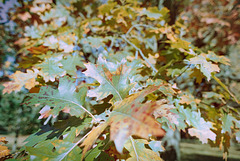
Novembrescence
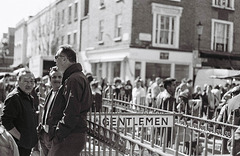
Gents or chavs?
| |
|
|
|
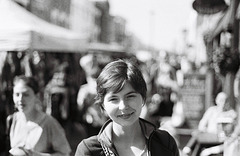
Four hours in London
| |
|
|
|
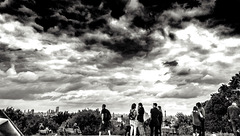
Parliament Hill (no parliamentarians present)
| |
|
|
|
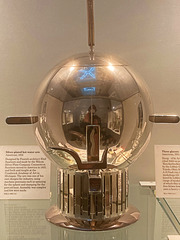
An object from Space
| |
|
|
|
Gottlieb Eliel Saarinen {1873 – 1950) was a Finnish-American architect known for his work with art nouveau buildings in the early years of the 20th century. In 1925 George Gough Booth asked him to design the campus of Cranbrook Educational Community, intended to be an American equivalent to the Bauhaus. Saarinen taught there and became president of the Cranbrook Academy of Art in 1932.
In c. 1929–34, Eliel Saarinen was produced in product design for the Wilcox Silver Plate Co. / International Silver Company in Meriden, CT. His iconic tea urn (c. 1934) was first exhibited in 1934–35 at the Metropolitan Museum of Art in New York. Over the years, the tea urn has been widely exhibited, including in St. Louis Modern (2015–16) at the St Louis Art Museum, Cranbrook Goes to the Movies: Films and Their Objects, 1925–1975 at the Cranbrook Art Museum (2014–15), and in 2005–07, in the touring exhibition Modernism in American Silver:
In 1951–52, the tea urn was featured in the Eliel Saarinen Memorial Exhibition which travelled to multiple venues across the United States. In addition to Cranbrook, the Dallas Museum and the St Louis Museum, The British Museum in London and the Metropolitan Museum of Art also hold tea urn-related Eliel Saarinen designs.
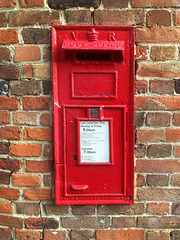
The Red Post Box
| |
|
|
|
The red post box is a quintessential emblem of British life, instantly recognisable from London to the tiniest village green. First introduced in the 1850s after the revolutionary Penny Post made sending letters affordable, these sturdy cast-iron sentinels have stood the test of time. Painted pillar-box red since the 1870s, they brighten up even the dreariest British weather and are as much a part of the landscape as a cup of tea or a Sunday roast. Each bears the royal cypher of the reigning monarch—spotting a rare Edward VIII or the latest King Charles III cypher is a treat for keen-eyed history buffs. Some boxes are beautifully ornate, especially those designed for Victorian London, while others are tucked into ancient stone walls or perched on lamp posts. A handful have even been painted gold to celebrate Olympic heroes. Despite the march of technology, the humble post box remains a beloved fixture, offering a nostalgic thrill to tourists and locals alike. Popping a postcard into one is a rite of passage for visitors, a simple pleasure that connects you to nearly two centuries of British tradition and the quiet romance of Royal Mail.
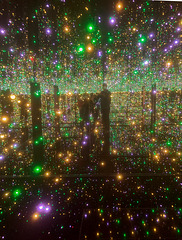
Infinity Room
| |
|
|
|
Step into infinite space
Tate presents a rare chance to experience two of Yayoi Kusama’s Infinity Mirror Rooms. These immersive installations transport you into Kusama’s unique vision of endless reflections.
Infinity Mirrored Room – Filled with the Brilliance of Life is one of Kusama’s largest installations to date and was made for her 2012 retrospective at Tate Modern. It is shown alongside Chandelier of Grief, a room which creates the illusion of a boundless universe of rotating crystal chandeliers.
A small presentation of photographs and moving image – some on display for the first time – provides historical context for the global phenomenon that Kusama’s mirrored rooms have become today.
Born in 1929 in Matsumoto, Japan, Kusama came to international attention in 1960s New York for a wide-ranging creative practice that has encompassed installation, painting, sculpture, fashion design and writing. Since the 1970s she has lived in Tokyo, where she continues to work prolifically and to international acclaim.
www.tate.org.uk/whats-on/tate-modern/exhibition/yayoi-kusama-infinity-mirror-rooms
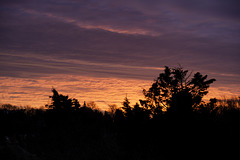
...another beautiful morning seen from my kitchen

Tree of crows
| |
|
|
|
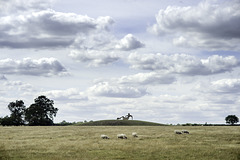
Hertfordshire countryside house of Henry Moore
| |
|
|
|
Large Reclining Figure is the product of Moore’s fourth and final collaboration with the architect I. M. Pei. In 1976, one of Pei’s most ambitious projects opened in Singapore: a fifty-two storey skyscraper – then the tallest in South East Asia – for the Overseas-Chinese Banking Corporation. Pei had wanted to site a major sculptural commission at the base of the building, but it was several years before a suitable space became available. When Pei approached Moore about the commission, he was fearful of his response. Moore – by now in his eighties - had already told Pei that he was no longer producing monumental sculptures and that he was concentrating on producing drawings for the Foundation. He conceded, however, that it might be possible if the commission were based on an existing work.
Further reading: catalogue.henry-moore.org/objects/14059/large-reclining-figure
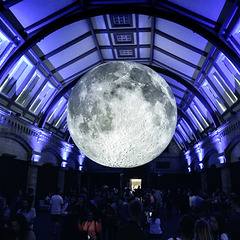
mus eumo ft emo on
| |
|
|
|
The touring artwork by UK artist Luke Jerram was on display in the Jerwood Gallery from 17 May 2019 to 5 January 2020.
Museum of the Moon, a six-metre spherical sculpture suspended from above, features high-resolution NASA imagery of the lunar surface. Allowing visitors the chance to see the far side of the Moon, the artwork will offer a new and exciting perspective of Earth’s celestial neighbour. The sculpture is accompanied by a surround-sound composition by BAFTA and Ivor Novello award-winning composer Dan Jones.

From the Spring seris
| |
|
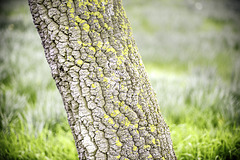
Diagonal
| |
|
|
|
A yellowy orange coloured leafy lichen that is one of the most common species around. The yellow chemical xanthorin is thought to be produced as a defence against UV radiation to which it is exposed in its normal habitat - cement tiled roofs, exposed twigs and branches etc. When it is growing in the shade it does not require such protection and xanthorin production stops and the lichen remains green. In or after rain, this lichen appears more greeny yellow as the algae shows through the more translucent fungus.
www.naturespot.org.uk/species/xanthoria-parietina
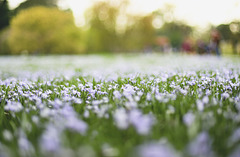
invisible
| |
|
|
|
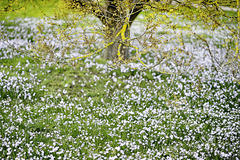
"Un tappeto di fiori" or Just colour left after th…
| |
|
|
|
Jump to top
RSS feed- Latest items - Subscribe to the latest items added to this album
- ipernity © 2007-2026
- Help & Contact
|
Club news
|
About ipernity
|
History |
ipernity Club & Prices |
Guide of good conduct
Donate | Group guidelines | Privacy policy | Terms of use | Statutes | In memoria -
Facebook
X
