


Rediscovered Shots: A Gallery Rewind

This is my personal treasure trove — a space where forgotten memories and overlooked moments from my photo archives come alive again. Over the years, many images have slipped into the background, quietly waiting to be seen and felt anew. This album is a heartfelt attempt to revisit, honour, and share the stories and emotions captured through my lens. Each photograph here resonates with nostalgia, …
(read more)
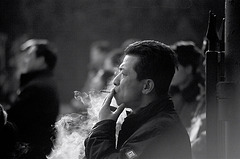
Smokin‘
| |
|
|
|
This is my latest idea — an album to create a space where forgotten photos come alive again.
....
China—where smoking is more than routine, it’s a ubiquitous part of daily life. More than 300 million people—over half of adult men—smoke here, making China the world’s largest producer and consumer of tobacco. About one in every three cigarettes on Earth is smoked in China, its haze curling through every corner from bustling cities to quiet courtyards. This photo captures a familiar moment in a country where tobacco’s presence is both ordinary and extraordinary, shaping public health and everyday scenes alike.
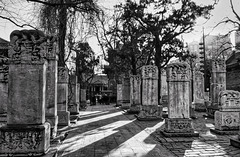
Silent Steles
| |
|
|
|
Dongyue Taoist Temple in Beijing stands as a profound testament to history and tradition. Its many steles, which form what is often called a “forest of steles”, invite visitors to reflect on centuries of spiritual and communal life.
These stone tablets are deeply meaningful, some dating back over 700 years, offering wisdom and insights carved by past generations. The temple’s steles are not only records of important events and temple associations, but they also capture the sense of continuity and connection valued by the people of Beijing. Inscriptions composed by renowned artists and calligraphers such as Zhao Mengfu represent the enduring brilliance of classical Chinese culture.
Many steles were created by incense associations — local groups that organised festivals and worship— documenting the spirit of unity and collective memory. Imperial steles, commissioned by the Kangxi and Qianlong emperors, embody a sense of reverence and authority, linking the temple’s history to the broader story of Chinese civilization.
Even during the upheavals of the Cultural Revolution, the steles proved resilient. Though some were damaged or buried, many have since been restored, symbolising the lasting nature of wisdom and tradition in the face of change.
Walking among the steles of Dongyue Temple, one gains a sense of peace, perspective, and respect for the timeless values held by generations before us. They serve as reminders that wisdom endures, not just in words, but in the very stones beneath our feet.

People's Bank of China
| |
|
|
|
The People’s Bank of China (PBOC) headquarters in Beijing serves as more than just an office — it stands as a testament to China’s financial authority and deep-rooted history. Since its founding in 1948, the Bank has guided the nation’s monetary policy, overseen currency issuance, and helped safeguard financial stability.
A charming detail: the building’s distinctive circular design symbolises unity and stability — qualities at the heart of any central bank. Its exterior is clad predominantly in Roman travertine, making it the first building in Beijing to feature this elegant stone, while most other buildings favour granite due to its resilience in cold climates. The pavements encircling the structure are fashioned from app 8,000 square metres of light grey granite from Shandong Province.
Another enriching this architectural narrative, the headquarters’ rounded form draws inspiration from the “yuanbao”, the traditional Chinese gold ingot, artfully blending contemporary finance with a tribute to the nation’s ancient trading heritage. Covering nine floors and nearly 40,000 square metres, the building reflects the scale and significance of the PBOC’s operations.
This connection to tradition echoes China’s historical role as a major trading power, particularly along the famous Silk Road. Today, the central bank continues that enduring legacy, guiding the country’s finances and economic development in a manner befitting its remarkable headquarters — all details confirmed by expert accounts on the building’s architecture and construction materials.
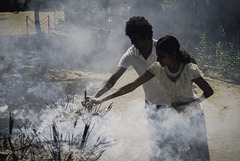
the Essence is in the air
| |
|
|
|
Revisiting... the People at Kelaniya Raja Maha Vihara quietly place fresh flowers, pour water over them, and light sticks of incense near the shrine. Each simple act is a way of showing respect, wishing for peace, and remembering that everything in life passes and changes. Flowers stand for beauty and impermanence, water for purity, and incense for calm and good intentions. These everyday rituals fill the temple with gentle scents and colors, bringing everyone together in a spirit of hope and kindness.

A Hostess
| |
|
|
|
This photo was taken while waiting for the opening ceremony of the Luohe Food Fair in 2011. It felt unusual to stand on stage among two dozen guests of honour, doing nothing but waiting. To capture the atmosphere of the moment, I took a few photographs. This one stands out as a minimalist impression—very Chinese in its "red-carpet" mood.
More of the hostesses can be seen here www.ipernity.com/doc/havran/11922687
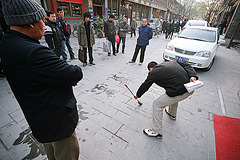
Dιѕαρρ…єαяιɴɢ Ƈɑllι…ɢʁαρhყ
| |
|
|
|
In Beijing’s Liulichang Street, a historic cultural quarter over 300 years old, people often practice 地书 (dishu), or “ground calligraphy.” Using large brushes with sponge tips, they write Chinese characters on the pavement with water. The strokes shimmer for a moment before evaporating in the sun, leaving no trace.
This tradition began in the 1980s and has become a beloved morning ritual, especially among older residents. It’s more than art — it’s gentle exercise, mental focus, and social interaction. Writers often reproduce classical poetry or philosophical sayings from memory, following traditional calligraphy rules. The act is meditative yet communal: people gather, chat, and exchange thoughts on technique and meaning.
Liulichang dates back to the Ming dynasty, named after a famous coloured-glaze factory that once produced tiles for palaces and temples. Later, it became a centre for scholars and imperial exam candidates. Today, the street is lined with antique shops, bookstores, and art studios. Watching dishu here feels natural — a living tradition in a place long devoted to literacy and aesthetics. For Western visitors, it offers a quiet, authentic glimpse into daily Chinese life: no performance, no commerce, just the fleeting grace of expression in water and sunlight.
The Head (of China House)
| |
|
|
|
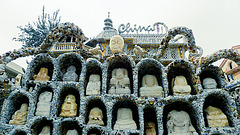
The China House, also known as the Porcelain House, is one of Tianjin’s most unusual landmarks. It’s a French-style mansion from the early 1900s, completely covered in over 400 million pieces of ancient porcelain and ceramic shards collected from dynasties as old as the Tang (600s AD).
Businessman and art collector Zhang Lianzhi bought the decaying villa in 2002 and spent five years turning it into a porcelain museum. The result is a glittering mosaic of vases, plates, bowls, and dragons that gleam in the sunlight. A 768-meter-long porcelain dragon curls across the roof, and the outer wall—known as the “Peace Wall”—is made from 635 antique vases symbolising harmony.
Inside, porcelain fragments create mosaics of famous art, from Da Vinci’s Mona Lisa to China’s Five Oxen painting. The collection also includes rare Ming and Qing dynasty furniture and over 200 artworks inspired by both Chinese and Western masters.
Fix that car
| |
|
|
|
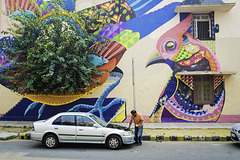
What once were plain residential blocks are now an open-air museum bursting with colour — Lodhi Art District is Delhi’s answer to street art at its grandest. Since 2015, artists from both India and around the world have flocked here, using exhaustive imagination to paint over fifty massive murals.
Stroll through leafy avenues and you’ll encounter glowing abstractions, whimsical creatures and portraits with powerful social messages, each so different that every turn feels unexpected. There’s no set trail — exploration is the thrill, and new wall art appears often, changing the landscape each year. With its peaceful neighbourhood vibe and lack of crowds, visitors find not only dazzling visuals but also serene green streets perfect for reflection and photography.

Solitude Under Jomolhari
| |
|
|
|
Bhutan is often overlooked — its carefully managed tourism and mandatory daily fees push many travelers toward the “free” alternatives across the Himalayas. But those who skip it miss something rare. This journey was one of those quiet rewards.
We spent six days trekking across high terrain, crossing three passes above 4,000 meters, moving through landscapes that feel both vast and deeply personal. Nights were spent under the shadow of Jomolhari (7,326 m), Bhutan’s second-highest peak, rising with a presence that is both imposing and serene.
What stayed with us just as much as the mountains was the absence of crowds. Over those days, we encountered almost no tourists—just a few solitary trekkers here and there—leaving long stretches of silence and a rare sense of solitude.
There is a certain stillness in Bhutan—not just in its mountains, but in its approach to the world. This trek was not only about altitude or distance, but about stepping, briefly, into that different rhythm.
Jump to top
RSS feed- Latest items - Subscribe to the latest items added to this album
- ipernity © 2007-2026
- Help & Contact
|
Club news
|
About ipernity
|
History |
ipernity Club & Prices |
Guide of good conduct
Donate | Group guidelines | Privacy policy | Terms of use | Statutes | In memoria -
Facebook
X
