

Bratislava

Folder: Slovakia
✨ Seeking a hidden gem? Let me introduce you to Bratislava—a city that’s a mashup of contradictions and surprises.
Imagine wandering ancient cobblestone streets that suddenly burst into color with vibrant street art, where medieval castle views stand shoulder-to-shoulder with bold Soviet-era architecture. This city once crowned Hungarian kings and queens—seriously, royalty walked these very lanes… (read more)
Imagine wandering ancient cobblestone streets that suddenly burst into color with vibrant street art, where medieval castle views stand shoulder-to-shoulder with bold Soviet-era architecture. This city once crowned Hungarian kings and queens—seriously, royalty walked these very lanes… (read more)
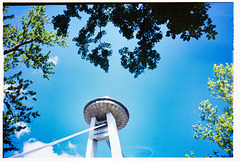
The 'UFO'
| |
|
|
|
Previously published photo showing a night view from this iconic bridge. Towering above Bratislava on the SNP Bridge, the UFO tower’s flying-saucer design has symbolised modern Slovakia since 1972. Its circular dome at 95 meters hosts a café and an observation deck offering views up to 100 km—on clear evenings, Austria and Hungary are visible. An elevator whisks visitors to the top in 45 seconds; an emergency staircase inside the pylon boasts 430 steps. Originally built for both function and flair, the UFO’s distinctive form was practical for bridge assembly—not planned as a “spaceship”, but the nickname quickly stuck. Today, the UFO glows over the city at night, linking the Danube with Bratislava’s skyline and futuristic spirit.
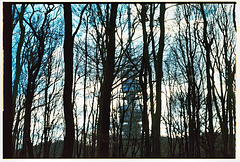
Koliba
| |
|
|
|
I previously published a mobile photo of this structure, accompanied by a few notes on its particular place in Bratislava’s skyline. My first exposure; the film ran out. The remainder: digital, deliberate, frictionless. I now await the outcome⁓tangible or pixelated, which will hold?
A small background: Bratislava is a city ringed by the Small Carpathians, green hem at its edge. Koliba rises near the center ⁓ hill, path, television tower. A ski slope with bobsleigh track. The forest wraps it all. The tower: visible, inert, held in the gaze. Ugly or beautiful; communist, brutalist, accidental. Ingenious, obsolete, a monument, a relic, iron pressed into memory ⁓ it persists.

Underpass
| |
|
|
|
The Klariska Street underpass in Bratislava is a humble hero of urban design—simple, sturdy, and smarter than it looks. Built beneath the tram tracks at Kapucínska Street, it quietly connects historic Old Town with Staromestská, letting pedestrians dodge trams and rain with equal ease. While it might not win awards for beauty, its no-nonsense concrete and straightforward form are pure “function over fashion”—like a trusty old raincoat for the city. Some might call it brutalist, but it’s really just a practical workhorse from the late 20th century, built to handle crowds and keep feet dry. Think of it as Bratislava’s secret tunnel for time travelers (or at least for people who hate waiting at red lights)!
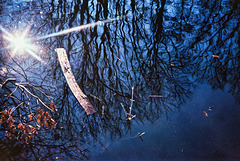
Reflection of ...
| |
|
|
|
Imagine stepping away from the bustle of Bratislava into the peaceful haven of Železná Studnička. Here, the city’s noise fades, replaced by the gentle sounds of the Vydrica stream and rustling trees.
The area, known as the “Iron Well,” takes its name from an iron-rich spring discovered in the 1800s, once famous for its supposed healing waters. A spa was built, attracting visitors seeking health and relaxation, but as the spring’s mineral content changed, Železná Studnička evolved into a beloved forest park.
Today, it’s a favorite spot for walks, picnics, and quiet reflection. Trails wind through lush greenery, past old mills and ponds, offering a perfect blend of nature and history. With easy access from the city, Železná Studnička remains a tranquil oasis—a place where you can enjoy the calm of the forest while still feeling connected to Bratislava’s past.
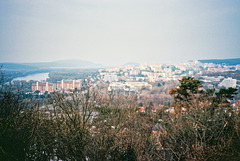
Blurred view on Bratislava's southwestern corner
| |
|
|
|
Hotel Bôrik sits gracefully atop a hill, just moments from Bratislava’s city centre and the iconic castle. Originally built to host high-level government officials, the hotel still plays a vital role today, welcoming state visits, conferences, and important meetings.
Perhaps its greatest treasure is its location. From the terraces and guest rooms, guests are treated to sweeping vistas over the Danube River, the western quarters of Bratislava, and, on clear days, all the way to the Austrian hills and the Danubian Lowland. The classic “Bôrik view” is legendary: it captures the city’s rooftops, Bratislava castle, the winding Danube, and the riverside forests, often glowing in the golden light of sunset. It’s a perspective that leaves a lasting impression on both official guests and anyone lucky enough to visit.
Yet, my heart is drawn in another direction-toward Karlova Ves, the neighborhood where I grew up. Looking that way, you’ll spot the distinctive red-and-white Družba dormitories, home to generations of university students, standing proudly along the banks of the Danube’s backwaters. This area is a rare blend of city and nature, where quiet inlets and green spaces offer a peaceful escape from the city’s bustle.
Higher up the hill lies Dlhé Diely, an extension of Karlova Ves built in the final years of socialism. Once gardens and vineyards, it has become a densely packed concrete jungle on the foothills of the Small Carpathians-a stark contrast to its tranquil past, best left to the imagination. And far across the Danube’s distant bank, you can glimpse Lower Austria.
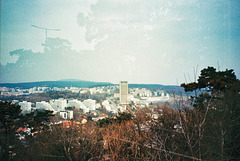
double bratislava
| |
|
|
|
This is the kind of view that makes you pause for a moment, even if you’ve lived in Bratislava your whole life. Taken from the hillside near Hotel Bôrik, above Karlova Ves, the photo gives you a sweeping look over the city’s western neighborhoods. You can spot the distinctive high-rise in the center- it is the Television building -and the modern white apartment blocks that seem to step down the slope toward the Danube.
What makes this spot special isn’t just the cityscape, but how it’s framed by nature. The foreground is all tangled branches and dark pines, a reminder that you’re standing on the edge of a leafy hillside, not far from the Little Carpathians. On a clear day, you can see the hills rolling away in the distance, and sometimes even catch a glimpse of Austria.
Locals may love this view because it shows Bratislava’s character: a city that’s modern but still closely tied to its landscape. From up here, you see how the neighborhoods, river, and hills all fit together-urban life meeting quiet nature. It’s a perspective that locals are proud of and visitors quickly come to appreciate.
---Double exposition with famous Olympus XA
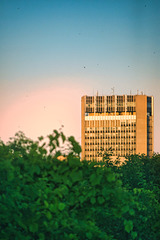
Slovak TV building
| |
|
|
|
Tucked into the leafy expanse of Mlynská dolina in Bratislava, the Slovak Television Building rises above the treetops like a silent guardian of Bratislava’s modern era. For decades, its 108-metre appearance has marked the skyline, a landmark visible from the hills of Karlova Ves, especially striking at sunset when its windows catch the last golden light.
The story of this tower began in the 1960s, when Slovakia’s growing television industry needed a new home. Architect Jozef Struhar, along with Vaclav Curilla and Olga Mankova, won the competition to design a complex that would reflect both ambition and cutting-edge technology. Construction started in 1965 and, after years of effort, the high-rise was ceremonially opened in December 1975. At the time, it was a record-breaker: the first building in Czechoslovakia to surpass 100 metres, and the tallest in the country for nearly three decades.
The building itself is a feat of engineering, with a reinforced concrete core housing all the elevators, services, and washrooms, leaving the rest of each floor open for flexible office space. Four concrete cross-bracing walls not only strengthen the structure but also give the facade its distinctive, rhythmic appearance. The entire television complex was built in stages, with the high-rise as its dominant feature, and was equipped with some of the most advanced broadcast technology of its time.
For years, the tower was the bustling headquarters of Slovak National Television, later Radio and Television of Slovakia. It even boasted a restaurant on its 28th floor, offering panoramic views of the city. But as times changed and media operations moved elsewhere, the building gradually emptied out. Today, it stands mostly unused, maintained only minimally, a preserved relic of the city’s broadcasting history.
Still, the Slovak Television Building remains a symbol of Bratislava’s aspirations during the late 20th century-a monument to the era when the city was reaching upward, determined to make its mark. To outsiders, it may seem just another office tower, but to locals, it is a familiar companion, a silent witness to decades of Slovak stories and the changing face of the capital.
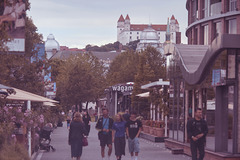
Bratislava with a special lens
| |
|
|
|
I conducted an experiment where I mounted a large format lens onto a digital camera, as shown in the photo.
The camera is a Nikon Df, and I used an adapter to attach the large format lens to the camera body. This setup allowed me to explore the unique optical characteristics of large format glass on a modern digital sensor.
The process involved carefully aligning the lens and ensuring a secure fit with the adapter. One of the main challenges was achieving proper focus, as large format lenses are not designed for digital cameras and often require precise manual adjustment. Additionally, the lens projects a much larger image circle than the camera sensor, resulting in a cropped field of view and a distinctive rendering style.
This experiment gave me the opportunity to capture images with a unique depth of field and bokeh, combining the classic qualities of large format optics with the convenience and immediacy of digital photography. The photo above documents my custom setup and the successful integration of these two different photographic technologies.
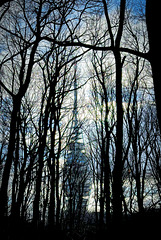
Kamzík TV Tower, a striking 194-meter-tall landmar…
| |
|
|
|
Perched atop Kamzík hill in Bratislava’s beautiful forest park, the Kamzík TV Tower is a striking landmark and the tallest structure in Slovakia. Built in the 1970s, its unique shape ⁓ often compared to a wine bottle ⁓ stands out against the lush greenery of the Little Carpathians. From the forest trails below, the tower rises gracefully above the trees, inviting curiosity and adventure.
Visitors can take an elevator up to a rotating restaurant and observation deck, where breathtaking panoramic views stretch across Bratislava and even into neighbouring countries on clear days. Whether you’re hiking through the peaceful woods or enjoying a meal high above the city, Kamzík Tower offers a perfect blend of nature, technology, and stunning scenery ⁓ a must-see spot for locals and tourists alike.
⁓⁓ I also have a film picture here
www.ipernity.com/doc/havran/53036966/in/album/1376558
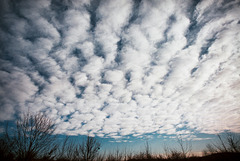
Cloud Tapestry Over the Danube: Unity Above Border…
| |
|
|
|
From the foothills above the Danube, I watched the sky unfurl a tapestry of clouds, each tuft drifting west to east, just like the river beneath. The Danube divided Austria and Slovakia, but above, the clouds cared nothing for borders. Their patterns rippled across the sky, echoing the river’s flow, while bare branches below reached upward, tracing invisible lines of connection. In this moment, the beholder sensed the land’s unity—how sky, water, and earth wove together beyond human divisions. The clouds, wild and free, belonged to both sides, reminding all who looked up that nature’s boundaries were softer, more forgiving. Standing there, I felt the quiet truth: the river might divide, but the sky forever unites.
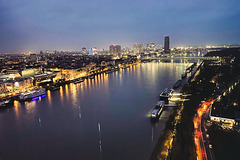
Bratislava at night
| |
|
|
|
The UFO Tower in Bratislava, Slovakia is an iconic landmark situated atop the Bridge of the Slovak National Uprising (Most SNP). This unique flying saucer-shaped structure was constructed between 1967 and 1972 based on designs by architects J. Lacko and A. Tesár. Perched 95m above the Danube River, the 7th largest suspension bridge in the world, the UFO Tower has become an integral part of the Bratislava skyline. Originally opened in the 1970s and voted Building of the Century in Slovakia in 2001, the tower underwent renovations in 2005. A restaurant with 80 seats, two modern bars with capacity for 60 guests, and an observation deck with panoramic views up to 100km were added. The UFO Tower is now a member of the World Federation of Great Towers, recognised internationally as a symbol of Bratislava. The iconic tower can be spotted in the background of every postcard, an unmistakable fixture in the capital's urban landscape.
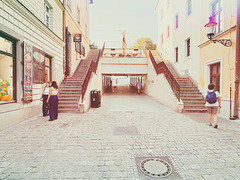
A Brutalist Underpass
| |
|
|
|
I previously posted a photo from here, and then realised the viewers might not get the whole picture of this rather ingenial work. So up here’s a second take - enjoy!
On a warm summer evening under Kapucínska’s tram lines, the brutalist underpass comes alive. Golden light spills over rough concrete, setting the stage for a rare sound mix. A man blows sharp, ancient notes on a Slovak koncovka flute while an electric box hums the veena’s deep, dreamy tones. The raw concrete walls drink it all in, blending tradition with a fresh, electric pulse in the heart of Old Town.
This gritty, brutalist structure isn’t just functional—it’s a bold statement of raw urban strength. Its exposed concrete, strong lines, and cavernous spaces define a the 20th-century vision where utility meets stark beauty. Against the fading light and floating music, the underpass reveals itself not only as a crossing, but as an architectural landmark that holds the pulse of the city.
A Postcard For You
| |
|
|
|
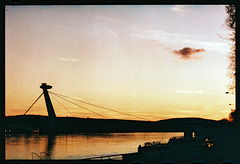
Most SNP (the Bridge of the Slovak National Uprising) offers one of Bratislava’s most iconic and visually striking panoramas, especially with its flying saucer-shaped observation deck set high above the Danube. The crisp lines of the bridge against the cityscape are instantly recognisable and often evoke strong local pride, as well as memories of Sixties architectural ambition. For anyone familiar with Bratislava, the dramatic contrast between the bold silhouette of Most SNP and the historic old town never fails to impress, blending modern engineering with centuries of history in a single unforgettable view.
Against the Sun
| |
|
|
|
Ayran!
| |
|
|

Monuments and Memory
| |
|
|
|
Námestie slobody — Freedom Square — is where layers of history and memory meet in the heart of Bratislava. Back in the seventeenth century, this area was covered by vineyards, then later became home to the Summer Archbishop’s Palace, which now serves as a government building. Over time, bold landmarks like the vast Post Office Palace and the Slovak Technical University were built, turning the greenery into a dramatic urban stage.
The centerpiece of the square is the Fountain of Union ( fontána Družba ), completed in 1980 and renowned as the largest fountain in Bratislava and Slovakia. Its dramatic 9-meter-tall stainless steel linden flower sculpture, a symbol of Slavic heritage, was fully restored in 2023 after years of disrepair. Today, water flows again and the revitalized fountain stands as both a historical marker and a vibrant gathering point for the city.
This square has seen more than its share of drama. In 1948, after orchestrating a Communist coup that swept away Czechoslovakia’s democracy, Klement Gottwald had the square named after him, sealed with a towering statue — a very public sign of the Communist regime’s grip on the country for decades. Through years of shifting politics, the square was a stage for all manner of mass events, from grim fascist rallies to Commie-era parades, its modernist architecture reflecting each twist in the nation’s fate.
All of this changed with the Velvet Revolution ("Tender Revolution" in original) in 1989, when the square regained both its original name and its spirit. Today, the square hums with life once again. It plays host to democracy rallies and pride celebrations, surrounded by modernist shapes and open green spaces that invite both reflection and lively gatherings. It is much more than a relic of dictatorship; it stands as living proof of Bratislava’s commitment to memory, dialogue, and moving forward.
Conquering the Universe
| |
|
|
|
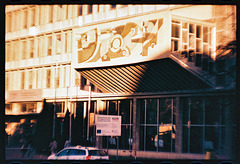
The “Conquering the Universe” mosaic on the Faculty of Mechanical Engineering at the Slovak University of Technology in Bratislava stands as a visionary piece of public art. Created by academic painter Dezider Castiglione in 1962, this bold work forms the front of one of four projecting lecture halls on the main facade facing Freedom Square. Each of these protruding volumes features its own monumental mosaic, highlighting a different theme from the technical and scientific ideals of the time.
This mosaic dedicated to space exploration presents a stylised satellite, reminiscent of Sputnik, moving along its distinctive orbit. The composition places the sun in the centre, with a blue segment indicating the Earth on one side. These elements capture the era's excitement about cosmic discovery and reflect the immense pride in scientific achievement prevalent in 1960s Central Europe.
Thousands of coloured stone tesserae were meticulously set into the concrete surface to compose the mosaic, blending artistic innovation with the era’s engineering ambitions.
The building itself is a hallmark of 1960s Slovak modernism, designed under the direction of architect Martin Kusý . It stands out for its clear, rational layout and its crisp, balanced forms — qualities emblematic of the modernist drive for efficiency and harmony. The rhythmic projection of four lecture halls breaks up the facade’s geometry, providing a dramatic architectural setting for the mosaics and reinforcing the building’s civic and educational significance within Bratislava’s urban landscape.
#HWW
Urban
| |
|
|
|
Jump to top
RSS feed- Latest items - Subscribe to the latest items added to this album
- ipernity © 2007-2026
- Help & Contact
|
Club news
|
About ipernity
|
History |
ipernity Club & Prices |
Guide of good conduct
Donate | Group guidelines | Privacy policy | Terms of use | Statutes | In memoria -
Facebook
X
