

A Broken Flower
Nightmare
National Aquarium of Denmark is the largest aquari…
BÅDTEATRET
Let's go swimming!
Golden Tower
le Tricolore
Why they call him a river horse???
A Treetop House
Watching as Meditation
Bright and Tidy
In the tank
Orava
Imposing
Blumenbank - HBM
Dystofuturium
Lagerhaus - HWW
Gartenzaun mit Schneehaube - HFF
Lover's Leap
Over the Roofs of Tomorrow
Cut Off
From that rooftop: a Boatride
Ein Regentag
Zurück in die Zukunft!
Carpathian forest in a puddle
Lemon Tree
All Tied Up
V.M.
Last sunny days of the year
English-German
Wild Goose Chase
seltene Momente
Barren
Overgrown
Different Lifestyles
Typical street scene in Copenhagen
Study of nature (I and II)
Wet Weather
Study of nature I
Party Aftermath
Fachwerkhaus - HWW
...
Rosy Outlook
Blurred camera streetphoto
Revered Teachers

Location
Lat, Lng:
You can copy the above to your favourite mapping app.
Address: unknown
You can copy the above to your favourite mapping app.
Address: unknown
See also...
Keywords
Cricket Street Championship


Boys in India claim whatever space they can find as a cricket ground, just as boys in Europe turn any patch of concrete or grass into a football pitch. A narrow lane between houses, a side street with parked scooters, or a dusty open corner near apartments becomes enough as long as there is room to bowl and swing a bat. The pitch is simply the flattest strip of ground available, and the boundaries are imaginary lines drawn between a doorway, a tree, and a parked car.
Everything is improvised and slightly bent to fit the surroundings. The ball is usually a tennis or rubber ball so that windows and passing people are a little safer, and stumps are whatever stands upright: a backpack, a crate, or three chalk lines on a wall. Rules shift from place to place: one particular balcony might be “out,” a six hit onto a neighbour’s roof might end the innings, and a one‑bounce catch might still count, because nobody wants to lose the ball or break anything. The tight space forces the boys to keep their shots low, find gaps between obstacles, and react quickly when the ball kicks off a stone or edge in the road.
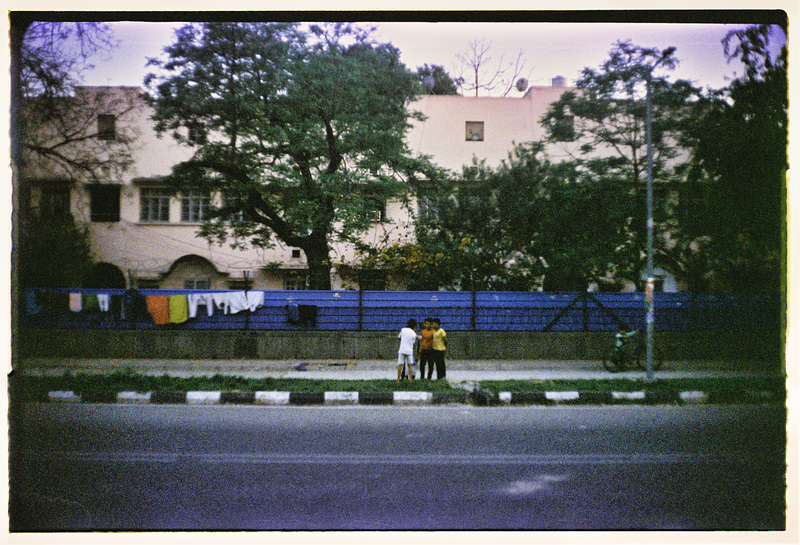
The rhythm around the game feels very similar to street football culture. As school or chores end, someone arrives with a bat, another brings a ball, and teams are picked quickly, usually with a bit of bargaining over who gets the best batter or fastest bowler. Play is filled with chatter: appeals, mock outrage, laughter, and endless arguments over close decisions that are settled by a mix of loudness and compromise. Younger kids start at the edges as fielders, gradually earn a turn to bat, and slowly become part of the core group.
For the boys, these informal matches are more than a way to pass time; they are their daily tournament, a place to copy the stars they see on TV, test themselves against friends, and carve out a little piece of the city where they feel completely at home.
Everything is improvised and slightly bent to fit the surroundings. The ball is usually a tennis or rubber ball so that windows and passing people are a little safer, and stumps are whatever stands upright: a backpack, a crate, or three chalk lines on a wall. Rules shift from place to place: one particular balcony might be “out,” a six hit onto a neighbour’s roof might end the innings, and a one‑bounce catch might still count, because nobody wants to lose the ball or break anything. The tight space forces the boys to keep their shots low, find gaps between obstacles, and react quickly when the ball kicks off a stone or edge in the road.
The rhythm around the game feels very similar to street football culture. As school or chores end, someone arrives with a bat, another brings a ball, and teams are picked quickly, usually with a bit of bargaining over who gets the best batter or fastest bowler. Play is filled with chatter: appeals, mock outrage, laughter, and endless arguments over close decisions that are settled by a mix of loudness and compromise. Younger kids start at the edges as fielders, gradually earn a turn to bat, and slowly become part of the core group.
For the boys, these informal matches are more than a way to pass time; they are their daily tournament, a place to copy the stars they see on TV, test themselves against friends, and carve out a little piece of the city where they feel completely at home.
Annemarie, John FitzGerald, William Sutherland, Boarischa Krautmo have particularly liked this photo
- Keyboard shortcuts:
Jump to top
RSS feed- Latest comments - Subscribe to the comment feeds of this photo
- ipernity © 2007-2026
- Help & Contact
|
Club news
|
About ipernity
|
History |
ipernity Club & Prices |
Guide of good conduct
Donate | Group guidelines | Privacy policy | Terms of use | Statutes | In memoria -
Facebook
X


Admired in: www.ipernity.com/group/tolerance
Sign-in to write a comment.