

København Comes Alive
Song of the Sea - Compass
Der Rosenlaui-Gletscher
Gletscherschlucht Rosenlaui.
Gletscherschlucht Rosenlaui
Bubbles & the street
Forged in Iron, Bound by History
The port seen from La Barceloneta
The 'UFO'
ᨒ↟
Koliba
Carpathians in Cyan #1
Snapshot of K-Pop: The Gangnam Style Landmark
Seoul Shadowed Horizons
Starfield Library: Seoul’s Towering Temple of Book…
Starfield Library: a detail of the roof
Antelope Canyon, Arizona.
Streets series (Insadong)
Giant lanterns 연등
A Brutalist Underpass
Blick vom Säntis auf den Altmann, 2'436 m.
Blick vom Säntis.
Silent Steles
The Palace's Melting Mirror
Just an ordinary morning
Liminal Fragments
the police (chinese cars series)
000040 (waterfall)
A street scene
Mortals-Endless Tower by Xiang Jing
Underpass
Neulich abends in Brissago.
A nap
Rajasthan / Thar desert
Youth
headlights (chinese cars series)
A monument
rainbow07 sufi
Biblioteca Popolare Ascona.
Verstrickt.
Full moon tonight
rainbow11 teepee
Auf der Bussalp.
Schiff von rechts! :-)
rainbow01 panorama

Location
Lat, Lng:
You can copy the above to your favourite mapping app.
Address: unknown
You can copy the above to your favourite mapping app.
Address: unknown
See also...
Keywords
Authorizations, license
-
Visible by: Everyone -
All rights reserved
-
926 visits
Family tree
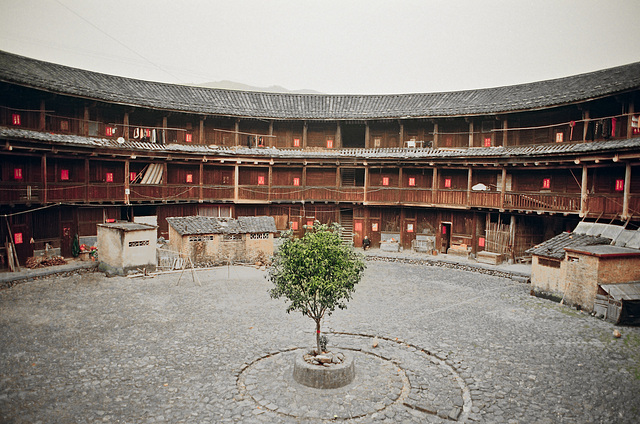

The Living Heart of Tulou: A Tree, a Clan, and the Shape of Equality
A Tulou is a unique communal dwelling found in the hills of Fujian, China—imagine a massive, round or square fortress built from earth and wood, designed to house an entire clan under one roof. These structures, some centuries old, can rise up to five stories and often shelter dozens of families, each with their own vertical stack of rooms. There are no penthouses or privileged suites; every family’s space is equal, and all share the same thick walls, a single fortified entrance, and a wide, open courtyard at the heart.
At the very center of this courtyard, you’ll often find a tree—sometimes a camphor, sometimes a banyan—its roots deep in the same soil that built the Tulou’s walls. This tree is far more than a decorative flourish. It is a living symbol of unity and continuity, believed to bring luck and harmony to the residents. Its branches offer shade from the summer sun, and its presence draws people together, making it the natural gathering place for conversation, play, and rest.
The daily life inside a Tulou revolves around both privacy and community. Each family has its own rooms behind closed doors, but water wells, kitchens, and even farmland are shared. Duties like cleaning the courtyard or organizing festivals rotate among the families, ensuring everyone has a role in the upkeep and spirit of the house. The tree at the center is a constant, silent witness to these rhythms—festivals, reunions, and the quiet moments in between.
For visitors, a Tulou offers a glimpse into a way of living that values equality, cooperation, and connection to the land. Walking through the arched gate, you enter a world where life moves at a slower pace and the boundaries between home, family, and nature blur. The tree in the courtyard is a reminder of these values, its roots and branches mirroring the ties that bind the community together.
Even as modern life draws many families to cities, the Tulou and its central tree endure. Some apartments stand empty except during festivals, when descendants return to their ancestral home. Yet the tree remains, steady and green, holding the memory of shared meals, laughter, and the enduring circle of community at the heart of the Tulou.
A Tulou is a unique communal dwelling found in the hills of Fujian, China—imagine a massive, round or square fortress built from earth and wood, designed to house an entire clan under one roof. These structures, some centuries old, can rise up to five stories and often shelter dozens of families, each with their own vertical stack of rooms. There are no penthouses or privileged suites; every family’s space is equal, and all share the same thick walls, a single fortified entrance, and a wide, open courtyard at the heart.
At the very center of this courtyard, you’ll often find a tree—sometimes a camphor, sometimes a banyan—its roots deep in the same soil that built the Tulou’s walls. This tree is far more than a decorative flourish. It is a living symbol of unity and continuity, believed to bring luck and harmony to the residents. Its branches offer shade from the summer sun, and its presence draws people together, making it the natural gathering place for conversation, play, and rest.
The daily life inside a Tulou revolves around both privacy and community. Each family has its own rooms behind closed doors, but water wells, kitchens, and even farmland are shared. Duties like cleaning the courtyard or organizing festivals rotate among the families, ensuring everyone has a role in the upkeep and spirit of the house. The tree at the center is a constant, silent witness to these rhythms—festivals, reunions, and the quiet moments in between.
For visitors, a Tulou offers a glimpse into a way of living that values equality, cooperation, and connection to the land. Walking through the arched gate, you enter a world where life moves at a slower pace and the boundaries between home, family, and nature blur. The tree in the courtyard is a reminder of these values, its roots and branches mirroring the ties that bind the community together.
Even as modern life draws many families to cities, the Tulou and its central tree endure. Some apartments stand empty except during festivals, when descendants return to their ancestral home. Yet the tree remains, steady and green, holding the memory of shared meals, laughter, and the enduring circle of community at the heart of the Tulou.
Annemarie, William Sutherland, ivanhoe, have particularly liked this photo
- Keyboard shortcuts:
Jump to top
RSS feed- Latest comments - Subscribe to the comment feeds of this photo
- ipernity © 2007-2026
- Help & Contact
|
Club news
|
About ipernity
|
History |
ipernity Club & Prices |
Guide of good conduct
Donate | Group guidelines | Privacy policy | Terms of use | Statutes | In memoria -
Facebook
X

Admired in: www.ipernity.com/group/tolerance
Sign-in to write a comment.