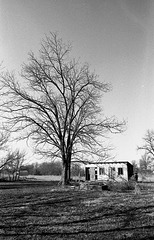
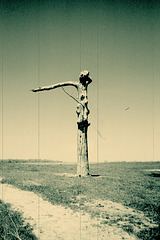
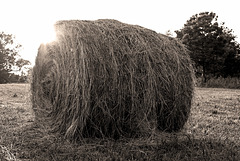
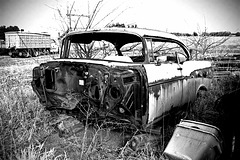
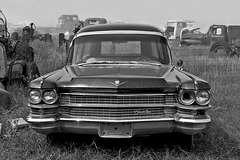
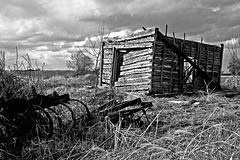
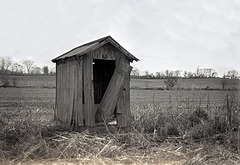
I return to this old shed over and over again when I'm needing a shot. It never fails me.
Camera: Pentax K1000
Lens: SMC Pentax-A 28mm, f2.8 wide angle lens
Film: Kentmere 100, black and white 100 ISO film
Aperture: F/16
Shutter speed: 1/60th sec.
Date: March 6th, 2010
Location: Norris City, Illinois, U.S.A.
Developing process, chemicals were at 68 degrees:
Kodak D-76 developer: 8 mins.
Ilford Ilfostop stop bath: 1 min.
Kodak fixer: 10 mins.
Kodak Photo-Flo 200: 1 min.
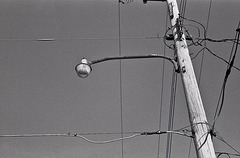
I thought this ordinary streetlight looked kind of interesting agains a clear, blue sky. (I assume it was blue....)
Camera: Pentax K1000
Lens: SMC Pentax-A 28mm, f2.8 wide angle lens, with Sears 2x tele-converter
Film: Kentmere 100, black and white 100 ISO film
Aperture: f/10
Shutter speed: 1/30th sec.
Date: March 6th, 2010
Location: Norris City, Illinois, U.S.A.
Developing process, chemicals were at 68 degrees:
Kodak D-76 developer: 8 mins.
Ilford Ilfostop stop bath: 1 min.
Kodak fixer: 10 mins.
Kodak Photo-Flo 200: 1 min.
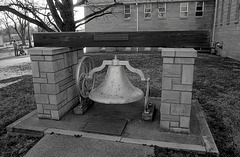
This is the bell that used to hang in the first Methodist Church ever built in Illinois. It was called Ebenezer Methodist Church and was organized on October 16th, 1838. In the 1980's, the old church was raized and the bell was moved here, to the Methodist Church in town.
Camera: Pentax K1000
Lens: SMC Pentax-A 28mm, f2.8 wide angle lens
Film: Kentmere 100, black and white 100 ISO film
Aperture: F/5.6
Shutter speed: 1/30th sec.
Date: March 6th, 2010
Location: Norris City, Illinois, U.S.A.
Developing process, chemicals were at 68 degrees:
Kodak D-76 developer: 8 mins.
Ilford Ilfostop stop bath: 1 min.
Kodak fixer: 10 mins.
Kodak Photo-Flo 200: 1 min.
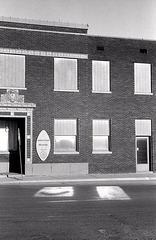
I happened to catch the late afternoon sun as it reflected off the windows of the old bank building downtown and onto the roadway below. Just a lazy Saturday afternoon.
Camera: Pentax K1000
Lens: SMC Pentax-A 28mm, f2.8 wide angle lens, with Sears 2x tele-converter
Film: Kentmere 100, black and white 100 ISO film
Aperture: F/11
Shutter speed: 1/30th sec.
Date: March 6th, 2010
Location: Norris City, Illinois, U.S.A.
Developing process, chemicals were at 68 degrees:
Kodak D-76 developer: 8 mins.
Ilford Ilfostop stop bath: 1 min.
Kodak fixer: 10 mins.
Kodak Photo-Flo 200: 1 min.
With this frame, I think I got everything at optimum in a developing chemical test I did. I used a Konica Autoreflex TC with a Konica Hexanon AR 50mm F/1.7 lens to shoot it with. The film was Kodak Tri-X 400 ASA and I pushed it to 1600 ASA, or two stops. I then processed it in D-76 at 68 degrees and at a 1:4 dilution for 15 minutes. It wasn't as grainy as before. This equation has a much more even tone to it.
Camera: Konica Autoreflex TC
Lens: Konica Hexanon AR 50mm F/1.7
Film: Kodak Tri-X 400 ASA black and white 35mm film (pushed to 1600)
Shooting program: Manual (no batteries)
Aperture: F/16
Shutter speed: 1/500
Date: February 20th, 2011, 3:17 p.m.
Location: Norris City, Illinois, U.S.A.
Developing specifics (chemicals at 68 degrees):
D-76 (1:4): 15 mins.
Ilford Ilfostop stop bath: 1 min.
Kodak fixer: 7 mins.
Another grainy, crappy shot from the first roll of Fomapan Classic I ran through my Konica Autoreflex TC SLR. But the film wasn't at fault - the graininess was caused because some of the negatives, all the shots I took outdoors, were overexposed by snow and bright sunlight and to get the scanner to see them, I had to really adjust it. Doing so picked up all the grain. Most of these shots turned out terrible like this, but they begin to grow on me a little....
Camera: Konica Autoreflex TC
Lens: Konica Hexanon AR 50mm, f/1.7
Film: Fomapan Classic, 100 ISO black and white film
Filter: Hoya Skylight 1B
Aperture: F/16
Shutter speed: 1/125 sec.
Date: February 9th, 2010, 3.18 p.m.
Location: Norris City, Illinois, U.S.A.
Chemicals were all at 68 degrees:
Developer: Kodak D-76, for 6 minutes
Stopbath: Ilford Ilfostop, for 4 minutes
Fixer: Kodak Fixer, for 6 minutes
And I finished the developing process by soaking the negatives in Kodak Photo-Flo 200 for about 1 minute with moderate agitation.
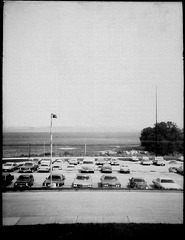
In 1979, I was attending college, majoring in photography. During my first photography course, we all got to learn about cameras and how they worked from the inside out by having to build our own pinhole cameras. Mine was the size of an ordinary box camera and we used cut 8x10 sheets of black and white photo paper as negatives. You could get four "negatives" from one sheet of paper. This is what is/was known as Calotype photography, first used in 1839 by William Henry Fox Talbot.
The college had a darkroom the students could work in, so to be able to use your camera, you had to load one "negative" into your homemade camera, (in the dark, of course), and then about the only thing readily available as a subject was the college and it's surrounding area - it was located out in the middle of nowhere. I chose some cars in the parking lot, looking off in the direction of the nearest small town. When the picture was taken and developed, you had to contact print it to get your image. This image is actually one of the "negatives" I made 30 years ago, only just rediscovered. I have reversed it so that it becomes a negative image of what was originally a negative image. Now it's a positive image and looks essentially fairly normal. It also has the advantage of being one stage clearer, from not having to contact print it to produce the final, positive image.
Depending on the size of the hole you made for your aperture, you could get more or less detail. I remember experimenting and this image is an earlier shot when the aperture hole was smaller. Later pictures seemed to have lost a little definition, but gained a cool "vignette" effect on the overall image. Being an imprecise science, there is some distortion in this image along the right edge.
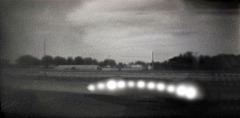
This was my fourth attempt at getting a usuable image with my little homemade Kodak Trix-X film box pinhole camera. Finally, it worked! The frame was the average height of a regular 35mm negative, but the width turned out to be like a panoramic camera. I wasn't sure of the focal length, but the equivelant image I took with a digital camera translated to be 18mm. So, that would lead me to believe this film box camera was 18mm also.
I'm still not certain what is causing the little arc of exposed dots along the bottom of the frame. This glitch also turned up in the last shot I took with this camera, but that one had a different pinhole piece than this one, so it wasn't an imperfection in my pinhole. (Or maybe I recreated the exact same imperfection?) If anybody recognizes this aberration or what causes it, please let me know. I'd really like to be able to correct this and get one really good shot.
Camera: Film Box Pinhole Camera
Lens: Pinhole (approx .051mm)
Film: Kodak Tri-X 400 ISO black and white 35mm film
Exposure length: 2.2 secs.
Date: September 25th, 2010, 15:07:26 p.m.
Location: Fairfield, Illinois, U.S.A.
Developing specifics (chemicals at 68 degrees):
D-76: 7 mins.
Ilford Ilfostop stop bath: 1 min.
Kodak fixer: 8 mins.
Rinse: 5 mins.
Kodak Photo-Flo 200: 1 min.
Help & Contact|Club news|About ipernity|History|ipernity Club & Prices|Guide of good conduct Donate|Group guidelines|Privacy policy|Terms of use|Statutes|In memoria