

Lacing Pillow
Thomas Cranmer's Burning
Sharpening at Berkeley
臭豆腐
皮蛋
Nosemorph
Henry Holiday & John Martin
The Vanishing and the Gneiss Rock
Snark Logo
Collembolacollaboration
Entropy Export
Hongkong
Bonnetmaker@ipernity
Mad Tea-Party
Mad Tea-Party500500
The Snark in your Dreams
The Snark in your Dreams (low resolution)
Monster Face
Johannes Vermeer & Salvatore Dalí: The Lacemaker
Adriano Orefice: La cerca dello Squallo
The Bellman and Charles Darwin
Hennry Holiday, the Bonnetmaker and a Bonnet
The Ancient of Bad Hair Days
Yellow Tape Platform Art
Munich 1900
Springtails at Night
Cartoons, 1981
Southern Californian Factory
The Boojum sitting on some of the 42 boxes
Be prepared for May 25th (and all the other days)
Victor in Your Dreams (2013)
El Bug, 1972
IT WAS A BOOJUM (bw)
The Bellman and Sir Henry Lee (no marks)
Wood Shavings turned Pope (1st version)
6 Sources to the Beaver's Lesson
Bellmen
Darwin's Fireplace and the Baker's Dear Uncle
Henry George Liddell in "The Hunting of the Snark"
Snarked: Henry George Liddell
Gestrüpp
Craneflies
Holiday - Millais- Anonymous - Galle, detail
Bankersnatched by the Bandersnatch
Holiday and Gheeraerts I
See also...
Keywords
Authorizations, license
-
Visible by: Everyone -
All rights reserved
-
3 051 visits
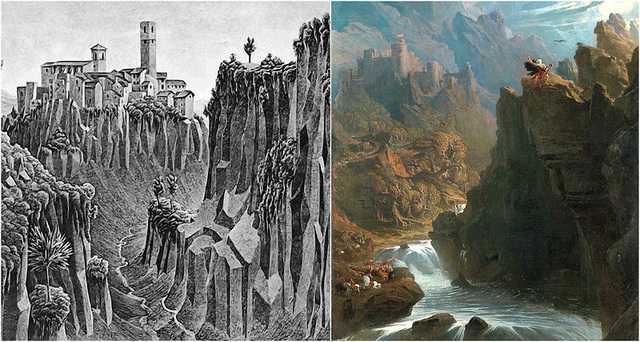
M. C. Escher's allusion to John Martin's "The Bard"

www.flickr.com/photos/bonnetmaker/8460032132
This discovery is a kind of "bycatch" from my Snark hunt: M. C. Escher's "Italian" scene shown above (left side) is not a copy like his version (1935) of a segment from a paintig by Hieronymus Bosch. The scene is a more subtile allusion to John Martin's The Bard.
Segments:
[left] Maurits Cornelis Escher: Cimino Barbarano, 1929 (in Escher's "Italian" period)
[right] John Martin: The Bard, ca. 1817
For this side-by-side comparison, I redrew and then horizontally compressed Escher's lithograph after applying selective Gaussian filtering to the image in order to remove details which are not required for the comparison. Parts of the image on its sides have been removed. The top of Martin's painting has been removed too.
Earlier I thought that Escher here perhaps has combined an Italian scenery like Civita di Bagnoregio with what may be supposed to be a (Cambrian?) landscape, as it was there where Edward I went after the Welsh bards. But the landscape is not "Cambrian":
www.socialhistoryofart.com/19thCentury/ ... /John Martin.doc
"Ignoring the Welsh highlands, Martin clearly modeled his landscape on the Swiss Alps which had recently emerged as a major destination for English travelers thanks to the Romantic Alpine poems of Byron and Shelley, among others, and the Alpine landscapes of Koch and Turner. Spurning the tranquil and majestic “Alpine sublime” developed by Koch, Martin took the more dramatic Alpine compositions of Turner and transformed them with his own, quasi-Apocalyptic fervor. In so doing, he gave Alpine landscape the emotional turmoil found in Blake and Byron. And in all this, he took Gray’s Bard into completely new territory, leaving behind all traces of eighteenth-century restraint, decorum, reason, and quiet morality."
Robert Baldwin, 2010
The © for this image applies to the presentation of the discovery of the relation between Escher's print and Martin's painting. Escher's original illustration is © Cordon Art B.V. - Baarn - Netherlands.
See also: flipsideflorida.wordpress.com/2013/03/06/escher-the-bard
This discovery is a kind of "bycatch" from my Snark hunt: M. C. Escher's "Italian" scene shown above (left side) is not a copy like his version (1935) of a segment from a paintig by Hieronymus Bosch. The scene is a more subtile allusion to John Martin's The Bard.
Segments:
[left] Maurits Cornelis Escher: Cimino Barbarano, 1929 (in Escher's "Italian" period)
[right] John Martin: The Bard, ca. 1817
For this side-by-side comparison, I redrew and then horizontally compressed Escher's lithograph after applying selective Gaussian filtering to the image in order to remove details which are not required for the comparison. Parts of the image on its sides have been removed. The top of Martin's painting has been removed too.
Earlier I thought that Escher here perhaps has combined an Italian scenery like Civita di Bagnoregio with what may be supposed to be a (Cambrian?) landscape, as it was there where Edward I went after the Welsh bards. But the landscape is not "Cambrian":
www.socialhistoryofart.com/19thCentury/ ... /John Martin.doc
"Ignoring the Welsh highlands, Martin clearly modeled his landscape on the Swiss Alps which had recently emerged as a major destination for English travelers thanks to the Romantic Alpine poems of Byron and Shelley, among others, and the Alpine landscapes of Koch and Turner. Spurning the tranquil and majestic “Alpine sublime” developed by Koch, Martin took the more dramatic Alpine compositions of Turner and transformed them with his own, quasi-Apocalyptic fervor. In so doing, he gave Alpine landscape the emotional turmoil found in Blake and Byron. And in all this, he took Gray’s Bard into completely new territory, leaving behind all traces of eighteenth-century restraint, decorum, reason, and quiet morality."
Robert Baldwin, 2010
The © for this image applies to the presentation of the discovery of the relation between Escher's print and Martin's painting. Escher's original illustration is © Cordon Art B.V. - Baarn - Netherlands.
See also: flipsideflorida.wordpress.com/2013/03/06/escher-the-bard
(deleted account) has particularly liked this photo
- Keyboard shortcuts:
Jump to top
RSS feed- Latest comments - Subscribe to the comment feeds of this photo
- ipernity © 2007-2026
- Help & Contact
|
Club news
|
About ipernity
|
History |
ipernity Club & Prices |
Guide of good conduct
Donate | Group guidelines | Privacy policy | Terms of use | Statutes | In memoria -
Facebook
X

John Martin
Version with completely desaturated colors (not required for shape comparison):
Holiday "copied" shapes. Escher used Martin's whole composition.
Sign-in to write a comment.