

Black and Colours June 2014
Orange with Stripes
Pink Palm
Abstract White
Bougainvillea
A man's got to have a hobby
Abstract Oil
Texture on Texture
Sunspace Sunflower
Brighton Beach Huts
Mineral
So many berries
Conifer Green
native to noosa
Beach Huts Green and Brown
Helena Olive
St Patrick's Cathedral, Fifth Avenue
Copper Jewellery
Mr Peabody and Sherman
Blue faced Honeyeater
pickled apple
shades of brown
Scarlet Rose
Art Gallery Bank Est.1909
Metal
Metal
Apple Juice
Bougainvillea and Terracotta
Black String
Noosa Boardwalk
Black and Colours
Black and Green
Coast Guard Noosa
Black and Sunset
Extreme Yellow
Bright Yellow
Jungle Bougainvillea
Capsicum and Aubergine
Chinese New Year
Coffee is my life
Chinese Red
Purple Spin
Black with Flowers
Oil Painting by Toliol from Guadalest
Jungle Bougainvillea

See also...
Keywords
Authorizations, license
-
Visible by: Everyone -
All rights reserved
-
727 visits
Meeting a Dolphin
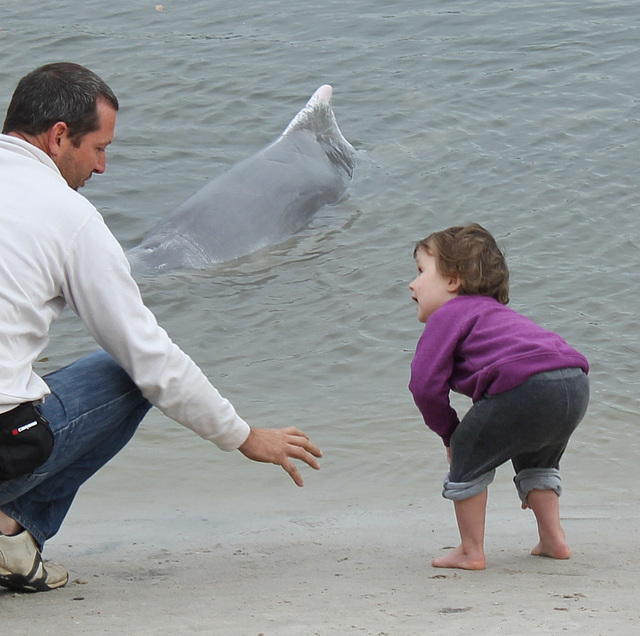

At Dolphin Cove in Tin Can Bay, Queensland.
This child had dropped the tiny fish in the water and his father was explaining that he should have held it just under the water. The dolphins take the fish very gently.
The locals have named these two visiting Dolphins Mystique (male) and Patch (female), members of a pod of frequent Dolphin visitors.
It is a delightful experience to see these wild river/estuarine dolphins willingly coming close to the shore to meet their old friends who host the meeting with these lovely creatures. Every morning around 7-8.30am they can be seen in varying numbers.
The Indo-Pacific Humpback Dolphins have been interacting with residents and visitors of Tin Can Bay for 30 years. It all started with “Scarry” nicknamed due to the numerous rough edges along her dorsal and tail fins. “Scarry” appeared with a young male dolphin, Mystique, believed to be her youngest surviving offspring.
“Scarry” has not been seen since early 2003 but her son Mystique and girlfriend “Patch” still come in to the boat ramp to observe humans and be hand fed.
barnaclesdolphincentre.com.au/dolphin_feeding.htm
Indo-Pacific humpback dolphins are referred to as an 'inshore' species as they occur in shallow nearshore waters, often near river mouths, and are rarely sighted more than 1 km offshore. In Moreton Bay they can be found up to 6 km offshore and have also been recorded up to 55 km offshore in the northern Great Barrier Reef where waters are shallow. Their distribution is tropical and subtropical. Key localities in Queensland are Moreton Bay and its adjacent offshore waters, and the Tin Can Inlet of the Great Sandy Strait.
www.ehp.qld.gov.au/wildlife/animals-az/indopacific_humpba...
Archive Airings AA53 Candid street scenes
2017 Alphabet Site M
This child had dropped the tiny fish in the water and his father was explaining that he should have held it just under the water. The dolphins take the fish very gently.
The locals have named these two visiting Dolphins Mystique (male) and Patch (female), members of a pod of frequent Dolphin visitors.
It is a delightful experience to see these wild river/estuarine dolphins willingly coming close to the shore to meet their old friends who host the meeting with these lovely creatures. Every morning around 7-8.30am they can be seen in varying numbers.
The Indo-Pacific Humpback Dolphins have been interacting with residents and visitors of Tin Can Bay for 30 years. It all started with “Scarry” nicknamed due to the numerous rough edges along her dorsal and tail fins. “Scarry” appeared with a young male dolphin, Mystique, believed to be her youngest surviving offspring.
“Scarry” has not been seen since early 2003 but her son Mystique and girlfriend “Patch” still come in to the boat ramp to observe humans and be hand fed.
barnaclesdolphincentre.com.au/dolphin_feeding.htm
Indo-Pacific humpback dolphins are referred to as an 'inshore' species as they occur in shallow nearshore waters, often near river mouths, and are rarely sighted more than 1 km offshore. In Moreton Bay they can be found up to 6 km offshore and have also been recorded up to 55 km offshore in the northern Great Barrier Reef where waters are shallow. Their distribution is tropical and subtropical. Key localities in Queensland are Moreton Bay and its adjacent offshore waters, and the Tin Can Inlet of the Great Sandy Strait.
www.ehp.qld.gov.au/wildlife/animals-az/indopacific_humpba...
Archive Airings AA53 Candid street scenes
2017 Alphabet Site M
Gudrun, Eric Desjours have particularly liked this photo
- Keyboard shortcuts:
Jump to top
RSS feed- Latest comments - Subscribe to the comment feeds of this photo
- ipernity © 2007-2026
- Help & Contact
|
Club news
|
About ipernity
|
History |
ipernity Club & Prices |
Guide of good conduct
Donate | Group guidelines | Privacy policy | Terms of use | Statutes | In memoria -
Facebook
X

Gillian Everett club has replied to tiabunna clubGillian Everett club has replied to Shuttering YukonSign-in to write a comment.