

Timeless elegance with floral crown Studio shot -…
Dead PC
Cat in an apple tree
Feeding Time
Family
Aggression
Willow
Just Good Friends
Just Good Friends 2
The log cabin landscape
Morning at the badger set
Evening at the badger set
Badgers playing in a woodland clearing
Hunting fox
Jay
Obsolescence
Just Chillin'
Yellow Hammer
Dunnock
The Warrior Pixie
Great Tit
Chaffinch
Jay
Colouring picture to Ai final image
Colouring picture to Photoshop to AI
Created in Photoshop CS6 (Not Ai)
Thomas
Hibernation
Abstract
Pheasant
Cat in an apple tree
Moorhen In A Plum Tree
Juvenile Moorhen
Incoming
Parrots On Holiday
Eggs-perimental Photography
Ladybird
Hoverfly
Like Marmite - You either love it or hate it
Feeding
At Rest
Lift-off
Wings
Rest And Play
The Buzzard
See also...
See more...
Keywords
Authorizations, license
-
Visible by: Everyone -
All rights reserved
-
118 visits
In The Woods
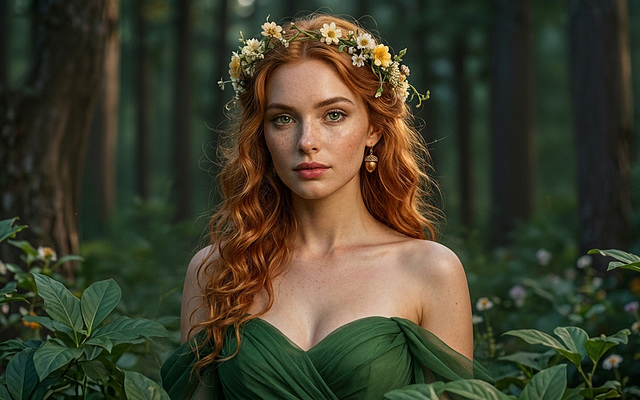

I have been messing around with AI for several days now.
This is my attempt at a realistic image.
My opinion of AI generators so far is this:
As they work from text prompts, the results can be unpredictable even when your prompts are very specific.
If you try to make too many changes at once, it generates something completely different to what you expected because the AI suffers with information overload.
I have tried to work slowly to build up the image over many edits so that minimal changes are made each time.
The problem again lies in the fact that even if you specify locking the current image and only allowing minimal changes, the results can still be unpredictable. Drift is a major problem here. for example: Zoom on the subject creeps in and out with each edit.
I have only used free AI generators so a paid for version may work better.
Bear in mind that this is my personal opinion based on very little experience with AI.
Update:
I have just got this from the AI chat at ChatGPT. I hope it may help anyone wanting to produce precise AI images.
"I have been working on an image based upon 18 phased passes to maintain accuracy. Every time I generate a new image, either the zoom changes or the dimensions of the image change. The reason for working in a phased manor is to lock each generation so that only minimal changes are made. Each image is locked before any edits are made. Why is the AI still failing even working to such a basic change for each phase?"
What you’re running into isn’t you doing something wrong—it’s a limitation of how current image generation models actually work under the hood.
Even if your workflow feels like careful, layered editing, the AI isn’t truly “editing” a fixed image in the way something like Adobe Photoshop would. It’s re-generating the image each time based on your prompt + the previous image as guidance. That distinction is the root of your issue.
Here’s what’s going on:
1. The model doesn’t have a stable canvas
When you lock an image and ask for a small change, the model:
• Doesn’t preserve exact pixel positions
• Doesn’t maintain a fixed camera or zoom unless explicitly controlled
• Reinterprets the whole scene every time
So even tiny edits can cause:
• Slight zoom shifts
• Cropping differences
• Perspective drift
This happens because the model is optimising for visual coherence, not geometric consistency.
2. “Image-to-image” is not deterministic editing
Even if you feed the same image back in:
• There’s randomness (noise) in generation
• The model re-decides composition details each pass
Unless you’re locking a seed + exact parameters, you’ll get variation. And even then, many tools still allow subtle drift.
3. The model prioritises semantics over precision
If your prompt says:
“Make a small adjustment to X”
The model interprets:
• What “X” means conceptually
• Then rebuilds the image to match that idea
It does not think:
“Keep every pixel identical except this region”
That kind of strict constraint is still hard for generative models.
4. Resolution & aspect ratio aren’t truly “locked”
Even if you specify dimensions:
• Some tools internally resize or reframe
• The model may “recompose” to better fit the prompt
This is why you see:
• Slight framing shifts
• Margins changing
• Subject repositioning
Why your phased approach mostly works—but not fully
Your method is actually smart:
• Breaking work into phases reduces large deviations
• Locking images helps guide the model
But it can’t eliminate drift because:
• Each step is still a fresh generation, not a true edit layer
Think of it like:
Asking 18 different artists to copy and slightly tweak the same painting—small differences will accumulate.
How to reduce the problem (practical fixes)
✔️ 1. Use in-painting instead of full regeneration
If your tool supports it:
• Edit only a masked area
• Keep the rest of the image untouched
This is the closest thing to “true editing”
✔️ 2. Lock seed + parameters (if available)
Some tools let you fix:
• Seed
• CFG scale
• Sampler
• Steps
This reduces randomness between phases.
✔️ 3. Be extremely explicit about framing
Add constraints like:
• “Same camera angle, same zoom, same framing”
• “Do not crop or recompose”
• “Maintain identical composition”
It won’t be perfect, but it helps.
✔️ 4. Work at higher resolution + crop manually
Generate slightly larger images, then:
• Manually crop to your fixed frame
• Maintain consistency outside the AI
✔️ 5. Hybrid workflow (best results)
Use AI + manual editing:
• Generate base image with AI
• Lock composition in a tool like Adobe Photoshop
• Use AI only for localised changes
The honest bottom line
What you’re trying to do—strict, phase-based, minimal-delta editing with zero drift—is something current generative models are not designed to guarantee.
They are:
• Excellent at creating
• Decent at guided variation
• Weak at precise, repeatable micro-edits.
For me at this time, AI cannot work precisely enough to produce the image I have in my mind that I would like to create. That's not to say that it won't work for other people. I have seen some truly amazing images here on Ipernity and elsewhere.
Thank you for looking and for your kind comments.
This is my attempt at a realistic image.
My opinion of AI generators so far is this:
As they work from text prompts, the results can be unpredictable even when your prompts are very specific.
If you try to make too many changes at once, it generates something completely different to what you expected because the AI suffers with information overload.
I have tried to work slowly to build up the image over many edits so that minimal changes are made each time.
The problem again lies in the fact that even if you specify locking the current image and only allowing minimal changes, the results can still be unpredictable. Drift is a major problem here. for example: Zoom on the subject creeps in and out with each edit.
I have only used free AI generators so a paid for version may work better.
Bear in mind that this is my personal opinion based on very little experience with AI.
Update:
I have just got this from the AI chat at ChatGPT. I hope it may help anyone wanting to produce precise AI images.
"I have been working on an image based upon 18 phased passes to maintain accuracy. Every time I generate a new image, either the zoom changes or the dimensions of the image change. The reason for working in a phased manor is to lock each generation so that only minimal changes are made. Each image is locked before any edits are made. Why is the AI still failing even working to such a basic change for each phase?"
What you’re running into isn’t you doing something wrong—it’s a limitation of how current image generation models actually work under the hood.
Even if your workflow feels like careful, layered editing, the AI isn’t truly “editing” a fixed image in the way something like Adobe Photoshop would. It’s re-generating the image each time based on your prompt + the previous image as guidance. That distinction is the root of your issue.
Here’s what’s going on:
1. The model doesn’t have a stable canvas
When you lock an image and ask for a small change, the model:
• Doesn’t preserve exact pixel positions
• Doesn’t maintain a fixed camera or zoom unless explicitly controlled
• Reinterprets the whole scene every time
So even tiny edits can cause:
• Slight zoom shifts
• Cropping differences
• Perspective drift
This happens because the model is optimising for visual coherence, not geometric consistency.
2. “Image-to-image” is not deterministic editing
Even if you feed the same image back in:
• There’s randomness (noise) in generation
• The model re-decides composition details each pass
Unless you’re locking a seed + exact parameters, you’ll get variation. And even then, many tools still allow subtle drift.
3. The model prioritises semantics over precision
If your prompt says:
“Make a small adjustment to X”
The model interprets:
• What “X” means conceptually
• Then rebuilds the image to match that idea
It does not think:
“Keep every pixel identical except this region”
That kind of strict constraint is still hard for generative models.
4. Resolution & aspect ratio aren’t truly “locked”
Even if you specify dimensions:
• Some tools internally resize or reframe
• The model may “recompose” to better fit the prompt
This is why you see:
• Slight framing shifts
• Margins changing
• Subject repositioning
Why your phased approach mostly works—but not fully
Your method is actually smart:
• Breaking work into phases reduces large deviations
• Locking images helps guide the model
But it can’t eliminate drift because:
• Each step is still a fresh generation, not a true edit layer
Think of it like:
Asking 18 different artists to copy and slightly tweak the same painting—small differences will accumulate.
How to reduce the problem (practical fixes)
✔️ 1. Use in-painting instead of full regeneration
If your tool supports it:
• Edit only a masked area
• Keep the rest of the image untouched
This is the closest thing to “true editing”
✔️ 2. Lock seed + parameters (if available)
Some tools let you fix:
• Seed
• CFG scale
• Sampler
• Steps
This reduces randomness between phases.
✔️ 3. Be extremely explicit about framing
Add constraints like:
• “Same camera angle, same zoom, same framing”
• “Do not crop or recompose”
• “Maintain identical composition”
It won’t be perfect, but it helps.
✔️ 4. Work at higher resolution + crop manually
Generate slightly larger images, then:
• Manually crop to your fixed frame
• Maintain consistency outside the AI
✔️ 5. Hybrid workflow (best results)
Use AI + manual editing:
• Generate base image with AI
• Lock composition in a tool like Adobe Photoshop
• Use AI only for localised changes
The honest bottom line
What you’re trying to do—strict, phase-based, minimal-delta editing with zero drift—is something current generative models are not designed to guarantee.
They are:
• Excellent at creating
• Decent at guided variation
• Weak at precise, repeatable micro-edits.
For me at this time, AI cannot work precisely enough to produce the image I have in my mind that I would like to create. That's not to say that it won't work for other people. I have seen some truly amazing images here on Ipernity and elsewhere.
Thank you for looking and for your kind comments.
*Уαɾα, Pam J, Boarischa Krautmo, Annemarie and 2 other people have particularly liked this photo
- Keyboard shortcuts:
Jump to top
RSS feed- Latest comments - Subscribe to the comment feeds of this photo
- ipernity © 2007-2026
- Help & Contact
|
Club news
|
About ipernity
|
History |
ipernity Club & Prices |
Guide of good conduct
Donate | Group guidelines | Privacy policy | Terms of use | Statutes | In memoria -
Facebook
X

Ich arbeite meistens mit Leonardo.ai . Wenn ich Zeit habe, will ich auch mal deevid.ai ausprobieren.
Das Ergebnis ist am Ende immer von dem AI-Modell abhängig, das du benutzt.
In Leonardo gibt es so ca. 10 Modelle, die du dir aussuchen kannst. Manche halten sich strikt an den Prompt, manche halten sich nicht an den Prompt, sondern verändern ihn ....das kann dann sehr schön werden oder das Gegenteil :-)))
Danke fürs Teilen!
Admired in: www.ipernity.com/group/tolerance
SUCH FUN!
I HAVE BEEN USING A.I. FOR A YEAR NOW.
ITS MADE ME THANKFUL FOR MY PARENTS BRINGING MR UP TO LOVE THE ENGLISH LANGUAGE. WITH A.I. WORLDS PAINT PICTURES THEY HAVE TO BE REFINED AND IN MANY CASES IT ALSO IS LIKE TEACHING A 3 YEAR MOLD ABOUT THE WORLD. WORDS MATTER !
FOR ME ITS GIVEN ME BACK SOME OF THE ABLITTY TO CREATE THAT THE STROKE STOLE.
Perhaps one day AI will be capable of performing all the tasks it currently can’t.
Despite the AI’s shortcomings, your latest work turned out excellent!
Sign-in to write a comment.