

Don Barrett (aka DBs travels)'s photos
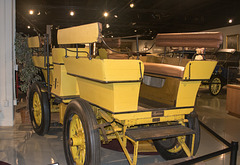
South Bend Studebaker 1909 electric shuttle (#0110…
| |
|
|
Studebaker’s first cars were electric because gasoline powered automobiles were “clumsy, dangerous, noisy brutes which stink to high heaven, break down at the worst possible moment, and are a public nuisance.” Though in 1903 they had an electric that could run 40 miles on a charge, gas won out in popularity due to range and higher speed, so they stopped building electric in 1911.
Their most interesting electric, to me, was this vehicle which they built for the US Government in 1909. This was one of two vehicles built for the tunnel between the Senate office building and the Capitol – because there wasn’t space in the tunnel for the vehicle to turn around, it had control for driving in either direction. They had a top speed of 12 mph and could carry 11 passengers. The cars were replaced by a rail system in 1912.
Sources: placards in museum
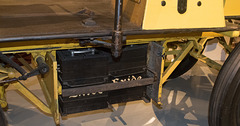
South Bend Studebaker 1909 electric shuttle (#0111…
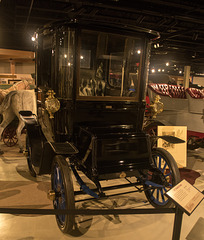
South Bend Studebaker 1911 electric coupe (#0117)
| |
|
|
|
$1850 (at that time) for a coupe that had a range of 70 miles and a top speed of 21mph (the batteries weighed 970 pounds)
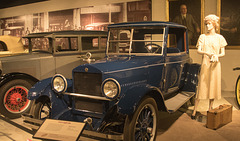
South Bend Studebaker 1924 Chinese cooperation (#0…
| |
|
|
The 1924 Light Six with custom aluminum body, fold-out windshield, teak-trimmed interior, and mohair upholstery – coachwork by Shanghai Horse Bazaar and Automobile Company of Shanghai, China.
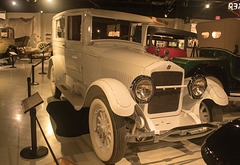
South Bend Studebaker 1922 Child’s Hearse (#0123)
| |
|
|
Due to very high infant mortality in the 1920’s, funeral homes used special, white (to signify innocence), hearses for children’s funerals. Oddly, this was owned by a funeral home in the small western Indiana farm town of Brazil, where it doesn’t seem there would have been the wealth for such a fancy hearse.
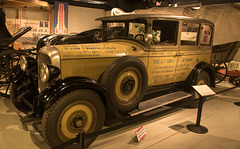
South Bend Studebaker cross-country ?? (#0124)
| |
|
|
A 1927 Studebaker Commander driven from New York to San Francisco – in just over 3 days? And that’s not 3+ days of time actually driving, that’s 3+ days total (Tuesday, August 30 to Friday, Sept 2). Obviously they had multiple drivers and some sort of sleeping arrangement, but that was long before interstates and would have been on what became US 40 in 1926, a two lane highway going right through the center of every town along the way.
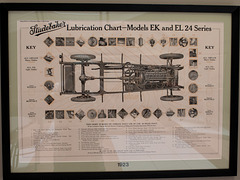
South Bend Studebaker 1923 lubrication chart (#012…
| |
|
Apologies for the glare on the picture, I snapped it quickly and didn’t realize till later how it would be an interesting reminder of the changes this reflected in car maintenance – 38 points to oil and lube, some weekly, some monthly, some every 90 days. My current car requires service about every 12,000 miles.
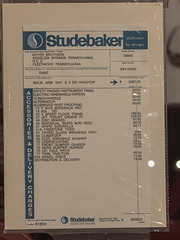
South Bend Studebaker ‘64 sticker (#0131)
| |
|
|
The actual sticker – interesting to see what was considered an accessory in those days.
South Bend Studebaker ‘64 (#0132)
| |
|
|
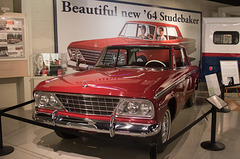
A leap to more modern times – a 1964 Studebaker Daytona with a sticker prices of $3,256.33 ($26,473 in 2019 dollars).
South Bend Studebaker – my car (#0136)
| |
|
|
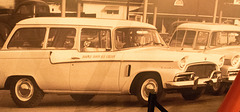
A terrible picture, but this is basically the Studebaker model I had for awhile in high school in the early 1960’s – I was working half a day and needed a car to get to work. I got the car through my brother – his girl friend had a mid-1950’s Studebaker wagon that no one was using because it was fairly beat up. It was two-tone light and dark blue, easy to drive even with worn shocks and an automatic transmission that slipped some times.
The car in this picture looks distorted due to being a picture of a picture, taken at an odd angle. The link below shows what the car looked like.
www.rodauthority.com/news/ebay-find-rare-56-studebaker-commander-parkview-two-door-wagon
South Bend Studebaker labor relations (#0142)
| |
|
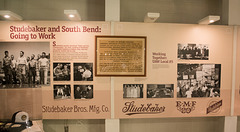
I was glad to see a display on labor relations at the Studebaker museum, and there was much moe than this. At other points in the museum there was mention of labor and community relations, and there had been a special display on the women of Studebaker at the entrance.
The sign in the middle that’s barely readable due to glare is a 1911 poster for classes that Studebaker offered to Hungarian and Polish employees who couldn’t speak English.
South Bend Studebaker war years (#0144)
| |
|
|
|
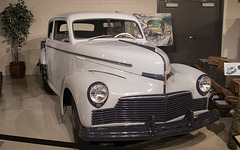
I’d wondered what car manufacturers did during the war years – they made ‘blackout’ models with trim instead of chrome, non-critical metals instead of aluminum, and apparently chose non-bright colors. This car was built in 1942.
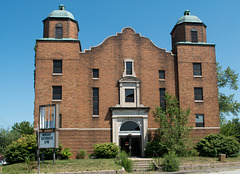
Michigan City abandoned church (#0105)
| |
|
|
Abandoned church building next to the street rail in Michigan City – looks to be in good condition.
Michigan City street rail (#0104)
Michigan City street rail (#0101)
| |
|
|
|
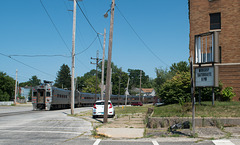
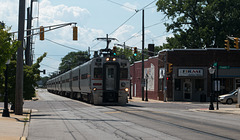
Mid-day commuter train approaching Michigan City 11th street stop. The train runs down the center of 10th and 11th street, for 2 miles. (see adjacent pictures)
Linked below is an interesting winter picture from about the same spot, taken by another Flickr user:
www.flickr.com/photos/craig_walker/35639122191
Michigan City street rail (#0099)
| |
|
|
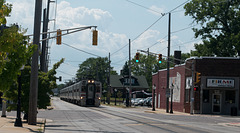
The real reason I had stopped in Michigan City – to see a section of residential city street shared with rail service. It used to be relatively common to see streets that were both auto and rail in the U.S., but such has largely disappeared. I knew about this street/rail combination from having seen it on other Flickr accounts. Note that I haven’t seen any explanation as to why this situation remains while it has disappeared in much of the rest of the country.
The train here is the South Shore Line commuter train that runs from Chicago to South Bend; looking at the train schedule there’s at least 30 commuter trains a day on this route. From the other pictures I’ve seen on Flickr, there are also freight trains that use these tracks, though I didn’t see any of those. (see adjacent pictures)
Michigan City Franklin Street historic bridge (#00…
| |
|
|
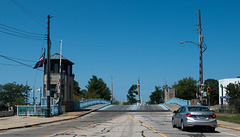
You have to be bridge fanatic to like this, but for bridge fanatics this is an historically important bridge. Built in 1932, the bridge is over Trail Creek to what is Washington Park. What is historic about it is that it is the only remaining lift (bascule) bridge in Indiana and the details (the railings, the tender’s building) are original.
historicbridges.org/bridges/browser/?bridgebrowser=indiana/franklin
Michigan City Washington Park Zoo New Deal (#0095)
| |
|
|
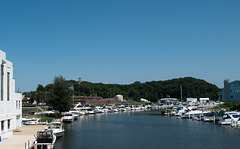
One of those odd consequences in life…. It was only by happenstance that I was down at the coast in Michigan City in the first place, so I hadn’t done any research on what I would be seeing – if I had known this when I was there, I would have put much more time into exploring.
Some of the forested area behind the brick buildings is the Washington Park Zoo (the tower is in the zoo). The zoo was started in the late 1920’s and most of the work on it was in the early 1930’s, thus per their website: “...the Washington Park Zoo is the only zoo in Indiana completely designed and landscaped by the WPA [a New Deal agency] and its predecessor agencies, FERA and CWA (Civil Works Administration). The Zoo and surrounding Washington Park has the most comprehensive collection of WPA-designed and built leisure facilities for the public in Indiana.”
washingtonparkzoo.com/about/history
Jump to top
- ipernity © 2007-2026
- Help & Contact
|
Club news
|
About ipernity
|
History |
ipernity Club & Prices |
Guide of good conduct
Donate | Group guidelines | Privacy policy | Terms of use | Statutes | In memoria -
Facebook
X
