

Richard And Jo Demeester's photos
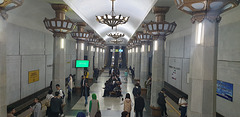
Yunus Rajabiy
| |
|
Yunus Rajabiy is an interchange station in the Tashkent metro system. The steps from the other line come down mid platform, allowing appreciation of the tall hall, its columns and light fittings.
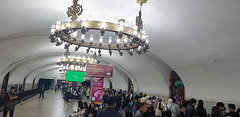
Chilonzor
| |
|
Our self created Tashkent metro tour began at Chilonzor. Grand light fittings, and many beautiful panels depicting life in Uzbekistan.
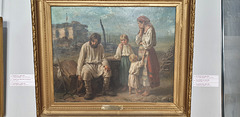
Homeless Fire Victims
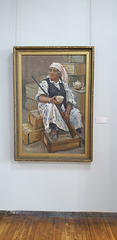
Watchwoman - Сторожиха
| |
|
Сторожиха, 1955, by Fadeev Valentin Aleksandrovich.
Relaxing with her tea, but still fully aware of keeping an eye out. What or whom for? A one-off reason to be careful, or a regular task? Was the tea green tea or black, and did it have lemon?
Despite those unanswered questions, the painting still says so much, capturing a character wonderfully.
A Toast to the Host
| |
|
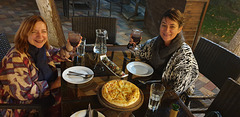
Back in Tashkent, and back with Caroline. A wonderful home for us to crash at while in the Uzbek capital. So chill and stress-free to stay with her.
Tonight's dinner is Georgian, with double cheese kachapuri , eggplant and walnut rolls, and a bottle of red to get us started.
Monument of Courage Earthquake Memorial
| |
|
|
|
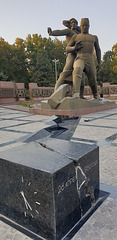
This is translated as "Monument of Courage Earthquake Memorial". In 1966, Tashkent was largely flattened by an earthquake, which although not terribly strong, was destructive due to its shallow nature and the fact that the epicentre was right under the city. The death toll was not incredibly high, but there were hundreds of thousands rendered homeless.
The cracked stone with date and time are intriguing and say something. That is why I chose to include the photo.
The statue itself is not be related to the earthquake itself - just striving too hard to be an acceptable Socialist artwork from Soviet times. And the images behind it also seemed rather random. To me it was odd, and explains why the translation calls it a "monument", with "memorial" almost tacked on as an afterthought.
I found it more confusing than it should have been, and therefore less moving than I had anticipated.
May Peace Prevail on Earth
| |
|
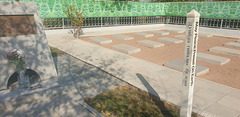
Japanese and German POW graves in Tashkent.
Before coming here, and reading up about this part of history, we did not know that after the war, these people were not allowed to return directly to their homes and families. Despite being the "losers" in the war, we assumed that once over, surrender signed, repatriation of prisoners to their homes would have been a human right.
So, for us, visiting here, and remembering that these people died, still as prisoners, AFTER the war, was both sobering and enlightening. They were required to stay for many years, and to help with the rebuilding efforts.
The photo is from the small Japanese section. There are a dozen or so Japanese POW cemeteries around Uzbekistan.
Nearby was a German section, which was smaller again.
Truly a Ship
| |
|
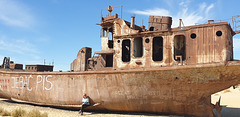
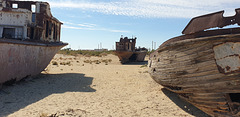
Many of these were boats, but some of them, truly are small ships. There was something so powerful seeing these decaying hulks, so at odds with their purpose and function.
The Ship Graveyard
| |
|
This was the only wooden boat that we saw. The timber was deteriorating fast. Not much was left of the deck, other than rows of rusting bolts with no planks left underneath. But a sizeable boat it still was.
Rusting Ship, and No Water
| |
|
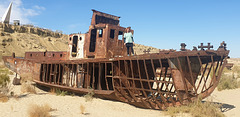
Scores of kilometres, 80 or more, from the current shoreline of the Aral Sea.
Moynaq was a fishing village in the 1950s and 60s, canning tonnes of fish every day. Over the decades, the Soviet agricultural developments started overusing the water from the feeder rivers. Primarily cotton, but it seemed too easy to keep diverting more and more water to irrigate dry and arid lands, not realising the long term consequences.
Now, somewhere between 80% and 90% of the original water sources have disappeared. The sea is now less than 20% of its early 20th century size. Increased salinity means fish struggle to live in what remains.
And these skip skeletons decay in the sun and sand as a stark monument to the sea which is gone, and will likely never return.
Soviet Avant-Garde
| |
|
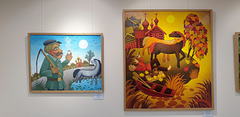
The Savitsky Collection, from what I gather, contains more than 80,000 artworks, most banned or frowned upon during the Soviet times. Especially during Stalin's time at the helm of the USSR, the only acceptable art form was "socialist realism" - art which showed communism in a positive way, showed ideal citizens living and working for the common good, and always showed an optimistic present and future. Strength, health, work, and benefits should be features of the art.
In a little corner of the Union, in the desert of current Karakalpakstan Repubilc (ostensibly part of Uzbekistan), Savitsky gathered together his substantial collection of controversial art. Creators of these works were likely to suffer persecution and anonymity for their efforts. Far from the watchful eye of Moscow, and with good rapport with the local community, he even got support to create spaces to exhibit these works, which were taboo in the rest of the USSR.
It is now considered one of the great collections of works from Soviet artists, most who may have remained anonymous had Savitsky not gathered and protected them.

Full Moon and Kalta Minor
| |
|
|
|
The squat Kalta Minor Minaret was destined to be much taller. The death of the sponsor meant work stopped, and the project never resumed.

Ichon-Qala Bathes in Late Afternoon Light
Atmospheric Juma Mosque
| |
|
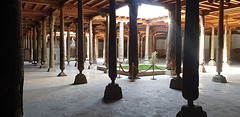
Hundreds of wooden pillars in the cool dark interior of this Khiva mosque create a calming and reflective mood. Some of the columns have come from the earliest mosque on this site, making them over 1000 years old.
Wall Burials
| |
|
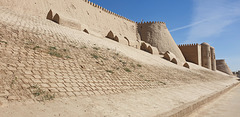
I don't know if it was law or superstition, but there was a time when anyone who died in the city had to be buried within the walls, and if a person were to perish while away, their body could not be brought in. These graves along the walls were probably for people who were supposed to rest within, but they met their demise while away, so this was the closest burial spot that could be used.
Pahlavon Mahmud Mausoleum
| |
|
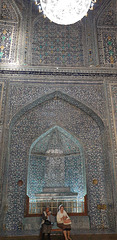
Distinguished telework in the mausoleum of Khiva's patron saint, a 13th century poet, philosopher, and wrestler. Mulpiple pilgrims chose to ignore the signs asking visitors to not bow to the tombs, or kiss them, but nobody seemed interested in enforcing the posted requests. Thankfully there were no attempts to carry out the equally prohibited act of animal sacrifice.
Jo and the Towering Islom Hoja Minaret
| |
|
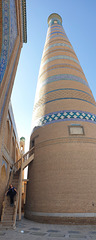
Reminiscent of a light house, this is Uzbekistan's tallest. It is also the most recent built Islamic monument in Ichon-Qala, at a very young 112 years old.

Morning Approach to Khiva
| |
|
We came on the overnight train from Bukhara, arriving at the very respectable time of 8 a.m. Khiva train station is east of the old centre, known as Ichon-Qala. So our pleasant walk to town accompanied the growing light on the walls, minarets, and domes.
Jump to top
- ipernity © 2007-2026
- Help & Contact
|
Club news
|
About ipernity
|
History |
ipernity Club & Prices |
Guide of good conduct
Donate | Group guidelines | Privacy policy | Terms of use | Statutes | In memoria -
Facebook
X
