


Photographic Tricks and Amusements

Folder: Photos
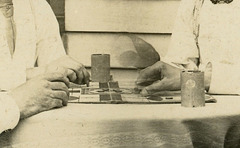
A Pair of Parcheesi-Playing Posers (Detail)
| |
|
|
An enlarged view of the board, game pieces, and dice cups in a trick photo of two young men playing against themselves in a game of Parcheesi. The photo is well composed with only a translucent part of the Parcheesi board underneath the hand on the right and a slightly darker streak running vertically through the middle of the photo to give away the double exposure. I'm not certain what might have caused the dark shape on the side of the building directly above the board.
For more information, see the full version of this real photo postcard.
.
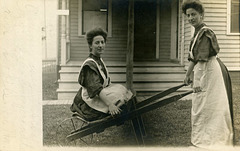
A Teacher on Her Way to School in Her Own Private…
| |
|
|
|
A double-exposure trick photo of a woman pushing herself on a wheelbarrow. The double exposure did produce an amusing photo, but the photographer had to add white outlining at the bottom to make the wheelbarrow stand out from the dark streak that runs vertically through the center of the photo.
This is a real photo postcard postmarked in Sheboygan, Wisconsin, on October 1, 1908, and addressed to Miss Flossie Minch , Waldo, Wisconsin. The sender of the postcard, who's the woman pushing and riding the wheelbarrow, was a schoolteacher. She identified herself only by her initials—N.B.—on the other side of the card. (It's possible, I suppose, that a schoolteacher might use N.B. as the abbreviation for the Latin phrase nota bene , but my guess is that these are the initials of her name.)
The message that N.B. wrote on the front of the card (to the left of the photo) has been erased, but enough of it remains that I was able to decipher it. Her written caption for the photo was: "On my way to school in my own private automobile. Ha. Ha."
Here's my transcription of N.B.'s message on the other side of the card:
Hello Floss, How are you spending these cold days? I enjoy teaching ever so much. Have 21 pupils.
Regards to Miss Thomas, Miss Patterson, Miss Stratton.
N.B. Sheb., Wis., c/o Mr. J. Kuemmet , R.#4.
Love to all the girls.
For some other double-exposure trick photos with wheelbarrows and wagons, see:
-- A Man Simultaneously Pushing and Riding a Wheelbarrow
-- A Man Pushing Himself on a Wheelbarrow
-- A Woman Pulling Herself on a Wagon
-- Girls Pulling Themselves on a Wagon
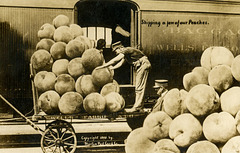
Shipping a Few of Our Peaches
| |
|
|
|
A fruits and vegetables photo for the Vintage Photos Theme Park.
William H. Martin (1865-1940), a Kansas photographer, created this amusing photomontage and published it as a real photo postcard in 1909.
This photo postcard was addressed on the other side to Mr. Alfie Watts, Kingston, Ontario, Canada, and postmarked in Lima, Ohio, on Nov. 20, 1910.
Handwritten message: "Lima, Nov. 20/10. Write soon. Friend James. 116 Circular St. W., Lima, Ohio."
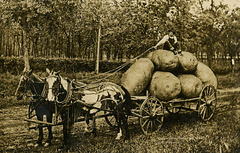
A Mess of Potatoes
| |
|
|
|
A Vintage Photos Theme Park photo for the monthly theme of pick your favorite theme(s)—why is it (are they) your favorite(s)? (submit a photo on this topic each week in addition to—or instead of—a photo for the weekly topic).
William H. Martin (1865-1940), a Kansas photographer who was a master of photomontage , created this real photo postcard in 1908. Postcards like this by Martin and other photographers were especially popular in the early twentieth century and featured gigantic fruits and vegetables, dangerously oversized animals and fish, and amusingly huge products. These humorous trick photos are some of my favorite kinds of vintage photographs. For more examples, see my album of Tall-Tale and Exaggeration Postcards , which includes both photographic and printed cards.
This particular postcard bears a postmark of April 7, 1909, and is addressed to "Mrs. Susan W. Dick, Roaring Springs, Penna. Care [of] Ora L. Dick." The message on the other side refers to the photo on the front: "Dear Mother, Hope you are better. I thought I would send you a mess of potatoes. They look good. Thad & Sue."
Breaking News
| |
|
|
|
A Vintage Photos Theme Park photo for the theme of adage illustrated (a photo illustrating a common adage—please identify the adage) .
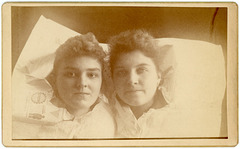
The old adage about two heads being better than one turns out to be true when it comes to a photo like this one. This is a nineteenth-century CDV showing two young women with their heads sticking out through the torn pages of a newspaper.
And why did they pose like this? They were perpetuating a photographic joke that was popular in the late nineteenth and early twentieth century. They're literally breaking the news or perhaps just looking through the paper .
For other examples, see Breaking the News, Lititz Express, July 4, 1907 and Looking through the Newspaper .
Vacation Bible School, St. John's Lutheran Church,…
| |
|
|
A religious photo for the Vintage Photos Theme Park.
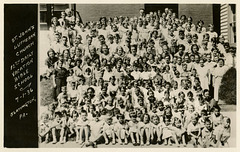
"St. John's Lutheran Church, 12th Daily Vacation Bible School, 7-1-36, Slatington, Pa."
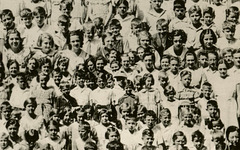
A real photo postcard of the children and adults who participated in a vacation Bible school at St. John's Lutheran Church in Slatington , Lehigh County, Pennsylvania, on July 1, 1936. It wasn't until I attempted to count the number of people in the photo—there are about 215—that I realized that this is a montage combining two or more images. A close-up of part of the photo makes the montage obvious.
Vacation Bible School, St. John's Lutheran Church,…
| |
|
|
A detail from a photo of the participants in a vacation Bible school at St. John's Lutheran Church in Slatington, Pennsylvania, in 1936.The children in the top half of the image look like giants compared to the ones in the lower half, which makes it obvious that this is a montage of two or more different photos.
For the full real photo postcard, see Vacation Bible School, St. John's Lutheran Church, Slatington, Pa., July 1, 1936 .
Too Much Pork for Just One Fork
| |
|
|
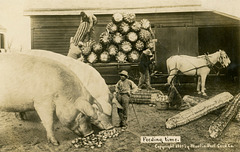
The caption on the front of this exaggeration postcard is "Feeding Time," but I borrowed "Too Much Pork for Just One Fork" from Southern Culture on the Skids , who used it as a song and album title.
This is a photomontage by Kansas photographer William H. Martin (1865-1940). For more examples of Martin's work, see Good Corn Makes Good Hogs and A Mess of Potatoes .
This real photo postcard is addressed on the other side to Mr. Richard Storey, Medora, Ill., but there's no stamp or postmark.
Handwritten message: "5/15 1910. They raise 'em like this in Indiana. J.O.B."
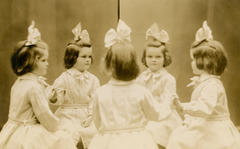
A Little Girl with a Big Bow—Mirror Photo
| |
|
|
|
Printed on the back of this unused real photo postcard: "Atlantic City Souvenir. Myers-Cope Co., 1635 & 1521 Boardwalk, Atlantic City, N.J." On the other side of the card is an Azo stamp box (squares in each of the four corners) that suggests a date sometime in the 1920s, 1930s, or 1940s.
The little girl in this mirror photo (or "photo-multigraph") is posing with her right hand against one of the mirrors, which makes it look like she's holding hands with her other multiple selves. The real girl, of course, is facing away from the camera, and the remaining four images are mirror reflections.
For another photo with a similar subject, see Mirror Photograph of Girl with Bow, Pittsburgh, Pa. For more examples, see my album of Mirror Photos .
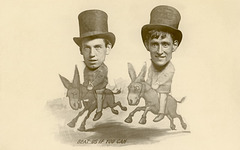
Beat Us If You Can
| |
|
|
Caption: "Beat us if you can."
Printed on the back of this unused real photo postcard: "Slater's Interurban Post Card Studio, 430 Superior St., Toledo, Ohio."
Judging by the design of the stamp box on the other side (it has the initials "PMC" and diamond shapes in each of its four corners), it's possible that the date of the photo may be as early as 1907 (see Playle's How to Identify and Date Real Photo Vintage Postcards ).
For similar photos, see Two Jolly Good Fellows , Aunt Lora and Uncle Will Are Coming Home, March 10, 1908 , and Men in Bowler Hats .
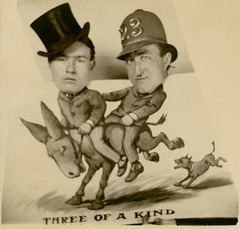
Three of a Kind
| |
|
|
|
A Vintage Photos Theme Park photo for the theme of number(s) in a photo .
Printed on the other side of this real photo postcard: "The Automatic Vaudeville Co. , 9 Tremont Row, 634 Washington St., Boston, Mass."
The "23" on the one fellow's hat is a reference to the "23 skidoo" fad that became popular in the United States beginning in 1906 or 1907. Back then, telling someone "23 skidoo" meant "scram" or "beat it," and using "23" in an unexpected place like this was a way to let others in on the joke.
For another example of "23" used in a photo for humorous effect, see Too Many Places to Go and Too Much to See .
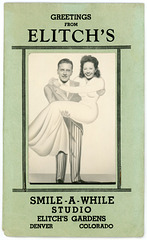
Lovey-Dovey Couple at Elitch's Gardens, Denver, Co…
| |
|
|
|
A Vintage Photos Theme Park photo for the theme of romantic or in love .
"Greetings from Elitch's. Smile-A-While Studio, Elitch's Gardens, Denver, Colorado."
A souvenir novelty photo from Elitch's Gardens , an amusement park in Denver, Colorado.
For an earlier picture from the park, see Labor Day Photo from Elitch's Gardens, 1905 .
Aunt Maggie's Trick Shot
| |
|
|
|
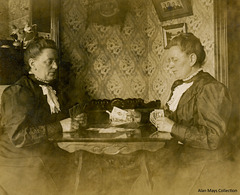
A Vintage Photos Theme Park photo for the theme of playing a trick: high jinks .
Handwritten note on the back of this photo: "Aunt Maggie trick shot by Art."
Aunt Maggie certainly played her cards right! This trick photo uses a double exposure to make it look like she's playing cards with her doppelgänger.
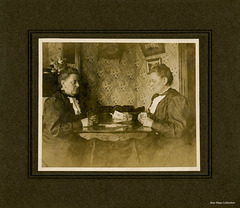
This is an undated photo mounted on cardboard (see the full photo ) with no further identification of "Aunt Maggie" or her photographer "Art."
Aunt Maggie's Trick Shot (Full Photo)
| |
|
|
Aunt Maggie is playing cards with herself! For more information, see the cropped version of the photo.
Archers on the Woodpile
| |
|
|
|
A Vintage Photos Theme Park photo for the theme of odd, unusual, or quirky .
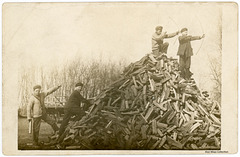
Trick photos with double exposures usually involve typical scenes with props like wheelbarrows (see A Man Simultaneously Pushing and Riding a Wheelbarrow ) or playing cards ( Aunt Maggie's Trick Shot ). The setting for this one, however, is rather unusual.
A huge pile of firewood dominates the scene. On the left, two boys stand at the bottom of the woodpile. Partially visible behind them is a farm wagon and beyond the wagon are some trees. Both boys are looking toward the photographer. One of them is pointing toward the top of the pile and wielding a piece of wood as if he intends to use it as a weapon. The other boy is about to start climbing up the pile.
On the right, standing at the top of the woodpile are the same two boys. They're both drawing bows as if they're about to shoot arrows, but neither of them has an arrow.
So, it appears that the storyline is that the boys are about to climb the woodpile to stop themselves from shooting arrows as they stand on top of the pile. Or at least that's all I can make of it.
Foursome Flying over Long Beach, California, 1914
| |
|
|
A Vintage Photos Theme Park photo for the theme of pick a particular format (daguerreotype, cabinet card, CDV, real photo postcard, cyanotype, slide, Polaroid, or what have you?) .
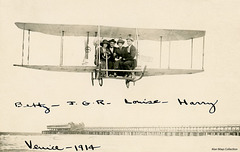
Handwritten caption: "Betty -- J.G.R. -- Louise -- Harry. Venice -- 1914."
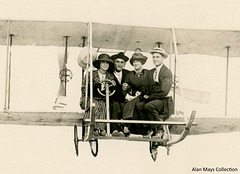
This is a real photo postcard showing two couples -- Betty and J.G.R. along with Louise and Harry -- pretending to ride in an early biplane (see a cropped version of the photo for a better view of the foursome). The design of the Noko stamp box on the other side of the card indicates a date range of 1907 to 1929, which corresponds to the handwritten year of 1914 on the front.
Although the caption indicates the location as "Venice," the structure pictured below the biplane was the pier in Long Beach -- not Venice -- California. The photo, of course, is a montage composed of a studio photo of the plane and its flyers along with the addition of a separate image of the pier.
For a similar shot of an early plane, see Buzzing the Beach in a Biplane, Los Angeles, Calif.
For an interesting discussion of the captions and messages on other real photo postcards, see Kenneth Wilson, Snapshots and Short Notes: Images and Messages of Early Twentieth-Century Photo Postcards (University of North Texas Press, 2020).
Foursome Flying over Long Beach, California, 1914…
| |
|
|
|
Four flyers pose in an early biplane in Long Beach, California. For more information, see the full version of this real photo postcard.
Get Right with God at the Anderson Campaign Tabern…
| |
|
|
|
A Vintage Photos Theme Park photo for the theme of church, chapel, or any other religious building .
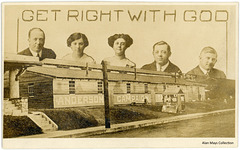
Caption: "Get Right with God." Painted on the side of the building: "Anderson Campaign Ta[bernacle]."
This is a real photo postcard with a photomontage consisting of five giant heads peering over the top of a large wooden building. "Get Right with God" is the admonition at the top, and the sign on the building identifies it as the "Anderson Campaign Tabernacle."
I also have a second copy of this card that has the name of a photographer -- "D. W. Faulk, 7 Second Ave., Coatesville, Pa." -- embossed on it.
A different version of this real photo postcard that I spotted online is captioned, "Be Sure Your Sins Will Find You Out," with the location given as "Coatesville, Pa." On the back of all three of the photo postcards is a Noko stamp box design (with "NOKO" on all four sides) that indicates a time frame ranging from 1907 to 1929.
After some searching, I discovered that "Anderson" refers to George Wood Anderson, a minister who ran some of his first large-scale revival meetings in a tabernacle building in Coatesville, Pennsylvania, in 1914. As reported in the Christian Advocate , December 3, 1914, p. 36:
"The Rev. George Wood Anderson, pastor of Elm Park Church, Scranton, Pa., has been conducting for six weeks an evangelistic campaign at Coatesville, Pa., an industrial town of 11,000 people. The service has been carried on in a tabernacle specially constructed. The local paper tabulates results, showing total attendance 140,700, with 2,208 conversions.... Beginning next spring, Dr Anderson will leave the regular pastorate, to devote his life to evangelism, in obedience to an impulse which he has long felt."
A later photo of the "George Wood Anderson Evangelistic Party" appeared in the Christian Workers Magazine , May 1916, p. 712, and allowed me to identify some of the giant heads on this photo card. That's George Wood Anderson himself on the left, his wife Nellie Anderson next to him, and Miss Agnes Smith, director of women's work, in the middle. The man on the right is Carl Leonard, business manager, but I haven't been able to determine who the man next to him is.
George Wood Anderson went on to build tabernacles in other states to continue his revival campaigns. A recent Facebook posting by the Logan County History Center , for instance, describes his evangelistic services and provides photos of tabernacles in Bellefontaine and Belle Center, Ohio.
Jump to top
RSS feed- Latest items - Subscribe to the latest items added to this album
- ipernity © 2007-2026
- Help & Contact
|
Club news
|
About ipernity
|
History |
ipernity Club & Prices |
Guide of good conduct
Donate | Group guidelines | Privacy policy | Terms of use | Statutes | In memoria -
Facebook
X
