

Alan Mays' photos

A Simple Little Shamrock That Grows on Erin's Isle
| |
|
|
"A simple little shamrock that grows on Erin's Isle."
Printed on the back of this postcard: "Raphael Tuck & Sons' Post Card Series No. 157 The Emerald Isle."
Postmarked Newport, R.I., March 17, 1909, and addressed to Mr. Harrison Barker, 26 Third St., City.
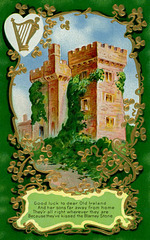
Good Luck to Dear Old Ireland
| |
|
|
Good luck to dear old Ireland
And her sons far away from home
They're all right wherever they are
Because they've kissed the Blarney Stone.
Printed on the back of this postcard: "St. Patrick Series No. 4."
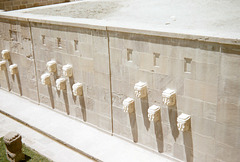
Wall of Stone Heads, Tiwanaku Semi-Subterranean Te…
| |
|
|
|
A photo of fences, walls, or other boundary markers for the Vintage Photos Theme Park.
This slide, taken in La Paz , Bolivia, in the 1950s by an unknown photographer, shows some of the stone heads on one of the walls surrounding a replica of the Semi-Subterranean Temple, which is located at the Pre-Columbian Tiwanaku archeological site near Lake Titicaca in western Bolivia.
The walls of the original temple at Tiwanaku are decorated with 175 carved stone heads, which apparently reflect "an earlier practice of exposing the severed heads of defeated enemies in the temple" (see UNESCO's description of Tiwanaku: Spiritual and Political Centre of the Tiwanaku Culture ).
The replica of the Semi-Subterranean Temple was constructed in La Paz to hold the Bennett Monolith (see Monolito Bennett for a Spanish-language Wikipedia article), which was removed from Tiwanaku in 1933. See below for a second slide from the 1950s or 1960s that captures a view of the temple that includes the back of the Bennett Monolith.
For other images of the Semi-Subterranean Temple replica in La Paz, check out the Wikimedia Commons photos of Monolitos Miraflores La Paz Bolivia , which presents a close-up of the layout of the temple replica, and Estadio Hernando Siles, Barrio Miraflores , which shows an overview of the temple with the nearby soccer stadium looming in the background.
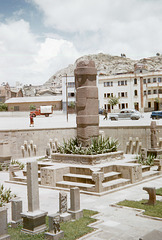
Bennett Monolith, Tiwanaku Semi-Subterranean Templ…
| |
|
|
|
The Bennett Monolith is the name of the large sculpture in the middle of this photo, which comes from a slide taken in La Paz , Bolivia, by an unknown photographer in the 1950s.
In 1933 the Bennett Monolith was removed from the Semi-Subterranean Temple located at the Pre-Columbian Tiwanaku archeological site near Lake Titicaca in western Bolivia. As seen here in a rear view, the monolith was installed as the centerpiece of a replica of the temple that was constructed in La Paz.
The removal of the Bennett Monolith from the archeological site was controversial, however, and in 2002 it was returned to Tiwanaku, which is a UNESCO World Heritage Site (see Tiwanaku: Spiritual and Political Centre of the Tiwanaku Culture ). A reproduction of the monolith now stands in place of the original in the replica of the temple in La Paz.
For more information about the Bennett Monolith, see the Spanish-language Wikipedia article Monolito Bennett and view additional images of the monolith on Wikimedia Commons.
The wall surrounding the replica of the Semi-Subterranean Temple (part of the wall is visible here in the background) was captured in another slide by the same photographer. See Wall of Stone Heads (below):
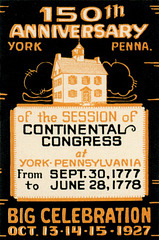
Continental Congress Session at York, Pa., 150th A…
| |
|
|
|
A poster stamp advertising the celebrations in 1927 that commemorated the 150th anniversary of the sessions of the Second Continental Congress that were held in York, Pennsylvania, after British troops occupied Philadelphia.
"150th Anniversary, York, Penna., of the session of Continental Congress at York, Pennsylvania, from Sept. 30, 1777, to June 28, 1778. Big celebration, Oct. 13, 14, 15, 1927."
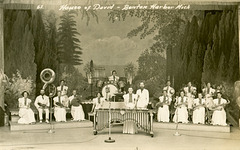
House of David Band, Benton Harbor, Michigan
| |
|
|
|
"61. House of David - Benton Harbor, Mich."
The House of David was a religious commune in Benton Harbor , Michigan, whose members performed in touring bands (like the one above), played on baseball teams, and ran an amusement park that featured miniature trains (like the ones below). Benjamin Purnell (see below) and his wife Mary formed the group in 1903.
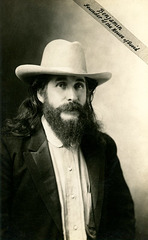
Benjamin Purnell, Founder of the House of David, B…
| |
|
|
"Benjamin, founder of the House of David."
Benjamin Purnell (above) and his wife Mary founded the House of David , a religious commune, in Benton Harbor , Michigan, in 1903. The members of the commune performed in touring bands (see below), played on baseball teams, and ran an amusement park that featured miniature trains (like the ones below).
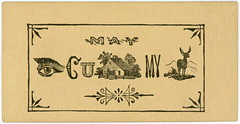
May I See You Home?
| |
|
|
|
Rebus: "May Eye C U Home My Deer."
Translation: "May I see you home, my dear?"
An acquaintance card that uses a rebus to ask its question. For a similar card, see I Am Uriah E. Heckert (below). For additional examples, see my Acquaintance Cards album.
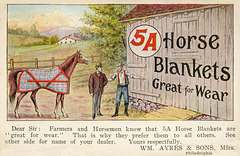
5A Horse Blankets Are Great for Wear
| |
|
|
|
"Dear Sir: Farmers and horsemen know that 5A Horse Blankets are 'great for wear.' That is why they prefer them to all others. See other side for name of your dealer. Yours respectfully, Wm. Ayres & Sons, Mfrs., Philadelphia."
Printed on the back of this advertising postcard: "Dear Sir: When buying horse blankets, ask for 5A Blankets and Robes, which are known as the best and strongest; always look for the 5A trademark. They are sold by R. J. Brophy, Waterloo. Buy 5A Square Blankets for street use, 5A Bias Girth Blankets for stable use, 5A Lap Robes for your own comfort."
Addressed to Mr. Thomas Martin, Waterloo, N.Y., and postmarked Philadelphia, Pa., Oct. 13, 1908.
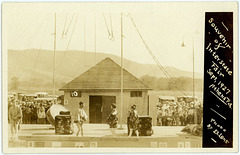
Acrobats at the Interstate Fair, Athens, Pa., Sept…
| |
|
|
A photo for the Vintage Photos Theme Park showing agility--acrobatics, balancing, gymnastics .
"Souvenir of Interstate Fair, Sept. 1927, Athens, Pa. Photo by E. S. Lent. 10."
Acrobats or trapeze artists on stage at the Interstate Fair in Athens , Pennsylvania, September 1927. Photographer Eugene S. Lent (1894-1962) published a series of real photo postcards of performers and buildings at the fair. As the handwritten number on the building indicates, this is no. 10 in the series.
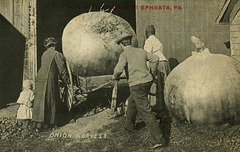
Onion Harvest
| |
|
|
"How we do things at Ephrata, Pa."
Wisconsin photographer Alfred Stanley Johnson, Jr., reused these same onions in another tall-tale postcard that he entitled Onions (below).
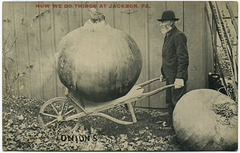
Onions
| |
|
|
"How we do things at Jackson, Pa."
These same onions appear in another tall-tale postcard entitled Onion Harvest (below), which was also published by Wisconsin photographer Alfred Stanley Johnson, Jr.

The Leap Year Man Hunt in 1908
| |
|
|
|
"The Man Hunt—in 1908. Leap Year. Ha! Ha! A butts! Foiled curse you! 1067."
Many Leap Year postcards from the early twentieth century depicted gender stereotypes that seem outrageous to us today. This series of comic postcards (see examples above and below), for instance, featured women using guns, axes, dogs, nets, and traps to capture men, who could easily be lured with food and drink (pretzels, cheese, and beer) or money.
The Leap Year lemon logo on each of these 1908 cards likely derives from the fad that began in 1906 or 1907, when handing someone a lemon was a way of saying "scram," "beat it," or in the slang of the day, "skidoo" or "23 skidoo" (for additional information, see my Skidoo 23 Is Now 37 postcard and Skidoos and Lemons album).
For more on Leap Year postcards, see Katherine Parkin's Leap Year Postcard Database on Monmouth University's Web site and Gwen Sharp's posting, Leap Year, Gender, and Reversing the Proposal Script , on the Sociological Images blog, Feb. 29, 2012.
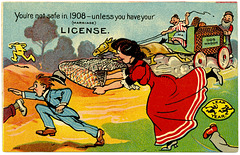
You're Not Safe During Leap Year in 1908—Unless Yo…
| |
|
|
"You're not safe in 1908—unless you have your (marriage) license. Leap Year. Dog wagon. Ma. Pa. 1063."

The Leap Year Trap in 1908
| |
|
|
"The Trap. One way of catching them—in 1908. Be careful, girls, this one will put up a fight! Leap Year. 1060."

The End of the Leap Year Chase in 1908

The Leap Year Hunting Season in 1908
| |
|
|
"Where did you catch him, May? In 1908. Leap Year. Hunting Season from Jan. 1, 1908 to Dec. 31, 1908. Game can be hunted with any old weapon--trapped, shot, or stabbed. Any huntress found with more than one specimen will be prosecuted under the laws governing the preservation of species. 1071."

How to Catch Them During Leap Year in 1908
| |
|
|
"How to Catch Them—in in 1908. Build a large mouse trap. Disguise the front entrance as a palatial mansion. Take an empty flour sack, fill it with rubbish, and print a dollar sign on it. Hang on for bait. Scatter a few loose coins about the entrance for effect and await results. Leap Year. 1065."
