

Alan Mays' photos
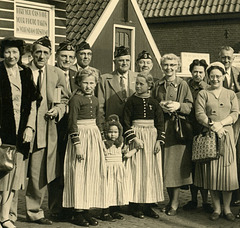
Souvenir Photo from Volendam (Cropped)
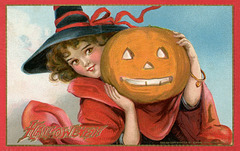
Halloween—Witch with Jack-o'-Lantern
| |
|
|
A Halloween postcard addressed to Mrs. C. Studt, Lilly, Pa., and postmarked at Conemaugh, Pa., Oct. 31, 1910.
Handwritten message on back: "With love, from Kit."
Printed on back: "Raphael Tuck & Sons' 'Hallowe'en' Series of Post Cards No. 174."
For another postcard sent to the same person in 1910, see Halloween—Witch with a Black Cat on a Pumpkin .
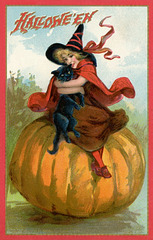
Halloween—Witch with a Black Cat on a Pumpkin
| |
|
|
|
A Halloween postcard addressed to Mrs. Chas. Studt, Lilly, Pa., and postmarked at Conemaugh, Pa., Oct. 29, 1910.
Handwritten message on back: "Dear Grandmother, I wish you were down to get some taffy & fudge and nuts. I hope you are well and I will be up soon. Roy.
Printed on back: "Raphael Tuck & Sons' 'Hallowe'en' Series of Post Cards No. 174."
For another postcard sent to the same person in 1910, see Halloween—Witch with Jack-o'-Lantern .
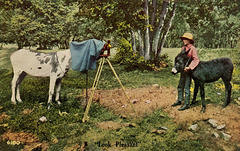
Donkey Photography—"Look Pleasant"
| |
|
|
|
"Look pleasant" is what the horse/photographer is saying as a donkey and boy pose for a photo.
This is a postcard addressed on the other side to Mrs. Emma Cranford, Lisbon, Ohio, R.F.D. No. 2, and postmarked Wilson, Pa., June 27, 1910.
Handwritten message: "Sun. eve., just closing. All well and have been busy all day. Will write you a letter tomorrow. Got cherries and were fine and many thanks till better paid [I'm not sure of the meaning of this run-on sentence]. Love, Alice & Jno.
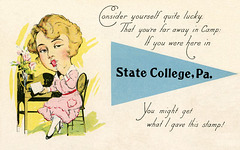
You Might Get What I Gave This Stamp!
| |
|
|
Consider yourself quite lucky,
That you're far away in camp:
If you were here in State College, Pa.,
You might get what I gave this stamp!
Looks like that stamp is getting a licking , though I suppose she could be giving it a kiss.
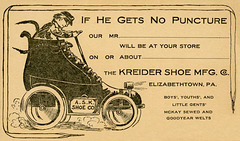
If He Gets No Puncture—Kreider Shoe Manufacturing…
| |
|
|
A humorous "advance card" for the A. S. Kreider Shoe Manufacturing Company in Elizabethtown, Pennsylvania. Salesmen from the company sent postcards like this in advance of their trips to let store owners know when they planned to visit.
The salesman depicted here is wearing his motoring clothes—goggles, cap, and coat—as he steers his shoe-shaped automobile through the dusty streets. His "A. S. K. Shoe Co." case of sample shoes is safely stowed on the running board.
The Kreider Shoe Manufacturing Company is no longer in business. Its former factory buildings in Middletown (below) and Elizabethtown , Pennsylvania, now contain apartments.
For other salesmen postcards, see my album of Advance Cards .
If He Gets No Puncture
Our Mr. ________ will be at your store on or about ________.
The Kreider Shoe Mfg, Co., Elizabethtown, Pa.
Boys', youths', and little gents' McKay sewed and Goodyear welts.
A. S. K. Shoe Co.
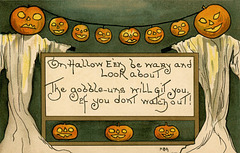
On Halloween Be Wary and Look About
| |
|
|
On Hallowe'en be wary and look about
The gobble-uns will git you ef you don't watch out!
A Halloween postcard illustrated by H. B. Griggs. The lines about the "gobble-uns" are from " Little Orphant Annie " (1885), a poem by James Whitcomb Riley.
For another Griggs card, see Have a Devilishly Happy Halloween .
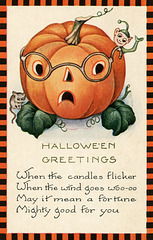
Halloween Greetings—When the Candles Flicker
| |
|
|
|
A Halloween postcard, circa 1920s.
Hallowe'en Greetings
When the candles flicker
When the wind goes woo-oo
May it mean a fortune
Mighty good for you.
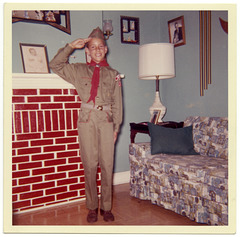
A Boy Scout Salute in the Living Room
| |
|
|
An example of color photos or slides for the Vintage Photos Theme Park.
A Boy Scout gives a three-finger salute while wearing his uniform as he poses for a photo in a living room with distinctive furniture and decor dating to the 1960s. The same sofa and wall decorations appear in a pre-prom photo , and the same boy appears with his sister in a Christmas photo .
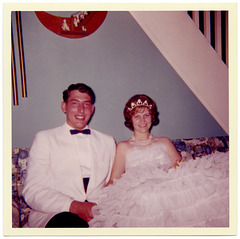
Prom Night
| |
|
|
A couple dressed for a prom or dance in the 1960s. The same sofa and wall decorations appear in a photo of a Boy Scout who's probably the brother of one or the other.
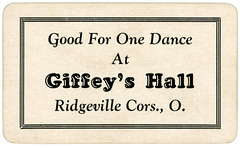
Ticket Good for One Dance, Giffey's Hall, Ridgevil…
| |
|
|
"Good for One Dance at Giffey's Hall, Ridgeville Cors. , O."
Dance ticket for Giffey's Hall , which was built in 1916 and currently houses a community theater.
Compare this dance ticket with Rhodes Casino on the Pawtucket, Ticket Good for One Dance, Season 1901 .
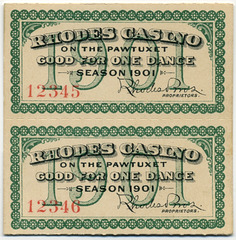
Rhodes Casino on the Pawtucket, Ticket Good for On…
| |
|
|
"Rhodes Casino on the Pawtucket. Good for One Dance. Season 1901. Rhodes Bros, proprietors. 12345. 12346."
Compare this dance ticket with Ticket Good for One Dance, Giffey's Hall, Ridgeville Corners, Ohio .
The Man with the Iron Mask—Walking Round the World
| |
|
|
|
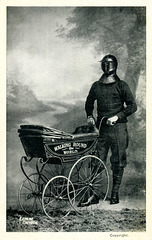
A postcard addressed to W. F. Esling, 26 The Grange, Beccles, and postmarked Colchester, July 16, 1908.
Has this gentleman arrived your way yet?
Handwritten message on the other side: "Dear Fred, Has this gentleman arrived your way yet? He was in Col. a day or two ago. I don't think he will manage it, do you? Thanks for nice P.C. I don't know where we are going at L-- yet but will let you have address, that is, if you like. I am looking forward to going. Yrs., Edith. Going to Ipo. on Thurs. to have photo taken."
So who was this gentleman that Edith wrote about, and why was he traveling around England in 1908? Furthermore, why was he wearing a helmet and pushing a baby carriage with a "Walking Round the World" sign?
After some searching, I found that the man's name was Harry Bensley , and he had to walk around the world to fulfill a bet that he lost. It required him to wear an iron mask (a helmet from a suit of armor) to conceal his identity, and he also had to push a perambulator (baby carriage) throughout his travels. He called himself "The Man with the Iron Mask" (inspired by the seventeenth-century Man in the Iron Mask ), and the only way he could support himself during his journey was by selling postcards and pamphlets (see my gallery showing some of his other postcards that appear on Flickr).
I don't think he will manage it, do you?
In her message on the postcard, Edith expressed doubt that the gentleman would manage to complete his walk, and her suspicions were well founded. Newspaper accounts provide documentation that Bensley did travel through part of England in 1908 (see Tim Kirby's Research for an impressive Google Map that traces his route). Some sources claim that he continued walking through other countries for the next six years, stopping only when World War I began in 1914 (see the Official Story ), but there doesn't seem to be corroborating evidence for this. In any case, it's clear that he did not "walk round the world" to meet the terms of his bet.
All bets are off!
In fact, it turns out that there wasn't even a bet! Bensley made the whole thing up! See, for example, Harry Bensley - Man in the Iron Mask: Hoax , a posting on the Big Retort blog. It reproduces an article, "The Great Masked Man Hoax: The True Story of an Astounding Fraud," which appeared in Answers magazine, December 19, 1908. The article is written in the first person but doesn't identify the Masked Man as Harry Bensley.
If Bentley was the Masked Man in the article and if we can believe this story, then we learn that Bentley concocted his scheme in 1907 while he was in prison. He set off on his journey on January 1, 1908, and immediately received newspaper publicity about his walk and the alleged bet. His main motivation, as far as I can figure, was to earn money from the sale of his postcards and pamphlets. He kept up the ruse for ten months, claiming that he traveled 2,400 miles while pushing a heavy perambulator and wearing an uncomfortable helmet the entire time.
For additional details about the whole strange affair, see Iron Mask: The Story of Harry Bensley's "Walking Round the World" Hoax (Bear Alley Books, 2018), a brief, unpaginated book by Steve Holland.
Other walking wagers?
While looking for information about Harry Bensley, I came across EastMarple1's Flickr photo of John Clark of Douglas, Isle of Man alias "Marcello The Walking King," 1905 , who "alleged that he was walking around the world in 1905 for a wager of £1,000." That makes me wonder whether there were other travelers besides Bensley and Clark who said they were walking for similar reasons, real or imagined.
Footrace Photo Finish?
| |
|
|
|
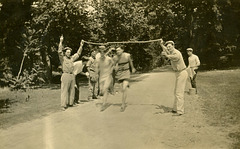
A photo of sporting events or competitions for the Vintage Photos Theme Park.
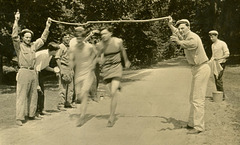
Two runners end (or begin?) their footrace in a blur of motion as they cross a finish line (starting line?) marked by a long branch held up over their heads by two young men. It's unclear whether the runners are beginning or ending their race since the guy at far left is holding the branch with one hand while his other hand is pointing what may be a starting pistol straight up in the air.
Another fellow on the left is holding a round object that looks like a large alarm clock, which he may be using--or pretending to use--to time the race. He seems to be peering down the road as if he expects to see more runners show up in the distance (that's one reason why I assumed at first that this must be the end of a race).
Curiously, a bucket and a glass bottle with unknown contents are visible along the roadway (you can see them in the background between the two runners), and there's also a bucket at the feet of a guy on the right who's holding a cloth of some sort.
This is an unused real photo postcard, and there's nothing on it to indicate where or when this race took place. For a better view of some of the details, mouse over the image above to see a cropped version of the photo .
Footrace Photo Finish? (Cropped)
Philadelphia Electric Company Wheel Chart, ca. 193…
| |
|
|
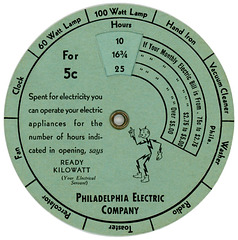
In January 1934, the Philadelphia Electric Company (now PECO) was the first utility to license the Reddy Kilowatt character to promote electricity usage, according to Wikipedia. The early date may explain why Reddy's first name is misspelled as "Ready" on this advertising wheel chart , which demonstrates how far 5 cents worth of electricity goes in operating appliances like clocks, coffee percolators, and radios.
See also the other side of this wheel chart.
Philadelphia Electric Company
For 5c spent for electricity you can operate your electric appliances fort the number of hours indicated in opening, says Ready Kilowatt (Your Electrical Servant).
Hours--If your monthly electric bill is from 75c to $2.75; $2.75 to $5.00; over $5.00.
100 watt lamp. Hand iron. Vacuum cleaner. Washer. Radio. Toaster. Percolator. Fan. Clock. 60 watt lamp.
Philadelphia Electric Company Wheel Chart, ca. 193…
| |
|
|
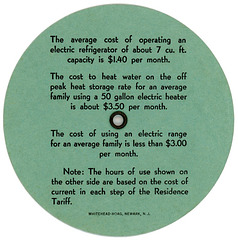
The reverse of an advertising wheel chart promoting the use of electricity. For more information, see the front side .
The average cost of operating an electric refrigerator of about 7 cu. ft. capacity is $1.40 per month.
The cost to heat water on the off peak heat storage rate for an average family using a 50 gallon electric heater is about $3.50 per month.
The cost of using an electric range for an average family is less than $3.00 per month.
Note: The hours of use shown on the other side are based on the cost of current in each step of the Residence Tariff.
Whitehead-Hoag, Newark, N.J.
Stick to Me and You Will Wear Diamonds, L. M. Arno…
| |
|
|
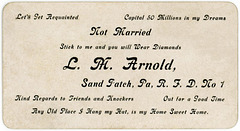
The last line on this amusing acquaintance card refers to a song, "Any Old Place I Can Hang My Hat Is Home Sweet Home to Me," which was published as sheet music in 1901 and recorded on phonograph cylinder in 1902, making it likely that the card dates from sometime in the early 1900s.
For more cards, see my album of Acquaintance Cards . For information about my book of detachable acquaintance cards, head over to my Flickr About page
L. M. Arnold, Sand Patch, Pa., R.F.D. No. 1
Let's get acquainted. Capital 50 millions in my dreams. Not married.
Stick to me and you will wear diamonds,
Kind regards to friends and knockers. Out for a good time.
Any old place I hang my hat is my home sweet home.
